Showing posts with label Arena (gravity). Show all posts

Wednesday, January 5, 2022

Terra Lander (Playstation 4)

Gravity Arena
Checkpoints ON
1 Difficulty level
20 Stages (loopable)
Ship speed variable
- - - - - - -
Developed by DM Games
Published by Funbox Media in 2021


Adding difficulty to the controls in a shmup will never be something people expect, let alone desire. Freedom of movement is what defines this genre after all. Gravity based shooters, however, are in a league of their own in terms of controls, and are often cited as some of the hardest games out there. I won't disagree with that, yet I'll firmly stand by my opinion that these are some of the most immersive and addictive gaming experiences once you start to come to grips with how they're supposed to be played.

That said, it's a mistake to underestimate releases like Terra Trilogy, a compilation of three vector-based games originally created for PCs a few years back which flew completely under the radar wherever it was released. Not only does it offer a great trip down memory lane for old timers who grew to love classics such as Gravitar, but in the case of Terra Lander and its sequel it also simplifies the controlling method quite a bit by sticking to a straightforward twin stick mechanic that's the epitome of pick up and play these days. Move with the left analog stick, aim and shoot with the right analog stick, with absolutely no need to rotate the ship around. Cool, huh?

Terra Lander starts simple enough but gets quite demanding halfway. At times it leaves you wondering how on Earth some levels can be completed, yet the compelling nature of the gameplay keeps pulling you back for another try.

My completion of Terra Lander's 1st loop on the Playstation 4

In each level the ship is spawned in a fixed point with the primary objective of reaching the landing zone, which is the only safe area where you can actually land. You'll die if you are too fast when trying to land, get shot or touch a wall/enemy, going back to the start of the stage for another fresh attempt. Other ways to die include running out of time (all levels have a predefined time limit) and running out of fuel (you'll slowly plummet to death if that happens). Just like in River Raid or Scramble, replenishing your fuel gauge is accomplished simply by destroying stationary fuel cells spread around the level. Fuel consumption is only related to the act of thrusting the ship, not firing, so there's absolutely no need to refrain from shooting if necessary.

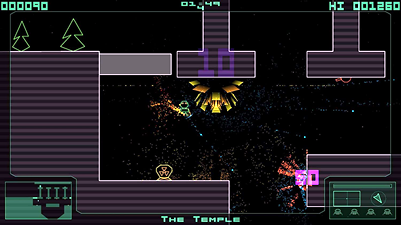
Moving the ship around creates momentum so the closer you are to an obstacle the more careful you should be. It's interesting to see that the slower you move the more zoomed in the screen gets, as if the game was trying to bring you closer to the action for best maneuvering conditions. Controls are smooth as silk, which is absolutely necessary during claustrophobic sections. Lots of particles come off from the ship as you fly, yet the bulk of the visual spectacle is reserved for shots bouncing on surfaces, both those from your ship and those from your enemies. Despite the foreground particle feast there's absolutely no frills in Terra Lander's art design: walls and surfaces are made of sharp lines and corners, a star-dotted background is always present even when you are exploring the underground and colors are kept to a minimum to avoid distractions.

Minimalistic colors are in line with the amount of enemies you're bound to face. Since no flying opposition is to be expected, enemies consist solely of two types of turrets and the environment itself. Much like your ship's firepower, red turrets fire single bullets that travel straight ahead. Purple turrets, on the other hand, fire triangle-shaped projectiles that follow you around in arching trajectories and explode into three minor bullets after a while. Purple turrets are the worst kind of enemy and the single source of all difficult moments in Terra Lander. Shaking effects and maze-like levels with moving walls that must be opened by hitting buttons are also part of the challenge, but they wouldn't be as tough if it weren't for those annoyingly effective purple turrets. As for confusion amidst the frequent particle chaos, it's nicely avoided by the fact that all bullets carry the color of their sources (player's bullets are blue, for example).

Memorization of course represents a big part in performing better in a game like this. There are a few aspects however that definitely help in dealing with some of the toughest turret arrangements. The tiny map in the lower left corner is excellent to see every single turret or fuel tank that lies ahead, for example. Almost all turrets behind walls can be destroyed even if you can't see them on screen, all it takes is correctly using the geometry around you to bounce your shots towards them. Last but not least, and this is independent from the game's hazards of course, the rule of thumb is that it's always better to be careful than hasteful.
Particles everywhere!

Scoring is pretty straightforward and rewards several types of performance aspects upon level completion, with bonuses for remaining time, enemies killed, remaining fuel, fuel tanks destroyed and even how centered you are when you park the ship in the landing zone. Of course checkpoint milking is a valid "strategy" for scoring, especially when you consider that for each level completed you recover one lost life (if the life stock isn't already full, that is). Destroying all fuel tanks in a level also doubles your fuel capacity for the next stage.

Meager production values aside, my view of Terra Lander is that of an infuriatingly addictive game. Some of the levels riddled with purple turrets are definitely to blame for the infuriating part of this assessment, easily getting on people's nerves while potentially making them give up. Well, I kept going, and that's also in part due to the music, a continuous looping of the Blue Danube Waltz from Johann Strauss II. Never was a composition in the public domain so fitting for a shooter, soothing and engaging at the same time while giving you genuinely cool vibes from 2001 - A Space Odissey. Whenever my daughter saw me playing it she would mention it was the game with the "wedding music".

If there's anything Terra Lander could've done better, aside from perhaps revising the positioning of some purple turrets, is distinguishing them from red turrets in the map (they're all red). The game could've done without the robotized voice taunting you negatively after each death ("your understanding of physics is poor", "your intelect must be small", etc.). It's sort of funny up front, but when you're head on trying to figure out how to get out of level 11 it's hard not to think of them as cheap, annoying provocations. At least you can continue from the last stage reached in the start menu. There you can also apply general tweaks on control settings, vibration and audio levels.

A real ending after all the hard work to beat stage 20 would also be nice, since the game just starts anew with no breaks or congratulation message whatsoever. My best result ended in level 31 (stage 2-11) with the high score below. Hopefully soon I'll have the chance to tackle the sequel Terra Lander II - Rock Slide Rescue. It's also included in the Terra Trilogy compilation, which right now is available both in digital and in physical formats for the Playstation 4 and the Nintendo Switch.


Sunday, September 27, 2020

Subterrania (Mega Drive)

Gravity Arena
Checkpoints OFF / ON
3 Difficulty levels
9 Stages
Ship speed variable
- - - - - - -
Developed by Zyrinx
Published by Zyrinx in 1994


When Gravitar was released by Atari in the arcades a new type of shooter entered the gaming scene. It was different, and it was decidedly very challenging. Due to its unique gameplay, only a few other titles were bold enough to follow in its footsteps, of which Subterrania is definitely one of the most interesting and exciting ones. Released both in Europe and in the US, this outstanding game was unfortunately a commercial failure due to a combo of bad advertising and word of mouth about supposedly hideous controls and impossible difficulty. Suffice it to say neither of these foul gameplay accusations is true in the slightest.

The overall feel of an Amiga video game is no coincidence, after all Subterrania was developed on Commodore Amiga computers for specific use on the Mega Drive. That's probably why it does not share the same lukewarm or disastrous results of both Amiga shmup conversions for Sega's 16-bit console, Battle Squadron and Xenon 2 Megablast. In fact, it's actually one of the best Mega Drive games I have ever played regardless of genre. Players who're not afraid of a challenge and are keen on experiencing something different and compelling with outstanding music and gameplay will feel right at home here.

Infiltrating underground environments to defeat aliens and rescue trapped miners is how Subterrania initially works. You pilot an experimental fighter craft and need to fulfill several missions in order to go from one stage to the next. Prior to the start of every level, briefing instructions are displayed and indicated over a full stage map, then you're dropped in a specific spot where you need to return to once all mission objectives are completed. Controlling the spacecraft is accomplished by using button B for thrust, down to reverse-thrust and left/right to turn. Button C either shoots the weapon or activates the resource selected by using button A.

Warning for shield low

Firing the regular weapon produces a constant stream of shots that behave according to three colors: red (default), green and blue. These colors can be switched or upgraded (take the same color over the current one) by touching the correspondent cycling flasks found in fixed locations. The differences between weapon colors are minimal when they're maxed out at level 3, but in general red offers brute force, green has a mild homing ability and blue adds side shots to the main pattern. Other types of flasks contain items such as extra lives and special weapons/resources that can be either temporary or essential to the completion of the current level (guided missiles, antipressure device, mirror lazer, etc).

Dealing with gravity is what actually turns many players off since it's such an unusual way to propel your ship. That's why getting used to the controls in the first couple of stages is so important in the long run. Subterrania doesn't allow players to strafe, so whenever you need to hit a target, moving or not, it's necessary to devise a proper strategy that involves good positioning, clever use of gravity and the ideal amount of thrust. Getting hit and bumping into obstacles damages the ship, which is indicated by the red coloring of the current life icon. Dying strips away one power level of the main weapon and forces you to depart again from the take-off point. Finally, besides focusing on the mission objectives you also need to worry about the most precious resource of all: fuel.

Managing fuel is essential for survival. The more you thrust the faster you burn fuel, whereas free falling makes fuel level go down more slowly. Even when you're safely landed fuel is also consumed, albeit at a much lower rate. Once the fuel reserve is low a message will appear on screen, prompting you to look for the closest orange refill canister. These are always located on flat surfaces, and the correct way to refuel is to safely land the ship over them. Blue refill canisters, on the other hand, serve to recover the ship's hull/life to its full original status. Watch out for the message that warns you about the shield being low.

While most missions are straightforward in execution, the puzzle element is certainly more important in a couple of them. In stage 3, for example, you need to use/position a series of deflector shields in order to advance. Later on, as stage 7 begins the computer briefing fails and isn't shown anymore, leaving players alone with figuring out what to do to navigate increasingly larger mazes in between rocky underwater formations, all of that at the mercy of much stronger gravity. During this final part of the game there won't be miners to rescue anymore, and the main objective is to find the way out before runing out of resources. Tip: don't forget to dive left as soon as you start the last stage to pick up the item for unlimited fuel.

A blast of absolute subterranean awesomeness on the Mega Drive
(courtesy of YouTube user narox)
 
Even though Subterrania does strike people as a hard game, it's never outright impossible or unfair. There are indeed a few enemies that can kill you in a single blow with slingshot attacks, and the ship can explode in mere seconds if you get caught inside a dent in a wall and try to desperately flee with the wrong thrust input. Fortunately the game gives you a few alternatives to help out with some of these hazards. If you refrain from shooting, for example, you'll see the "mega" gauge fill up, which allows you to fire a more powerful blast. This attack can kill several enemies at once if used correctly, as well as inflict great damage on larger targets. In some places there are also rail threads to which you can cling to and ride in order to move around and reach tricky areas more easily. 

The good news about the gameplay is that once you get the hang of the controls the game acquires a whole new dimension. Memorization makes conquered levels easier and might even lead to better time bonuses. That factors in nicely in the scoring system, which makes cheap exploits useless because even if you die and replay the level enemies won't respawn at all. If you happen to completely fail an objective (by killing miners, accidentally destroying items or dropping them in wrong places), all you have to do is get back to the mission starting point to reestablish your directives. You'll still be at the mercy of the remaining fuel cells though, so take that in consideration.

With so much to worry about gameplaywise, it's easy to overlook the fact that Subterrania doesn't have many bosses. In fact, you'll only face boss-like enemies in three levels, and only in the final one players need to cope with a real threat. Thankfully you won't be sent back to a checkpoint if you die on the last boss (also look out for the extra gauge that appears below the mega bar and shows Svin's health in his two forms).

Some people will certainly frown upon the lack of continues in the game. I have no qualms about it but understand those who do, but other than that I can't point out any other aspect that might disappoint the fans. However, a detail that does come out as an incorrectly implemented idea is the acid meter that appears in stage 8. At first I thought it should impose some sort of extra strain on the ship's energy, but it actually doesn't. I also ran into a strange bug a couple of times that made me restart one of the later levels with all mission objectives already fulfilled, so all I had to do was head directly to the way out again. 

My 1CC score shown below was achieved in the Normal difficulty. I had great fun remembering things since this wasn't the first time I beat the game. Note: if you can cope with more severe gravity and more demanding fuel/health requirements, Hard difficulty will also grant better stage bonuses for higher completion scores.


Sunday, October 24, 2010

Solar Jetman (NES)

Gravity Arena
Checkpoints OFF
1 Difficulty level
12 Stages
Ship speed variable
- - - - - - -
Developed by Rare
Published by Tradewest in 1990


I often get asked by some people why I don't play adventure/action games anymore. It doesn't matter what I answer, I inevitably end up labeled as an "elitist" or a "weirdo" for my tastes in gaming. Well, this post is for them. I gotta say I finally went into some adventure time, complete with deep exploration and secret-finding. And it was all intertwined with the shooting aspect of Solar Jetman - Hunt for the Golden Warship, one of the cornerstones of the gravity arena subgenre. While some will disregard this game as being a real shmup, my feelings towards it are very clear: you pilot a spaceship and shoot to make progress - associated with the fact that the ship is seen in its entirety, this is the basis for a game to be called a shmup, borderliner or not.

Solar Jetman is, in fact, the third in a trilogy that has Jetpac and Lunar Jetman as first installments, both appearing only on the ZX Spectrum. They seem to have nothing in common with the NES title except for the pilot, the spacesuit and the idea that you have to fulfill a mission in order to go on to the next level. Solar Jetman is probably the first full blown game to arise from the seed planted by Gravitar, which was the first gravity arena shooter to see the light of day. As with almost all gravity shooters, it is widely considered to be extremely difficult, a general misconception related to this fascinating subgenre and here exacerbated by the fact that Rare/Tradewest were responsible for its creation. If this doesn't ring any bells, these are the same people who would release Battletoads in the following year...

The basic story in the game is that you're a member of the Federation of Space Loonies, and you fly across the galaxy to get the necessary pieces to assemble the golden warship. Each planet/stage has one piece of this golden warship, which you will find by piloting a "pod" that always departs from a stationary mothership. In order to get to the next planet it's necessary to gather enough fuel so that your mothership can blast off. In all missions the hero will face lots of menaces, but the most dangerous one is gravity. Every planet has its own gravity level, sometimes weaker and sometimes stronger, as well as its own set of perils and treasures to be collected. Exploring is a must, as well as memorization and a certain dose of strategy.

Federation of Space Loonies on the go!

As an NES game, there's no denying that Solar Jetman is an outstanding achievement in gameplay. It uses the NES controller like very few other games do: button A is shoot, button B is thrust, SELECT + A uses special weapons, SELECT + B activates boosters (stronger thrust), ← and → rotate the ship, ↓ activates the shield, ↑ deactivates the shield, START + SELECT shows a map of the planet. These inputs are all essential for survival, and some of them must be unlocked by collecting special items. But that's not all, the gameplay goes way beyond that! There are two energy bars, one for the pod's power and another for the selected special weapon (special weapons and upgrades can be bought in the shop that appears prior to all even-numbered planets). Pod power is consumed by thrusting or by being hit. Getting hit by an enemy bullet will instantaneously destroy the pod and leave you in your spacesuit, but even though this spacesuit has a full power gauge and better maneuvering capabilities it can't activate shields or special weapons. Therefore, it's just a weak albeit useful means of displacement. To get into a pod again you have to fly back to the mothership or fly into a small wormhole, which then sends you back to the mothership. In fact, the mothership is where you want to go whenever you're low on power - it will always refill both meters. Lives are only lost when your power meter is depleted while in the spacesuit.

Another important aspect of the gameplay is the ability to drag objects. As long as the shield is down, a tractor connection is activated automatically whenever you're close to an object that can be carried. Fuel cells, crystals and treasures all have to be brought to a collecting point, which can be the mothership or one of the small wormholes spread around the planet. Once you have enough fuel cells, look for the big wormhole so that you can fly through it and get the piece of the golden warship.

I could go on and on talking about specifics on Solar Jetman's gameplay. It's that dense and rich. Fuel tanks to replenish pod power, spare ships, improved pods,
water areas, inversed gravity, gravity spheres, cyberzones and warpzones. At least one warpzone was important for me, because I adopted it as part of my strategy to beat the game. Right at the start of planet 8, I took it to travel to the extra planet (13) and continue the journey on the last planet (12). And even doing so, I think my complete playthrough clocked in almost 3 straight hours.

Preludon, the 1st planet - spacesuit + special zone + shield probes + crystal + fuel + WIN
(courtesy of YouTube user Ferret5317)

The technical highlights of Solar Jetman, besides the addictive and challenging gameplay, are the music and the sound effects. Sometimes minimalistic and increasingly haunting, the songs surely get you in the mood for serious deep space adventure. Graphically, the game is decent. You can see that a good deal of effort was applied to the design of every planet, to the point you can face each one of them as a sort of mini-game to be won. I only wish there was more detail in the backgrounds other than the star dots, because when you're flying through vast spaces it's hard to know exactly where you're going to. The game is also known for having bugs, but the only one I ran into is when you accidentally let go of an item when it is inside a wall/rock. Depending on how it happens, it gets impossible to reach it again, and if we're talking about a fuel cell this might disrupt and ruin the whole game. It happened to me twice, but fortunately I got smart after that.

When I started playing the game I thought it was a little slow, but then it came to me that it was running on an NES. And later on I was thankful that it ran at that speed, because when things get nasty you'll want to have control over that little oval ship. After weeks of sparse plays I finally gave Solar Jetman the proper attention during part of my vacation, with the FAQ provided by
the StrategyWiki on the game (a big thanks to everyone involved in it!). I would play one stage per day in an emulator, practicing it to exhaustion and even recording my runs. For such a heavy exploratory shooter, it worked wonders and gave me the confidence to go for a 1CC on the real thing (since the game gives passwords for each stage, it's still possible to practice in a real NES). No matter what your choice is, you're up for a hell of a ride, and that makes this definitely one of the best and most fulfilling NES games ever released.

Solar Jetman is not the hardest game ever, but it's got its hairy moments. The highest tension comes with the fight against the last boss, when you finally get to fly the golden warship in a jerky horizontal scrolling section. Regardless of life stock, you have only one shot at succeeding! Don't go chickening out after all the hard work, OK?

Instead of a proper score, progress is measured by a money counter, and in the picture below when I'm about to beat the last boss my standings are $ 7.904. If I consider all the items I bought, such as anti gravity (most important special weapon in the game), the super map and the two
permanent pod upgrades, my total wallet would be $ 55.904. I played stages 1 through 7, warped from 8 to 13 and continued till the end. 1CC mission accomplished!