Tuesday, August 30, 2022

The Lost Sunheart (PC Engine)

Horizontal
Checkpoints OFF/ON
2 Difficulty levels
6 stages
Ship speed selectable
- - - - - - -
Developed by Manjyu-Do
Published by I'Max in 1992


It doesn’t take much to realize there’s a touch of weirdness in The Lost Sunheart. It's got that offbeat atmosphere often associated with Japanese stuff, and for many people that alone is a good reason to try it out. Though not reaching the heights of something like Ai Cho Aniki, the game has some bold imagery in boss designs whose context gets lost in the story completely presented in kanji. The broad understanding on my part is that five magic crystals are stolen by evil creatures, and our mission as players is to get them back. One fiendish boss at a time.

Also known by the Japanese title Bouken Danshaken Don San-Heart Hen, this little and obscure shooter can be quite deceiving. The overall design is dark and moody, and the start of the journey tricks you into thinking the challenge ahead might not be that taxing. That's the impression we get when each life comes with a health bar, isn't it so? Soon enough the stakes start to get higher though, demanding a little strategy in order to preserve health as you go through each checkpoint. After all, every death sends you back to the very beginning of the section.

If you go to the options there’s a mode switch whose sole purpose is to turn cut scenes on and off (adventure ON or OFF), with no interference in the gameplay whatsoever. Shooting is accomplished with button II and movement speed can be toggled between four settings at the press of the SELECT button. As for button I, besides inputting your initials at the start of every credit it's also used to trigger special powers that become available later (keep reading). Even though your ship is changed for a new one at certain points in the game, these "upgrades" don't add anything to your arsenal except for the first ship replacement, which activates permanent Darius-like bombs.

Silly observation: the first couple of ships remind me of a faucet and a fried chicken. Look closely and tell me if you agree!

A creepy man in disguise or just a pregnant owl?

Aesthetic alterations aside, the ship’s actual capabilities are improved with items released by destroying yellow carriers. The way the upgrade system works in The Lost Sunheart is rather confusing though. The most important items are two interchangeable icons for the central firing stream: C (default) and H (a thicker wave shot), both enhanced three times by picking up successive items of the same type. The other items consist of F (partial or full health refills) and B (adds a fire effect to the bombs). Finally, one-time items appear early in the game: T permanently alters the default pea shot to a 3-way spread pattern and S activates an orb that endows the ship with special powers.

These special powers vary according to the selection you make whenever the game is paused. Four extra choices besides the initial one become available as the lost crystals are recovered, for a total of five: 1 (rotating orb), 2 (bombs home on enemies), 3 (two-way shot from an auxiliary force pod), 4 (bullet-blocking shield) and 5 (extra shot stream). 1 and 3 are fired with the main weapon whereas 2, 4 and 5 use button I. Note that special power 4 cannot be used as a permanent shielding resource since each activation of button I merely creates a single shield with very brief duration, only enough to deflect incoming bullets and damage everything that it touches. On the other hand, just like the main weapon (button II), special powers 2 and 5 do benefit from rapid firing, hence the recommendation to have a turbo controller at hand in order to fully enjoy the game.

Given the intricacies I mentioned above, I reckon it's common to find people who have played the whole game without taking full taking advantage of the weapon system. Knowing about the proper use of the special powers, for example, represents a huge advantage against some of the trickiest sections and bosses. On top of that, a few other aspects of the gameplay deserve to be mentioned. Getting hit downgrades all weapons by one power level, and although it's possible to play with speed setting 2 or 3, in a few areas it's beneficial to maximize the flying speed to evade quick attacks. Narrow passages aren't really dangerous because there's no harm in touching walls, in fact leaning against walls or screen borders is what it takes to place the force orb of special weapon #3 above or below the ship.

Eyes everywhere!
(courtesy of YouTube user The VideoGames Museum)

The Lost Sunheart unfolds at a steady pace and does a good job at keeping the interest alive by means of the bizarre boss encounters. That said, there's a recurring emphasis in the enemy gallery with respect to eyes. Weak spots of almost all bosses are an eye or an arrangement of multiple eyes, often attached to demon-like creatures or mechanical machinery. I'd say there's a lot of Parodius in the game as whole, as well as a veiled influence from Darius in level backgrounds and ideas behind some stage designs, including an underwater section that ends with the ship entering the mouth of a creepy whale. Besides, pretty much all enemy waves give you varying bonus points when fully obliterated.

Even though attempting to destroy complete waves and dying to cash in on checkpoints are valid objectives when trying to score, in the long run it's just not worth it. A couple of turrets that spit large fireballs in the second level can be exploited forever if you so wish, thus rendering the scoring system useless. Speaking of which, score-based extends are registered with 100, 300 and 500 thousand points, and if you shoot the floating head in stage 3 long enough you'll also be able to collect an icon for extra life (UP).

Certainly the most intimidating foe you'll come across in this game, the last boss is the only thing expecting players in the sixth and final level. It also seems to have been lifted straight out of one of the Fantasy Zone games. I died a few times when going for the 1CC in the top spot of the table below (there are separate high score tables for both difficulty settings). It was a fun and satisfying experience that only lacked a more compelling sountrack to go along with the decent visuals.

Monday, August 22, 2022

1942 (NES)

Vertical
Checkpoints ON
1 Difficulty level
32 Stages
Ship speed fixed
- - - - - - -
Developed by Capcom
Published by Capcom in 1986


It's really hard today to believe there was a time when this game was actually a hit in children's homes around the world. But this port of 1942 was indeed very successful in its era. These days the game is widely panned for its monotonous gameplay and grating music (or lack thereof), however with the glaring exception of the "monotonous" qualifier all aspects of the game are actually inherited from the original arcade title.

In my opinion arcade 1942 is probably one of the hardest classic shooters ever designed. Whenever I feel inclined to play the original I can't help but experience real fear and subsequent horrible defeat. The good news for us wimps is that for many tough arcade shmups out there chances are we'll find a suitable console port that's a tad more approachable. So if arcade 1942 mops the floor with me I can always chicken out and go to the NES version, and that's what I did during a tediously dull evening. I was tired and I was bored.

Here we have the quintessential shooting game of the lone airplane fighting enemies in wide open areas. In a sense, it's a marginally improved take on what you'd find in the Atari 2600 catalog – especially in the audio department, which consists of sound effects and beeps/whistle noises for music. The game box heightens the expectations with all sorts of thrilling and exciting descriptions, starting with the Super Ace moniker given to the Lockheed P-38 Lightning aircraft. Granted, NES 1942 is far from evoking much enthusiasm, yet one can at least find solace in the fact that it's actually reasonably faithful to the arcade game.

Disrupt enemy formations ready to attack!
(courtesy of YouTube user No Commentary Gameplays)

Controls are simple and straightforward: button B shoots and button A performs the "loop the loop", an evasive maneuver that makes the fighter plane invincible while the loop animation lasts. As a panic function the loop is of course quite an invaluable resource, the only concern is in its finishing part: if you land over a bullet or an enemy you’ll inevitably die. You get three loops at the start of every stage, regardless of how many of them were used in the previous level. Unused loops are converted into bonus points, as is the stage destruction ratio (the more kills you get the better the reward at the end of the level).

As you fly over land and sea flocks of incoming craft the same size of yours will arrive from the top of the screen. There’s not much variety to them, but watch out for the red/orange-colored ones that arrive in specific formations. If you destroy a full formation a Pow item will appear, and the color of the item determines its effect upon collection: double firepower (green), two side/option planes (white), extra life (red), extra loop (red w/ orange border) and instant smart bomb (white w/ red border). All items are also worth 1.000 points each. The only other single item to be collected is the yasichi lollipop that's released if you hit the plane that quickly accelerates upwards from the sides. It’s worth 5.000 points.

Players also need to be cautious of mid-sized and larger planes coming from below, that's why it's not a good practice to hug the bottom of the screen at all times. These are stronger enemies that take more hits to go down, especially the huge one that starts shooting out a spread pattern once it reaches the middle of the playing field. An even larger plane appears four times throughout the game at the end of specific levels, however despite its massive size this boss (the only boss you'll come across actually) can be easily defeated by standing close to one of the wings, thus avoiding the bullet sprays coming out of its tail.

Daring fighter pilot Super Ace intercepting enemy air warriors!

Every four levels the behavior of enemies is different: none of the small planes will shoot at you, in what the original game calls "% and point up" stages. The only enemies that will shoot are the large planes that enter the screen from below. The opportunity is there to rack more destruction percentage bonuses, so having the side fighters to increase firepower definitely helps. Just note that these side planes can also be individually destroyed. Racking up points is the way to achieve extra lives, starting with 20.000 and then proceeding with futher extends for every 80.000 points scored afterwards.

Since the game has 32 stages, a full credit of 1942 lasts well over an hour. Every stage ends with the plane landing in an aircrat carrier, collecting the bonuses and reloading the stock of loops. The impression of going through a repetitive and tiresome ordeal is all over the game, even when you consider the poor choice of background colors that sometimes makes it hard to track enemy bullets. At least in this port bullets don't get any faster as you advance, which leaves bullet density as the sole promoter of higher stakes later in the game. It's nothing outstanding in terms of challenge though, unlike the arcade original. There's no autofire, so a turbo controller that works (mine didn't) is definitely useful.

I was hoping to top my previous best score this time, but it wasn't the case and I simply didn't want to try again. Once the game ends it's really hard to get back to it because of its length and utter lack of excitement. That's why I attached below my old 1CC score, for the sake of keeping up with my records. As we can see from the picture, the high score in the NES port of 1942 rolls over the million mark, with the regular final score (to the left) representing the points in excess over one million. The sum and final result in this case is 1.292.800 points.


The NES was lucky enough to also get a port of the sequel, so hopefully soon I'll be trying out the 8-bit version of 1943 - The Battle of Midway.

Wednesday, August 3, 2022

ExZeus (Playstation 2)

Rail shooter
Checkpoints OFF
75 Difficulty levels
5 Stages
Ship speed selectable at start
- - - - - - -
Developed by Hyper-Devbox
Published by Metro 3 / Conspiracy Entertainment in 2004


The history of this game is quite an interesting one, according to the info on Wikipedia. Developed for the arcade market by a French company, ExZeus was ported one year later for the Playstation 2 exclusively in Europe. Then it was published again for arcades, only now running on the more famous Sega NAOMI board, before appearing for the Nintendo Wii under the title Counter Force. After showing up on mobile phones, a decade later it was again taken out of obscurity by a joint release with sequel ExZeus 2 for Steam (PC), Nintendo Switch, Xbox One and the Playstation 4 (also on physical media).

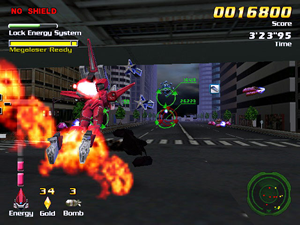
ExZeus is a futuristic sci-fi rail shooter with a post-apocalyptic setting about humans retreating to the underground and sending powerful robots to the surface in order to repel the alien invaders. The art style in cut scenes and during the game is decent enough, if only a bit unpolished in parts. However, the gameplay itself has a very particular flow and doesn't play like the majority of rail shooters out there. You won't get anywhere just by performing circular movements in order to avoid incoming bullets, for example, as you would in games like Space Harrier. Evading and blocking enemy attacks requires a slightly different mindset here.

Besides what I mentioned above, going into the game blindly can be disorienting due to the shaking effect that takes place on pretty much every action you take. Frankly, it's hard to even know what's going on. Fortunately you can disable this by switching off all screen swing/shake settings in the options menu, and I strongly recommend doing this before even starting to play. If you're not from Europe a proper 60Hz option also gets rid of the screen shimmering related to the native PAL encoding system.

Calista below a passageway in the town of ruins

Every credit starts with the choice of a robot. Sophia is the more balanced of them, with equal stats for power, speed, weapon and armor. Dynamis is the strongest one at the expense of speed, whereas Calista is the opposite. Since the only function of button △ is to toggle the view from behind the robot to a little above/behind its position, the actual gameplay uses five buttons: × fires the main gun and charges the laser whenever it's available, □ deploys the lock-on attack, ○ drops a megabomb and L1/R1 provide fast evasion maneuvers left or right (also accomplished with double taps). Charging up the laser happens automatically, with two available power levels that render you invincible when this attack is unleashed.

Death can happen in two ways: by allowing the energy bar to deplete completely or by timing out the stage (a message will warn you to hurry up). An uncommon feature of ExZeus is that the robot actually has two health bars instead of one: the uppermost gauge on the top left is the shield and serves as the primary barrier against damage, whereas the leftmost indicator down below represents the actual player energy, which starts going down only when you have no shield energy left. Both shield and energy have specific refill icons in the item gallery, which also consists of lock-on energy, speed boost, gold (to purchase upgrades/refills between levels) and power-up (increases the firing spread). Most of them are randomly released by destroying enemies. You just need to fly close to the items to pick them up, they will be automatically sucked into the robot when within a certain distance.

The reason why circling around isn't effective in ExZeus is that enemies have attack routines that are mostly independent from aiming directly at the player's position. These attacks are also unusual, with melee-like laser approaches and bullets fired in clusters, yet sometimes you need to face heavy artillery that leaves trails of energy behind. Some of these enemies must either be destroyed or avoided at all costs, especially since successive or powerful blows can drain a huge chunk of your energy. On the other hand, if enemies are destroyed after they have fired, all their bullets will turn into gold. Additionally, enemies destroyed in quick succession add to a hit combo that gives you a few extra points, in what's the only worthy aspect to point out in the game's rudimentary scoring system.

Gameplay on bosses is a tad different. They don't fire a single bullet at the player, a task that's left for occasional enemies that appear throughout the fight. All bosses have a set of attacks that include all sorts of variations of laser beams, fire breathing and melee strikes. The general strategy is to find their rhythm and hit them between these attacks, but note that whenever they're blue they're invincible to regular fire and only vulnerable to lock-on shots. The most important thing to have in mind, however, is to not panic with their initial levels of aggression and the inevitable loss of your shield. For some mysterious reason boss attacks have an extra reach regarding the shield, which is meant to be lost during the fight. Once the shield is gone it's perfectly possible to take advantage of the gaps in their attack patterns, just remember to use L1/R1 to quickly move around when needed.

Continuing through the town of ruins and the cave to hell
(courtesy of YouTube user 10min Gameplay)
 
I admit it took me a while to finally understand what I just mentioned above. After all, ExZeus is keen on draining the player's resources in a snap if you're not careful enough. One example is the power-down penalty whenever you get hit. It takes two power-ups to achieve the maxed out 5-way spread shot, and normally for each hit the robot takes you're downgraded one level, first reverting to the 3-way pattern and then to the default single shot. However, if the blow is too powerful you'll be instantly sent to the default shot, and this can be a severe handicap in certain areas. At least the game throws more power-ups a few moments later, except during boss fights.

My primary assessment of ExZeus is that the price of admission to the fun side of the game is a bit too steep. Even though the gameplay is rather unorthodox, after a while I started digging the intensity, the flashy nature of the visuals and the fact that the enemy gallery keeps you on your toes at all times. The music is energetic and vibrant, although not memorable as a whole. Most of the levels take place in wide open areas, but every once in a while you'll be flying inside closed chambers or tunnels. Cities, forests, icy ravines and even an underwater passage complete the environment selection. The upgrades to be purchased with your hard-earned gold are extremely helpful, with the most important one being the extra energy block (you can have a maximum of six blocks). It's also possible to increase the length of the shield gauge, but I always preferred to spend the rest of the cash on shield and lock-on shot refills.

Difficulty settings in ExZeus are spread across a spectrum that grades alien and boss attack speeds (50%, 75%, 100%, level progressive and game progressive). 75% is the default, which I considered to be the Normal difficulty setting. There's also something called "collision accuracy", which ranges from 50% to 100% and has 75% as default. I played on full defaults (75% in all three settings) and got the final 1CC result below with robot Calista. Quick observation: ExZeus on the PS2 is yet another case of a game where the score isn't reset when you continue.


When the time comes I'll probably tackle sequel ExZeus 2 on the Playstation 4.

Thursday, July 28, 2022

Jikkyou Oshaberi Parodius - Forever with Me (Playstation)

Horizontal
Checkpoints ON
8 Difficulty levels
8 Stages (loopable)
Ship speed by icons
- - - - - - -
Developed by Konami
Published by Konami in 1996


After its debut on the Super Famicom, it wasn't expected but it was certainly nice to see the fourth chapter of the Parodius franchise finding its way to both 32-bit platforms. Also unofficially known as "Chatting Parodius", 16-bit Jikkyou Oshaberi Parodius introduced a few new features while considerably increasing the character roster. Both 32-bit ports were released only in Japan but received the ~Forever with Me~ subtitle while applying graphical, audio and performance improvements with minor extras on the side. The constant chatting of the narrator is of course kept in all its comical (or annoying) nature, yet you can still shut him off with a specific switch in the options menu. 

This is the third version if this game that I play, having previously looped the SNES original with Soitsu and the Saturn port with Upa. This time I had the idea of just pressing START from the opening screen until entering the game, which naturally made me begin the adventure using the classic Vic Viper ship from Gradius, the primordial mold upon which the Parodius series is actually built. The level of parody and wack with Gradius and other Konami games has obviously gone a long way ever since the franchise started, so players can obviously expect all sorts of bizarre enemies and situations here.

The menu in Japanese is a bit intimidating, but as I mentioned above it's actually quite simple if you just want to dive directly into the game. Choosing the first option will lead you straight to the single player character selection (the second option activates 2-player mode, which now works in co-op as opposed to the alternate turns of the 16-bit original). By default there are 16 selectable characters, but you can also choose secret players Dracura (sic!) or Kid-D(racura) with the aid of a special button code to be inserted at the main Japanese menu (←, →, ←, →, □, ○, ↑, ↑, ↓, ↓, L2, R1, L1, R2, ○, □, ←, →). You could also do it the hard way, but that's just stupid and doesn't make any practical sense (keep reading).

Memim against Penkuro, the second boss in the nonsensical Boss Rush of stage 7
 
Once the character is chosen you must select between auto or manual power-up mode. In manual players are supposed to activate the desired upgrade in the weapon array just like in any Gradius game, thus having full control on how the character is supposed to evolve. Auto power-up mode, on the other hand, gives the game almost full control of the power-up process, leaving little to the player to decide. In a nutshell, it will activate only one speed-up (or two in the high speed stage) and prioritize laser over double, so if you want to have an extra speed-up or use the equivalent to the double shot just activate the power-up as usual. As always, upgrades in the weapon array are shifted by collecting orange capsules, while inputs consist of shot/missile (mapped to the same button by default), power-up and bell power.

What's mostly interesting in Parodius titles, and particularly in this chapter, is the fact that the chosen character can have a huge influence over the difficulty and the scoring potential of any run. This gap is somehow shortened with practice, but it's undeniable that characters like Soitsu and Dracura have the primary edge both for survival and for scoring. When they are maxed out in power bosses become less troublesome and hidden fairies can be found and collected more easily. Fairies are after all a great source of scoring since each one is worth 10.000 points. The same conclusion about the scoring aspect of the game sort of applies to the other main source of extra points: yellow bells.

Reminiscent of the TwinBee series, bells are released regularly in between power-up capsules and are mostly generated in the yellow color. However, at every four shots taken they will switch to a different color that endows the character with a special power: green (inflate+invincibility), white (bullet-cancelling kanji messages), brown (three bullet-blocking barriers), purple (turns all small enemies into power-up capsules or bells) and blue (screen-clearing bomb). Special notes: green forbids you to fire or collect any bells; green and white are instantly activated when collected and cancel all defensive upgrades; brown and blue bells are stored for later use and need to be triggered with the bell power button; whenever brown and blue are in stock you're forbidden from using the character's shield or force field.

Together with hidden fairies, yellow bells are the bread and butter of the scoring system. Don't let any bell fall of the screen and see the value from yellow bells quickly increase from 500 to 1.000, 2.500, 5.000 and then 10.000 points each. If one of them is lost this value is reset to 500. Juggling bells is obviously easier said than done, especially when you destroy those mid-sized enemies that often appear right after the pre-stage and explode into lots of bells of different colors, or during the whole high speed level themed after Lethal Enforcers. The total number of fairies collected can be tracked in a special option in the menu, and one of its purposes is probably to see how close you are to finding 140 fairies in order to naturally unlock secret characters Dracura and Kid-D. Damn it, Konami, at least we can thank you for the button code, huh?

Soitsu on auto power-up mode
(courtesy of YouTube user Tiza)

When compared with the 16-bit original, 32-bit Jikkyou Oshaberi Parodius (often abbreviated as JOP) is certainly a completely different beast. The complete elimination of slowdown is the obvious highlight, but the extend routine that goes beyond the million points is another important change since now you can amass many more extra lives as your score goes up (first extend comes with 20.000, then you get a new one after every 100.000 points). Since the game is much more easygoing than any chapter originated in the arcade platform and has a considerably mild rank progression, JOP is also the choice to go if you're new to the series and you'd like a more approachable starting point with many characters to choose from.

Just like with the other versions of the game, this port has a built-in checkpoint-based save function. Three save/load slots are available at the press of the SELECT button. In the title screen you also have the choice of two new special game modes: Omake 1 is a completely new single stage where you're supposed to get high scores, whereas Omake 2 works as a racing mini-game where the objective is to get to the end of the area as fast as possible. Even though both 32-bit ports appear to be very similar, there is a specific switch in the options screen that alters the gameplay significantly in each version. In the case of the Playstation this tweak is called "Accident", and its function is to add polygonal-based bonus areas to the end of each level. On the Sega Saturn this is replaced by "Extra", which changes enemy formations completely. Besides these interesting tweaks to the base game, both ports allow the OH! bogus power-up to be replaced by a slot machine for bells if you turn "Slot!" on. As for "Duet", "Ikari" and "Nage", they are specific tweaks for co-op play.

Click for the main menu translation for the Normal game in Jikkyou Oshaberi Parodius - Forever with Me on the Playstation

Despite the comical aspect of the ship, playing with this version of Vic Viper is actually very much like going back to the first Gradius. On the other hand I never thought much of its weapon set-up for a Parodius game prior to now, but it was interesting to notice after all these years how good it actually is against some of the bosses. I played on full defaults (difficulty 4, Roulette ON, Slot!/Accident/Revival OFF, Oshaberi ON) with auto power-up mode and reached stage 3-2 with the result shown below. Note: while you're playing you can always see your difficulty level and loop below the indication for the hi-score at the top of the screen.


Next in line is definitely Sexy Parodius.

Monday, July 11, 2022

Kiki Kaikai (Playstation 2)

Arena
Checkpoints ON
4 Difficulty levels
8 Stages (loopable)
Ship speed fixed
- - - - - - -
Developed by Taito
Published by Taito in 2005


I guess we can all agree that the shmup genre as we know it today was in its infancy back in 1986. However, this was a very special year in the history of Japanese developer Taito because that's the year when Darius came out. A huge accomplishment in itself, Darius definitely overshadowed everything that the company delivered at around the same time, including titles such as Bubble Bobble, Tokio / Scramble Formation and Kiki Kaikai. Easily overlooked back then, players were given a new chance to play these secondary arcade games at home by means of compilations such as the Taito Memories discs released for the Playstation 2. In the case of Kiki Kaikai, the edition you should look for is Taito Memories Volume 1 (Joukan).

The name Kiki Kaikai translates to something like "Bizarre Mysterious World". Drawing clear inspiration from Capcom's Commando, the game is an unscrolling multidirectional shooter rooted in Japanese folklore. It follows the adventures of Sayo-chan, a shrine maiden that goes out on a quest to free the seven lucky gods kidnapped by a mysterious villain. There's a strong characterization based on Japanese mythology, but given its primitive graphical assets it's fairly easy to judge Kiki Kaiki as another one of those dry, repetitive, bare-bones arcade romps of the 80s. This impression gets even worse if you venture into the game right after being exposed to the visual spectacle provided by modern games.

However, if you're persistent enough to get beyond the drab surface soon you'll find out that being simple in graphical terms is the only feature of Kiki Kaikai that might have aged. The gameplay is tight and the challenge is vicious, with a fun factor that lies somewhere between the punishing gameplay and the game's subdued natural charm. The soundtrack is rather limited and alternates between two tracks only across all levels, but the collection of sound effects is quite varied and diverse. As for the quality of this port, even though it lacks a TATE mode it's pretty much arcade perfect. Unfortunately there's no TATE option for any of the vertical games included in Taito Memories Volume 1, so playing on a large TV is definitely better if you want to get a hold of all the tiny details of Kiki Kaikai.

On the way to meet the fox demon to free god of wealth Juroujin in stage 6

First of all, Kiki Kaikai needs to be unlocked first if you're going to play it by means of the Taito Memories Volume 1 compilation, either by playing any game(s) for at least five hours or by entering the button code L1, R1, R2, L2, SELECT and START at the title screen (which also gives access to all remaining unlocked games). Seriously, Taito, why? Anyway, the game controls are quite simple: one button is used to shoot ofuda scrolls in eight directions, another button swings Sayo's purification rod directly in front of her. Both attacks can be used to dispatch the majority of enemies (there are exceptions), while pressing both buttons at the same time activates the special power related to any crystal ball you have in stock (these need to be found and collected).

Control inputs are fully configurable in the options, but if you have a turbo controller with you I strongly recommend its use. Considering that Sayo-chan is a fragile little lady that doesn't possess outstanding magical powers, autofire will certainly help her go a long distance. She's at the mercy of the gods when it comes down to resources and upgrades to be collected along the way, which leaves her severely underpowered most of the time. Items are released either by destroying a full wave of tiny brown enemies (otamas), by sweeping lit totems with Sayo's purifying rod or by shooting specific places in the scenery. Most of them will be the blue scroll that extends the reach of your regular shot, but every once in a while you might get more useful items.

Scroll item variations include red (piercing shot), yellow (larger/double shot) and double blue (increases the allowed shot ratio), but you can also find an icon that looks like a small house (oniguiri, worth 2.000 points), an extra life (very rare) or blue/yellow crystals. When activated by pressing both action buttons, the yellow crystal clears the screen from all enemies while the blue crystal freezes all enemies for a brief period of time. The only single item that appears out in the open is the golden key, which must be collected to allow your entry in the stage boss chamber. If you don't take it the boss fight will be denied and you'll have to go back all the way to get the key.

The problem with going back is that doing it (or refusing to move on) has a nasty effect in the gameplay. Besides some of the demons and spirits getting faster and more aggressive other dangerous foes might enter the screen, such as a jumping creature that reminds me of Q-Bert and the ring of supernatural fire that chases you around. Of course that doesn't mean the rest of the enemy gallery is less deadly. On the contrary, after the first couple of stages things get quite intense, demanding players to be on their toes at all times. By far the most dangerous enemy is that brown ghost that arrives in flocks and slows you down, only letting go if you're able to pass below one of the red archways. Since archways are far into the level more often than not you'll die horribly as if you were being dragged to hell like Rick Aviles and Tony Goldwyn in Ghost. You can get rid of them if you have a crystal in stock, which is actually the most important strategy to adopt prior to entering stage 4.

First couple of "scenes" of Kiki Kaikai on the Playstation 2
(courtesy of YouTube user PickHutHG)

Getting comfortable with fighting off all sorts of cute spirits in Kiki Kaikai certainly takes a while. Besides what I just described above, special attention must be given to creatures with odd behavior such as the demon head that suddenly pops out of large huts or the tombstones that follow you vertically, as well as enemies that can't be pushed back with the purifying rod (snakes, folded umbrellas) and environmental hazards such as bridges and pits (avoid getting close to their borders at all costs). At least normal walls aren't fatal, and since you can't strafe it's possible to lean onto them to direct your shots. Bosses are in a different league because you can only hurt them with the regular shot, and sometimes only when you're allowed to. They start quite easy, but later on some of their attacks become rather tricky to avoid.

An interesting twist here is that the final level has no boss, but you'll need to collect three hidden scrolls in order to complete the game. The good news is that these special scrolls are always in the same place, so it's just a matter of memorizing where they are. If you can't find them the stage just goes on forever, whereas in the case of success you'll eventually reach a corridor and the game will end as soon as you get through it safely.

Although not clearly noticeable, Kiki Kaikai has a built-in rank system related to the amount of surplus scrolls collected. Long story short, the more of them you pick the more health bosses will have (this is easily noticeable when you die and have to face the boss again). If you don't want to make bosses stronger just avoid collecting more than two blue scrolls or any extra scroll beyond the ones you've already applied to your firepower. In my experience I didn't care for this and collected them all because each scroll is worth a few points and boss battles become more manageable once you get used to their behavior. In essence, score chasers will take every single item the game gives, on top of killing everything that moves of course.

Click for the option menus translation for Kiki Kaikai on Taito Memories Vol. 1

Kiki Kaikai has absolutely no continues, with extends granted at 70.000 and 150.000 points. When the game is over a random counter will give you a three-digit number, and if it matches the last three digits of the player's total score you'll be awarded a new credit. This doesn't make much sense in the console world, but it must be great if you're playing the game in an arcade center. Speaking of consoles, Kiki Kaikai received a limited number of home ports and was followed by two sequels developed exclusively for the SNES. Out of Japan they were released with the name Pocky & Rocky, which is the most common title used for this series since the 90s. Later on a canned sequel was reworked and released for the Playstation 2 as Heavenly Guardian, but even though it shares elements with Kiki Kaikai the emphasis on exploratory gameplay pretty much excludes it from the shmup genre.
 
Once I beat the game I played a little further in the second loop and found my demise in the rematch against the second boss (scene 10). I did have fun with it, but I didn't feel inclined to play again to improve my score. For now let's leave it to one of the ports or sequels, starting with Pocky & Rocky!


Sunday, June 26, 2022

Project Starship (Playstation 4)

Vertical
Checkpoints OFF
2 Difficulty levels
5 Stages
Ship speed fixed
- - - - - - -
Developed by Panda Indie Studio
Published by Red Art Games in 2022


Second chapter of a confusing trilogy developed by tiny developer Panda Indie Studio / Arabong, Project Starship retools some of the elements of Red Death into a slightly more ambitious effort that preserves its minimalistic interface and roguelike approach. The game still feels rather bare bones in almost all aspects, but at least it chooses to focus on a full blown gameplay experience that literally floods the wide screen of HD TVs with colors and bullets, as opposed to the standard 4:3 vertical orientation of the prequel.

Before we move on it should be noted that Project Starship is completely different from Project Starship X. The latter is the third part of the series, yet in terms of physical media it was actually the second game to be published.

Another consideration to be made about Project Starship concerns the whole mindset behind the roguelike design. It is after all an acquired taste, which in this case is put to the test by an uneven balance between enemy patterns and resources and how they get randomized across the 16:9 screen ratio. The overall tone is cartoonish with large sprites, an extremely psychedelic enemy gallery, 8-bit styled music and bullets of all sizes that fly around at varying speeds. There's nothing special about the animations, yet there's so much going on most of the time that the game does feel overwhelming and deserving of the bullet hell moniker.

Release trailer for Project Starship on the Playstation 4
(courtesy of YouTube user PlayStation)

Pressing either ×, ○ or OPTIONS/START sends you into the game proper, then you must choose between a boy (Garret) or a girl (Gwen) and select the desired difficulty (Easy/Hard). The difference between the pilots is purely cosmetic, with no distinction at all between them besides ship color (blue/red) and in-game voices (male/female). On your last life the character also comically appears waving for help at the bottom of the screen, but that's it. Shoot with buttons ×, L1 or R1, fly slower by pressing ○, L2 or R2 (focus shot) and deploy the current special item in stock with button □. It's not possible to remap inputs or apply any changes to the game, which has just one single roguelike campaign with five stages.

Levels in Project Starship might differ in terms of environments and backgrounds, whereas enemies are completely spawned and placed according to the procedural generation routine. Level transitions happen when bosses go down and a big LEVEL UP message appears on screen. All stages have a mid-boss and a regular boss with 2 to 4 large health bars, but bosses can sometimes be replaced by a dark maze or by a fiery wall that shoots out almost undodgeable flame lasers if hit by one of the approaching space debris. As a rule of thumb, whenever a big enemy is defeated you get at least one item as reward, and if you're lucky it will be one of the special kind.

Item pick-ups are in a category of their own since they're one of the main sources of confusion when you start playing. There are three types: regular upgrades, weapon/ship enhancers and special attacks. Regular upgrades are denoted by alphabet letters and include P (power), T (rotating turret/option), R (ratio), M (missile), H (homing, very rare) and S (shield/life). Enhancers are denoted by symbols and might provide extra help in the long run or just alter your shot sprite into more powerful forms such as a shuriken, a black firing stream or a blue/red thick laser that's extremely powerful (the so-called "holy grail"). Examples of helpful enhancers include a full stock of spare shields, a small shard-like barrier that rotates around the ship and is capable of deflecting enemy bullets or a Super Mario-like green mushroom, which grants you another chance to succeed before the credit is finished (technically not a continue).

The final item type is the one that can be stocked for later use by pressing the □ button. Once collected they appear in the container at the top of the screen. Some of the most useful ones I can recall are "TV doesn't work" (blanks the screen with static for a few seconds and gets rid of all bullets and minor enemies) and the EMP (screen clearing blast), while "Ultra Mega Super Laser" and "President Button" send more powerful laser/missile attacks upwards.

Low production values aside, it's certainly possible to see the potential of the ideas behind Project Starship. The problem is that this potential is often buried by unfair procedural generation. Even though the hitbox of the ship is clearly shown at all times, it's common to get the feeling that the default speed is too fast and the focus speed is too slow. Tapping the focus button helps with that, you just need to get used to it. Players also need to cope with items that are best avoided such as the overload / lightning sign (it actually increases enemy aggression instead of your ship's firepower) and the skull (takes away one shield/life but only appears in the final level). I don't recommend picking up the large ring either since it splits your firepower in two less powerful firing streams, but you absolutely need to avoid the large red sword. Finally, remember that collisions against walls are fatal and mean instant GAME OVER. 

A red star full of anger

No matter how used you get to all items, I was still seeing new ones by the time I was done with the game. On top of all the confusion the plethora of items can make, Project Starship also throws several special sections called "mad events". These are brief interludes where you're faced with special challenges such as dodging crazy obstacles or evading large laser blasts with inverted controls. There's no logic as to when a mad event will kick in, but if you perform well enough a special item appears afterwards. Difficulty varies greatly in these parts, and evading some of them without losing lives can be quite tricky to pull off.

As for the scoring system, there isn't anything really important to be said about it since score meanderings are quite obtuse. Every shot landed and every enemy destroyed gives you points, but I don't know if there's any sort of hidden multiplier in place for not getting hit, for example. Suffice it to say that most of the points in any run comes from the final level.

Despite the constant feeling that Project Starship is being unfair, in all honesty it's quite hard to put it down once you're deep into a gaming session. In the end that's the best thing about the game, even though it might take a while to actually understand it to the point where success becomes more likely than failure. And though not clearly stated, success when playing in Hard mode earns a few interesting new items shown whenever you start a new credit. The first one is an H that stands for "hardcore" and takes away all your spare lives. Just ignore that and try to beat the game again: after the final boss you'll finally get the chance to face a true last boss with multiple forms that gives you a massive amount of extra points. If beaten, a new B item will appear at the start of every credit to turn the game into a boss rush, and on top of that you'll finally be able to see which level you're playing at the top of the screen.

Truth be told, I certainly had more fun with the game than I had initially anticipated. Since there's no high score table anywhere and no distinction between difficulties in the high score shown at the start screen, I just took the final snapshot at the end of my best run. I only played in the Hard difficulty, and after a while I settled with Garret because I felt more comfortable with a blue ship than with a red ship.


Wednesday, June 8, 2022

Silpheed - The Lost Planet (Playstation 2)

Vertical
Checkpoints OFF
2 Difficulty levels
6 Stages
Ship speed fixed
- - - - - - -
Developed by Game Arts / Treasure
Published by Working Designs in 2000


As the direct sequel to one of the most avant-garde shmups ever created, Silpheed - The Lost Planet must have generated high expectations during the first year of the Sony Playstation 2, both in Japan and in the US. In the case of the US version, for instance, it was supposed to come out on the console's launch date. Short delays notwithstanding, the Western disc includes a few nice improvements made by publisher Working Designs over the original Japanese version, namely the elimination of most of the slowdown and the addition of analog controls. Mind you, this is explicitly stated in the game's instruction manual, I haven't been able to try out the Japanese variant.

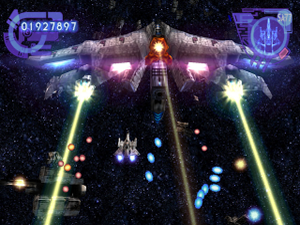
In the process of designing the game, developer Game Arts brought along the expertise of Treasure, then already quite famous for making Guardian Heroes and Radiant Silvergun. My best bet is that Treasure took care of the spectacle and the design of some of the largest bosses, with the rest of the game still at the hands of Game Arts. Eye candy aside, unfortunately it doesn’t take long to realize that the results of this enterprise aren’t up to the standards set by the original Silpheed, which is kinda baffling considering the powerful resources associated with the Playstation 2 hardware.

Alone in the galaxy against large enemy battleships
 
The story of The Lost Planet takes place three decades after the events of Silpheed, and is fully explained by a few animated sequences and several long texts narrated in English prior to each stage. Sci-fi buffs will be marveled at the amount of detail, whereas diehard shmuppers will feel relieved to be able to skip all interludes with relatively short loading times. As for the actual gameplay, what’s left is a very simple game since all you need to use is a single button even though there are three buttons in all configuration layouts. In the default configuration □ and ○ are responsible for shooting each of the side cannons, but there’s absolutely no reason to use any of them considering that button × fires both.

Upon starting a level the pilot has to choose the weapons to be equipped in each cannon. The initial weapon gallery is quite meager, but for every stage completed new weapons are unlocked for immediate selection. Halfway the level you have the chance to replace your choices during the reload cycle, which also refills four energy cells of the ship. Ship energy is arranged in two blocks of five cells, providing an initial health bar that lets you take at least nine hits before dying within the level. And once the next stage starts this health bar is completely replenished. How many shmups allow players to have so many lives, I wonder?

Having such a generous health bar for every stage isn't probably just about making the game more friendly to beginners. It actually factors into the risk associated with playing aggressively for score, which is by far the best thing about Silpheed - The Lost Planet. It lifts the game above the level of mediocrity. In essence, scoring is very simple and is based in proximity kills, which means that the closer you are to your enemy the higher your score over its base value will be. Proximity multipliers range between ×1, ×2, ×4, ×8 and ×16. Since enemies have no health indication at all, practice and good knowledge of their behavior is the best way to achieve those precious ×16 multipliers, especially against mid-bosses, bosses or any instance where you might be able to dismantle them piece by piece.

The only catch when going for proximity kills is that you can't just go on a rampage and sacrifice your health in order to get a ×16 multiplier on a boss, for example. If you get hit all your targets will result in ×1 multipliers for a few seconds no matter how close you are to them. Getting hit or touching the boss just before sending him into oblivion is the worst thing that can happen in every high scoring run.

3rd stage of Silpheed - The Lost Planet
(courtesy of YouTube user BelowAverageJoe)

There are two reasons for why this sequel fails to live up to its heritage. The first of them is the weapon gallery, which is full of gimmicky and useless unlocks from the second level onwards. Once the first stage is over, for example, I'll only use a combination of Optics Laser and Napalm Bomb for the rest of the game. The laser is great to deal with enemies from afar, and napalm is just devastating in close range. A few other weapons might get the job done if you get out of your way to learn how to use them, but I don't think they're worth the effort.

The second reason why the game doesn't reach its full potential is the lack of environment interaction, as aspect for which Silpheed is regarded as one of the best Sega CD games ever made. That feeling of flying across obstacle mazes at varying speeds as if you're chasing the core of a death star is nowhere to be found in The Lost Planet. Truth be told, some of the 3D backgrounds are impressive and have great textures, but the closer we get to interacting with obstacles is a few buildings slowly collapsing to the ground here and there in the second stage, which by the way drags.

Of course there's nothing essentially wrong about the game. The slanted perspective is still quite charming to look at, and the constant radio chatter seems to have been carried over unaltered from the first game. Although there are no real standouts in the music tracks, they at least get the job done and even evoke parts of the soundtrack of the original Silpheed in a few areas. The huge last boss is also back for a quick rematch prior to the real final boss in The Lost Planet, which is kinda neat, but there are also a few other large bosses that are quite creative in terms of design and attack patterns.

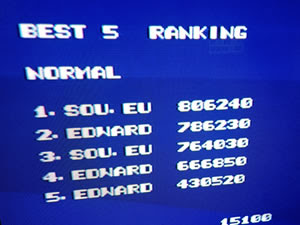
I tried to squeeze what I could from the proximity bonus system and got the best result of position 3 in the picture below. I think it's perfectly possible to top the highest score of 10 million, but for now I'm done... if only I wasn't constantly being stunned by a hit or just standing too far from a few bosses during the kill!