Showing posts with label Rail. Show all posts

Thursday, March 20, 2025

Gamera 2000 (Playstation)

Rail shooter
Checkpoints OFF
3 Difficulty levels
8 Stages
Ship speed fixed
- - - - - - -
Developed by TYO Productions / Digital Frontier
Published by Virgin Interactive in 1996


Gamera is a giant monster, or kaiju, originated from a series of Japanese films that started in the 1965 film Gamera - The Giant Monster. A legendary colossal turtle believed to have inhabited the lost continent of Atlantis, Gamera was created to compete with the success of Godzilla and appeared in a total of 12 films, and while it failed to garner the same fame of Toho's fire-breathing lizard it is still fondly remembered by kaiju fans all over the world. Given the obscure nature of Gamera 2000, however, I don't think the same statement applies to the world of video games.

Deeply hidden in the Japanese Playstation library, Gamera 2000 is a rail shooter that doesn't veer too far from the norm in terms of gameplay, which in many ways is very close to the likes of Sega's Panzer Dragoon. Polygon-based graphics set the tone for the action, while low-res cinemas with real actors complete the fan service with campy yet genuinely delightful results. Dubbed in English by default with Japanese subtitles, these can also be watched in Japanese, a feature that's rarely seen in the world of shmups even by today's standards.

Introduction and initial stages of Gamera 2000
(courtesy of YouTube user TGApuleius)
 
At the center of the game and the story is an elite member of the United Nations Science Academy called Jack Morton. He's the one piloting the jet fighter and interacting with several other characters and computer machinery in between levels. Gamera flies by his side, providing aerial support during most of the time. Tap button × or ○ to fire regular shots. Hold × to lock on to enemy targets and release it so that Gamera shoots its homing fireballs against them. Hold ○ and watch as Gamera charges its spinning attack according to a vertical gauge on the right side of the screen, and release it to see the giant monster wreak havoc against any on-screen enemy. The more you charge the longer the attack, but then it also takes longer for Gamera to recover from it in order to have another go.

As the stage progresses in four main locations (Tokyo, Hawaii, San Francisco and Hong Kong) an overhead radar shows the appearance of enemies as yellow dots. Since they can come from all directions, it's possible to turn the camera view 90ยบ left or right by pressing L1 or R1. Pressing both buttons at the same time brings the camera back to the default forward view. At first moving around with the camera isn't that important, but eventually you'll find out that wiping out all threats and targeting boss parts as fast as you can is the best strategy to preserve health and survive. After all, each stage comes with only one full health bar with no recovery in sight. If the health bar is depleted the game is over.

A significant change in the gameplay appears in the forest of stage 3, which starts as if you were directly thrown into the hoverbike scenes from Star Wars Episode VI - The Return of Jedi. The effect is neat and you don't need to worry at all about hitting obstacles, focusing solely on the enemies coming from all sides. During these hoverbike phases Gamera is absent, so you can't rely on its attacks to help you out. The hoverbike sections continue inside an underground tunnel full of mutated dogs and laser-firing bats before you face a huge flying creature that represents the first big challenge of the game. That's where avoiding deadly lasers and destroying enemy bullets with your own firepower becomes absolutely necessary since dodging is nigh impossible.

Even though Gamera 2000 is pretty much a straightforward rail shooter where aiming is an important part of the gameplay, a few obstacles appear here and there, such as the debris thrown by the tentacle mid-bosses when they're about to die. Some levels have splitting paths that take you to different mid-bosses, but I found it's very confusing to figure out where the splits are in order to consciously choose the desired path. Fortunately it doesn't make much difference in the end.

Gamera and a two-headed flying friend

Getting used to the rhythm of boss attacks then becomes the main objective of Gamera 2000. Sure, abusing the spinning attack of the turtle monster whenever possible is an absolute must, just remember to unleash it during the most profitable parts of the battle. The 7th stage in particular is quite a challenge since you must get through three long phases of the Bionic Gyaos boss. A huge flying saucer mothership awaits in the final stage, but if continues are used you won't be able to fight it. The game ends right there and then and awards the player with a "bronze" medal.

More noble closures to the game will be achieved if you at least get to the last stage in one piece ("silver" ending) or complete the mission without using any continues ("gold" ending). The instruction manual also mentions that in order to get the best possible ending you need to gather as much information as possible from the movie screen system in between levels. I'm not really sure of the requirements, but suffice it to say I didn't fret over watching all the clips and still got the gold medal.

Since Gamera 2000 has no scoring system, there's no need to get out of your way to kill everything. Some enemies will vanish after they fly past you, so just move along, do your thing and watch Gamera's victory roar at the end of the levels. The journey isn't really an outstanding ride graphicwise, but it certainly gets the job done for kaiju and rail shooting fans. The overacted sappy movie intermissions are harmless, and if you're able to pay attention to it amidst the non-stop action you'll notice the music is rather decent with a few standout tracks.

As mentioned above, here's my golden badge for the ending of Gamera 2000 on the Playstation, playing in the Normal difficulty of the standard game mode. A special "family mode" is actually a cooperative option where one player controls the ship and the other controls Gamera.


Friday, December 29, 2023

ExZeus (Playstation 4)

Rail shooter
Checkpoints OFF
1 Difficulty level
5 Stages
Ship speed selectable at start
- - - - - - -
Developed by Hyper-Devbox / Ziggurat Interactive
Published by Limited Run Games in 2022


Talk about unexpected resurgences, and ExZeus - The Complete Collection is certainly a release that *might* have drawn some attention when coming out for recent platforms a little while ago, both digitally and also in retail form for the Nintendo Switch and the Playstation 4. This collection includes ExZeus and ExZeus 2, two rail shooters with unique approaches to the mecha motif that always flew under the radar ever since gracing the arcades, and in the case of the first game gaining obscure ports such as those made for the Playstation 2 and the Nintendo Wii.

ExZeus won't set the world of any rail shooter fan on fire, but it at least has enough spectacle to get you through five stages of uneven intensity and fluctuating stakes. It all starts with the choice between three mechas with varying stats for power, speed and stamina, and then getting used to the slightly unorthodox gameplay, for rail shooters that is. At a distance ExZeus sounds like a Transformers game where you won't be able to transform at all, and up close it's a feast of in-your-face bullets, with lasers and melee attacks often killing you in the blink of an eye.

"Where did my energy meter suddenly go", you wonder? Well, you can either continue (with the unwanted benefit of not resetting your score) or start over if you're one of those players who aim for the 1CC no matter what.

Calista versus Dracaena

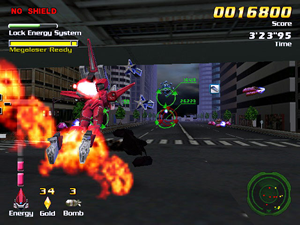
Button × is responsible for three inputs: fire, fire guided missiles on enemies targeted by the lock-on attack (button ○) and release the megalaser attack, a special laser burst that works with a meter that recharges over time automatically. Button □ drops the mega bomb over the screen, but you can only use it three times during the duration of any full credit. L1 and R1 provide a quick rolling maneuver left and right,  but you can also double tap in order to achieve the same effect. Items appear floating in the air from destroyed enemies, and although most of them are random at least the POWER for shot upgrades seems to show up under the same circumstances at all times while you're in need of power-ups. Take one to get a 3-way spread, then another one to max out at a 5-way horizontal spread.

The remainder of the items can be lock-on energy (if you run out of it you can't use this resource), gold tokens, booster and either shield or energy refills. The shield is the first barrier against damage and is shown in the upper left part of the HUD. Once without the shield you start losing the energy of the robot, which appears on the left side of the screen and means game over if depleted. Booster just makes you fly faster, helping you out in the time bonus at the end of the level. Finally, gold tokens accumulate in a counter for you to use in between levels in order to extend your energy, shield or lock-on meters, as well as purchase refills. Since the gold counter maxes out at 999, there's no sense in saving gold whatsoever. Watch out for the shop screen though because it opens up right over the Exit button, so try to avoid getting trigger happy there.

Gameplay in ExZeus is rather obtuse, in a clunky and unexpected way. As with any other game that requires memorization it will demand knowledge of what's coming ahead, but given how the screen might move in relation to the character (in a wider scope than what you can immediately see) adaptation is extremely important to survive. Damage is directly related to the amount of bullets or lasers that hit you in a single blow, and it's not uncommon to go from a full energy meter to the brink of death if you happen to be mass targeted. Heavy damage also powers you down one level or even two levels, sending you back to the default shot right away. When in doubt about what's coming ahead it's just better to be safe than sorry, even though you might be tempted to stay in the line of fire to destroy an enemy since all on-screen bullets fired by your target will turn into gold if you're able to kill it.

Boss fights are in a category of their own. The main strategy with all of them is finding their rhythm and pounding their weak spots in between their attacks. The further you get the more aggressive they become, of course. Just note that whenever they're blue they're invincible to regular attacks, and the only way to hit them is by using lock-on shots. On the other hand, a fully powered megalaser also renders you invincible.

Release trailer for ExZeus - The Complete Collection for the Playstation 4
(courtesy of YouTube user and developer Ziggurat Interactive)
 
For comparison sake, the version of ExZeus included ins this collection has some striking differences from the port that came out for the Playstation 2 in 2004. There is no rain in first stage, weapon power does not carry over to the next stage (you always start with the single shot), item prices in the shop are different (you also drop by the shop in the middle of the 4th stage, before diving into the depths of the ocean), there are more enemies overall and different details such as bulkier leaves falling from trees in stage 2 and lava spikes of just a single color in stage 3. My lucky guess is that this Playstation 4 port is based on the revised arcade iteration of the game, which ran on the Sega NAOMI board, as opposed to the original European version that served as basis for the Playstation 2 port.

As a result, the Playstation 4 version is slightly harder with less opportunities for scoring. The scoring system preserves the elementary hit counter during levels but implements a series of end-of-stage bonuses based on your performance. Available options do not include any tweaks for extra difficulties or screen swing/shaking, only the possibility to invert the Y axis and to apply a normal/cool graphic mode switch that doesn't seem to do affect anything whatsoever.

And here's my final 1CC result for ExZeus on the Playstation 4. I played with robot Sophia (blue), the most balanced of the three, but my overall impression is that maneuveratibility is still more important than brute force. In that sense, Calista (red) might be a better choice.


Coming up next: ExZeus 2.

Wednesday, August 3, 2022

ExZeus (Playstation 2)

Rail shooter
Checkpoints OFF
75 Difficulty levels
5 Stages
Ship speed selectable at start
- - - - - - -
Developed by Hyper-Devbox
Published by Metro 3 / Conspiracy Entertainment in 2004


The history of this game is quite an interesting one, according to the info on Wikipedia. Developed for the arcade market by a French company, ExZeus was ported one year later for the Playstation 2 exclusively in Europe. Then it was published again for arcades, only now running on the more famous Sega NAOMI board, before appearing for the Nintendo Wii under the title Counter Force. After showing up on mobile phones, a decade later it was again taken out of obscurity by a joint release with sequel ExZeus 2 for Steam (PC), Nintendo Switch, Xbox One and the Playstation 4 (also on physical media).

ExZeus is a futuristic sci-fi rail shooter with a post-apocalyptic setting about humans retreating to the underground and sending powerful robots to the surface in order to repel the alien invaders. The art style in cut scenes and during the game is decent enough, if only a bit unpolished in parts. However, the gameplay itself has a very particular flow and doesn't play like the majority of rail shooters out there. You won't get anywhere just by performing circular movements in order to avoid incoming bullets, for example, as you would in games like Space Harrier. Evading and blocking enemy attacks requires a slightly different mindset here.

Besides what I mentioned above, going into the game blindly can be disorienting due to the shaking effect that takes place on pretty much every action you take. Frankly, it's hard to even know what's going on. Fortunately you can disable this by switching off all screen swing/shake settings in the options menu, and I strongly recommend doing this before even starting to play. If you're not from Europe a proper 60Hz option also gets rid of the screen shimmering related to the native PAL encoding system.

Calista below a passageway in the town of ruins

Every credit starts with the choice of a robot. Sophia is the more balanced of them, with equal stats for power, speed, weapon and armor. Dynamis is the strongest one at the expense of speed, whereas Calista is the opposite. Since the only function of button △ is to toggle the view from behind the robot to a little above/behind its position, the actual gameplay uses five buttons: × fires the main gun and charges the laser whenever it's available, □ deploys the lock-on attack, ○ drops a megabomb and L1/R1 provide fast evasion maneuvers left or right (also accomplished with double taps). Charging up the laser happens automatically, with two available power levels that render you invincible when this attack is unleashed.

Death can happen in two ways: by allowing the energy bar to deplete completely or by timing out the stage (a message will warn you to hurry up). An uncommon feature of ExZeus is that the robot actually has two health bars instead of one: the uppermost gauge on the top left is the shield and serves as the primary barrier against damage, whereas the leftmost indicator down below represents the actual player energy, which starts going down only when you have no shield energy left. Both shield and energy have specific refill icons in the item gallery, which also consists of lock-on energy, speed boost, gold (to purchase upgrades/refills between levels) and power-up (increases the firing spread). Most of them are randomly released by destroying enemies. You just need to fly close to the items to pick them up, they will be automatically sucked into the robot when within a certain distance.

The reason why circling around isn't effective in ExZeus is that enemies have attack routines that are mostly independent from aiming directly at the player's position. These attacks are also unusual, with melee-like laser approaches and bullets fired in clusters, yet sometimes you need to face heavy artillery that leaves trails of energy behind. Some of these enemies must either be destroyed or avoided at all costs, especially since successive or powerful blows can drain a huge chunk of your energy. On the other hand, if enemies are destroyed after they have fired, all their bullets will turn into gold. Additionally, enemies destroyed in quick succession add to a hit combo that gives you a few extra points, in what's the only worthy aspect to point out in the game's rudimentary scoring system.

Gameplay on bosses is a tad different. They don't fire a single bullet at the player, a task that's left for occasional enemies that appear throughout the fight. All bosses have a set of attacks that include all sorts of variations of laser beams, fire breathing and melee strikes. The general strategy is to find their rhythm and hit them between these attacks, but note that whenever they're blue they're invincible to regular fire and only vulnerable to lock-on shots. The most important thing to have in mind, however, is to not panic with their initial levels of aggression and the inevitable loss of your shield. For some mysterious reason boss attacks have an extra reach regarding the shield, which is meant to be lost during the fight. Once the shield is gone it's perfectly possible to take advantage of the gaps in their attack patterns, just remember to use L1/R1 to quickly move around when needed.

Continuing through the town of ruins and the cave to hell
(courtesy of YouTube user 10min Gameplay)
 
I admit it took me a while to finally understand what I just mentioned above. After all, ExZeus is keen on draining the player's resources in a snap if you're not careful enough. One example is the power-down penalty whenever you get hit. It takes two power-ups to achieve the maxed out 5-way spread shot, and normally for each hit the robot takes you're downgraded one level, first reverting to the 3-way pattern and then to the default single shot. However, if the blow is too powerful you'll be instantly sent to the default shot, and this can be a severe handicap in certain areas. At least the game throws more power-ups a few moments later, except during boss fights.

My primary assessment of ExZeus is that the price of admission to the fun side of the game is a bit too steep. Even though the gameplay is rather unorthodox, after a while I started digging the intensity, the flashy nature of the visuals and the fact that the enemy gallery keeps you on your toes at all times. The music is energetic and vibrant, although not memorable as a whole. Most of the levels take place in wide open areas, but every once in a while you'll be flying inside closed chambers or tunnels. Cities, forests, icy ravines and even an underwater passage complete the environment selection. The upgrades to be purchased with your hard-earned gold are extremely helpful, with the most important one being the extra energy block (you can have a maximum of six blocks). It's also possible to increase the length of the shield gauge, but I always preferred to spend the rest of the cash on shield and lock-on shot refills.

Difficulty settings in ExZeus are spread across a spectrum that grades alien and boss attack speeds (50%, 75%, 100%, level progressive and game progressive). 75% is the default, which I considered to be the Normal difficulty setting. There's also something called "collision accuracy", which ranges from 50% to 100% and has 75% as default. I played on full defaults (75% in all three settings) and got the final 1CC result below with robot Calista. Quick observation: ExZeus on the PS2 is yet another case of a game where the score isn't reset when you continue.


When the time comes I'll probably tackle sequel ExZeus 2 on the Playstation 4.

Wednesday, July 7, 2021

Total Eclipse Turbo (Playstation)

Rail shooter
Checkpoints OFF / ON
1 Difficulty level
5 Stages
Ship speed variable
- - - - - - -
Developed by Crystal Dynamics
Published by Crystal Dynamics in 1995


Even if you weren’t exactly into the new 3D trend, I bet all gamers who lived through the 32-bit generation were eager to try any title that dared to present 3D innovations. Even if they were adaptations of games previously released for competitor systems, as is the case of Total Eclipse Turbo, which was both a launch title and a direct port of Total Eclipse from Panasonic’s 3DO. The sci-fi rail shooting adventure set in outer space is pretty much the same in both variations since the differences between them seem to be in negligible details only, except for a password feature in the Playstation version that allows you to start playing directly in later stages.

My copy of Total Eclipse Turbo is the jewel case CD version that came out three years after the original longbox launch release. Once again the idea behind the game is that the Earth is under attack by alien scum, who now aim to turn the sun into a supernova with a powerful mortal weapon (hence the game's title). A lengthy introduction and a wealth of narrated briefing messages tell everything you need to know about the story. You are of course the last hope of mankind, so prepare to fly into all sorts of environments inspired by the likes of classics of the genre such as Galaxy Force II and After Burner.

The game does come with its own flair though, and while it doesn't always succeed it's at least honest in its attempts to provide a genuine rail shooting rush.

A burst of shooting in the Aqueous Major area
(courtesy of YouTube user 10min Gameplay)

There's not much you can do in the main menu of Total Eclipse Turbo, but it's very important to decide early on between one of the four controller configurations available. In Simulation A and B verticals are inverted, while in Arcade A and B they're not. Other inputs consist of shot, bomb, roll left, roll right, accelerate and brake. This definitely seems overwhelming up front, but once I realized that the roll buttons are almost useless things became less complicated. I went with Arcade B myself so that I could have a pseudo racing-type configuration with acceleration and brake on R1/L1.

Each stage is divided into four sections with similar structures. You often start the section above ground, flying over terrain and avoiding obstacles along the way. A blue beam of light pointing upwards is the entrance to a tunnel area which might lead to a way out before the section ends. When flying outside you can guide yourself by the overhead map, which not only shows the layout of the terrain but also serves as a radar for all incoming items. While you certainly can do without the map in the beginning of the game, later on it becomes very important in order to navigate stages that have dead ends or multiple looping paths. Due to the reduced space inside the tunnels the map is not active when flying through them.

One thing is certain in Total Eclipse Turbo: you will get hit, either by incoming enemy fire or by colliding and rubbing against terrain and obstacles. The catch is that instead of restricting shield recovery to the S item alone, the game also grants you extra energy for every enemy you destroy. Some of them give you back more energy than others, so knowing which ones are the best targets to keep your energy level high becomes second nature after a while. Besides, since the bomb is a destructive flash that expands forwards it's also the best way to quickly regain energy by destroying everything that lies ahead. If the energy gauge gets empty the life is lost and you're respawned in the last checkpoint.

Items placed at fixed locations give everything you need to upgrade the ship's firepower. Besides the abovementioned S for shield recovery you'll also come across a nice array of weapons: the stellar blaster (a stream of 3 straight shots), the ion whipgun (spread pattern that comes out in a horizontal plane), the photon strafer (fires in two planes simultaneously), the scatter gun (an all-encompassing spray of bullets) and the rotary gun (a wide ∞ shaped pattern). The green dots below the weapon indication on the upper left show your firepower level, which is upgraded by sticking to items of the same type. Lastly, you might also come across extra bombs, extra lives (1UP) and stars that provide extra points (take five consecutively in the same area for progressively higher bonuses).

Follow the lava river for great justice

Though a bit raw by today's standards, graphic textures are competent enough to allow for a decent hit detection. Mixing wide open areas with claustrophobic tunnel parts is definitely a nice idea for a rail shmup, but Total Eclipse Turbo goes beyond the regular dodging schedule by succesfully adding speed control to the gameplay. Accelerating and braking are essential to conquer several areas that demand a fine sense of timing and placement. Moving passageways, closing doors, narrow ravines, splitting pathways and energy barriers that either push you forward or drain your energy are quite common in the second half of the game. The gimmick definitely works, I only wished the developer also added a speed gauge so that we could know how fast we're flying.

On difficulty terms the game requires just the right amount of dedication to be learned, with a few aspects that help players advance. One of them is the fact that all items appear again in the same place if you replay a checkpoint, which means you can reclaim lost lives by repeatedly collecting 1UPs (note that score-based extends are also granted at every million mark). One variation of stage 2-3, for instance, has nothing less that three 1UPs for grabs, which means you can hoard extra lives as much as you want before moving on (this is reason enough to invalidate the game's scoring system). On the other hand, this same stage is quite hard due to the amount of enemies that fire red bullets, which are much more deadly than the initial yellow ones. Flying slow towards a turret or an enemy that drops many of those might kill you almost instantly.

When you consider the forgiving nature of the energy gauge feature and the several little challenges imposed by the game, Total Eclipse Turbo ends up being a nice entry point for the rail shmup subgenre. Not overly hard like the arcade classics but not a pushover either, and a nice diversion for cheap sci-fi aficionados. The unbalance in the sound design is a pity though (sound effects are too loud and will not let you listen to the soundtrack whenever you're shooting).

The picture below was taken at the end of the spiralling escape sequence after you beat the final boss. That's the final chance you have to see your score. Interesting note: the game received a sequel for the North American Sega Saturn called Solar Eclipse, which was soon ported for the European market as Titan Wars (also on the Playstation).


Friday, May 7, 2021

Cosmos Cop (NES)

Rail shooter
Checkpoints OFF
1 Difficulty level
6 Stages
Ship speed fixed
- - - - - - -
Developed by Mega Soft
Published by Gluk in 1991


Even those who have not lived it somehow know that the 80s was an awesome decade, especially when talking about video games and the delight they provided kids at home. The NES specifically was an endless fountain of fun for pretty much everyone, but even the best electronic systems couldn't deliver great games only. They also had their share of average titles, as well as the truly bad cartridges almost no one would dare to rent or buy. And then there were those games released by companies such as NTDEC/Mega Soft/Caltron, which in mediocrity terms are in a category of their own.

The more you dig into any video game library the more you learn, and this is as true now as it was back then. NTDEC wasn't on my radar as a child, therefore here I am very late to the party to share my less than enthusiastic impressions of yet another unlicensed product from the company. A rail shooter marketed at the time as having the same thrills as Sega's amazing Space Harrier, Cosmos Cop is another demonstration of the lousy work from some of the same people who delivered stuff like Magic Carpet 1001 (just check the end credits to see it). Although it can't really be qualified as torture, it does stand out as a truly shabby effort that smears the genre's flair for excitement and wonder.

The terror legion from alienation space invaded galaxy!
(courtesy of YouTube user DarkMurdoc666)

Cosmos Cop puts you inside a giant mecha that flies forward in a mission to save the galaxy from outer space scumbags. It’s a simple game with a simple objective: to defeat a giant boss after five short levels of straightforward shooting with very little variety. The scrolling surface never changes from its initial dark blue color, only the background in the distance does in order to reflect the themes for each stage, which is always preceded by a quick message describing the next mission. The first level is a "defensive" area, followed by a flight towards volcanoes, an enemy arsenal, an energy station, the mandatory end-of-game fortress and of course the final boss. This last enemy, in fact, seems to have been the object of most of the design efforts because it's got a really creepy and menacing look. Honestly speaking, it's the single highlight of the whole game.

Button B fires your regular cannon (with autofire) and button A deploys the so-called neutron missile, a supposedly more powerful attack that has limited ammo and no autofire. Each life comes with an energy gauge that allows you to take a few hits before dying. What's particularly weird about Cosmos Cop is the way enemy bullets are fired at the player. They deviate from the norm in that all projectiles explode into cross or × shaped patterns of four bullets that spread out in varying angles according to the enemy that fired them. In that sense, it's not enough to just dodge. You also need to keep your space until all expanding bullets have cleared the area.

Due to the peculiar nature of the enemy fire, losing lots of energy in a short period of time during a quick bullet shower is quite common in the beginning. Lost energy is recovered by collecting the P icon that approaches floating by (the only item you'll come across in the whole game). Besides refilling the energy gauge, this icon is also responsible for adding a few more neutron missiles to the stock. Energy is fully replenished at the start of a new level as well.

As I mentioned above you don't face any sort of boss until you reach the end of the game, but it can be quite hard to preserve health and not die on the way. The good news is that you're granted with an extra life for every 10.000 points you score. If it weren't for this somewhat merciful extend routine Cosmos Cop would certainly be more a challenge, regardless of how bare bones it looks like with all those generic formations of saucers, drones and rocks. At least it scrolls at a decent pace and doesn't incur in any slowdown or flicker.

The impending dangers of the volcano area

In the constricted realm of NES rail shooters it's very easy to mistake this game for Cosmic Epsilon due to their names looking alike. However, while Cosmos Cop's stale experience fails to leave any lasting impression, Cosmic Epsilon might possibly be the best 8-bit rail shooter ever created. Just take note of that if you happen to stumble upon both of them in any game discussion or in your next garage sale. Note that besides the standalone Spanish release by Gluk, Cosmos Cop is also included in the famous Caltron 6-in-1 multicart.

I beat Cosmos Cop in my first attempt playing it, but wasn't fast enough to pause and take the picture of my score (there's no hi-score buffering anywhere and the game halts at the credits screen). Then I played it once more and got a better result, shown in the picture below. It was quite quick, after all a full credit lasts about just 12 minutes!


Wednesday, January 27, 2021

Geimos (NES)

Rail shooter
Checkpoints ON
1 Difficulty level
6 Stages (loopable)
Ship speed fixed
- - - - - - -
Developed by Wixel / Ascii Entertainment (Corporation)
Published by Ascii Entertainment in 1985


According to the game's instruction manual, in the distant future an alien race is disrupting the peace in the galaxy. Earth's defense forces then launch a fleet of space fighter crafts to try and stop the invasion. They must battle the enemy across six planets of our solar system: Earth, Mars, Jupiter, Saturn, Neptune and Pluto. Take those as designations for the levels, in a neverending adventure that forces you to keep fighting as the game loops over and over.

As a complement to the *aham* non-stop action, the game also comes with a soundtrack that might not make anyone's ears bleed but certainly adds to the endurance test with a brief Star Wars-like snippet at the start of the stage and a four-note beeping noise that's repeated non-stop until the stage itself is finished.

With such primitive video game efforts like Geimos, pretty much all that's left besides the fairly tedious gameplay is trying to understand the context of the market at the time of its release. Geimos is a rail shooter, but one that lacks the all-encompassing influence provided by Space Harrier – simply because it came out before Sega's classic. Hence its main visual influence being Capcom's Exerion, even though that's not a rail but an extremely odd vertical shooter instead.

Lovely craters to the left, the endlessness of the universe to the right

Another influence imprinted in the gameplay comes from Xevious, since button B fires your main shot while button A drops bombs aimed at hitting ground targets. Geimos lacks autofire, so the best way to enjoy the game is to get a turbo controller, activate rapid fire for both buttons and keep them pressed at all times. Flying enemies arrive in waves that start shooting at you as soon as they've travelled enough into the screen, ground targets are mostly harmless but every once in a while an angry turret will show up firing several scattered shots towards your location.

Once you've defeated the regular enemies a large mothership called Phobos will warp into the center of the screen. If you fail to destroy it in time (20 seconds), it will warp out and you'll have to play the level again. If you succeed in destroying the mothership it explodes and you move on to the next stage/planet. The main background and colors change accordingly, in what's certainly the most variation you'll come across while playing the game. And once Phobos is once again blasted into oblivion in Pluto you're sent back to Earth with no fanfare, no ending message, no sign of clear victory at all.

Apart from the timeout constraint on the boss fight, dying is another occurrence that sends you back to the start of the level regardless of where you stand in it. Dying is also the only means for the player to see his/her life stock or the current stage/round that's being played. However, since you're forever stuck with the same firepower and all stages have the same short duration, there's actually not much hassle from deaths in Geimos once you've got used to the game's overly repetitive patterns. Phobos can be destroyed with any particular method every single time, for example (you can't pause when fighting it though, which is just a minor harmless observation of course). The extend routine starts with 20.000 points and proceeds with 70.000 points, with a new extra life awarded at every 70.000 points after that.

Earth is under attack!
(courtesy of YouTube user FamicomGuide)

An interesting additon in Geimos is the possibility to play the game with a different approach as to how the screen behaves (use the SELECT button). Mode A offers the regular experience where your ship moves around freely. Mode B, on the other hand, fixes the ship at the bottom center of the screen while everything else moves around you. Despite adding a reticle to the ship's aim, the latter is quite confusing and tough to get used to, that's why most people will certainly opt for Mode A. Whatever the chosen mode, the difficulty increases and maxes out by the second loop, after that it's all a matter of how long you can hold on to your strategies until you counterstop the game.

Once I got used to how things worked I decided I coud try to max out the score, and so I did. In the picture below the counterstop came in round 45 of mode A, which corresponds to the 3rd stage in the 8th loop. I can't say I was either thrilled or actually amused by the experience, but it wasn't that horrible either. Most of the time it was just a matter of flying low, destroying targets as they approached and moving around before getting hit by enemy fire.

That's Geimos in a nutshell, folks!


Saturday, October 3, 2020

Space Fantasy Zone (PC Engine CD)

Rail shooter
Checkpoints OFF
4 Difficulty levels
9 Stages
Ship speed by icons
- - - - - - -
Developed by NEC Avenue in 1991
Published by ? in ?


As two of the most famous franchises created by Sega, Fantasy Zone and Space Harrier certainly had their glory days, be it in the arcades or in console formats. There were always hints of both of them being part of the same universe, but Sega never really dared to mesh their concepts and characters in a single title. However, early in the 90s Nec Avenue dared to develop a bastard crossover in the form of Space Fantasy Zone, which would eventually be nixed by Sega on the account of publishing rights and concerns regarding the quality standards of the game.

Even though the official release of Space Fantasy Zone was cancelled, years later the ROM was found online for everybody to try it. It was complete and perfectly playable, yet not properly polished the way a final product should since it presents a few unbalanced traits in the gameplay and has little music variety (the same song is used in all levels) as well as a few audio glitches. Several fan-made physical releases started appearing afterwards, using the art taken from video game magazine previews of the era. I got my copy in 2010, and for what it's worth it's a decently-made bootleg that fits the collection nicely.

Pocarius stage from a different point of view

In simple terms, this game mirrors the original Fantasy Zone in a rail shooting fashion, with details from Space Harrier thrown in and music that borrows from both games. You see Opa-Opa from behind and most enemies and bosses are taken from Fantasy Zone, whereas obstacles and a few other creatures are inherited from Space Harrier. The first major change in the gameplay is that there are no coins to collect anymore, so all you need to worry about is blasting everything to oblivion as you move forward against incoming enemy waves and pillars. The second major change in Space Fantasy Zone is that you now have a life bar instead of regular lives. 

Even though there’s no need to collect coins anymore, players do have the chance to acquire upgrades in the Weaponald’s shop (!) that appears in between levels. The sympathetic lady offers players all sorts of items in different categories in exchange of some of their score. Speed-ups, power-ups, life recovery/extension items and special weapons comprise the bulk of what you can purchase there. All the accompanying text is in Japanese, but the icons should give you an idea of what to expect.

Autofire is implemented by default, and you even get the same shot bending effect from Space Harrier (where shots will automatically hit enemies that are close enough to the bullet’s firing direction). Since button II is used to shoot, firing the extra weaponry you get from the shop is done with button I. All extra weapons purchased are stacked for use one after the other, as seen in the indicator on the top right corner of the screen.

Just like in the game that is its main inspiration, the use of colors in Space Fantasy Zone is nothing short of excellent. The brief intro showing Opa-Opa departing for battle is a nice preamble for an experience that’s visually very charming. However, even though it doesn’t do anything wrong the gameplay does suffer from the poor frame rate in later stages. Things start scrolling by too fast, making dodges even trickier than they normally are. The design sort of deteriorates towards the end, and a clear sign of that is the lack of the traditional boss rush in the 8th level. You get a generic boss and then proceed to the final stage to fight the very last (and kinda lame) enemy. 

Three levels of Space Fantasy Zone
(courtesy of YouTube user Fukuten / ใตใใฆใ‚“)

Besides getting used to the increasing scrolling speed you also need to cope with specific attacks such as those from missile projectiles, which seem to harm you regardless of their perceived distance. Getting hit over and over often ends up in disastrous results in any level, forcing you to deplete all your score in health recovery items after the boss is defeated. Memorization and continuous practice helps change that, as well as being wise about using your hard earned points in the shop. After a while I figured it was a lot better to just purchase the strongest power-up (level 4) instead of getting the intermediate ones. It makes it easier to kill enemies faster, including bosses. That’s great for scoring because the remaining time whenever you destroy a boss is cashed in as bonus points.

The only other scoring technique in Space Fantasy Zone – besides not taking any hits, of course – is killing complete enemy waves for extra points. Beware of ground obstacles when going for full wave bonuses, since they make you trip and leave you at the mercy of enemies for a few seconds. Despite the somewhat uneven and to a certain extent unfair challenge, the shop mechanic allows players to adopt all kinds of strategies, such as spending all your score in extra additional health and special weapons so that you can limp your way towards the end.

Space Fantasy Zone does come off as an interesting oddity for fans of the main franchise. It's worth a try, at least. Unfortunately my CD has a problem and always freezes once the screen fades after the last boss, so I couldn't see the ending in any of the clears I got in the Normal difficulty (the high score below was taken from pausing the game as soon as the final bonus registered after the boss kill). Note: perhaps as a leftover from debug resources, the SELECT button skips levels entirely; it's certainly useful to practice later stages if you feel like doing it.


Thursday, July 2, 2020

Microcosm (Sega CD)

Rail shooter
Checkpoints OFF / ON
1 Difficulty level
5 Stages
Ship speed fixed
- - - - - - -
Developed by Psygnosis
Published by Psygnosis in 1993


Ever since I watched Innerspace and Fantastic Voyage I had wondered about a video game based on the idea presented in these films. We always see vehicles and spacecrafts flying above ground or sent to outer space, but what if they would instead travel into the inside of living creatures? Granted, games like Abadox, X-Multiply and Wings of Wor were partially or fully designed around this premise, but weren't exactly what I had in mind. Microcosm, on the other hand, owes a lot to the abovementioned films, and could actually pass as a video game adaptation had the story been given a distinct treatment.

Originally created for the FM Towns computer system and later ported to other platforms, Microcosm is a very early take on full motion video used as backgrounds for a shooting game. As one of the most important pioneers of this style, Psygnosis did quite a bit of experimentation when developing it. One of the results is that Microcosm plays with a different point of view across the systems it came out for. The Sega CD version, for instance, is a pure third-person rail shooter, whereas the FM Towns original adopts a first-person cockpit perspective.

Meet first boss Torus

Since FMV was all the rage back then a fully animated introduction was almost an obligation for lots of CD-based video games, and Microcosm is no exception. Of special note is the fact that the developer purposedly kept the color palette at an even lower limit than the Sega CD is capable to deliver, which lends a grainier and slightly surreal aspect to the animation. Sending a miniaturized vessel into the body of a living person is of course the main part of the story, which begins at the cephalic vein and ends at the brain. Even though there seems to be no stage separation in the game, there are actually five areas to play through.

The entry into different areas is signalled by a change in the vessel you're piloting. All of them use the same inputs though, with A for shot, B for weapon switch and C for special attack, which can be either a smart bomb (stages 1, 3 and 5) or a brief invincibility period, here named as "sonic shield" (stages 2 and 4). Odd levels unfold as exploration missions with a boss waiting at the end of the organ, followed by a brief portal section that leads you into the next areas (except for level 5, which has two tunnel stretches with two bosses). Even levels, on the other hand, consist of high speed pursuits after escaping enemy capsules. The bad news is that if you fail to destroy them in time the credit is immediately lost, no matter how many lives you have left. In this particular case it's best to take damage, die and play it again from the start than to see the game end all of a sudden.

Microcosm has no continues, so getting a game over like that says a lot about how weirdly the game behaves when it comes down to lives and such. Another strange feature is that you're not able to pause at all during the gameplay itself. You can only pause when some of the intermediary screens between levels are being displayed. A cryptic password made of moving symbols is shown when you lose all your lives so that you can access later levels directly from the start screen. 

I believe the lack of a pause function and the sudden loss of all lives aren't much of a hassle, what's more aggravating is the flimsy hit detection and how it slowly undermines the experience proposed by the game. Sometimes it just takes more than the usual share of shots for enemies to die, as opposed to how easy it is to see your energy depleted by confusing incoming bullets. A full energy recovery is possible by taking the ship-like item, but just like all other pick-ups you need to destroy the enemy that's carrying it first. The item gallery also includes double shot (2), triple shot (3), laser (L), missile (M), orbiter (O) and smart bomb / invincibility (SB). They are all limited, the only unlimited weapon in the arsenal is the default single shot. Well, for all it's worth it's actually the most efficient weapon in the game.


Complete intro for Microcosm on the Sega CD
(courtesy of YouTube user SegaCDUniverse)

Another way to fully recover your energy gauge is by advancing to the next stage. There are no extends of any kind, no matter what the instruction manual of the Sega CD says (by the way, much of the information in there cannot be trusted at all). Note that despite the cheap hits everywhere, in Microcosm you receive absolutely no damage when touching walls. This of course can be exploited whenever you're low on energy and need to play safe. There's a vertical health meter for all bosses and the capsules during the pursuit stages on the left side of the screen. Hint: try to get to the bosses with smart bombs in stock, then trigger them to take away large chunks of their health.

Padding Microcosm with lots of cut scenes makes it seem longer than it actually is, but most unplayable parts can be duly skipped if you want to. The few ones that can't are quite short, and just like the nice atmospheric soundtrack they contribute positively to the cinematic feel of the game. Unfortunately the lousy gameplay does take its toll in the overall appreciation, yet Microcosm on the Sega CD is still more engaging than the versions that use a cockpit perspective such as those released for the PC and the FM Towns (in technical terms it's of course not on par with the 3DO port, which is also a true rail shooter where you see the craft from the outside and actually get to dodge stuff). Psygnosis improved their approach on the spiritual sequel Novastorm / Scavenger 4, a game that shows refinement in pretty much all aspects that matter.

In order to get the picture below I had to film the end of my credit. Once the last boss goes down the final score appears for less than a second only! Then you're treated with the ending animation and sent back to the start screen.


Tuesday, April 21, 2020

Night Striker S (Saturn)

Rail shooter
Checkpoints OFF
4 Difficulty levels
6 Stages
Ship speed fixed
- - - - - - -
Developed by Taito
Published by Ving in 1996


Even though lots of games were made on those special super scaler arcade boards manufactured by Sega in the 80s, there was a very particular style of sprite scaling that became famous in that decade. Super scaler boards were perfect for racing games such as Out Run, but also gave birth to several classic rail shooters such as After Burner, Thunder Blade and Galaxy Force II. Many video game fans still consider the term "super scaler technology" to be a synonym with Sega, but it should also be known that in the case of rail shooters a few other companies soon ventured into this niche subgenre, as seen in the likes of Night Striker by Taito, among other noteworthy titles of course.

The Sega Saturn version was the third home console adaptation after the much criticized port for the Mega CD and the previous release for the Playstation. Rebaptized as Night Striker S, the game includes a new FMV introduction and an exclusive arrange mode comprised of only six straight stages, as opposed to the branching levels seen in the original arcade blaster. As for the core game, it isn't a faithful conversion since it changes enemy locations, firing patterns and energy recharge routine, all of these leading to an easier challenge overall with a lower framerate. Well, the arcade game wasn't that difficult to begin with, so here we have a rail shooter that can be enjoyed more leisurely than those tough-as-nails Sega classics.

In a large city
(courtesy of YouTube user FunCade 64)

Drawing clear inspiration from TV series Knight Rider, this game presents itself as a dark mixture of  Out Run and Space Harrier. The player pilots an advanced hi-tech armored car sent on a mission to rescue a scientist and his daughter, who were kidnapped by terrorist insurgents. The car fires deadly plasma beams and is able to take flight at any moment, going through a series of environments such as city, suburbs, sky, tunnel, temple, canal, sea, factory, etc., which are repeated throughout depending on the path you decide to take. With the exception of the final level, each stage branches into two splitting tunnels where the player must choose the stage to play next, much like Out Run and Darius. Final stages are also unique in that the armored car receives special attachments or morphs into completely different forms, such as a robot or a futuristic motorcycle.

Each hit taken takes away one energy shield. Special warnings appear when you're low on energy, and the credit ends if you run out of shields and get hit. For each level completed you receive a bonus based on the time remaining from the boss fight, 100.000 points for each shield in reserve and two energy shield refills (in the original arcade game you only get one). By killing all enemies in a level you win a special bonus of one million points, but there's an even better reward waiting those who're able to not get hit while refraining from shooting. This "pacifist bonus" starts at 2 million in the first stage or in other million multiples in further levels, with figures that increase greatly if you're able to go on unscathed afterwards.

While the pacifist bonus goes against one of the defining pillars of the genre (a shooter where you're encouraged not to shoot!), it does provide a special kind of rush for those willing to pursue it. By setting auto neutral to OFF in the options you're able to hover anywhere around the screen without being drawn to its center, so that certainly helps in identifying better spots for a safe navigation. The pacifist bonus can also cause some restartitis, but since the game is relatively short and entertaining the whole process shouldn't be that taxing. Especially when you realize how significant it is for scoring purposes, of course.

Exclusive forest level in the Extra Game

As I mentioned above, Night Striker S is decidedly easier than the arcade game. Nevertheless the game preserves a few important aspects such as the ongoing bonus score of 8× when you're driving on roads instead of flying (doesn't work in sky, river and sea areas) and the fact that flying enemies do not incur in any collision at all (you only crash against explicit pipings/walls and vehicles/obstacles at ground level). There's no need to worry about making turns if you're at ground level, this is no racing game after all. Even though it's the visuals that attract immediate attention, one of the technical highlights in my opinion is the soundtrack delivered by Taito's in-house composer group Zuntata. Most tunes are pumping and atmospheric, and I personally love the one that plays in between levels.

After cleansing my gaming palate of the foul impression left by the Mega CD port, I can definitely say I started appreaciating this game. I've yet to try the Playstation version, but in whatever form it's a great pick for a quick rail shooting sci-fi romp, full of replay value thanks to the branching level structure. The picture below shows my best completion score on full defaults (Normal difficulty) except for control, which I changed to reverse. My chosen path was route ABDHLR. Even though it's a much harder game, unfortunately the arrange "Extra Game" mode shares the same high score table as the main arcade course. The disc does include a save feature, which is nice.


Sunday, December 8, 2019

Galaxy Force (Master System)

Rail shooter
Checkpoints OFF
1 Difficulty level
5 Stages
Ship speed fixed
- - - - - - -
Developed by Sega
Published by Activision in 1989


I often ask myself if the the 8-bit generation was ready to handle arcade ports of rail shooters. Most examples say it wasn't, but when you realize several other rail shooters were also released for less powerful platforms then you can somehow forgive Galaxy Force on the Sega Master System. Never mind the confusion related to the arcade releases of Galaxy Force and Galaxy Force II, which widely replaced the former to the point almost no one ever saw it running. If you'd still like to have a glimpse of what it *looked like* you could try the Master System port, yet from the references I got it probably isn't the case.

Anyway, the only thing one can infer from playing this version of Galaxy Force is that little is to be expected that resembles the frantic, jaw-dropping action of the arcade game. Gone is the thrilling sensation of cruising through space taking down multiple targets. Just the basic framework was preserved in the transition: you fly a spaceship in rail shooter fashion through four different planets in any desired order, shooting down enemies until you enter a tunnel full of turns designed to test your piloting abilitites. For some cinematic flair, in every stage you see your ship taking off from a hangar.

Button 1 shoots single bullets, button 2 fires missiles that target enemies framed by your lock-on indicator. Button 1 has native autofire, button 2 doesn't. Ammo is unlimited for both.

Beware, floating platforms ahead

Stage selection is completely up to the player. The default order is an outer space station, then a volcanic planet, a plant world and a desertic landscape. Once all of them are conquered you will battle the final and only boss in the whole game. Yes, there's only one actual boss. Stages in Galaxy Force have no proper target cores at the end of the tunnel sections, which is one of the main sacrifices made to squeeze the game in the Master System cartridge (bosses are replaced by a brief animation showing the destruction of the planet). Sure, as the back of the box says it's got not double, not triple, but four times the playing power of a regular cartridge - meaning 4 Mega power! But hum... no, you don't get the hottest space combat, nor the baddest explosions. As for the sounds, well... at least we can say the soundtrack is undoubtedly the best thing about this port.

Many enemies are unique to this version, which tries to preserve the feel of the original game by means of the background scenery alone. Nevertheless the enemy gallery is practically the aspect that best conveys some sort of sprite scaling; tunnel sections use a flashing effect over static pillars to achieve the illusion of scrolling into the screen. For all it's worth, the trickery kinda works. The overall frame rate is still apalling and needs some getting used to. You still get to lock onto multiple enemies with your crosshair aim, but never in a reliable, repeatable fashion.

Another concession made on the port is the absence of the stage timer, and by extension the acceleration and break inputs. Everything is much more simple now, and your only concern while moving around in your killing spree is to preserve energy. The energy shield meter is color coded and changes as you get hit. As a general rule, the more red and flashing it gets the closer you are to biting the dust. Shield energy is automatically recovered at the end of the level after your bonus is calculated based on the amount of hits/kills you just achieved. Note that the more enemies you destroy the higher the bonus gets for each enemy in the final tallying.

Cruising the galaxy for justice
(courtesy of YouTube user Old Games Database)

The elimination of the timer element more than offsets the difficulty imposed by the confusing sprite scaling effect and the way the turns behave inside the tunnels. These turns vary a little in length with every new level, which means that each stage tunnel demands a certain tapping strategy for you to perform the movement without hitting the walls. After a while you notice that later levels are actually easier than the starting ones, at least this was my case. In fact, I even consider the first stage to be the hardest of them all by dint of the random nature of the meteors and the lack of ground scrolling for better evaluation of enemy approach. The turns inside the frst tunnel are also the hardest ones to perform.

Though considerably butchered in technical terms, my feeling after playing Galaxy Force on the Master System is that the game isn't a total wreck. It's fun in an awkward, nostalgic manner, with a final message that calls players out for using continues and advises them to beat the game again on a single credit if they want to watch the real ending (not the one where the ship crashes onto the landing platform). All in all, I liked that the difficulty was duly adapted to the console's limitations, unlike what happenened with the remarkably tough Space Harrier port.

Here's the final 1CC score I got for Galaxy Force on Sega's 8-bit machine:


Sunday, March 24, 2019

Tetrastar - The Fighter (NES)

Rail shooter
Checkpoints ON
1 Difficulty level
7 Stages
Ship speed fixed
- - - - - - -
Developed by Home Data
Published by Taito in 1991


We all know the Famicom/NES was huge in its prime period. Even though the wonders of the 8-bit generation are way behind us, kids from the 80s happily enjoyed countless hours of fun with games that are still fun to play today. The mainstream genres were pretty much covered with instantly recognizable classics, an affirmation that sadly cannot be applied to rail shooters. In reality, most people would say that the 8-bit hardware wasn't tailored to handle them at all. At least until you decide to expose them to Tetrastar - The Fighter.

An impressive display of 8-bit processing marvel, Tetrastar is as smooth as it gets and comes filled with effects you wouldn't imagine possible at all on the NES. This excellence is also present in Cosmic Epsilon, another rail shooter released a few years back and co-developed by the same company that's just as good – and obscure – as this one. Even though they're easily the best rail shooters for the Famicom none of them came out of Japan, which is a shame.

In the future world of Tetrastar - The Fighter, Earth is under attack by a former alien ally that has gone evil. The only hope we have is a fleet of powerful spaceships and a navbot that looks like a robot dog. The animated opening, the several in-game cinematics and a slew of cut scenes with Japanese text further detail the story with remarkable depth, which is rather unusual for a shooter. Fortunately all the exposition is very well done, never disrupting and always skippable. It even throws some advice as to how you should behave during the game, to the point that the lack of knowledge in Japanese certainly detracts from the experience. You'll never really grasp, for example, the turmoil behind that segment where the Earth armada flies into the first warp gate or why during a brief passage the ship looks like a tie fighter from Star Wars, among other dramatic moments the pilot duo go through while chasing bad guys throughout the galaxy. All is not lost though, for a translated ROM exists for those who can emulate. :)


The start of a remarkable journey through the galaxy
(courtesy of YouTube user nesguide)

Button B is used to fire your main gun whereas button A is only active after you acquire at least one of the four special weapons. These are switched at the press of the SELECT button and consist of a "wide blaster" spread bomb (WID), an air-to-air homing missile (AAM), a napalm bomb that shakes the ground as it follows its fiery trail (NAP) and a chargeable bio-cannon (BIO). It's very important to take all the items that appear inside pink bubbles and stay on screen for a few seconds if you want to obtain additional ammo for their usage. Even though I didn't get to check that further, these icons might also provide some level of firepower upgrading.

Moving around the screen and never staying put is, of course, rule number one in any rail shooter. However, Tetrastar is different in that most of the time you're given lots of room to move and dodge those spinning 8-shaped bullets. It is, in fact, one of the easiest rail shooters I have ever played, both on the account of the softer challenge and the high number of extends earned as you play (some huge stage completion bonuses totally engulf the extend routine). Granted, you'll still have to face tricky areas where deaths are almost unavoidable if you haven't memorized them yet, such as the spiralling drones in stage 3 or the huge spaceships that ram into you in stage 6.

There are several reasons why I would recommend Tetrastar - The Fighter even to those who're not into this often neglected subgenre. Besides the great scrolling effects, the friendly difficulty and the involving storyline, there's also the outstanding diversity in gameplay. The game starts out epic enough as you need to defend New York from the alien invasion, but then it drifts into outer space, making you fly through blazing fast laser corridors and putting you against several alien fleets. Hazards also include enemies scrolling sideways, quickly-shrinking blockades, energized barriers, vertical rockets and bosses with several protected cores. Boss destruction is particularly neat in that some of them fall apart as if collapsing into multiple energy bubbles. These are the only moments when the game shows some slowdown, or perhaps it's just there for cinematic purposes.

In any case, this game needs to be seen it in motion. Static snapshots such as the one below don't do it justice.

Wide blaster armed and ready!

Tetrastar - The Fighter might not be that tough to beat, but it does pack an interesting scoring challenge. Each life in reserve is worth 140.000 points after you beat the final boss. Speaking of which, be warned that if the timer runs out in the final stage the game ends regardless of life stock. The good news on this is that in the final level you're given unlimited ammo for special weapons, so fire away those AACs and BIOs at will, if possible using a turbo controller for the AACs (there's no autofire at all in Tetrastar, so any kind of artificial autofire is definitely recommended). On the subject of special weapons, I rarely used the ground-based ones (WID and NAP) because I felt the ship's speed is enough to normally target most ground enemies.

If there's an aspect that isn't on par with the rest of this charming little game, that's definitely the soundtrack. You'd normally expect a collection of sci-fi inspired tunes to go along with the action, but instead all you'll listen to are classic songs of public domain. There's nothing wrong with their renditions per se, but it's impossible not to be thrown off a little when the music reminds you of something like Parodius... I wonder if that was a conscious decision by the developer or if they just ran out of money to hire a proper composer. A nice debug feature (check it here) gives access to a sound test, a stage select option and a few other tweaks – that's how I knew the game actually has 7 stages broken down into several checkpoint segments.

After the pilot (or pilots for the alternate ending) returns to Earth for a fireworks celebration over the New York city harbor the display for the final score appears for a few seconds only, so do your best to record it if you want to keep a historic memory of how well you performed in the game. Afterwards the screen halts in an ending panel and you need to reset the console to play again.