Sunday, August 27, 2023

Kyūkyoku Tiger II Plus (Saturn)

Vertical
Checkpoints OFF
4 Difficulty levels
6 Stages
Ship speed fixed
- - - - - - -
Developed by Takumi
Published by Naxat Soft in 1997


One of the defining titles in the shmup portfolio of Toaplan is Kyūkyoku Tiger, also known everywhere – with a few gameplay changes – as Twin Cobra. Given the amount of exposure and ports the game continues to receive even today, it’s only natural that many players are still unaware of its sequel. Add to that the fact that Toaplan went bankrupt before it could be completed, thus handing over the project to newly formed company Takumi (with the blessing of powerhouse publisher Taito, of course).

Following the trend of the original, Kyūkyoku Tiger II is also known as Twin Cobra II overseas. I guess we can measure the success it gathered by the number of home consoles that followed. There is only one so far, released for the Sega Saturn in Japan roughly two years after the arcade game appeared. Named Kyūkyoku Tiger II Plus, this version includes a special mode made for Sega's console (hence the Plus in the title), which comes with a new soundtrack, color palette changes, an exclusive new stage and lots of cut scenes fleshing out the story.

Many elements of the first game were kept in this sequel, and are mixed with new aspects that try to give it a fresh take. A mid-sized chopper is still the carrier of all power-ups and bombs. Power-ups cycle colors and switch or upgrade the main weapon between red (straight vulcan), blue (spread shot) and green (the "thunder claw", a combo of straight laser bursts and homing side shots). Bombs are stocked up to five, with every further icon upgrading bombs in stock to hyper bombs, a much more powerful version of the regular bomb. As for power-ups, it takes three of the same type to max out your firepower.

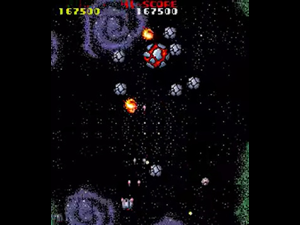
A very warm reception over a dark ravine in stage 5

All game modes in the Saturn port use a simple controller button layout of shot (A or C), bomb (B) and credit insert (R). Pause and press A+B+C to revert back to the main menu and switch game modes. The shot input has autofire by default, which despite not being that high still gets the job done so there's no need for a turbo controller. Bullets and lasers are almost always aimed and come in various patterns, but it's possible to "seal" enemies in order to avoid their attacks (stand very close or directly over them if we're talking ground targets). Tapping and sweeping is the bread and butter of survival, but getting sniped is still a possibility later in the game. However, if enemies can't see you they can't shoot, and for that reason sometimes it's better to just stick to one side of the screen in order to avoid unnecessary risks.

Even though the overall level of accomplishment might be questionable, Kyūkyoku Tiger II has interesting dynamics that sort of succeed in addressing some of the most dire traits of its predecessor. It's still harder than its world counterpart Twin Cobra II due to more resilient and more aggressive enemies, but it certainly takes it easy on players during the first couple of levels when compared with Kyūkyoku Tiger. When deployed, the bomb provides instant invincibility instead of leaving you vulnerable for a few seconds. The assortment of bombs is also much higher in the sequel since every carrier releases one power-up and one extra bomb. And if you die you're respawned with the same weapon you were using instead of reappearing with the vulcan shot.

Another striking feature of the sequel is the constant use of sprite scaling to convey the sensation of flying at different heights and diving into deeper and deeper layers of the enemy headquarters. My impression is that visually the game bears a strong resemblance to Donpachi, which is also the first game from another offshoot company that formed from the ashes of Toaplan. However, unlike Cave's perennial debut, Takumi's first game was never able to carry the Kyūkyoku Tiger/Twin Cobra torch into new grounds. Perhaps that wasn't their intention at all since the company decided to focus on Giga Wing instead.

As a result of the lack of development zeal, Kyūkyoku Tiger II ended up halfway into being a truly great shmup. One of the reasons for that is the dreadful unbalance of the weapon system. Once you realize how much more powerful the green shot is you'll certainly feel stupid whenever you take red or blue by mistake, with the obvious exception of the chopper taking off with the red shot at the start of the game. On the other hand, the green weapon is the worst one to die with since it's probably the least useful in a default condition. Depending on where you die you'll be in severe trouble because power-up carriers might take too long to appear, so don't get stingy with bombs if necessary. 

Quick fun with the Sega Saturn mode in Kyūkyoku Tiger II Plus
(courtesy of YouTube user ShiryGL)

Speaking of bombs, avoiding to use them is one of the key aspects of the scoring system. At the end of the level each spare bomb is multiplied by 5.000 and by the stage number, whereas each hyper bomb gets multiplied by 20.000 and the stage number. A full stock of hyper bombs in the final level, for example, results in a reward of 600.000 points. Good luck getting that though, especially if you keep collecting repeated power-ups for progressive bonuses, an act that eventually makes the speed of enemy bullets skyrocket. Once max power is achieved, each power-up builds up in steps of 10.000 points until a maximum of 100.000 points per item is obtained (if one power-up leaves the screen the next bonus is reset to 10.000 points though). Finally, ground and aerial stars released by enemies increase in value in steps of hundreds and then thousands until maxing out at 10.000 points each. Dying sends both the dynamic rank and all these bonuses back to their starting values.

So what would you choose, avoid surplus power-ups all the way for an easier game or get them all for higher bonuses at the expense of a much harder journey? In this port you can do it in Arcade mode (a direct TATE conversion of the arcade game), Sega Saturn mode (wobbling YOKO) or Arrange mode (just like Saturn mode but with the added features mentioned at the start of this post). The game has automatic saving while Arcade and Saturn modes share the same high score table, but note that Takumi or Naxat Soft unfortunately messed up with the scoring system by adding a few extra points for the blue helicopter (player 1 side) until max power is achieved. The red helicopter (player 2 side) isn't affected by this, but if you decide to play with it you need to cope with a highly unreliable replacement for the green laser. It's downright awful, honestly one of the weirdest weapons I've ever seen in a shmup.

Regardless of what scoring purists might think of the above and some odd design choices, Kyūkyoku Tiger II is still decent shooting fun, with plenty of action and fairly suitable music. Since it lacks checkpoints, it's also remarkably easier than Kyūkyoku Tiger. Fans of the first game should try the sequel, if only for the new elements related to scoring and the new approach towards rank. I played in Arcade mode (TATE) with the red chopper (player 1) in full defaults, which means Normal difficulty and Power Up set to A. Don't mess with this setting unless you want to tinker with the behavior of weapons when respawning.


Sunday, August 20, 2023

Sexy Parodius (Saturn)

Horizontal
Checkpoints ON or OFF
8 Difficulty levels
7 Stages (+1)
Ship speed by icons
- - - - - - -
Developed by Konami
Published by Konami in 1996


After the console venture of Jikkyou Oshaberi Parodius, originally released for the Super Famicom, Konami turned back to the arcades for the 5th chapter of the series in Sexy Parodius. While no big aesthetic changes are to be seen here, the company did tinker with the gameplay a little in order to bring new elements to the well-known style established since Parodius Da!. As a consequence, even though it looks like more of the same from the outside, Sexy Parodius comes packed with deeper mechanics aimed at pleasing players of all skill levels.

Does it succeed? I believe it does, but it took me quite a while to figure out why.

The game's also supposed to feature a sexy or risqué design but I didn't notice much of that at all. To be honest, the only real moment I thought could get some attention from a bystander, for example, is the final lady boss, which indeed appears in a very sexy manner and probably acts in the most comical way out of the whole series. That's quite fitting actually, seeing that Sexy Parodius is the final title in the franchise and it fades out, as expected, with a wacky bang. This Saturn port is pretty much arcade-perfect, down to the absolute lack of slowdown, and as far as I know there's no reason why the Playstation version shouldn't be of the same caliber.


Koitsu and his new sexy adventure
(courtesy of YouTube user The VideoGames Museum)

The main idea behind the story of  Sexy Parodius is a rather funny one, which players will eventually get to know due to the panels that appear in between levels. They show regular characters Takosuke (the octopus) and Pentaro (the penguin) running an enterprise that hires agents (the playable characters) in order to fulfill missions for special clients. There is a preamble to this in the attract mode animation, which also shows Takosuke dreaming about scantly clad girls everywhere (tentacles!). Anyway, that's the reason why you can't play with them this time around. The character roster includes eight pilots and their 2P counterparts with the possibility of co-op fun. Familiar faces such as Vic Viper, Michael, Koitsu, Mambo and Hikaru are back, with a couple of newcomers in the form of Option/Multiple (self-explanatory for Gradius fans) and Shooting Star/Black Viper.

Classic characters like Vic Viper still adhere to the weapon rules originally defined by the Gradius franchise, but newer additions to the roster are so unique that only the speed-up and the shield seem to be relatable to the old upgrade styles. Everything in between might be the most diverse combination of missiles and shots/lasers, which are still upgraded by taking orange capsules and activating the desired slot in the weapon array. This can be completely manual, but you can also select semi-auto and auto modes after the character is chosen. In semi-auto the game does the upgrading for you but allows players to do it as well. In auto mode the game completely dictates how the character should evolve, and you can't even trigger a new speed-up. On the other hand, auto mode eliminates checkpoints, gives you a bell shower upon death and does away with roulette capsules. These are special capsules that make the weapon array go crazy, cycling very fast until you press the upgrade button just like you would in a slot machine.

Speaking of input buttons, they work with (rapid) shot, (rapid) missiles and power-up. Shot also activates bell powers across all game modes (manual, semi-auto and auto) whenever applicable. At every four shots fired on regular yellow bells they change their color so that you can use special powers: brown (3 vertical barriers), purple (turns all minor enemies into capsules), blue (super bomb),  green (inflate + invincibility) and white (Alex, a special option/minion that helps you out in several ways). Yellow bells are only useful for scoring: if you don't let any of them go by they increase in value from 500 to 1.000, 2.500, 5.000 and finally 10.000 points.

Alex is one of the new features of Sexy Parodius, as is the mission gimmick applied to all stages. In each level you're given a task (collect a certain number of coins, kill a certain number of enemies, destroy bosses within a certain time limit). For stages 2 and 3, failing to accomplish the missions will send you to alternate levels with completely different layouts and bosses. A successful mission in alternate stage 3 sends you back to the main stage 4, but regardless of your results in any variation of stage 4 (main or alternate) you'll continue playing in a single route through stages 5 and 6. Additionally, a random level with bosses from previous games can appear anywhere between stages 2 and 6. Finally, if you complete all missions succesfully you'll also play a special stage after the end credits, which just like in Gokujyou Parodius ramps up the difficulty to ridiculous heights.

You will only see this lovely boss if you fail the mission in stage 2

An interesting note about the missions is that they add to the feeling that the game is longer than it actually is. With only six main levels (not counting the special stage), Sexy Parodius is actually the shortest game in the series since the very first Parodius. Another noteworthy aspect of the mission mechanic is that the biggest contributor to rank is the act of completing all of them. Maxing out your power, surviving longer and abusing bells for scoring certainly make the game harder, but there's a clear difference in enemy aggression if you continue to succeed in the missions proposed by Takosuke. I was brutally decimated with little to no fanfare when I got to the last stage a couple of times after being 100% successful in my missions, and once I tested the game in MAME I knew it was too high a price to pay just to access the special stage.
 
Then I got back to the Saturn game and cleared in on the very first time I completely ignored some missions. By failing to destroy the required number of geisha in stage 3 and failing to collect the minimum number of coins in stage 5 (don't get Alex, he'll definitely try to help you achieve that), the final level became much more approachable. This also leads to the conclusion that for players with normal skill levels such as myself it's perfectly possible (and maybe even easier) to get decent scores by not pursuing the special stage at all. Bells don't appear as frequently as in previous games, but still represent the primary means of scoring and are certainly easier to deal with when you're not focused in completing missions.

In a nutshell, Sexy Parodius is a shmup that can be made as hard as you want. Fun is likewise relative, and it might take some while to figure out the right amount of dynamic difficulty you're able to cope with, but the game's charm is undeniable. For my taste it goes a little too far with aggression just for fulfilling the proposed missions though, with the added albeit debatable drawback of the most pleasing versions of stages 3 and 4 being relegated to the failure route (I always died by mistake due to the exaggerated colors of the main 4th level, the girl factory). Minor details such as health gauges for bosses and colored bells showing descriptions when appearing are very welcome, but I missed not having a dedicated button to activate bell powers.

Once I saw how Mambo's awesome piercing laser behaved I had to have him as my character of choice, so most of my attempts at beating the game were with him. As I mentioned above, the highest score below (difficulty 4, auto mode) was achieved in my very first run after deciding to not fulfill all missions, thus refusing the see that ridiculous special stage.


Even though the Parodius series ends with Sexy Parodius, some of its traits lived on in Otomedius, which got an improved home version in Otomedius Gorgeous for the Xbox 360.

Friday, July 28, 2023

UN Squadron (SNES)

Horizontal
Checkpoints OFF/ON
3 Difficulty levels
10 Stages
Ship speed fixed
- - - - - - -
Developed by Capcom 
Published by Capcom in 1991


UN Squadron, also known as Area 88 in Japan, is one of Capcom's boldest attempts at the horizontal shooter genre. Loosely based on the manga of the same name released in the end of the 70's, the Super Nintendo port is the most recognizable home version of the arcade game, and in my perception is curiously more fondly remembered than its source material, probably because it expands on the original gameplay and also due to a harder challenge level as a whole.

A quick intro with a take-off sequence made with mode-7 sets the tone for UN Squadron. You take the role of one of three pilots and need to complete several missions to stop an army of mercenaries known as Project 4. They have taken over a peaceful kingdom, establishing strongholds in several parts of the country and deploying all sorts of military machinery and convoys to keep their evil clutches over the land. Only those brave enough will be capable of harnessing the power of the weapons carried by a selection of formidable aircrafts, scrambling through several colorful landscapes and dangerous caverns. Some slowdown is expected if the action gets too cluttered, but overall the graphical performance is decent, as is the soundtrack.

The choice of pilot affects gameplay in two ways: how fast your plane is powered up and how fast it recovers from taking a hit. Shin Kazama powers up faster and takes longer to recover. Greg Gates powers up slower and is the fastest to recover. Mickey Scymon lies in between both his coleagues. They all start the journey piloting the F8E Crusader, the most basic aircraft from the fleet, capable of carrying only three special weapons but a very versatile plane regardless. It suits most of the starting missions quite well. 

Intro for UN Squadron on the Super Nintendo
(courtesy of YouTube user mcbanjomike)

Fulfilling the missions is accomplished by using a vulcan cannon and by firing special weapons with limited ammo, which in turn are selected by a specific button in the controller. All inputs can be properly mapped in the options screen. Certain enemy waves leave behind power-ups when fully destroyed: the orange one adds 1 point to the upgrade meter of the main shot, the blue one adds 3 points. On the right side of the overhead display the POW number indicates how many points you need to advance to the next power level, which is shown right above the cash counter. Cash is the other component of the upgrading process, and is automatically registered as you kill enemies and complete full stages. It's used to purchase special weapons prior to each level and to earn the right to fly new aircraft models. Each pilot starts the game with a cash stock of $3.000.

Lives in UN Squadron are treated in a very unique way. Each life comes with a health bar that allows players to take some hits before dying, but there's a catch. Whenever you get hit the energy gauge flashes for a brief while, returning to normal once the plane has self-restored. If you get hit again during this critical period you die no matter how much health you have at the moment, then a new target area must be chosen from the map. Dying is also detrimental to the cash balance because all the special weapons you're carrying are instantly gone, whereas if you complete the stage successfully all cash from unused weaponry is reinstated into your account. A word of warning to preserve health: you can safely hug the upper and lower surfaces of any stage, but you absolutely can't do the same on mountains or walls inside caves.

Stage order is another factor that adds to the challenge. After the first level a selection of stages opens up in the map for you to choose from. Naturally some of them are harder than others, often demanding at least some basic planning for special weapons or which plane to use. Unfortunately the mission commander only lets you know about the details of each stage after you've selected it, which completely defeats the purpose of strategic thinking. While not that serious in the long run, it's certainly unfavorable for newcomers and might rub people the wrong way. This also applies to the selection of planes since their description is only visible for the ones you haven't purchased yet. If they're already in your inventory there's no way of knowing what they do unless you choose them for the mission, a decision that's final and might not be the best one depending on the stage.

And speaking of planes, testing them is probably the most fun part of UN Squadron. Some of them are faster or slower while emphasizing air-to-ground or air-to-air combat. The A10A Thunderbolt is the slowest one but comes with an extra downwards stream for the main shot at the expense of a max power level of 3. The best feature of the YF23 Stealth Ray, for instance, is that it's undetectable to homing missiles. However, if you want to be able to use all special weapons you'll definitely aim for the F200 Efreet, which at the cost of $ 1.000.000 also comes with a maximum power level of 7.

Shin Kazama is out for justice

Besides the odd decision to not let the player know beforehand any info of the level or the plane choice, another aspect of UN Squadron that's particularly annoying is the firing limitation of the main shot. You just don't have a normal automatic firing rate. One press of the button fires a bullet salvo for a few seconds, requiring another press in order to maintain a steady firing stream. Seriously, was this really necessary? I guess it's better than nothing (no autofire at all), but it's an extremely irritating mechanic that's very detrimental to the player's concentration at key points in the game. Of course this can be instantly alleviated by the use of a turbo controller, a luxury that's not easily available for most people, myself included.

One final note about the gameplay concerns the gallery of secret items. They are, in fact, extremely important for survival, and knowing where to find them might represent the difference between life and death. All you have to do is shoot their location to release them. Never stop shooting and watch out for unsuspected corners in caves or prior to boss fights, you might be pleasantly surprised. The fuel tank fills your health meter partially, the yasichi (the lollipop) completely refills it, the star gives you a cash bonus of $50.000, the mech (actually a miniature of the character from Side Arms) is a smart bomb that clears the screen of enemies, the weapons rack adds ammo to the special weapons and the unicorn grants you with a shield that can withstand a good number of hits. Finally, extra lives are registered with 30.000, 100.000 and then for every 150.000 points afer that.

In my quest to 1CC UN Squadron in the Normal difficulty I ended up purchasing only the F200 Efreet as soon as I could afford it. I did go for the convoys that start showing up in the map in order to grab at least some $100.000. Each convoy gives you roughly $20.000 and apparently they don't stop coming at all (honestly, talk about a lazy means of rebalancing the cash mechanic). These convoys are also the reason why it makes no sense to talk about high scores in this game. I played with Greg Gates and finished with the result below. Since there's no score buffering and this screen disappears really fast, if you want to have it in pictures you need to resource to special recording arrangements.


Sunday, July 16, 2023

Radiant Silvergun (Saturn)

Vertical
Checkpoints OFF
5 Difficulty levels
6 Stages
Ship speed fixed
- - - - - - -
Developed by Treasure
Published by ESP in 1998


Already established as a revered developer for the console market throughout the 90s, Treasure took to themselves the task of making their first arcade game with Radiant Silvergun. And my friends, what a debut! How many companies come up with such a hit in their first try, I wonder? Anyway, the similarity of the arcade board and the Sega Saturn architecture soon led to a port to Sega's 32-bit system that became extremely sought after and rare, further cementing the game's reputation as one of the most desired titles in the platform. Of course there are more noble reasons for that, after all the game is a masterpiece that challenges players in a way very few shmups do, with outstanding production values and incredible cinematic elegance.

It doesn't take long to at least understand the hype behind Radiant Silvergun. Just a few credits are enough to realize how different it is, from the enigmatic stage structure to the fact that you have 7 weapons at your disposal from the get go. It's all tied up into a detailed backstory and controls built upon a layout that originally uses only three buttons but in the port takes full advantage of the Saturn controller. With an ambitious soundtrack and a slew of graphical effects it's all about spectacle, but spectable backed up by an elaborate leveling up system that many consider akin to RPGs. I can't say I agree with that, in my opinion what makes this game unique is an intricate puzzle element that's rarely seen anywhere else in the genre.

And instead of just porting the arcade game Treasure went beyond the basics and added an extra Saturn mode that expands the original structure while cleverly giving less experienced players the chance to see the whole game without resorting to infinite continues. Gameplay basics are the same for both modes though, as are those ominous but nonsensical messages that appear during boss warning announcements, of which the most famous one is definitely BE ATTITUDE FOR GAINS.

Getting circled by Nasu, the boss of stage 2C

The three fundamental shot attacks consist of vulcan (button A), homing (button B) and spread (button C). The combination of these inputs lead to extra shot types that are mapped to the other buttons in the controller, which results in homing spread ring (button X, or B+C), backwide (button Y, or A+C) and lock-on plasma (button Z, or A+B). Finally, at the press of all basic inputs A+B+C or button R you activate the radiant sword, a short-range moving appendix that's also capable of blocking/absorbing regular bullets. If you absorb 10 bullets, as indicated by the gauge below the score counter, the next sword activation will be the hyper sword, a devastating attack that deals great damage and also makes you invincible.

The amount of weapons at the player's disposal is overwhelming up front, but they are all effective in their own way. Vulcan and spread are great for immediate offense, whereas the lock-on plasma and the homing ring can reach through walls. The current power of each basic weapon is shown in cycles right beside the score display, but in a game that has absolutely no power-ups how exactly are we supposed to upgrade our weapons? That's when chaining comes into play, and everything about Radiant Silvergun assumes a whole new level regarding strategy. It's not about haphazardly killing everything anymore, and there's simply no way around this if you want to have a chance at succeeding in the long run. If you ignore it completely there comes a point when your weapons start to lack power and bosses become virtually invincible.

Chaining in Radiant Silvergun is color-based. Except for bosses, every single enemy is either red, blue or yellow. The basic rule is that these enemies must be destroyed in successive groups of three of the same color, without killing anything else that bears a different color. By doing that the multiplier over the base values increase dramatically, additionally powering up all weapons used in the process. Dying or destroying an unwanted enemy resets the chain/combo value. Another source of upgrades is the act of correctly dismantling bosses. Almost all of them have multiple parts/components that can be destroyed independently. Managing to get a 100% destruction ratio yields a lot more points and faster upgrades, but if you go straight for the kill and leave the extra parts intact this destruction bonus of course won't be as good.

Extra scoring methods can be squeezed in depending on the enemy layouts. A secret chain, for example, is obtained when you destroy at least one red enemy, hit a blue one and then start targeting only yellow ones. Chain values skyrocket quickly and soon reach the maximum of 100.000 points for every three enemies destroyed. Despite the difficulty to actually pull it off, stage 2B is a great example of when to exploit the secret chain technique. Other ways to score more points is by standing close to bullets and lasers (grazing), landing multiple hits with the same weapon and finding the "merry dogs", which are hidden in specific places and can only be unlocked by using the homing ring (B+C). They come in three types, but increase in value progressively.

Long story short, the upgrade progression is directly related to the weapons you use and to how well you're able to score. As I hinted above, the puzzle element related to chaining is one of the defining features of Radiant Silvergun, as well as the amazing sense of style and grandeur evoked by the game's scope. The stage structure, for instance, is quite unorthodox. In Arcade mode the game starts in stage 3, which is comprised by 5 sections. After that you must choose between stages 2 or 4, both also comprised by 5 sections. Then you proceed to stages 5, 6 (where you face a humanoid final boss named Xyga) and 1 (where you can't shoot and must survive the attacks from the evil crystal behind everything in the story). Since each section has its own boss, it's as if the game had 13 stages. Each stage also has a name that ties into the story (Return, Reminiscence / Evasion, Victim, Origin and Link), an aspect that's fully developed in the new Saturn mode.

Original trailer for Radiant Silvergun on the Sega Saturn
(courtesy of YouTube user SegaSteve)

Specifically tailored for this port, Saturn mode spices things up with extensive backstory animations and Japanese narration while making players go through all levels from start to finish (after stage 3 you advance to stage 2 and then stage 4). There are also four extra bosses in stage 6 prior to the final showdown against Xyga. More merry dogs than usual can be found, and minor graphical tweaks were applied to make the game a little more colorful. Since this mode is longer, the upgrade progression is a little slower than in Arcade mode. In any case, the most important feature of Saturn mode is that you're given the option to save your game so that you'll always start with the power-up levels you had in your last run. Eventually you'll max out all weapons at level 33, thus making it a lot easier to defeat bosses and reach the end of the game. The only initial challenge of Saturn mode is that continues are limited and get unlocked as you play, whereas you can just add credits at will in Arcade mode (with the L button). You can always play Saturn mode on a clean slate at any time, of course. 

Given how the gameplay works, it's reasonable to consider Radiant Silvergun to be one of the most methodical vertical shooters out there. It sure has its share of hairy moments, with true bullet hell sections and pressure mounting against some gigantic bosses the less powered up you are, but for the most part the rhythm of the game is clearly dictated by slow moving bullets. That said, for the majority of players the deadliest enemy for a good while is the confusion regarding weapon usage. Missing a hyper sword charge or triggering it in the wrong occasion, for example, can throw everything off in any run. That's why planning ahead, applying good crowd control and devising safe strategies for bosses are so important. This process might take longer than usual for a shmup, but the journey is decidedly worth it.

Arcade and Saturn modes are quite distinct between each other, as I mentioned above. They do share the same extend routine though, with score-based extra lives granted at 1 million and 5 million points. Other than that, all credits across both modes have incredibly detailed stats that can be seen in the options screen, which is also where you switch between game modes. You can even unlock special menus that allow stage selection, for example. The only features that I really missed in this outstanding port is a replay save function and some decent practice options. Unlockable stage selection is nice but doesn't cut it, especially with the frequent deaths of my back-up batteries.

I focused on Arcade mode after I came across a working MAME rom. I used it to practice until stage 2C, where it unfortunately crashed, so I had to learn everything after that the hard way. It was a memorable undertaking, but certainly not as memorable as Saturn mode, which I'll leave for a future opportunity. A common misconception about Radiant Silvergun is that the game is too long, but that's only true about Saturn mode, which takes over an hour to be completed. As we can see from the photo below, I was able to 1CC Arcade mode in less than 27 minutes in the Normal difficulty, going through the stage 2 branch (stage 4 is too evil). My back-up battery was dead during this run, so all the history from a previous 1CC and other attempts were sadly gone.


Now I can finally say I'm ready to move on to Ikaruga.

Thursday, June 15, 2023

Andro Dunos II (Playstation 4)

Horizontal
Checkpoints OFF
3 Difficulty levels
7 Stages
Ship speed fixed
- - - - - - -
Developed by Picorinne Soft
Published by Studio Storybird / Pixelheart in 2022


There once was a horizontal shooter with a ship that looked like Zero Wing's but behaved like the one from Hellfire. While not well known even within the shmup community, it was an honest effort that graced the Neo Geo library with lively colors and decent fun factor. Other than that very few people really knew about Andro Dunos until recently, after all Andro Dunos II was released for several different platforms. An oddity in itself that finds very few parallels these days (Sol Cresta is perhaps another example), Andro Dunos II is the kind of sequel that comes off as quite surprising no matter how much love you had for the original. After all, what can one expect from such an unexpected continuation to a game released more than 30 years ago? 

Some of the best things in life, including gaming of course, is to be positively surprised when you least expect it. And that's the case of Andro Dunos II. In short, it makes you feel the same kind of thrills people experienced during the 16-bit era. There's a great sense of scope backed up by solid gameplay concepts, a package that's nicely crafted to provide players with lots of versatility in terms of challenge, strategy and fun. It totally respects and preserves the tone of the first game, but there are also elements that evoke classic series like Thunder Force and Gradius. Graphics make the most out of humble assets and look great, with simple yet efficient visual effects and a soundtrack that's quite engaging, often evolving in sync with important moments and transitions.

Once the game is started a brief tutorial shows you how to basically use all buttons to begin playing. It can be skipped by pressing any button, whereas to quit the game at any moment all you have to do is pause and simultaneously press L1, R1 and OPTIONS. 

My 1CC run on Andro Dunos II for the Playstation 4

There are four main weapons cycled by pressing the shoulder buttons (L1 and R1): a straight shot, a spread shot, a rear shot and a slow-firing laser that acquires an X-shaped pattern when you achieve power level 4. Getting there is just a matter of collecting the floating power-up when it displays an S, which then upgrades only the weapon you're currently using. Power-ups are released by incoming carriers and cycle between S, M and U before leaving the screen, so if the one you want doesn't appear right away just wait for the power-up to change. Each weapon is maxed out when reaching power level 7. As for the M and the U, they're used to upgrade missiles and summon/upgrade shield barriers. These extra resources can only be upgraded up to level 5 and behave differently according to the weapon you're using. Shield barriers deplete if too many shots hit them.

For each weapon there's also a hyper shot that can be unleashed by pressing a separate button. The caveat is that during the recharging time said weapon remains in its weakest form. On the other hand, this powerful attack does not depend on the current upgrade level of the weapon, which means it will always be the same no matter how powered up the weapon is. Using hyper shots and switching weapons in between is the secret to handling difficult sections and succesfully dismantling bosses. The hyper shot for the straight weapon is the strongest and can block regular bullets, but the one for the spread shot is definitely the best for crowd control. The laser hyper shot lacks power but is also a good means of shielding yourself from incoming bullets.

Amidst the action you'll also come across blue orbs that give you points and bonuses. Each stage has 30 of them, and for each 10 you're able to collect you get one token to be exchanged after beating the boss. You can either level up any of your weapons or auxiliary shots, as well as trade them for 5.000 points each. Considering that each power-up in excess is worth 2.000 points during the level, that's when you start to realize the built-in possibilities of the scoring system. Add to that the ability to destroy boss parts for a few more points and the strict nature of the game design, which never changes enemy patterns and totally rewards solid memorization. I felt that there might some rank involved if you survive long enough on a single life, but it's pretty mild and only affects bullet density.

Besides missing a few seconds of the action, the only penalty for losing a life in Andro Dunos II is the downgrade of one power level of the weapon you were using (missiles and shield are unaffected). No bonuses of any kind come from extra lives when beating the game, therefore the score extends granted with 100.000 points and then at every 150.000 points are there just to increase your survival odds. While the game isn't remarkably difficult, deaths happen quite frequently in the beginning due to incorrect weapon cycling. Sure you can stick to a single one that feels more comfortable, but using the whole arsenal according to the challenge imposed by each stage is quite amusing.

Zero Wing vs. Mech Warrior?

That said, the true fact of the matter is that Andro Dunos II definitely shines in the level design department. It puts all sorts of hazards on screen, scrolls up and down every now and then and showcases large bosses with attack patterns that always throw some sort of marginal variation, often taking players by surprise. I just missed the screen scrolling backwards as in the second stage of the first chapter. There are some other clear nods to Andro Dunos though, most notably the rearrangement of a few bosses in several parts of the game. By the way, my favorite part is the high speed section of the fifth stage (machine city), but the best music is certainly the one that plays during the underwater level.

There's no need to fear the pixellated resolution on the PS4, the game is so good that in no time it won't bother you anymore. An assortment of wallpapers is available when the game is booted, with the possibility of also applying scanlines over the mock-up of a curvy TV screen. It's nice for nostalgic old timers, I guess. A stage select option allows you to restart the game in any stage you've already reached or just replay them at will, even though the starting power levels are fixed and don't allow any adjustments. By beating the game you unlock a boss rush stage, which in turn unlocks two extra independent levels modeled after stages 1 and 3 of Andro Dunos. Just a couple of pointless curiosities, I'd say.

I 1CCed Andro Dunos II in the middle difficulty (Arcade) with the high score shown below, aiming for all blue orbs and just bonus points in the end-of-stage reward screen. The 10 at the end of the scores are a nice way to give away the chosen difficulty.


Monday, May 22, 2023

Vulgus (Playstation 2)

Vertical
Checkpoints ON
2 Difficulty levels
3 Stages (loopable)
Ship speed fixed
- - - - - - -
Developed by Capcom
Published by Digital Eclipse in 2005


Another first from another important developer, let's go!

Yes, every company has to start somewhere. I'm not saying that Vulgus was the first game designed by Capcom. It was however their first shmup, and as such deserves at least a bolded footnote in the history of the genre. Many would argue with that, and even more people simply ignore it because it was soon overshadowed by the games that followed. Fortunately Vulgus wasn't (and shouldn't be) forgotten, seeing that it was included in all of those compilations backed up by Capcom ever since the 32-bit generation hit the gaming world.

That said, It's possible to play Vulgus on the Playstation 2 by means of the Capcom Classics Collection. Unfortunately this compilation does not offer any option to play it in TATE, but that isn't that much of a loss if you've got a decently sized TV/monitor. The game's primitive mechanics don't require much as you're invited to attend the coming out party thrown by giant insect mutants from a planet callled... Vulgus. Basically it's just a relentless series of enemy waves attacking the player in random formations throughout three ever-looping ground levels separated by outer space intermissions.

Starting the fun with Vulgus on the Capcom Classics Collection
(courtesy of YouTube user VideoGaming4U)

In the world of Vulgus your tiny round spaceship is equipped with a regular shot and a more powerful and limited attack akin to a cannon, missile or torpedo. It drills straightly forward destroying all minor enemies, only stopping against those bigger bugs that cross the screen from time to time. It's mostly indicated against enemies that appear and enter into line formations after a brief while, kinda like those classic patterns first seen in Galaga. The difference here is that you also have other enemies flying around everywhere, which sometimes makes it difficult or impossible to aim the torpedo and kill complete enemy formations to get more points (the more you kill with a single blow the higher the bonus).

Another visual influence here is Xevious, particularly during the forest planet of the second level thanks to the simliar terrain and the appearance of revolving blocks that become invincible and scroll downwards if you fail to destroy them. The difficulty picks up accordingly from the crater planet of the first stage, quickly peaking as soon as you enter the icy planet in the third stage. Enemy movement patterns get more and more complicated, and since their shots are all directly aimed at the player it soon becomes clear that you absolutely can't stay put. Does this sound familiar? Of course it does, after all this is the same gameplay behavior seen in 1942 and Exed Exes, two spiritual successors in the Capcom shmup timeline.

Vulgus is also where you'll first see some trademark icons in the Capcom shmup lore, such as the Pow item and the yasichi (the colored lollipop). The Pow appears randomly as you defeat enemies, and each one adds an extra cannon/torpedo to your stock. The yasichi, on the other hand, is actually an enemy that approaches the ship and darts into its location. Other items show up in the form of letters D, E and S, which seemingly don't do anything. I don't think they affect enemy behavior to a noticeable extent (decrease quantity, increase number, increase speed) as seen in the hint included in this very same collection. What I noticed is that if you take many of them during the same stage without dying you'll eventually be able to collect a yellow star that's worth 10.000 points.

The loop boss!

An interesting aspect of the gameplay that might not be that intuitive in the beginning is that the quicker you take Pows and letters the quicker they will appear. If you fail or refuse to collect an item it will keep showing up until you take it, and only then the item spawning sequence will be resumed (most frequently it's a random letter for every two Pows). Items don't appear in outer space areas, but whenever they're on screen note that if you move left/right and leave it out of sight it might just disappear, as will some of the enemies.

For a quick burst of shooting action Vulgus is quite a decent diversion, given that it doesn't take too long to be looped. At the end of the 3rd stage a bigger enemy with rotating rocks appears, in what could be considered the loop boss. There are a few odd choices in the rudimentary mechanics, such as the cannon stock being retained even if you die and the routine for extends and extra lives. Extends are normally achieved at 20.000 and 60.000 points, whereas 1UPs come from destroying certain enemies and quickly vanish amidst the mayhem. No worries though because they get duly registered. And whatever your life stock is, the maximum amount shown in the life indicator is 4.

My final verdict on this game is simple. If you fancy the style of 1942 and Exed Exes but can't cope with their excruciatingly long campaigns and difficulty, which is my case, then Vulgus is certainly a nice option to try. It's just as relentless, but three stages is all it takes to add it to your 1CC achievement list. Both input buttons can be configured at will in the options screen, as well as rapid fire (a controller with turbo fire will give you better results though). The repetitive music is really the only atrocious aspect players need to endure, but there's a slightly less grating alternative in the Capcom Classic Collection disc. Just go to Options → Game Settings and switch on Sound Remix.

Here's my final result in the Normal difficulty, reaching the icy planet one more time on the second loop.


Thursday, May 11, 2023

Tiger-Heli (Playstation 4)

Vertical
Checkpoints ON
4 Difficulty levels
4 Stages (loopable)
Ship speed fixed
- - - - - - -
Developed by Toaplan
Published by M2 / Tatsujin in 2021


Paying respects to shmup classics is never a bad idea if you have some spare time. It also serves two noble purposes. One of them is to put into perspective their undeniable importance to the development of the genre. The other is, well, to have fun obviously. It could be easy fun, but challenging fun is preferrably the best option. Tiger-Heli is definitely one that fits the bill, and its resurfacing in new consoles thanks to the fine people from M2 offered a great chance to revisit this defining title in the history of Toaplan. After all, the only true arcade port of Tiger-Heli until recently was in the Toaplan Shooting Battle 1 compilation released for the Playstation in 1996.

Toaplan Arcade Garage - Kyukyoku Tiger-Heli is the first compilation in the M2 ShotTriggers Japanese series that's exclusively dedicated to Toaplan. It contains Tiger-Heli, Kyukyoku Tiger and Twin Cobra, in what's seemingly a repetition of the aforementioned package released for the PS1. However, it offers much more in terms of available adjustments, interface improvements and extra content since you can also play several console versions of these games through DLC. There's even a port of Get Star, an extremely odd platformer released by Toaplan in 1986. Unfortunately the downlodable content can only be redeemed with Japanese PSN accounts.

Even though it's quite different from the titles that followed in the Toaplan timeline, Tiger-Heli was immensely successful and established the company as one of the main shmup households during the 80s. The main inspiration for the game was Gyrodine, which actually had in its developmment team some of the guys who would later found Toaplan. However, despite the similar use of a helicopter as the player's avatar there isn't much in common between both games. Toaplan's debut enjoyed greater success both in the arcades and in people's homes, given that in certain regions the port of Tiger-Heli for the Famicom/NES was certainly one of the most popular shmups of the 8-bit era.

Art during the initial loading of Tiger-Heli on the PS4

As the first shmup developed by Toaplan, Tiger-Heli established the basic visual grounds that would define much of the company's style for a few years. In terms of gameplay, however, it's quite unique in how it deals with movement speed and bomb management for example. It's deceivingly slow and methodical, and despite the straightforward nature of enemy formations there comes a point when a solid amount of memorization becomes inevitable. It teaches the importance of never underestimating a simple game that uses only two buttons for shooting and for dropping bombs.

Once the helicopter takes flight over an urban landscape, tanks and turrets will fire aimed bullets at intervals that get increasingly shorter as the difficulty picks up proportionally. For each life you get two bombs placed on the sides of the chopper, which can explode if hit by a bullet. The firing rate is capped so you can only have a certain amount of bullets on screen at any time, nevertheless it's still possible to point blank in order to land a lot more shots per second. Bombs have no panic function but can still be used defensively, however a proactive approach can lead to much better survival chances in some of the trickiest sections.

Improving firepower is possible by hitting a tiny ground square that keeps cycling quickly between a white arrow pointing up, a red arrow point sideways and a blue B for extra bombs. The arrows generate "little helis" that float downwards and latch to the chopper on both sides when collected, providing great attack reinforcements. You can have a maximum of two little helis at any given time, but just like the bombs they can be destroyed with a single hit. As for the yellow pulsating squares, an extra life is achieved whenever ten of them are destroyed (a counter keeps track of how many you have). By the way, score-based extends are also registered with 50.000 points and for every 120.000 points after that.

Whenever you die and get sent back to a previous checkpoint the helicopter is respawned with two bombs. This bomb stock is also replenished during the landing/take-off sequence between levels, which is also where you can collect 5.000 bonus points for each bomb or little heli you're carrying when you land (surplus upgrades taken throughout the level give you 3.000 points). These are the main ways to score higher, but there are also a few secrets such as the indestructible red house at the start of the first stage that gives you 10.000 points (and more if you keep shooting it), or the areas where a racing car will slowly travel from right to left if you stand there after having fired exact multiples of 16 shots and is also worth 10.000 points.

Entering the second loop of Tiger-Heli on the PS4
(courtesy of YouTube user FunnyPlace Channel)

Before playing this port of Tiger-Heli, the 16-shot secret for the passing car was unknown to me. Achieving it is possible in all available spots of this version though, thanks to some of the gadgets designed by M2 (the shot counter and the stage map). A staple that has become synonym with the company, these gadgets are invaluable and give much more information than what you can see from the game screen alone. This port also offers four game modes to choose from. Arcade is locked in the Normal difficulty and denies any changes to the game settings, providing the unaltered original experience and avoiding the confusion related to different arcade board versions. Super Easy mode is also locked, Custom allows all sorts of tweaks possible and Arcade Challenge is a collection of stage-based score attack modes.

Since everything in this Playstation 4 version is in Japanese, if you want to watch a replay from the leaderboards note that you need to download it first by pressing ×, then proceed to Replay Theater inside the Materials Room menu to see it.

Click for the option menus translation for Tiger-Heli on Toaplan Arcade Garage - Kyukyoku Tiger-Heli

Despite the apparent bare-bones and primitive aspect of Tiger-Heli, its ability to keep sucking players for just one more credit is undeniable. There are no stage bosses, but those large tanks that appear in pairs at certain points could definitely claim the title of bosses if they wanted to. An interesting gameplay detail is that even though a few jets zap through the screen here and there there are absolutely no shots fired by aerial enemies, a concept that Toaplan would employ again in Daisenpu / Twin Hawk. And as far as looping games go, Tiger-Heli is also special because it excludes the first stage from subsequent loops, which then have only three stages instead of the initial four (the high score table mentions areas, with 8 areas comprising a full stage). Finally, the game makes the most out of the available music, changing its regular theme to an equally energetic variation whenever you're carrying at least one little heli.

My best result in Arcade mode / Normal difficulty is below. Once I got familiar with the game again I was able to reach the 3rd stage of the second loop (repetition of the 4th stage).