Showing posts with label Dreamcast. Show all posts

Monday, April 20, 2026

Satazius Next (Dreamcast)

Horizontal
Checkpoints ON
4 Difficulty levels
6 Stages
Ship speed by icons
- - - - - - -
Developed by Astro Port
Published by Pixelheart/JoshProd in 2022


A very competent developer for the PC scene, Astro Port branched out into different territories a while ago. In the case of the Sega Dreamcast, Astro Port Collector was the result, a compilation of four of their titles that sometimes gets confused with a similar release that came out for the Nintendo Switch at around the same time. The Dreamcast package includes Satazius Next, Wolflame and Zangeki Warp, as well as the mecha platformer Gigantic Army, and is by all means a great way to get to know the works of this neat developer.

I decided to start with this collection by playing Satazius Next, a game I had already known in its incarnation for the Steam digital distribution service as Satazius. A straightforward, colorful and well designed horizontal shooter whose inspiration from Gradius goes beyond the obvious phonetic association, the Dreamcast port is actually comprised of two game variants: the regular Satazius and Satazius Next, an arrange mode that plays just like the vanilla version but comes with a few differences to justify the maketing decision for the game's new name.

Straight shot + missiles in the first stage

So what's different beetween Satazius and Satazius Next? In order of importance, I'd say it's the soundtrack that veers more into electronic territory (the only theme that was preserved is the boss music), the ship sprites (which has turned into a more generic vessel instead of the "spiky" design reminiscent of Rayforce) and some visual differences (of which the most striking is the blue wasteland of the first stage replacing that greenish landscape). The game is otherwise exactly the same, down to item positioning and enemy behavior. Besides several chapters from Gradius, seasoned players will also spot influences from Darius and, to a lesser extent, R-Type and Thunder Force.

Inputs work with shot on button A, sub weapon selection on button B and special/charge weapon on button X. Prior to each level players must choose which weapons will be used from an array that gets increased as bosses are beaten and the game progresses. Button A fires both the main weapon and the sub weapon, but two sub weapons must be chosen at the selection screen, which will then be switched between each other with button B. These are also upgraded individually with the correspondent power-up, which will be applied to the current sub weapon choice. As for the charge weapon, it will recover automatically after each blast (faster if you refrain from shooting).

The power-up roster includes red P (main weapon), green P (sub weapon), yellow P (special/charge weapon), speed-up (blue pod), speed-down (gray pod), 1-hit shield (purple S) and stars for bonus points. All weapons have 8 power levels indicated at the selection screen and in the lower HUD. The 8th power level gives you a remakable boost, but it's only temporary and degrades back to level 7 if you take too long to take another power-up. There are four possible speeds, but even max speed (4) is manageable for most of the situations.

What makes Satazius Next an accessible game in terms of challenge is the fact that there's always a nice assortment of power-ups to get back up once you die and get respawned in a previous checkpoint. On top of that, each death only takes away one speed and two weapon levels, so the punishment for dying will never be that severe (unless you die multiple times in a row for stupid reasons, of course). You do get stuck with the same weapons until the stage ends though, which means wise choices are half the strategy for winning. And once you get used to stage layouts, higher scoring will naturally come to the forefront for those who enjoy perfecting routes and performance.

Trailer for Astro Port Collector
(courtesy of YouTube user and publisher PixelHeart)

For each surplus speed-up and shield taken you get extra 5.000 and 20.000 points respectively. Each star collected since the last time you died within the level is worth 10.000 points after you beat the boss, but if you manage to pick up all 10 stars the stage bonus is then doubled, meaning you'll get 200.000 instead of 100.000 points. Upon completing the game, each life in reserve is then worth 100.000 points. So the secret to higher scores is simple: never take any speed-downs, avoid dying and taking any damage and memorize the location of stars for maximum stage-end bonuses. Extends are granted at every 300.000 points.

While serviceable and competent overall due to the ingenious and creative level design, Satazius Next on the Dreamcast is kinda blurry and muddy due to the awkward resolution of the porting job. If you come straight from the PC original the downgrade perception is even more critical. In addition, I also had the impression of a very slight lag, fortunately not that severe. The game is rather bare bones with the functional options: Practice mode is great for direct access to specific stages you've already reached, but it's not possible to remap controller buttons. At least all difficulties are unlocked from the start.

I beat the game a few times when practicing but I didn't try to improve my performance, since I was let down by the game's resolution and the stupid arrangements I needed to make in order to at least be able to see the final score. The 1CC result below for Satazius Next was achieved in the Normal difficulty (2.857.100 points).


Tuesday, October 8, 2024

Triggerheart Exelica (Dreamcast)

Vertical
Checkpoints OFF
3 Difficulty levels
5 Stages
Ship speed fixed, start selectable
- - - - - - -
Developed by Warashi
Published by Warashi in 2007


Is a shooter with a unique gimmick always a worthy experience, even if this gimmick isn't unanimously approved by everyone? Tricky question, yes. Triggerheart Exelica's claim to fame, for example, is the ability to capture enemies and throw them around as you please, only abiding by the elementary rules of rotational momentum. Many games had already used the same idea of grabbing enemies for a defensive or offensive edge, but this one takes the concept to a whole new level, much beyond what was done in titles like G Darius, Gaiares or Macross - Scrambled Valkyrie.

Ported roughly a year after its arcade debut, Triggerheart Exelica was the second to last official release for the Sega Dreamcast, coming out just a few weeks before Karous. Packed with three game modes (Arcade, Story and Arrange), configurable controls, practice mode, TATE and save function, the game was also available in regular and limited editions, the latter in a DVD case including a soundtrack CD and an extra art booklet.

The story here is trivial and a bit convoluted as usual. Suffice it to say players are able to choose from two sexy sisters that must battle inside advanced mecha suits through five increasingly tough stages. Exelica fires a spread pattern, while Crueltear has a straight shot and moves a little faster. Besides shooting, they can also activate bombs and latch onto any enemy with an anchor/spear. Extra bombs (B) and power-ups (P) appear from specific enemies in the level. Just two power-ups are enough to maximize their firepower, however the more you play the more you realize that regular firing isn't as effective as the ability to use the anchor, especially in the last couple of stages.

Playing Triggerheart Exelica for the first time
(courtesy of YouTube user Random Gaming Moments)
 
By destroying enemies gold flocks/medals are generated for collection. If you let go of the shot button these will be automatically sucked into the character, adding to a medal count and a multiplier. Using captured enemies to destroy other enemies cashes in this multiplier in exchange for points and even more medals. Medals increase in size and value if they're left floating on the screen, so it's always best to hold the shot button for a while. You lose 30% of your medal count if you die, and 15% if you collide with a harmless obstacle, such as those originated during boss fights.

Anchoring and throwing enemies requires some basic steps: grab the target with the anchor, draw it close by pressing the shot button, keep shot pressed as you spin it around either left or right and release the anchor button to throw the enemy in the intended direction. Besides the direction you can also control the speed of the spin with the shot button, but if the captured enemy isn't moving it will explode it you let go of the anchor button. Finally, the larger the anchored enemy the longer it takes for you to take control. Those that can't be captured (such as ground targets or bosses) will still be latched onto so that you can inflict damage by firing. Once the enemy is thrown it will not only hit whatever lies ahead with destructive power, but also convert all bullets in its path into gold medals.

One thing is definitely true about Triggerheart Exelica. Being able to reliably control the anchoring mechanic is easier said than done. I'd say that fully understanding and using this mechanic is the shmup equivalent to striking decent forehands or backhands in tennis. It takes practice and it takes time. And on a bad day it can destroy your ability to play, let alone win. There is an alternative to make it less cumbersome though: a switch in the options called "autospin" makes enemies rotate automatically after being captured. Note however that by activating autospin you lose the ability to use enemies as static shields (by avoiding to spin them with the shot button).

Another important aspect of the game is how it treats boss confrontations, in what's normally referred to as V.B.A.S. or "Variable Boss Attack System". All bosses have multiple phases, which evolve according to your current number of medals. This means that if you don't have enough medals boss fights are abbreviated. The only boss whose forms do not depend on the medal count is the last one. On the other hand, if you have at least 3.000 medals by the time you beat the last boss phases in stages 1 and 3, a secret character named Faintear will appear and prolong the fight. It goes without saying, but extended boss fights allow for a lot more opportunities for scoring.
 
Exelica taking to the skies in stage 3

Even though I like Triggerheart Exelica's soundtrack, I'm not a fan of the thumpy choice for impact sound effects. As for the game's aesthetics, they're decent but the graphics could've certainly used a little more detail. While the cinematic transitions help to keep a dynamic flow, which is often interrupted by bulkier enemies that cause the scrolling to cease, the game is generally built upon a fine balance that gives you a constant flow of aerial enemies to use as shields or projectiles. But what if someone doesn't want to use the anchor at all, I wonder? Could you beat the game? I believe this is virtually impossible. Denying the use of the anchor could be done until stage 3, but once you enter the drone field of the 4th stage you won't get anywhere without throwing those huge blocks around.

The extra game variants add even more spice to the original Arcade mode. Story mode is identical to the Arcade, but makes you confront Faintear in stages 1 and 3 regardless of your medal count. She also appears halfway the final level. A bonus of Arrange mode is that finishing the game with no continues lets ou see a more optimistic ending than the sad one from Arcade mode. Arrange mode, on the other hand, has more bullets and more medals to collect, doing away with the multiplier. All modes share the same thresholds for extra lives at 50 and 100 million points.

I was able to get the 1CC in Arcade mode in the Normal difficulty, playing with Exelica with default controls (no autospin). I can't say I was having good fun all the time though, mostly because the varying efficiency of my touch with the anchor mechanics often ruined my runs in the most awkward ways. I might return to the game in the Playstation 2 port Triggerheart Exelica Enhanced, which has the distinction of allowing you to play with extra character Faintear.


Saturday, October 29, 2022

Armed 7 (Dreamcast)

Horizontal
Checkpoints OFF
4 Difficulty levels
7 Stages
Ship speed fixed
- - - - - - -
Developed by Astro Port
Published by Pixelheart / JoshProd in 2019


Regardless of the artistic or commercial outcome, robots versus robots will always be a great premise for any sci-fi product. This is the case of Armed 7, one of the many PC shooters from independent developer Astro Port converted to the Dreamcast by french company Pixelheart/JoshProd. Armed 7 (or Armed Seven in its original spelling) is another standard horizontal shmup, but instead of controlling a spaceship you handle a mecha/robot in an all-out war against a huge mechanized armada.

Even though it belongs in the same league and bears a few visual similarities with older titles like Arrow Flash, Spriggan Mark 2 / Spriggan Powered and Android Assault, Armed 7 has a particular vibe that makes it stand out on its own, not in a stellar fashion but at least in a decent, if only slightly derivative way. The overall rhythm and the difficulty slope are perfect for the game’s short length, while the average challenge level should please fans of sci-fi shmups looking to have another doable 1CC under their belt.

Gameplay originality notwithstanding, Armed 7 could’ve used a little more polish in the interface. Texts are a little hard to read in a regular TV connection, and the cramped HUD on the horizontal borders makes it impossible for you to see the score on the top of the screen on a normal TV. Other than that it’s at least better than the lousy port for Supercharged Robot Vulkaiser. And the pause function now works, so you won’t have to watch your credit go to shreds if for whatever reason you need to get away from the TV.

A short trailer for the Dreamcast release of Armed 7
(courtesy of YouTube user and publisher JoshProd)

Upon choosing the difficulty of the game, players need to arm the robot with three types of attacks: main weapon, sub weapon and charge weapon. There are four choices for each with small symbols to help you figure out their behavior in advance. Of course the only way to know how they work and try to settle on a preferred combination is by actually playing the game. Button A shoots both main and sub weapons, while button B fires the charge weapon once it’s allowed by a gauge that fills up automatically. Charging times depend on the type of weapon selected.

The shooting direction of the main weapon can be tilted up and down by moving vertically without firing. The act of shooting then locks the firing direction until you release the button (tilting direction can be altered in the options in the “rotation” setting). The descent to the surface of the planet in the first level is an early example of when it’s good to tilt your firepower down, in a section that’s very reminiscent of the first stage in Eliminate Down. The game then moves on across several landscapes with neat parallax effects and huge bosses, which should please fans of 16-bit shooters in general.

In order to offset the simplicity of the base game, Astro Port infused it with some very smart motivational devices for scoring. It all starts with the upgrade icons for power and shield, which are brought by specific carriers and get sucked into the ship when within a certain radius. The item with the red core increases firepower in 8 steps, whereas the item with the blue core adds one shield cell. Since every life starts with no extra shields, these blue power-ups give you a very important survival leeway. It’s possible to stack up to two shields, but if you pick up a third one an indication of MAXIMUM will appear in the area for the shield gauge.

MAXIMUM shield doesn’t actually mean you’ll have better survival chances, after all if you get hit you’ll be left with only one spare shield. What MAXIMUM does is continuosly add more points to the score as long as you’re able to go on without receiving damage, in a gimmick that's similar to the max bomb bonus in Dodonpachi. This is great to motivate flawless play, however Armed 7 also encourages you to behave aggressively because additional multipliers are applied for speed-killing medium and big-sized enemies.

Twin cannons coming up halfway stage 4

Playing well also yields better rewards in between levels, which include time remaining on boss fights and shields in reserve. Upon game completion an extra bonus is given for all remaining lives, and three score-based extends at each initial million points add to this final prize. Finally, all bonuses increase in value according to the selected difficulty level. There’s no doubt these scoring strategies are the biggest contributors to the game’s replay value, it’s just too bad you can’t see your actual score unless you have a dedicated monitor. As I mentioned above, a regular TV set won't let you see it at all.

If your favorite weapon combinations are those that emphasize aggressive play and point blanking it’s important to watch out for deaths in critical situations. Besides leaving you with no shields, deaths also power down the ship. Except for the huge laser from the 3rd boss, which seems to expand beyond what you can actually see, hit detection is well implemented in Armed 7. What doesn’t quite work or isn’t visually pleasing is the glow effect that appears over the mecha once you collect a shield. It looked nice in the PC version, it just doesn’t on the Dreamcast. Last but not least, music and effects don’t stand out in any way, probably due to the strangely muffled sound quality.

An alternate version of the game, dubbed Armed Seven, can be selected during boot. From what I could gather it comes with an arranged soundtrack and a different color palette, but other than that the game is exactly the same, as hinted by the shared high score indication of both variants. However, since soft restart isn’t implemented the console needs to be turned off and on again if you want to switch versions. In both of them a practice mode lets you adjust all ship stats prior to directly playing the desired level. According to this resource Armed 7 has rank, but it must be so subtle that I didn't in all my play sessions notice anything related to a dynamic difficulty adjustment. 

My favorite weapon configuration was riot gun + cluster gun + beam cannon. The beam cannon is the one that takes longer to charge, but its power is second to none if you want to use it to weaken or obliterate larger enemies. The best 1CC score I got in the normal difficulty is below. All high scores in this screen are properly saved in the VMU.


Monday, January 17, 2022

Supercharged Robot Vulkaiser (Dreamcast)

Horizontal
Checkpoints OFF
4 Difficulty levels
6 Stages
Ship speed fixed
- - - - - - -
Developed by Astro Port
Published by Pixelheart / JoshProd in 2021


The inrush of ports of PC titles released on the Dreamcast by French publisher Pixelheart has included quite a few shmups in the last couple of years. Many of them have been developed by Astro Port, whose complete catalog seems to be bound to find its way to the defunct Sega platform through the hands of Pixelheart. One such example is Supercharged Robot Vulkaiser, a cheap take on the horizontal shooting formula that should please those who dig those old Japanese serials from the 1970s.

On the outside the packaging and the art that comes with it is rather cool, with a reversible manual/cover for Japanese/US versions. Unfortunately the actual port to a less powerful system didn't get any sort of proper treatment, even in graphical terms. Absolutely no changes were implemented over the original version on Steam, and when I say absolutely I mean it. The game itself isn't unplayable despite the expected decrease in frame rate, but good luck reading any text or numbers such as your hard earned scores, for example. The people responsible just cramped the HD resolution into the CD format without any downscaling, which hurts the eyes on everything that requires a little more detail.

Note: I used (as always) a default composite cable on my Dreamcast. 

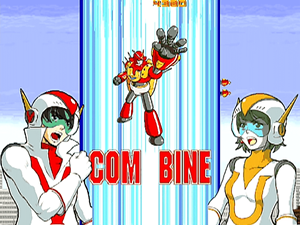
Needle kaiser combine, go!

Simple and straightforward is the name of the game in Supercharged Robot Vulkaiser. Button A (shot) is pretty much what you'll use all the way, since button X serves to deploy a bomb attack than can be triggered only once per level and varies according to the attached "kaiser" fighter, an enhancement pod that's activated by collecting the respective icon that appears floating from the left side of the screen. Each of the four available fighters replaces the default firing pattern with a more efficient shot type: rocket (special attack is an impact bomb), needle (special attack is a larger spread shower), thunder (special attack is a huge laser beam) and drill (special attack is a drill that slowly moves forward).

The special attack mentioned above becomes available when the charge gauge is full. Just let go of the shot button to unleash it. The lower HUD on the left side of the screen shows this charge gauge and also the energy bar for Vulkaiser itself (the robot) and a smaller energy bar for the kaiser fighter. The corresponding character is gone if the energy bar is depleted, which means the lost kaiser fighter is gone for the rest of the game if it "dies" while you're using it. Obviously a depleted bar for robot Vulkaiser means GAME OVER, no continues allowed. Whenever a kaiser fighter is lost you revert back to the default shot, and the special attack in this case is the detachment and launch of the robot's fists.

Preserving health/energy is of course the most important strategy to succeed in the game. A determined amount of health is recovered for both the robot and all kaiser fighters at the end of the level, but getting there with a sliver of energy won't help much. Bonuses for energy left and time performances on boss kills are also given in between stages, which actually respresents the most precious resource if you're playing the game for score. After all, the multipliers you see during the level as you kill enemies in quick succession don't account for nearly as much in the final score tag.

Original trailer for the PC version of Supercharged Robot Vulkaiser
(courtesy of YouTube user curiousfactory)

As I mentioned above, the porting job of Supercharged Robot Vulkaiser to the Dreamcast is as lazy and lackluster as it gets. The game is still quite colorful though, the low budget somewhat compensated  by harmless humor and creative designs for bosses. The core gameplay isn't affected at all, but the drill kaiser is simply an awful choice of fighter and should be avoided at all costs (beware of fighter icons coming from behind and latching to the robot in the heat of the battle). Just like in the original, a glowing point in Vulkaiser's chest shows his hitbox whenever he gets too close to bullets and enemies.

It's reasonable to assume that players tend to get used to the game's resolution (which makes it impossible to see your scores during the stages and barely allows you to glimpse the lower HUD, for example), but unfortunately you also need to deal with a couple of silly functional oversights in this port. Once you choose between English and Japanese after the disc is booted, for example, you're greeted with an extremely low-res intro that can't be seen again unless you reboot the CD. And even though the instruction manual mentions a pause function in the Start button it's just impossible to pause the game either in the regular campaign or in the Training option, which allows you to practice the stages you have already reached (the lack of a pause function is actually inherited from the original PC game). Many people also reported freezing problems in the port, but it only happened to me once in the first level.

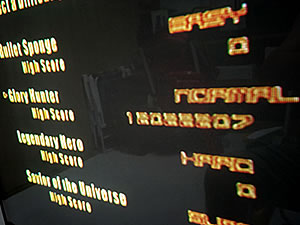
My best 1CC result in the Normal difficulty (Glory Hunter) is below. It reads 12.022.207 points, I tried to get the best possible picture after tweaking the settings on the TV!


Wednesday, January 9, 2019

Ghost Blade (Dreamcast)

Vertical
Checkpoints OFF
2 Difficulty levels
5 Stages
Ship speed fixed, selectable at start
- - - - - - -
Developed by Hucast
Published by Hucast / Play-Asia in 2015


My friends, I wish I was starting the log in the new year with a better game. However, one of my nephews saw the TV turned on its side and wanted to see how a video game looked in it, so on a whim I decided to take Ghost Blade off the shelf for a quick demonstration of its TATE mode. Then I thought it would be nice to tackle the game properly before putting it back, so here we are.

What a sad disappointment!

Aside from the usual letdown provided by pretty much all products made by Hucast (excessive development delays, promised game modes that never came to be, beta visual assets that never made it to the final product), Ghost Blade is a derivative mess that's completely devoid of any character. It lacks proper challenge and stutters a lot when the screen gets cluttered, in a frameskipping fest that strains the eye after only a few minutes. TATE mode is even worse because the frame rate is degraded all the time and practically makes you want to turn off the Dreamcast to go play something like Galaga instead. Don't be fooled by what you see from official trailers for this version of the game, that's not how it actually looks and plays.

One of the bosses

It's baffling how mediocre Ghost Blade is considering it was designed as a soft homage to developer Cave. The control scheme, for example, follows the classic Cave mold of shot, laser (focus) and bomb, which may be freely assigned in the Dreamcast controller so that you can play it as if you were playing Dodonpachi. Ghost Blade even comes with the choice of three ships: Milan (straight shot, no spread), Ghost (spread pattern) and Rekka (wider shot stream, no spread). Milan is the strongest and fastest of them all, Ghost is the weakest and Rekka stands between them as far as firepower goes. Upon selecting one of them the player is prompted to choose between Normal and Novice difficulties.

As you advance through the levels, little excitement is to be expected due to the generic sci-fi motif, the lethargic way the game is laid out and the naïve boss patterns. Destroyed enemies leave stars behind, and if you kill them with the focus shot they'll also release "tech orbs" that fill up a special gauge for extra bombs. All airborne items are automatically sucked into the ship, ground ones need to be flown over. There's no need to worry about powering up at all since you come out of the first level already fully powered and the Ps and Vs you pick up are never lost when you die. I also didn't care to check the extend routine because I got lost in numbers due to the massive bonus granted at the end of the level (a lone 1UP can also be picked during the 2nd stage).

The above is probably the most critical failure of this game and of any similarly designed shooter: if you don't even care about such precious things like powering up and extra lives, why bother at all? When you analyze the design closely, the background graphics in Ghost Blade are at least decent (faint nods to Ketsui and Pink Sweets included), and so is the soundtrack. But these aspects aren't enough to make a game, they just come off as a waste of resources. There's no kinetic balance when the game is in motion, and playing it often feels like crawling through quicksand, hiccups and bad visibility causing unexpected deaths when you least expect it. Nevertheless Ghost Blade is still remarkably easy, with lots of leeway provided by a bomb stock that's not reset upon death and bullet cancelling in place for most medium-sized enemies.


Intro for Ghost Blade on the Sega Dreamcast
(courtesy of YouTube user Team Shmup'Em-All)

Another similarity with Dodonpachi is in the chaining system, which tracks the number of enemies destroyed for an increasing score multiplier. However, combos in Ghost Blade don't give outrageous score boosts and are a lot less strict since the chain counter isn't lost if you take too long to kill the next enemy. It merely decreases, very slowly. Chains are only completely lost when you die. The end-of-level bonus mentioned above is based on the max combo and the amount of stars and tech orbs collected, as well as lives remaining. Now for something extremely odd: the max combo bonus is always the highest combo you can achieve, so if you manage to get a good one in the first stage you'll always get the very same bonus for all subsequent levels regardless of how badly you play them. This max combo bonus is even repeated in the next credits, so talk about an amateurish oversight! Lastly, I could swear I got an instant GAME OVER once or twice in the final level even though I still had lives in stock.

Besides the base game, Ghost Blade has a training mode and tweaks for the HUD and the audio balance. The collector's edition comes in two DVD cases with the game, the soundtrack and a "superplay" disc with special demonstrations for Ghost Blade, DUX 1.5 and REDUX - Dark Matters. As you can see, it's a royal feast for Hucast fans...

My best result for Ghost Blade in the Normal mode/difficulty is below, playing with the Ghost ship. Just note how even this high score table is messed up, some of the credits display zero as "max" combo. After this original Dreamcast release the game was also made available for more recent platforms such as the Xbox One and the Playstation 4 under the title Ghost Blade HD. It's supposedly a much improved final product, but I'll refrain from trying it for the time being.


Thursday, November 29, 2018

Battle Crust (Dreamcast)

Vertical
Checkpoints OFF
3 Difficulty levels
6 Stages
Ship speed fixed
- - - - - - -
Developed by Picorinne Soft
Published by JoshProd
 in 2018

As a few friends say around here, the Dreamcast is a platform that just refuses to die. A clear example of that is this new shmup called Battle Crust. Originally released for the Steam digital service in 2016, it found its way to Sega's console two years later. Giving the game a proper retail release on a dead niche platform is nothing short of commendable, even though its 16-bit sensibilities do not match the power of the Dreamcast at all. Sure it takes a lot less independent effort to offer a CD-based media instead of a cartridge, and the choice for Sega's much loved home machine was only natural given the expressive amount of independent releases it's been getting ever since its untimely demise.

Battle Crust speaks to those fans of the genre who enjoy the most pure methodical old school shooting action. By adhering to a simple set of rules and sticking to the tried-and-true formula of Irem classics such as Image Fight and R-Type, the game offers a decent space adventure with a challenge level that's much more akin to console than arcade standards. The disc is region-free and comes with TATE mode available at the press of a button (Y), but aside from that it's a bare bones release with no save functionality at all.

The story goes that Earth is at war against the rest of the universe. The invaders have dropped on our planet's surface deadly bombs made of a new metal (the "metal crust"), forcing the planet's defense forces to rise up and confront the menace. In order to level the odds against the universe, prior to departing for battle the ship must be equipped with one of three types of charge mechanisms: normal charge, mega charge and blast charge. Their power can only be unleashed once you acquire side pods by collecting at least one power-up. Charging is accomplished with button B (or L) and overrides the regular autoshot (button A or R), shooting out either a single beam if the button is released while the gauge is filling up or a fully-powered blast whose behavior depends on the chosen charge type.

Select charge system

Charge types differ enough to warrant slightly distinct strategies: the normal one is much like R-Type's classic beam, piercing through cannon fodder until reaching a tougher obstacle; the mega charge is the most powerful of them and even adds a short-range energy discharge to both sides of the ship, but freezes it in place for a split-second after being fired; finally, the blast charge comes out with a certain power, and once this power dissipates against the targets the energy radius stands there for a few seconds while damaging enerything that touches it. An extra benefit of the act of charging is creating a ball of energy that serves as shield against regular bullets and damages anything that touches it. All charge shots also possess a certain degree of bullet-cancelling capability.

After the first power-up is taken and the pods are generated, any further one will be fully active according to its color:
  • blue - straight lasers with rear shot capability;
  • brown - powerful soft forward shot;
  • red - wave shot with two spreading side shots;
  • yellow - a spread of impact shots;
  • green - needle-shaped gun with two homing side shots.

Choosing a favorite weapon is mostly a matter of aesthetical preference since all of them are pretty much equal in power. The green shot however does seem to oust the others when used at point-blank distance. In any case, the balance between charging and regular shooting is quite even, which means that most of the time the charge shot isn't needed at all. It only brings real advantage if you want to add a little extra damage as the bulkier enemies enter the screen.

In the world of Battle Crust players are constantly under a state of pressure due to the increasingly tight surroundings. While the first half of the credit unfolds in open areas, by stage 4 you'll find yourself navigating in cramped spaces and darting through closing gates. Stage 5 is the game's highlight in two parts: a meteor-filled entrance over alien terrain (mild Raiden vibe detected) and a fast-scrolling scramble with tight corridors and enemies arriving from all sides. And while bosses tend to die fast if pummeled hard, they often require lots of movement and bold positioning from the player who aims to properly beat the game.


Special trailer for the Dreamcast version of Battle Crust
(courtesy of YouTube user and publisher JoshProd Video Game Producer)

Slow-pacing aside, Battle Crust is fun and rewards good performances accordingly. Having weapons that are equivalent in power might be a missed opportunity gameplaywise, but at least you can take all of them for a score bonus of 1.000 points each. Another scoring opportunity comes from dispatching midbosses quickly to get a golden bug that's worth 3.000 points. The first score-based extend is achieved with 30.000 points, all others arrive at every 100.000 points afterwards; once beaten, the game rewards each spare life with 5.000 points and then adds a huge completion bonus. Finally, any attempt at milking those small projectiles flying everywhere is useless because they aren't worth anything.

A few brief bouts of stuttering slowdown are to be expected in the final levels. Other than that, some functional details weren't properly ironed out in the process of porting the game from its original PC incarnation to the Dreamcast. The spaceship rushing to the next stage is missing in those black screens between levels, for example. The audio presents some issues, such as this weird low-frequency humming that's more audible during silent moments or the music being randomly absent during the opening animation (the soundtrack is nice by the way, 4th stage BGM is my favorite). When playing in YOKO (standard orientation) the game doesn't fill up the entire screen and it's hard to read the opening texts due to the cramped resolution, that's why TATE or a bigger TV is a must in this case. Granted, my copy of Battle Crust is the European one and I was running it on a NTSC console, so that might be the reason for some of these minor setbacks.

The 1CC result below was achieved in Arcade/Normal difficulty with the blast charge type. The high score tallying is quite interesting in that it differentiates the difficulty by adding a determined number of points to the starting score (none on Easy, 10 on Normal/Arcade and 20 on Hard). Continues do not reset the score but add one single point to it.

Saturday, November 19, 2016

REDUX - Dark Matters (Dreamcast)

Horizontal
Checkpoints OFF
1 Difficulty level
7 Stages
Ship speed fixed
- - - - - - -
Developed by Hucast / Kontechs
Published by Hucast in 2014


Once upon a time, in the realm of homebrew games released for the Dreamcast, there was DUX. Despite some weird flaws it was at least a playable and gorgeous game. Later on the developer felt the need to revise the game and cater to the complaints of the masses, and then there was DUX 1.5. It was a shameless disappointment and added nothing of real value to the original. Some time later, thanks yet again to sloppy programming, Hucast shoved DUX 1.1 onto customers, but I have no idea about what it does to the original game. And then, in 2012, a Kickstarter campaign was created and succesfully funded for REDUX - Dark Matters, a misleading title that made lots of people (myself included) believe we'd be getting a sequel to the game when, in fact, it was nothing more than a repaint of DUX with an extra stage and an extra ship.

One thing I learned from all this is to never get your hopes up when purchasing a product from German developer Hucast. Ever. REDUX was the last straw for me, especially when I received the Kickstarter-exclusive steelcase with a single sticker glued to the cover and two CDs that barely fit the lousy supports on the inside (the second CD is just a bonus disc that contains DUX 1.5). At that moment I envied those who had ordered the regular version and had at least received a normal box with proper art.

There is more to it though. A couple of months after the game finally saw the light of day a REDUX 1.1 revision disc was promised for all Kickstarter backers, addressing freezing issues on bosses and a scoring bug as well as the blurry image (only for S-video, VGA and RGB connections). At the time I was busy with real life and lost the window to request my disc, but since the reported issues are a lot like some of the ones identified in DUX (plaguing 50Hz/PAL users only), I certainly won't be losing my sleep over it.

Soaking bullets for measly justice

REDUX is indeed built upon the primordial mold that gave birth to DUX. However, due to all the details whose objective was to give a darker tone to the whole game, apparently there was this need to lower the original resolution, hence the awfully blurry graphics that put the almighty Dreamcast to shame. Of course the longer you play the more used you get to it, but the initial impact of the downgrade is astounding. However, apart from the graphics there are other more fundamental changes and additions to the formula, which make the game seemingly more dynamic than previous iterations and point to the fact that Dark Matters is the final product following all those beta versions disguised as proper releases.

For a starter, when thinking of R-Typean influences REDUX is more akin to Pulstar than R-Type itself. This means it doesn't allow players to detach and summon the pod anymore because the pod is permanently fixed in front of the ship once you get the first power-up. Pod manipulation was never needed anyway, so this takes a lot off the shoulders of players from the get go. In fact, REDUX is a game where it's okay to take everything that comes towards you since none of the icons/upgrades you come across interfere negatively in the gameplay. You have power-ups for main shot (the choice of more than one weapon is gone), missile upgrades (provides 2, 4 and 6 missiles with each icon collected), side shields, stars (bonus points), 1UPs and obvious energy (refill the bullet soaking bar faster). Golden flakes of varying sizes appear everywhere from destroyed enemies and are sucked into the ship if you get close enough to them, adding to the score in the process.

I guess I should now give a mention to the controls. They're all configurable, and my layout of choice is R for autofire, A for shot (charge for beam), X to switch missile direction (horizontal/vertical) and B for bullet soaking. The only input that needs some explanation is the last one: when B is pressed a circle is deployed around the ship and every bullet inside its radius gets sucked into it. This lasts until the bullet soaking bar is depleted (see below the charge gauge), during which the ship remains invincible to bullets (not enemies or lasers) and new taps at B fire homing lasers on all enemies caught inside the circle. In order to keep the bar filled you either need to soak more bullets or acquire more obvious energy, those pink bits released by square caskets that are automatically drawn into the ship no matter how far they are. Note: if a large enemy has been locked on and the bullet soaking bar depletes you're still able to fire homing shots at him.

Besides the invincibility factor and the fireworks display provided by the bullet soaking device, most golden flakes released by destroyed enemies turn blue and are also sucked into the ship automatically. “Nice!”, I thought at first sight, obviously expecting some sort of boost in score when doing it. Sadly everything about this bullet soaking scheme is there just for show. It doesn’t matter if you collect golden or blue flakes or if you absorb bullets while invincible or using the pod, the real practical purpose of bullet soaking is geared towards survival. It’s a wasted feature, and there’s absolutely no need to manage its usage for maximum performance as I tried to do for a while.

REDUX 1.1 - Entrance
(courtesy of YouTube user headbangersworld)

When starting a credit of REDUX - Dark Matters players are prompted to choose between a Normal (orange) and a Veteran (purple) ship. Note that all the above paragraphs refer to the Normal ship choice. When selecting Veteran, the charge beam and the missiles are the only aspects that remain the same: main shot is changed into a 3-way rapid fire spread, you can’t use the pod and bullet soaking is not possible. The game becomes a lot more challenging and claustrophobic when going the Veteran way, with stages 2 and 5 being really fun to navigate. Deadly flower blossoms and venomous spores were rarely so menacing.

Both ship types are downgraded a little every time you die. There are many 1UPs to collect throughout, but losing two or more lives in a row can put you in dire straits if you’re using the Veteran ship. Regardless of the chosen craft, the rule of thumb for scoring is to not die (life count seems to work as a multiplier for boss kills) and absorb as many flakes/bullets as you can. The bonus for each stage corresponds to its number × one million points (1st = one million, 2nd = 2 million, etc.). Scores are segregated by an N and a V in the only high score table available, which is really unfortunate.

When all is said and done about REDUX, the truth is that it does reach a better balance than its previous incarnations. I definitely can't complain about the stellar soundtrack! It manages to be even better than before by striking a finer balance between exciting and moody. That helps heaps in keeping the fun factor, despite the wasted opportunities regarding the bullet soaking feature. The muddy graphics become less of a strain on the eyes after a couple of hours, and while the extra 7th stage comes off as a bit lazy (same meteor-filled background of stages 1 and 4) it at least puts some pressure even when playing with the Normal ship. As I mentioned above the packaging for the steelcase edition is atrocious, just like the pamphlet that serves as a poor man’s instruction manual. Lastly, several times I ran into a bug where I'd get altered/exploded graphics and mute SFX whenever I rejected a continue on the GAME OVER screen.

My high scores are in the picture below. To the left is my 1CC result with the Normal ship. To the right is my 1CC result with the Veteran ship.


Tuesday, September 15, 2015

Karous (Dreamcast)

Vertical
Checkpoints OFF
3 Difficulty levels
5 Stages
Ship speed by icons
- - - - - - -
Developed by Milestone

Published by Milestone in 2007

Third in line in the history of Milestone arcade shooters, Karous also has the honor of being the last officially licensed release for the Sega Dreamcast in Japan, six years after the console’s sad demise. Coming to the home platform just a few months after its arcade birth, it points to a refinement in Milestone’s approach to design, in that gameplay is made less complicated than previous efforts Chaos Field and Radirgy. While based in elements originally presented in the latter, to the point where it’s feasible to consider it a spiritual sequel or a spin-off, Karous still uses cell-shaded graphics but eschews the abundance of color seen in Radirgy in favor of an almost monochromatic gray palette.

The word “karous” is the equivalent to “crows”. It’s also the name of the main character controlled by the player, which is nicely animated with an avian form and even a beak (easier to notice when you choose to play on a large TV or in TATE mode). How this fits into the sci-fi urban setting of the game is beyond me, given that all your foes are flying machinery with occasional large beasts that cover the screen with bullets. The several flashes of conceptual artwork that appear in between stages should hint at something about a story, but we’re not given any chance to figure out what’s going on. Other than that, a navigator lady that looks a lot like the girl from Radirgy displays a few messages in Japanese every once in a while.

I could say that one of the strongest assets of Karous is being the perfect gateway into the world of Milestone shooters, both in matters of difficulty and ease of grasp regarding gameplay. It's remarkably addictive, with no need to learn convoluted inputs as in Chaos Field or to decide between three different weapons as in Radirgy.

Feathers and steel

Configurable controls consist of shot, sword slash and DFS bomb activation. I assume DFS stands for Defense Force Shield or something similar, a bomb that looks like a skull and plays a pivotal role both for survival and scoring. Karous can also attack by shielding, and all it takes to activate the shield is ceasing to shoot/slash and waiting a very brief moment – the shield materializes and starts deflecting all bullets that hit it. While this mechanic is inherited from Radirgy, everything else in the gameplay of Karous takes a different route. Attacks are upgraded separately and are directly related to how much you use shot, sword and shield throughout the game, each with a power level that starts at 0 and tops at 100 experience points. For every 10 points weapons receive a boost in power, with the most important ones happening at 20 and 50 exp.

Each destroyed enemy or bullet generates pills that fill up the experience meters for each weapon, as well as charging the DFS blue gauge on the left of the screen. Every time a weapon is leveled up a color-coded circling animation can be noticed around the character: blue for shot, yellow for shield and green for sword. When the DFS bar is filled up it starts glowing and a smaller gray circle sinks into the character, meaning the player is ready to deploy it.

Correct and aggressive use of the DFS is the secret to everything in Karous. Leveling up faster, scoring higher, surviving bullet curtains. Leveling up faster happens because all upgrade pills get bigger when collected inside the DFS radius and all soaked bullets help to power up the shield. Scoring higher then comes naturally since all kills and bonus items are multiplied by your total power level, which consists of the sum of all weapon levels and is permanently displayed in bold red fonts on the top right corner of the screen. And naturally the more enemies you kill or bullets you deflect outside or inside the DFS the faster it recharges for subsequent use. It’s very fun to finally get the hang of it and be able to anticipate attacks while diving head on into the mayhem of DFS manipulation. This creates a very strange phenomenon, at least for me: in the pursuit for higher scores, the first half of the game ends up being harder than the second because weapons aren’t powered up enough to destroy everything without incurring in more dodging and consequently more risk. Get them all above level 50 and see how awesome and more comfortable things get. One example is the shield being capable of deflecting bullets back to their sources as damaging arches of doom.

Another important factor in the gameplay is the nature of icons and power-ups. Most of them appear in the form of a tiny blue triangle that gives you a few bonus points, which when slashed will grow bigger and even change to a completely different item. Special items can be a temporary auto shield (shield active while shooting/slashing), DFS instant recharge, extra level-up experience, partial or full extra life (rare) and a yellow triangle that turns all on-screen bullets into items (very, very rare). There’s also a specific carrier that will always release a level-up unit or a speed item, which come in random fashion but can be cycled with slashing so that you can take the desired one (blue level-up → green level-up → yellow level-up → speed-up → speed-down → blue level-up).


Intro + I only use the blue shot!
(courtesy of YouTube user King Arthur Pendragon)

Playing Karous leisurely is perfectly possible, but obviously a laid back approach will never result in higher scores. Upon starting a credit the player must choose between three game modes (Easy, Normal or Hard) that are progressively denser in bullet count. All bosses can be milked to some extent, but don’t take too long to kill them or they’ll time out and deny you lots of points. By the way, going out on a killing spree is the best way to level up faster because every big enemy or small enemy wave is only spawned after the current one has cleared the screen or been completely destroyed. Since every stage has a definite course, you can have more or less enemy waves at the end of a level depending on how aggressively you play. This means that the faster you move the better chances you have at scoring, therefore two or three speed-ups are absolutely necessary to cause more havoc even though it gets a little harder to micro-dodge. Score extends are granted at 50 and 200 million points across all game modes.

Initially slashing is by far the strongest attack, but once the shield reaches level 50 it also starts being utterly destructive (trust the power of the shield!). The only downside to the DFS one needs to worry about is its ability to suck every single item within its radius into Karous. Having a speed-down sucked in by accident is not only bad for maneuvering, but it also means one less upgrade point to a weapon and the total power level, so a little less points in the end. You can try to slash it out of the DFS area but it doesn’t work all the time.

By choosing Hard mode the player is entitled to fight a True Last Boss if (1) all secret Milestone icons are collected and (2) the 5th boss doesn’t time out. The Milestone logos are always located on the ground and must be unlocked with a specific weapon by targeting a secret area that glows when hit. Logos in stages 1 and 2 are unlocked with shot, stage 3 with the sword and stages 4 and 5 with shield. An interesting trait about Karous is that there are no ground targets except for the Milestone secret logos and the 3rd boss, almost as if Milestone had tried to mimic Alfa System’s approach on the Shikigami No Shiro series. There’s an overall soft nature to graphics and sounds, with a techno-inspired soundtrack that fits the game but isn’t on par with previous Milestone efforts.

Greed can be a bitch, that’s why in the end of my time with Karous I incurred in a little restartitis. I kept getting hit stupidly on the first level. The Dreamcast disc offers many tinkering options and proper TATE, the only thing that baffles me is that the save function only saves your option preferences, not high scores (memory card > data save is worthless). The game was re-released later in compilation discs for the Nintendo Wii and the Xbox 360, also receiving a 3D makeover for the Nintendo 3DS.

My best result on Hard mode is below, having beaten the TLB with a final power level of 238 experience points.

Sunday, February 16, 2014

Sturmwind (Dreamcast)

Horizontal
Checkpoints OFF
3 Difficulty levels
16 Stages
Ship speed fixed
- - - - - - -
Developed by Duranik
Published by redspotgames in 2013


If there’s something positive to be taken from the long gestation period of the independently-developed Sturmwind, it certainly has to be the anticipation created by the dazzling, beautiful screenshots released in 2010. Three years later the game finally arrived to the eager hands of Dreamcast fans all around the world in two variations. Mine is the meatier one, a nice longbox with magnetic lids containing the main disc, a remixed soundtrack CD, a booklet with pics and info on all bosses and an odd miniature of the spaceship from the game (it seems to have been made from spongy plastic in a 3D printer). It’s a pretty cool package that hints at how much independent development love was dedicated to Sturmwind.

So how well does it fare as a game then?

Whenever a project’s ambition overflows from inside the walls of the developing studio into media domain, expectations rise proportionally. Style over substance becomes the main critical dilemma for everybody, and somewhere in between this spectrum most games end up falling short. Unfortunately, like many other indie instances in the past, this is also the case of Sturmwind. It is really beautiful to look at, with crisp, fluid animation applied to gorgeous graphics from start to finish. There's always something happening with great detail in the backgrounds, all of them extremely varied and dynamic (look out for some weird appearances, all of them "explained" in the game's ending). It isn’t a difficult game by any means, and the little difficulty that can be found is more due to design oversights than actual challenge. A few gameplay resources get botched by their own nature, which is a pity considering the noble intentions behind their essence.

Everything about the game and its story is expressed in German, from the narration in the animated intro to all names of stages and bosses (Sturmwind corresponds to Storm Wind - the rest of the names aren't so easy to translate though). Your mission consists of invading 16 locations in order to find "Mother", the planet of your living ancestors. Normal mode is where you'll play these 16 levels, whereas Arcade mode picks 6 of them for a much shorter ride, without any difference or gameplay addition whatsoever. It aims at being an arcade-like alternative to a relatively long game, but I only see it as redundant and unnecessary. For whatever's worth, in Arcade mode you can't continue and progress is not saved, two resources naturally built into Normal mode, which also offers the ability to start at any stage previously reached (good for practicing). All 16 stages are unevenly spread across seven worlds, some of them have just bosses and a few boss fights are timed. If you time out you lose a life and the fight is restarted.

Meet Laserläufer!

There are lots of control inputs (all customizable) in Sturmwind. By default: shoot with A, bomb with B, cycle through available weapons with R, activate charge shot with X, switch shot direction with L and switch drone shot direction with Y. If you take out the charge mechanic and the switching inputs, this gameplay scheme owes a lot to Konami’s 16-bit classic Axelay, an influence that’s also clearly noticed in the brown weapon, a dual vulcan spread whose opening angle can be controlled by the shot button in 180º above and below the ship. The other weapons consist of a forward shot (green) and a conical wave laser (blue), all of them upgraded by collecting the corresponding power-up color for the weapon that’s currently in use. This means that taking a blue while brown is activated has no effect at all – a very faint sound cue will tell if the pick-up was useless.

A single power-up item is released every once in a while with a tag of 1.000 points inside it. Shoot in order to cycle the item across all weapon colors: 1.000 points → brown → red → blue → brown → ... (the thousand point bonus appears only once). The first two upgrades applied to a weapon add two drones/options for a little extra firepower, and these drones can also have their shot direction inverted (button Y). They behave differently for each weapon and disappear after receiving too much damage (just take more power-ups to renew them). Other items that appear more rarely are extra bombs, 1UPs and bonus points (by hitting hidden spots). Bombs are independent of life stock, so it's advisable to not bomb-spam out of desperation expecting to get more bombs with a respawn.

Shooting and taking the desired power-up requires a bit of practice and timing, especially when you notice that weapons also serve as health. Upon getting hit you just lose the current weapon, dying only if you get hit while using the last remaining one. Sturmwind’s catch is that it’s possible to reactivate a lost weapon by taking its corresponding power-up color, thus reestablishing the ship to its original status and prolonging the current life. Granted, the recovered weapon is powered down a bit, but here’s where the gameplay starts falling apart: a weapon’s power level can only be seen in between stages (not while you play), it takes lots of power-ups to reach 100% and upgrading them beyond the pair of options is pretty much useless. All enemies, including bosses, will yield pretty quickly with whatever weapon you use, even at their default power. Even more useless than powering up is the charge shot, an attack that’s executed in two steps and makes you lose the weapon if you let the second energy gauge fill up completely. Yes, weapon overheating leads to ship damage and weapon loss... Why in hell haven’t those outer space engineers installed a safety device on those cannons? This is by far one of the most stupid gameplay ideas I’ve ever seen in a shmup.


Sturmwind's launch trailer
(courtesy of publisher and YouTube user redspotgames)

The basis of the scoring system in Sturmwind is killing complete enemy waves. When this happens a WAVE BONUS message appears, and by destroying all its characters a star is added to the multiplier in the top counter – be quick, sometimes the characters disappear quite fast. The multiplier is confined to each stage and is reset when you die, but what’s most unfortunate about this straightforward and simple mechanic is that it’s made irrelevant by a broken scoring system: during the confrontation against the fifth boss (stage 2.1) you can milk his small fireballs indefinitely. Sadly, both Normal and Arcade modes are affected by this.

Sturmwind boasts an excellent use of color, with sections containing prerendered graphics that create great-looking 3D backgrounds. However, no matter how accomplished it is, the design lacks finesse in how it treats boundaries. There are times where collision detection becomes a nightmare, with deaths happening when you least expect and boss fights taking longer simply because you don’t know where you’re allowed to move. It all leads to unnecessary frustration and really affects the overall fun factor. Strangely enough, this issue is less critical in the levels where the spaceship is seen from the top instead of sideways, as if it was a rotated top-down vertical shmup. This is rather unusual for a horizontal shooter but it works. Also curious are the swift effect of the ship taking off at the end of the stage and the fact that the screen fades to black every time you die, despite the game having no checkpoints whatsoever. Considering that Sturmwind is full of mechanical apparatus and large, intimidating multiple-part bosses, the sound effects are rather disappointing. One would expect all sorts of clanks and metallic sounds, but we only get a gallery of subdued muffled pants. At least the soundtrack is a little better, as it tends to grow on you with repeated plays.

As I mentioned above, style over substance is the main culprit of Sturmwind's faults. In a nutshell, the game just isn't as fun as it looks. Beautiful visuals are the saving grace, but the easy challenge, the gameplay blunders, the slightly abusive loading times and the broken scoring system all serve to undermine the game's lasting appeal. My 1CC high score on Normal is below. Note: Hard difficulty offers more bullets (still slow though), stronger enemy resilience and only 1 life to start the credit.

Sunday, February 2, 2014

Shikigami No Shiro II (Dreamcast)

Vertical
Checkpoints OFF
5 Difficulty levels
5 Stages
Ship speed fixed, selectable at start
- - - - - - -
Developed by Alfa System
Published by Alfa System
in 2003

By 2003 the Dreamcast was officially dead, yet it was graced by Alfa System with a port of Shikigami No Shiro II, joining a private little club also composed by the Gamecube, the Xbox, the Playstation 2 and Windows PC. The Dreamcast didn't receive any version of the first game, so this must have happened because the second one was originally built on Sega Naomi hardware. I admit the whole idea behind this particular shooting franchise isn’t that enticing to me. However, just like in the experience I had with the first chapter I was hooked and deeply involved by the time I was almost clearing Shikigami No Shiro II. You can’t really judge a game by its cover, and the whole process of learning and fluidly playing a game like this is nothing short of fascinating in several levels, from the choice of the character to all those stages and bosses that seem to be impossible at first sight.

Of course glory mode in Shikigami No Shiro II is much more than just achieving the desired 1CC. For those not familiar with them, these games belong to the bullet hell subgenre that involves “grazing”. In a nutshell, scoring higher is directly proportional to how close you get to the danger (bullets, enemies or scenery). Play safe and score peanuts, play risky and inflate your score. It’s that simple. And the basis of the so-called TBS (Tension Bonus System) is this: the closer you are to the danger the higher the multiplier applied to destroyed enemies (from ×2 to ×8). This is directly inherited from the gameplay of the first chapter, and while Shikigami No Shiro II tweaks other features in the game the general atmosphere remains the same. People are flying and battling other people, as well as all sorts of magical creatures.

According to Wikipedia, in the beginning of the game a giant castle appears from above the city of Tokyo, prompting mankind to initiate a battle against the gods (the Dreamcast port came out only in Japan and all in-game text is in Japanese). Normally the start of a level and every boss encounter are preceded by spoken phrases and dialogue interactions showcasing the chosen character’s (or characters’, in 2-player mode) story. I assume it might be fairly engaging for those who care about this, but I always set dialogue to OFF as soon as I press start to play.

Two against the mid-boss of stage 2

Shikigami No Shiro games are remarkable for having one of the most varied character rosters in the history of shmups. Even though they share the same inputs, the behavior of their powers changes drastically from one character to the next. Basic inputs consist of shot (A), rapid shot (R) and bomb (B). Shot overrides rapid shot, and holding it slows down the character while activating the shikigami attack. Very important: both shot and shikigami get a generous boost in power whenever your TBS multiplier is at ×7 or ×8. Two variations of the shikigami attack exist for each character, which must be chosen during the character selection screen and are commonly referred to as type 1 and type 2. The game keeps track of your performance in each of the two sections in a level, so you always know how well you’re doing as the credit unfolds.

Besides the TBS multiplier values, scoring is also intimately related to coins. Enemies release free-falling coins when destroyed with shot, but if they’re killed with the shikigami attack all generated coins are automatically sucked into the character. Provided you don't get hit, coin value increases from 10 to 10.000 points in each stage (good news: missing a coin has no negative impact in coin value). Keeping higher multipliers results in more coins, more points and better bonuses when you finish the section of a level. Most important to scoring is the fact that having a ×8 multiplier during the moment the coins are taken adds them to a special counter called "×8 action", which is probably the biggest contributor to the overall score in the game. This is easier said than done, especially on bosses and their bullet cancelling nature when one of their forms is destroyed.

As a departure from the first Shikigami No Shiro, here there are no power upgrades at all. You’re fully powered from the get go and there’s no power down punishment when you get hit. Getting hit has two consequences besides losing a life: (1) you reset the coin value and (2) gain an extra bomb. Unrelated to coins and scoring, the relation between life and bomb stock is quite distinct from the regular shooter. Bombs are independent of life count and have a maximum number of five (no such thing as 3 bombs per life). At any moment you can have up to three lives and five bombs only, any extend or extra bomb gained when you're maxed out is lost. Besides being granted with a bomb when getting hit you also get an extra bomb when you reach an extend mark, which comes with 400.000 first and for every 700.000 points afterwards.

In Shikigami No Shiro II time isn’t such a constraint anymore since only boss battles are timed. Remaining time after a boss is defeated is converted in score, but of course milking applies in certain cases. Milking, however, has to be carefully planned out because of the devil cycle: if time runs out the screen is quickly flooded with invincible little demons that swarm around you. The fourth boss (Yukari Horiguchi) can be particularly annoying with this, because if you fail to kill her last form before she fires the three groups of lasers she’ll recover half her health and the fight will be pretty much lost.

My 1CC run with Kohtaro Kuga, type 1

One of the things I love most about this game is how the Practice Mode helps to give a sense of improvement as you play over and over. Each section is unlocked only if you reach it on a single credit. Sure, the game eventually overrides the limited continues with free play, but if you care about playing a shooter properly you'll know what I mean. When the bullet clouds get denser and seem to be overwhelming, look out for the glow inside the character identifying his/her hitbox. Careful positioning and a good herding strategy often help finding optimal paths amidst the chaos, then it's all about focus. On a side note, the absolute lack of ground enemies makes it impossible to pay attention to what's going on in the backgrounds while you're playing, and I just wish things were different in that regard. The focus is always on the trajectory of bullets, whenever I try to figure out what's going on down below I get fried easily. Graphics are there merely as a visual complement.

At certain moments I felt this sequel wasn't as tough as the first game, but then I remembered I had played Shikigami No Shiro with the "wait" option set to OFF (it eliminates slowdown). There's no such option in the Dreamcast port for Shiki II so I can't really compare both of them now. Shikigami No Shiro II is also a lot less schizophrenic with its enemy gallery, which isn't nearly as surreal as the gallery from the first chapter.

By default the game offers the player two distinct modes for regular play: Normal and Easy. Easy is just a watered down version of the main game with only three stages. The Dreamcast port adds an Extreme Game mode where, on top of being a harder version, every defeated enemy will release a certain amount of suicide bullets. In all of these modes it's possible to select between the original and an alternate soundtrack, this last one being just a slightly rearranged take on the soundtrack of Shikigami No Shiro. Other options included are Story Recollect (where you can watch the dialogue sequences again, but only if they were seen at least once during gameplay) and Gallery Mode (with tons of artwork unlocked by playing with multiple characters). Interesting additional tweaks can be applied for fun with the extra options (unlocked with free play inside the regular options menu), which allow changes to game/bullet speed, bullet size, TBS range and patterns in the Extreme mode. Of course TATE orientation is there as well.

Included in the Limited Edition of the Dreamcast port is a soundtrack CD, a set of trading cards and a Japanese telephone card. My copy is the regular one but I did get the OST separately later, even though I don't think it's a standout in any way. The tracks do get better as you get closer to the end of the game though. I played it on TATE (Normal) and decided early on to go with protagonist Kohtaru Kuga, type 1, final result is below. He's got a straight shot and his shikigami seems to be an elderly ghost that homes on enemies. When I play the game again on the Playstation 2 I'll choose a different character!