Showing posts with label Master System. Show all posts

Monday, June 7, 2021

Xenon 2 Megablast (Master System)

Vertical
Checkpoints OFF
1 Difficulty level
6 Stages (loopable)
Ship speed by icons
- - - - - - -
Developed by The Bitmap Brothers
Published by Virgin Games in 1992


Fondly remembered by fans of the Amiga computer system, Xenon 2 Megablast was quite popular and successful at the time of its release, and soon became available for a few others systems such as the Master System. This 8-bit port actually came out at the tail end of the console's lifespan and roughly a year before the Mega Drive version, and much like its 16-bit counterpart was published exclusively in Europe. My copy is the second one by Virgin Games (a first release by Image Works came out the year before).

Having played the Mega Drive game a few years ago, I never nurtured any particularly good expectation for the Master System conversion. I did believe however that it would fit the console’s capabilities better than it did the Mega Drive’s, provided the porting job was at least decent. Unfortunately even trying out the game proved to be quite difficult since it showed graphical glitches that made it unplayable on any regular 60 Hz Master System console from other regions other than Europe.

Then a few weeks ago I plugged the cartridge on my Japanese Mega Drive with a non-official adapter and bang, the Master System version of Xenon 2 Megablast was finally free of glitches. The time came to venture into a brand new adventure in torture! Even though I could say this particular port shares the same sorry fate of the original with regards to its terrible ageing, it's also important to consider the fact that the development team clearly tried to achieve more than Sega's baby console could handle. 

The impending dangers of the volcano area

Xenon 2 Megablast boasts six slow-moving levels with otherworldly environments and one single song that plays from start to finish, a rearranged take on a music by Bomb the Bass named "Megablast". Although interesting on its own, I’d rather have a few more songs and variety on my soundtrack. At least players can turn off the music before starting the credit if desired, replacing it with some other live soundtrack to go with the game and its subpar sound effects.

Both buttons are used to fire, and the scrolling direction can be reversed by forcing the ship against the bottom of the screen. This is necessary whenever you reach dead ends, and proves inevitable during the maze-like corridors of the fourth stage. Each life comes with an energy gauge that allows the player to withstand some damage before dying. Losing energy happens whenever you get hit or touch enemies and walls, so do your best to memorize the movement patterns of enemy waves and to not get stuck in unsuspected corners. Lives are lost in a snap if you get sloppy, so it's always best to be cautious rather than hasty.

Power-ups can be acquired either by shooting at item containers that cross the screen from time to time or after the stage is over by purchasing them in the shop. Once inside the shop you're first given the option to sell your current items to Colin the alien, then you proceed to the buying section. The initial wallet in the shop corresponds to the exact amount of points achieved in the current level (a simplification from the original game, where bubbles supplied money independently from your score). The game balance around cash is really tight, so try to spend it wisely until the very last cent, after all you can't carry money over from one stage to the next.

One of the few positive aspects about this port is that it can be considered graphically quite faithful to its source, even including a single background layer for proper parallax effect. But that's where the positives end, unfortunately. As the stages progress it becomes clear that the game sliced the original levels in order to extend the stage count to six, yet it doesn't even include all scenes seen in the already butchered Mega Drive port. There are no mid-bosses and only two recurring main bosses appear, the nautilus in the odd levels and the crab in the even levels. My general impression of the game is even more dire than those I got from the Mega Drive version: it still feels like navigating through mud at the mercy of erratic enemies, but their attacks inexplicably do not obey frame rate limitations like your sluggish ship does. The result is that you might be bombarded with bullets you can barely see coming, so be ready for another painful exercise in frustration and patience.

A brief section of the first stage in Xenon 2 Megablast for the Master System
(courtesy of YouTube user The VideoGames Museum)

My strategy for power-ups was to get side shot, autofire and the last power-up on the first shop, then on further opportunities acquire laser and spend the rest of the money on health refills and whatever I still missed of side shot and autofire. Some of the upgrades can be bought more than once, which means they have more than one level of power/efficiency. I didn't bother purchasing double shot, cannon or the useless super Nashwan power, which lasts for ten seconds only at the start of the level and isn't really that "super" once you realize how much more potent a laser-equipped spaceship is. Make no mistake though, no matter how powered up you are you'll never really feel comfortable to tackle the enemy swarms in the last couple of levels. Memorization and clever positioning are still the best strategy you can come up with in order to succeed in Xenon 2 Megablast for the Master System. 

All things considered, including the atrocious frame rate which drops to a crawl whenever the screen gets too cluttered, the game does offer a challenge that's tightly tuned around its design choices. Some of the special items to be purchased in the shop serve as examples: extra lives are so expensive that in certain levels you won't even get enough money to buy one. Since there aren't any score-based extends, unless you sacrifice precious firepower along the way you'll pretty much have only three lives to complete the game no matter what. At least the appearance and consequent opportunities to use the zapper smart bomb seem to be more reasonable this time around.

Beating the top spot in the high score table requires you to at least loop the game and advance a few more levels. Once I did it I was able to reach the 6th stage again (level 2-6) before dying my last life. There's no increase in difficulty on the second round, it's the same endurance test all over again.


Tuesday, January 14, 2020

Sapo Xulé - SOS Lagoa Poluída (Master System)

Vertical
Checkpoints ON
1 Difficulty level
3 Stages (loopable)
Ship speed by icons
- - - - - - -
Developed by Tectoy / Sega
Published by Tectoy in 1995


Created by a talented cartoonist during the 80s and based on a famous Brazilian children's song, Sapo Xulé (which translates to something like "Stinky Feet Frog") was adopted by Tectoy and promoted to a local mascot a few years later. Starting with a plastic frog toy that exuded a bad odor when stripped off of his sneakers, the company soon followed with three video games released exclusively for the Master System.

The stinky detail about these games is that they are all official hacks, meaning they were all hacks officially endorsed by Sega at the time. Sapo Xulé Vs. Os Invasores do Brejo is a hack of Psycho Fox, whereas Sapo Xulé - O Mestre do Kung Fu uses Kung Fu Kid as a basic mold. In the case of Sapo Xulé - SOS Lagoa Poluída the game in question is Astro Warrior. The latter is also the only one that got an European release in Portugal.

All Sapo Xulé titles are nicely packaged in late Master System boxes, with sympathetic art, specific instruction manuals and rather detailed backstories. They are nice collector's items in their own right, but all they offer in terms of gameplay is an experience that's identical to the original template. In SOS Lagoa Poluída (or SOS Polluted Pond), Sapo Xulé must battle three underground areas in order to free his environment from evil greedy scientists. Astro Warrior's star-dotted backgrounds are recolored in green to resemble a swamp, and all sprites of the enemy gallery get replaced by cartoony renditions of garbage and a few random objects.

Meet Blublu

There's a single noticeable functional difference from this game and Astro Warrior: it's the number of starting spare lives, which in Sapo Xulé - SOS Lagoa Poluída is five, as opposed to the original two. Other than that the gameplay is exactly the same, down to enemy and boss behavior. Stage and boss names were altered to something more swampy though: Blurp Lake is protected by boss Plurb, Gulpb Lake is protected by boss Blublu, Sgurpb Lake is protected by boss Sblug. They all SURELY SURVIVE after defeat, meaning the game loops these three stages endlessly.

As you fly over terrain that resembles Star Soldier you can shoot around at will and collect the items that arrive floating in the middle of the screen. Even though these items seem to come at random spots as you play, they are actually spawned by destroying successive ground tiles. A red pepper serves as speed-up, a funny face is the power-up and a tiny thingie grants you a trailing option to increase firepower. It takes two power-ups and two options to achieve max power, with plenty of speed-ups to send you rocketing around the screen if you so wish. Beware not to let the option item pass by, if that happens you won't have the chance to collect another one for the duration of the current life. At one moment speed-ups stop appearing, but power-ups keep coming no matter how long it takes for you to pick them up.

By trying to make a sci-fi shooter look like a wacky cute'em up, Tectoy was only able to go halfway and doesn't really succeed. Sure, you will be shooting at rotten apples, dirty boots, banana peels, watermelon slices, amoeba flocks, matchsticks and other unidentified flying objects. Boss sprites are retouched in order to look like vehicles piloted by creatures from the pond (the detail of final boss Sblug's ugly face inside the cockpit is nice, for example). But that's it, essentially. Bullet patterns are unaltered and the music is unchanged. It's just like having a regionally different Astro Warrior. We couldn't ask much from a hack anyway, I guess.

Sapo Xulé to the rescue!
(courtesy of YouTube user Anarki)

With just three stages, Sapo Xulé - SOS Lagoa Poluída is a rather short game that loops forever, as I mentioned above. Difficulty is already maxed out on the second loop, however playing marathon runs isn't a trivial endeavor simply because recovering from deaths can be quite tricky. Blame it on the extremely slow default speed of our poor little stinky feet frog. And once all four extra lives are gained you won't get any more extends (the extend interval is 50.000 points, but note that the current score is only shown in between levels).

In my pursuit of a better performance in the game I had a few surprises. The first one was that upon beating Plurb again in stage 6.1 I noticed my score had rolled over on the mark of one million points. Suffice it to say my will to continue playing faded right there and then. However, upon reverting back to the start screen I found out the game actually has a counterstop on 999.900 points, as we can see in the picture below. Upon a quick research I discovered that this is also the case with Astro Warrior. Well, better late than never, I guess. Nonetheless I did have fun with SOS Lagoa Poluída, and I believe achieving the counterstop in either version still stands as a fun little challenge for all Master System owners.


Sunday, December 8, 2019

Galaxy Force (Master System)

Rail shooter
Checkpoints OFF
1 Difficulty level
5 Stages
Ship speed fixed
- - - - - - -
Developed by Sega
Published by Activision in 1989


I often ask myself if the the 8-bit generation was ready to handle arcade ports of rail shooters. Most examples say it wasn't, but when you realize several other rail shooters were also released for less powerful platforms then you can somehow forgive Galaxy Force on the Sega Master System. Never mind the confusion related to the arcade releases of Galaxy Force and Galaxy Force II, which widely replaced the former to the point almost no one ever saw it running. If you'd still like to have a glimpse of what it *looked like* you could try the Master System port, yet from the references I got it probably isn't the case.

Anyway, the only thing one can infer from playing this version of Galaxy Force is that little is to be expected that resembles the frantic, jaw-dropping action of the arcade game. Gone is the thrilling sensation of cruising through space taking down multiple targets. Just the basic framework was preserved in the transition: you fly a spaceship in rail shooter fashion through four different planets in any desired order, shooting down enemies until you enter a tunnel full of turns designed to test your piloting abilitites. For some cinematic flair, in every stage you see your ship taking off from a hangar.

Button 1 shoots single bullets, button 2 fires missiles that target enemies framed by your lock-on indicator. Button 1 has native autofire, button 2 doesn't. Ammo is unlimited for both.

Beware, floating platforms ahead

Stage selection is completely up to the player. The default order is an outer space station, then a volcanic planet, a plant world and a desertic landscape. Once all of them are conquered you will battle the final and only boss in the whole game. Yes, there's only one actual boss. Stages in Galaxy Force have no proper target cores at the end of the tunnel sections, which is one of the main sacrifices made to squeeze the game in the Master System cartridge (bosses are replaced by a brief animation showing the destruction of the planet). Sure, as the back of the box says it's got not double, not triple, but four times the playing power of a regular cartridge - meaning 4 Mega power! But hum... no, you don't get the hottest space combat, nor the baddest explosions. As for the sounds, well... at least we can say the soundtrack is undoubtedly the best thing about this port.

Many enemies are unique to this version, which tries to preserve the feel of the original game by means of the background scenery alone. Nevertheless the enemy gallery is practically the aspect that best conveys some sort of sprite scaling; tunnel sections use a flashing effect over static pillars to achieve the illusion of scrolling into the screen. For all it's worth, the trickery kinda works. The overall frame rate is still apalling and needs some getting used to. You still get to lock onto multiple enemies with your crosshair aim, but never in a reliable, repeatable fashion.

Another concession made on the port is the absence of the stage timer, and by extension the acceleration and break inputs. Everything is much more simple now, and your only concern while moving around in your killing spree is to preserve energy. The energy shield meter is color coded and changes as you get hit. As a general rule, the more red and flashing it gets the closer you are to biting the dust. Shield energy is automatically recovered at the end of the level after your bonus is calculated based on the amount of hits/kills you just achieved. Note that the more enemies you destroy the higher the bonus gets for each enemy in the final tallying.

Cruising the galaxy for justice
(courtesy of YouTube user Old Games Database)

The elimination of the timer element more than offsets the difficulty imposed by the confusing sprite scaling effect and the way the turns behave inside the tunnels. These turns vary a little in length with every new level, which means that each stage tunnel demands a certain tapping strategy for you to perform the movement without hitting the walls. After a while you notice that later levels are actually easier than the starting ones, at least this was my case. In fact, I even consider the first stage to be the hardest of them all by dint of the random nature of the meteors and the lack of ground scrolling for better evaluation of enemy approach. The turns inside the frst tunnel are also the hardest ones to perform.

Though considerably butchered in technical terms, my feeling after playing Galaxy Force on the Master System is that the game isn't a total wreck. It's fun in an awkward, nostalgic manner, with a final message that calls players out for using continues and advises them to beat the game again on a single credit if they want to watch the real ending (not the one where the ship crashes onto the landing platform). All in all, I liked that the difficulty was duly adapted to the console's limitations, unlike what happenened with the remarkably tough Space Harrier port.

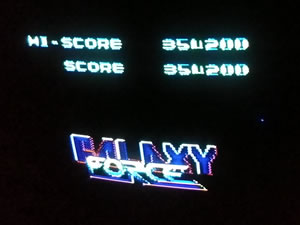
Here's the final 1CC score I got for Galaxy Force on Sega's 8-bit machine:


Friday, November 29, 2019

Cloud Master (Master System)

Horizontal
Checkpoints ON
1 Difficulty level
5 Stages (loopable)
Ship speed by icons
- - - - - - -
Developed by Hot-B / Taito
Published by Sega in 1989


Cloud Master, also known as Chuka Taisen, is the port of an arcade game of the same name. It stars a kid named Michael Chen, who flies on a cloud and shoots down enemies in ancient Japan. Michael is an apprentice and aspires to be considered a real "cloud master" by his enderly mentor. In order to achieve such honor he must get through five levels, destroying the incoming threats and defeating big bosses along the way.

The simple concept of this game fits the capabilities of the Master System much better than it did the arcade platform, especially when we consider design aspects such as the repetitive tiled backgrounds. Cloud Master on the Master System is an extremely colorful port that's rather competent in adapting the source material, with similar gameplay mechanics and faithful representation of both the enemy gallery and the stages (unlike the full-scale makeover seen in the PC Engine version). It's also no pushover, as one would imagine from the cute visuals. Hit detection is fine, a little flicker appears here and there and a sliver of slowdown might happen in crowded areas.

Flying over the Koh river

Controlling the kid on a cloud is extremely simple. Press button 1 to shoot and button 2 to fire a secondary attack. Upgrade items are released by destroying full enemy waves or specific enemies and consist of P (main shot power-up), S (two main shot power-ups), F (speed-up, means "fast"), A (autofire) and E (extra life). The evolution process of the main shot is very similar to that of Taito's own Darius II, in that each power-up adds another layer of power/spread to the current firing stream. When maxed out it assumes the form of a wave shot with regular bullets on the sides. Looking at it closely, the whole feel of the game and the upgrade system is like an amalgam of the first two Darius games.

Equally as important as the main shot is the secondary attack that's obtained by defeating a mid-boss and entering the door that he/she leaves behind. In there you'll be able to choose one of four special attacks, which remains active until you enter the next mid-boss door or die. Secondary attacks are automatically upgraded every time you enter one of these doors, even if you switch to a completely different type. Options include a rotating fire guard, spinning dragon fire, crescent arches, 2 or 3-way fireballs, a 4-way x-shaped mirror attack, bouncing/trailing fireballs and a scattering bomb that explodes when hitting the ground. I might be wrong here, but the impression I get is that the Master System port has more secondary attacks than the original arcade version, on top of allowing you to switch them even when at maximum power (doors don't stop coming when beating midbosses). 

Bowls of ramen, pigs with cannons, flying pig heads, bird flocks, large birds with human faces, tigers, pandas descending from clouds, dragons, turtles, monkeys, mushrooms, etc. With some exceptions there's always an animal or mythological creature appearing as basis for the enemy gallery. Regular enemies fire regular bullets, whereas midbosses and bosses shoot lightning bolts or round projectiles that force you to move more carefully due to their big sprites. From my experience at least three speed-ups are needed to fly around with decent maneuverability, just watch out for bullets that tend to travel slowly and might get mixed with backgrounds. You don't die by touching the short mounts of dirt at ground level, unless you get crushed by them at the edge of the screen.

Even with the hardware constraints of the platform it's nice to see a few animation details preserved, such as the character's eyes blinking and his hair and the cloud he rides on curling as he's moving around. On the other hand, graphics fade out before boss fights so that the Master System can handle their large figures. Eastern motifs rule the soundtrack, which fits the game but is otherwise pretty unremarkable.


Michael Chen starts his journey into enlightenment
(courtesy of YouTube user mrbeanchannel)

With two checkpoints per level, Cloud Master gets increasingly trickier to recover from death as the game progresses. Unless you play with some kind of turbo function doing it without the A power-up can be extremely demanding. Note that the rate of fire isn't the same at all power levels, which is the main reason why I avoided maxing out the main shot. If you keep your shot pattern at only two red blue balls or the spread before that you'll achieve a much better firing rate than the one you'd get with the maxed out wave shot. This is particularly important during boss fights, and you also need to consider hitting them at their weak points (mostly the head, or the belt for the shogun boss). You can kill them a lot quicker if you hammer them at point blank distance in between their attacks. Fun fact: the shogun is the last boss here instead of the dragon, which was demoted to guardian of the 4th level.

Besides the 1UPs you get with items, score-based extends are granted with 30.000 points and then at every 200.000 points afterwards. Attention: once you defeat the final boss and receive the definitive congrats from the elderly god figure there's a brief GAME OVER screen, but the game doesn't stop there. Wait a few seconds and it will start again in a second loop. The difficulty increase in further rounds is very subtle, the main difference I noticed is that the E item for extra lives does not appear anymore.

My best credit for Cloud Master on the Master System ended in stage 3-5. The unusual detail in this version, as you can see in the picture, is that the current score is on the right side of the panel and the high score is on the left side. It had me confused more than once as I was trying to figure out point values throughout the game.

Sunday, November 13, 2016

Fantasy Zone II (Master System)

Horizontal
Checkpoints OFF/ON
1 Difficulty level
8 Stages
Ship speed by icons
- - - - - - -
Developed by Sega
Published by Sega in 1987


I have no idea of the actual extent of the success the first Fantasy Zone achieved on the Master System, but it must have been quite remarkable. Especially in Japan. After all, Fantasy Zone II came out first for the Master System before being given an arcade release and seeing ports for other platforms, and if anything that says a lot about how much Sega believed in the sequel. The good news is that part II isn't merely a repetition of the first chapter, and in my eyes is just as engaging and addictive. Besides, every port and further revision based on this cute little game corroborates this assessment.

As expected, the world of Fantasy Zone II is as colorful as before. The action never stops, perils await at every corner and giant bosses try to stop you at least twice during the course of a credit. The only feature that declined a little is the music, but that's debatable since it's still filled with good tunes, yet not so catchy anymore (that song from the shop stays in my head for hours every time I play though). Opa-Opa is back and must destroy another batch of evil generators that are plaguing the beautiful areas of the Fantasy Zone. While the basic mechanics stay the same (one button fires, the other drops bombs), stage lay-outs are non-linear and require players to travel through warp gates across 3 or 5 panels within the level. Only when all generators/bases are destroyed you're allowed to face the boss by entering the red warp gate.

I already mentioned somewhere that dismissing this series as fluffy and childlike is a mistake. With this chapter it isn't any different, since a mere couple of credits is all it takes to get sucked into the fun and keep coming back for more. However, when I found out there's an item that gives you autofire I was even more excited about it. I say this because there's a huge difference in playing the original Fantasy Zone with and without autofire, a distinction that almost loses the purpose here.

Stage 1 - Pastaria
(courtesy of YouTube user coenak)

Each stage of Fantasy Zone II must be cleansed of enemy bases that pollute the scenery with all sorts of crazy enemies. Movement is allowed in both directions, and the scrolling can either be sped up by moving closer to the sides or halted by touching the ground. Some of the destroyed generators will uncover the warp gates, but most of them will release money bills. Regular enemies release gold coins, which are worth less than money bills, all values varying from stage to stage. Cumulated money is unrelated to score and is used to buy items in the shops spread around the stage, which provide several levels of upgrades for speed and firepower (some of these are temporary and last only 20 seconds), as well as a few survival aids.

Contrary to what we had in the first game, here all shops are static and can be accessed at all times (with the exception of the 3-panel shop of the final level, so don't be trigger-happy there). The assortment of items in each one is always the same, but in order to get the best upgrades players must look out for the hidden shops in stages 3, 5 and 6. There it’s possible to purchase autofire (auto beam) and power enhancers. “Power” is actually another name for health, indicated by a red gauge that can be made larger by getting red bottles and completely refilled by getting blue bottles. If you manage to get all bottles you’ll end up with a very generous life bar by the end of the game, allowing you to withstand lots of hits every time you’re respawned after dying (the upgrade is permanent). The main catch of the game is that autofire appears only in two of the hidden shops and is forever lost when you die. Remember that every time you buy an item its price will increase in the next purchase, with the prices of some items inflating even if you don't buy them.

Uncovering hidden shops is done by targeting their spots (shots disappear and you hear the sound of something being hit). A few precious items are also hidden in the same fashion throughout the game and can help you go the distance, namely the red/blue bottles (the clock gives an extra 30 seconds to any temporary weapon that's currently active, other than that it's useless). The moment I figured out the preciousness of the hidden bottles I planned the whole game around them because they’re both life and money savers. Speaking of which, in this installment money does not decrease in value no matter how long you take to kill generators or enemies, which of course opens the door for milking. I haven't tried to test it to the point of noticing any real climb in enemy aggression, but in any case it's a very time consuming and risky way to try and get more points.

All the improvements made to the classic gameplay serve to balance out the slightly tougher challenge, and in that regard Fantasy Zone II is a successful sequel. Not only is the power/health meter a very welcome addition in the long run, but the way shops are handled cleverly compensate for Opa-Opa’s sluggish default speed. Dying in later levels can be aggravating, yet it’s always possible to fetch a nearby shop and start getting back on your knees. Slowdown will occur when the screen gets crowded, but it's never game breaking in any way (actually it might be one of the best examples of "correct" slowdown in an 8-bit shooter). Flicker is minimal, I've only seen it during the fight against the 4th boss.

Ahouys, rollerballs/magoburus and cacti in stage 7 (Sbardian)

Before playing the game I was a bit wary of the warp gate gimmick, but the truth is that it works. Navigation from one screen to the next is fluid, fast and elegant. It allows for more backgrounds within the level, thus lending an alleviated complexity to the game while beefing it up in terms of graphics and length. Expect a very linear difficulty progression and a horde of zapping creatures as you reach the second-to-last stage, prior to facing rematches against angrier bosses in the final level. The last boss reserves a surprise for Opa-Opa and justifies the game’s subtitle The Tears of Opa-Opa. He's a bit underwhelming, but at least some of the previous bosses are quite impressive creatures, such as Bombdran in stage 4 and Halorings in stage 7.

My strategic approach in Fantasy Zone II was very simple. Get the normal engine and twin bombs on the first shop. Get the hidden red bottle in the 2nd stage. In the hidden shop of the 3rd stage purchase auto beam, big shot and another red bottle. Fill the expanded power meter with a hidden blue bottle in the 4th stage. Get twin big bombs and the red bottle in the hidden shop of the 5th stage. Purchase another red bottle from the hidden shop in the 6th stage (plus a bargain extra life for $100) prior to filling up the power meter with the hidden blue bottle. Get the final hidden red bottle and preserve health in the onslaught of the 7th stage. And, finally, spend all the money I can on extra lives and do my best to survive against the boss rush of the final stage. Each extra life in reserve upon completing the game is worth one million points, whereas all the remaining money is multiplied by ×10 and added to the final score. The game does not loop.

Below is my final 1CC result, with no additional auto/turbo fire. Next in the series I'll tackle either the NES port or the arcade version.


Saturday, March 28, 2015

TransBot (Master System)

Horizontal
Checkpoints ON
1 Difficulty level
2 Stages (loopable)
Ship speed fixed
- - - - - - -
Developed by Sega
Published by Sega in 1986


In an attempt to jump in the bandwagon success of Hasbro’s Transformers, one of the first games Sega published on card media for the Sega Mark-III in Japan was Astro Flash, later released in cartridge format with different titles all around the world. In North America and Europe it soon appeared as TransBot, but Tectoy would change its name again to Nuclear Creature a few years later for another release in Brazil. Answer quickly, which of these titles is the best for a Transformers-inspired game? Which one would lure you more vividly into playing a lackluster shooter that has an annoying power-up system and wears off faster than a seasonal McDonald’s snack?

Of special note is the ridiculous robot in the covers of all versions, which seems to be Optimus Prime’s poor cousin from outer space. The story to the game says that’s the robot form of starfighter CA-214, a powerful ship that has the ability to transform between spacecraft and robot with the aid of power-up icons. He’s forever doomed to patrol the surface and the undergrounds of a destroyed planet Earth in the far future, in an endless war against an artificial intelligence named Daluas. I don’t think Cybertron has anything to do with Daluas, and I advise shmuppers and Master System fans alike to give up on any positive expectations when putting their hands on Transbot.

A credit of Nuclear Creature
(courtesy of YouTube user J.C.)

Transbot’s gameplay revolves around killing endless waves of diverse ships and creatures as the screen scrolls and the background initially varies between three different landscapes, as well as destroying a particular enemy that serves as entry ticket to an underground base with a single boss awaiting at its end. Considering that these are actually two separate stages and that particular enemy requires very specific conditions to be killed, one can play the first level forever without ever knowing there’s a secondary area. And once this second level is done the game loops. Depending on how long you take to complete both stages you might need to see a few other loops to glance the whole of the enemy gallery. In a nutshell, if you finally come across an underground vertical laser barrier then you can consider you’ve seen all of TransBot.

An overhead display is reserved to show a series of alphabet letters, from A to G. A is the default condition of the CA-214 starfighter: ship form, default V shaped shot and unlimited ammo (button 2 shoots). By hitting a truck that comes from the left you release an orb that starts ascending, and by hitting it again the orb shifts to the left. When you take it the letter display starts cycling very fast from A to G, to which the player must press button 1 in order to choose the desired letter. Do it fast though, after four cycles the display settles at letter A and you lose the chance to select another one. Each letter has a defined function: B switches the weapon to a ring shot, C is a large vertical bar that disintegrates everything in its path, D is a single piercing shot, E is a short range 3-way gun, F is a two-directional weak shot and G refills both energy bars that control health (power) and weapon ammo (arm).

The limited nature of the ammo for all weapons except for the default is almost as annoying as the stupid roulette scheme, let alone the sluggish speed of the starfighter itself. Well, this speed is at least enough to weave around enemies and bullets without incurring in extra anger, even in the bulky robot form (C, E and F weapons). It doesn’t take long to get into the rhythm of the game though, and once this happens you realize that it takes a certain amount of destroyed enemies for the power-up truck to appear. By using ammo parsimoniously and successively activating the G upgrade it’s possible to keep the same weapon for a long while, but this takes a good timing skill.

In order to enter the underground area the player has to kill a single drone that crosses the screen after you’ve spent some time patrolling the planet. The only weapon that does this is the piercing shot (D), all others will make bullets ricochet from the enemy.

Flashing asteroids with a transforming robot

There are several other issues in TransBot besides the power-up system. One of the problems is that the game gets boring fast, no matter how much it mixes different waves or how many loops you complete. Since it’s not that hard of a challenge, concentration lapses are pretty much the only ways for a credit to end. For such a short game you can’t really expect much variation in the music, and the little there is isn’t anything to write home about. Scorewise there are no special considerations, with the exception that ramming into the power-up truck instead of destroying it results in 1.000 points. The first extend comes with 40.000 points, with further ones given with each 80.000 points afterwards. Since the game has no built-in autofire, I advise getting a rapid fire unit.

One last note: the more I learn about arcades and video games in general, the more I’m convinced that some of the most obscure arcade games in the 80s were produced by the once powerful Sega. TransBot is a rare case of a home video game that received a makeover for an arcade release (another one is Thunder Force III). The arcade revision of TransBot received four complete stages (surface + underground) and came with considerable changes in the gameplay. It was named Astro Flash in Japan and Transformer in the West.

I had as main objective in TransBot for the Master System to score at least one million points. In the picture below I’m fighting the underground boss in loop 7, just before giving up the credit.

Tuesday, November 4, 2014

Action Fighter (Master System)

Vertical
Checkpoints ON
1 Difficulty level
5 Stages
Ship speed controllable / by icons
- - - - - - -
Developed by Sega
Published by Sega in 1986


Action Fighter didn’t really belong to the lower and more unknown rank of Sega arcade games, but it does seem to be the case considering how obscure it is. Coming out in between the most successful titles developed by the company, the arcade game got easily eclipsed by the likes of Out Run and Thunder Blade. Of all ports released for it, the most famous is probably the one made for the Master System soon after the arcade board hit the market. By all means it’s a very primitive-looking shooter, but given how early an entry it was in the console library I believe this 8-bit version of Action Fighter pulls quite a stunt with its meager 1 Mega power tag.

Taking direct inspiration from (not to say shamelessly cloning) Midway’s racing shooter Spy Hunter, Action Fighter blends the style of the competition with more traditional vertical shooting sections. Lots of compromises were made while adapting the arcade material, but at least the Master System game is able to retain the original frantic atmosphere that keeps you on your toes all the time. Make no mistake, the high degree of randomness in the gameplay makes Action Fighter one of the hardest shmups on the Master System. Nothing is etched in stone and lots of practice is needed to overcome the challenge of completing five missions commissioned by the president himself.

Some information sources point to the fact that the motorcycle you start the game with is the same one from Sega’s own classic Hang On. The initial objective of the player is to destroy enough enemies in order to collect the necessary alphabet letters to make this motorcycle turn into a car, these letters being A, B, C and D. Button 2 is used to shoot in both forms, while the combination of buttons 1 and 2 switches between motorcyle and car forms. By collecting further letters E and F you enable the car to automatically turn into a flying vehicle at a certain point in the stage’s course (prior to a bridge), and then this jet-car takes into the skies in standard shooting fashion. The action continues like that until the flying car lands by itself back into another driving area.


I want to fly!
(courtesy of YouTube user Enrique Garcia)

During the driving parts you’re allowed to go faster or slower depending on how high you are on the screen (press ↑ and ↓). While you need to pay attention to the road signs that warn you about turns and splits, it’s often safer to drive faster in order to avoid getting touched by vehicles coming from below, but not so fast as to overtake the incoming cars and trucks. Getting rammed by an enemy and sent against the sides is deadly. Powering up the vehicle is done by getting inside the SEGA truck that appears from time to time: just align the motorcycle/car with the truck and see it get in and out, first with a double missile upgrade, then with a homing missile to be fired against helicopters (only in motorcycle form) and finally with 15 seconds of invincibility. Dying rips you off everything, except for the alphabet letters already collected.

During the flying parts it’s obviously not possible to revert back to motorcycle or car forms. Button 1 is then used to drop ground bombs in the famous Xevious style. In these sections upgrading the jet car’s firepower is done by means of small colored Ps that appear randomly. A yellow P serves as a single weapon power-up (get missiles), a white P works as speed-up, the green P is a screen-clearing bomb, the brown P corresponds to an extra life and the blue P gives you the temporary invincibility. From my experience, the great majority of the items consist of yellow and white Ps (power-ups and speed-ups). The others are very rare and I never got more than one of each in any of my runs. Just to have an idea, I came across the invincibility item only once.

One might think that going from motorcycle to car and then a flying machine is the strangest aspect in Action Fighter, but that’s actually not true. Just like in its mold Spy Hunter, lives are treated in a very weird way. At the start of the level they’re padded by a timer that starts at 999, and as long as this timer doesn’t reach zero you’re allowed to die without any consequence on your actual life stock (at this point dying only slows you down). Once the timer expires you’ll finally be playing with the regular life stock, where dying takes away a life and brings you closer to the GAME OVER screen. The real purpose of the timer is to cut you some slack towards surviving, since the better you play at the start of the level the less you’ll need to rely on your life stock before reaching the boss. However, while this may be true in the first two stages, the later flying sections are so long that regardless of performance you’ll be pretty much at the end of the timer when starting the intermediate driving section.

There are almost no bullets to be dodged in the driving parts of Action Fighter. Danger comes almost exclusively from other vehicles trying to ram into you. By the way, don’t feel bad by taking down those ambulances, they won’t think twice before doing the same to you. The only driving enemies capable of shooting at you are the 3-wheel motorcycles that appear from stage 3 onwards and the helicopters that drop bombs when reaching the top of the screen. To get rid of them you need to revert back to the motorcycle form and fire guided missiles with button 1, provided you’re upgraded to level 2 at least. If not don’t worry: just revert back and forth from car → motorcycle → car. Most of the time the helicopter gets scared and runs away when you do this. Remember that the car form is a lot more stable than the motorcycle, which is weak and prone to being run off the road by any other type of vehicle.

Three tanks = first part of the third boss

Gameplay rules change dramatically as you enter the flying area. Helicopters, drones, rockets, dirigibles and heat-seeking missiles all appear in different formations, and each one of these enemies must be dealt with specific approaches. Tanks, boats and harmless buoys, hatches and cars comprise the terrestrial opposition, often overlapping their presence with some sort of aerial attack. This wave-based action resembles Star Force, but there are a few aggravating aspects to it such as bullets and enemies being camouflaged by clouds or the awkward hit detection that makes it hard to collect the tiny red flags. I’m not sure, but I suppose these red flags interfere with the item generation routine while adding something to the score (Action Fighter is one of those games that don’t show your score unless you die or pause). Watch out for the cat’s face appearing at random once you collect enough flags... I have no idea what it actually does!

Driving and flying don’t always come in the same order throughout the game. With the exception of the second boss, all other bosses must be defeated while flying. When that happens you’ll continue flying as the next stage starts, with a mandatory landing and another flying section before facing the next boss. The overall enemy firing rate increases level after level, whereas later bosses toughen up quite a bit. They shoot lots of bullets and require lots of dodging. Bosses were the reason why I gave up on the game years ago when playing it with one of those awful stock Master System controllers (everybody knows they suck for precise 8-way movement). This time I went into battle armed with a Mega Drive controller and a Rapid Fire unit. Action Fighter has no autofire, so unless you can mash that button 2 hard you’d better get yourself some means of turbo firing.

Final verdict on Action Fighter? I could say it’s fun, but I’d be partially lying. It's an intense challenge, but it's also repetitive in every aspect you can think of. The soundtrack lacks variety and comes with one recurring theme for each part of the game (driving, flying, boss), but at least the sound effects were handled rather nicely. The main issue, however, is that the game demands too much to start getting fun. Dodging feels a little clunky at first and there are no continues whatsoever. Bullets are always aimed but tend to vary in speed, often cornering you when you least expect it. Most scoring opportunities are left for the end of the game because the final boss is worth a lot more points than all previous bosses. There’s an extend routine that grants roughly one extra life per level, but you’ll only see changes in the life stock when the timer phase ends or when you pick up the brown P.

My 1CC high score is shown below. You need to enter your initials/name before starting the credit, just like in the arcade version of Side Arms.

Friday, October 17, 2014

Forgotten Worlds (Master System)

Arena
Checkpoints OFF
3 Difficulty levels
5 Stages
Ship speed by icons
- - - - - - -
Developed by Capcom
Reprogrammed and published by Sega in 1991


The apocalyptic setting of Forgotten Worlds, as devised in the arcade game, was certainly too much for the Master System to handle. As Sega took it and reworked graphics and music to fit its 8-bit platform, concessions were made and the original nine stages were condensed in five. It wasn’t just a matter of downscaling the material though, since one of these five stages is a brand-new underwater-themed area, complete with a new crab boss. Nothing extraordinarily fancy, but if you’re the kind of player who likes to compare versions and try them all because they have exclusive material, feel free to put this one in your checklist of ports to be experienced.

As expected, this adaptation got away with the ability to play in co-op. Now it’s just one lone nameless flying warrior fighting against the threat of emperor Bios, a winged man who slaves a world that time forgot. In your quest to rid the planet from evil you’ll be travelling through a junkyard, a barren wasteland, an Egyptian temple, an underwater passage and the ultimate tower of doom from where Bios exerts his dirty deeds. It’s a short game, but it’s got no continues and it still demands a bit of strategy to be properly learned and played. Downgrades notwithstanding, Forgotten Worlds for the Master System can actually be considered a relatively faithful port.

First stage of Forgotten Worlds on Easy
(courtesy of YouTube user sylesis)

Since the Master System controller has only two buttons, both of them are used to rotate the character (each one in a different direction). In an awkward little twist for a shooting game, the very act of shooting occurs automatically so you don’t need to worry about it at all. The constant firing doesn’t get in the way of the gameplay, with the exception of the gas pipe area at the end of the 1st stage and the splitting pathways of the 3rd stage, where it would certainly be good to refrain from shooting. You can either get a gas blow in your face by hitting the pipes or choose the wrong path inside the pyramid. The satellite - that thing that surrounds the character as you rotate the aim - provides protection against incoming bullets and also fires a powerful special weapon. Last but not least, a “mega crush” can be triggered by pressing both buttons at once, quickly oblitering all enemies and bullets on screen at the cost of a little health.

In Forgotten Worlds there’s only a single power bar as life meter, therefore preserving power/health is extremely important to not bite the dust and have to start all over again. By entering the shop in every level you are allowed to purchase several types of upgrades, depending on how much money you have collected up to that point. “Zenny” is the official currency and consists of those blue spheres left behind by some types of enemies, and the good news is that this port is rather generous in money: you never feel that you need to be stingy when going into the shop, unlike in the arcade original where Zenny was as precious as fuel for Max Rockatansky. Besides, there's no time limit for when you're shopping. Note that the last stage has two shops, one in the ground and another in the vertically scrolling section of the tower.

Of all items available inside the shop, the most important ones are the flying stone (to change the sluggish starting speed of the character / buy only once), the power packs (increase the power gauge), the two types of boosters (they upgrade firing strength), the life potion (resurrects the player upon death) and the aqua stone (available only in the underwater level / improves your maneuverability and makes it actually possible to do something). Only one type of satellite is allowed at any time, so you need to choose carefully when trading your current sattellite in for another from the shop. The satellite gallery isn't as rich as in the arcade version, but there are a few exclusive satellites to try here. One of my favorites in this version is the 4-way laser, which is great to deal with the turrets from the last stage.

Purchasing items like the protector armor becomes unnecessary when you get more comfortable with the game. By shooting at certain locations you uncover hidden items for immediate taking, such as these armors and others like a star (extra points), a yasichi (full health) and a Pow sign that refills most of the power gauge. Because the armor item is so small and may go unnoticed, you need to pay attention or you'll miss it.

Really!?

My choices of satellite purchases in the shop were guided missiles in the first level, fire bomb (a.k.a. napalm) in the second level, burner (flamethrower) for the third and fourth levels and 4-way laser in the final stage. The enemy gallery preserves the most iconic creatures like the lizardmen, the snakes, the turrets, the Egyptians, the flying heads, etc. Some of the larger foes, such as the ice boss, were downranked to just a few ice minions that precede the entry to the tower leading to the final boss. The action is relatively slow, but if you choose to play with the super high speed flying stone the flow of the game gets a lot better. I did get stuck in parts of the scenery and lost health unfairly a couple of times, so it's good practice to avoid going into the gaps in walls an such. Normally you don't lose any energy by leaning against the scenery.

Forgotten Worlds for the Master System was only released is Europe and Brazil. Knowing its arcade origins is probably what attracts most people to the game, but it's not a bad title at all by Master System standards. Flicker is minimal, as well as slowdown. It's reasonably fun but a little on the easy side once you get used to the controls. It even includes the famous cut scenes showing the nameless warrior before each stage starts. Would the game be better if these were left out in favor of more actual gameplay, I wonder? We'll never know!

Below is my final 1CC score on Normal. Tip: save a little money for the last stage and buy the item named “dress” if you want to get an even higher score upon completing the game.

Monday, January 6, 2014

Power Strike II (Master System)

Vertical
Checkpoints OFF
3 Difficulty levels
8 Stages
Ship speed by icons
- - - - - - -
Developed by Compile
Published by Compile in 1993


Top rarity on the Master System? Check. Top shmup on the Master System? Well, that’s debatable. Released only in Europe and Brazil, Power Strike II is a late sequel that does not correspond to Aleste 2 in the same way Power Strike corresponds to the first Aleste. Even though it follows on the same gameplay footsteps it's actually an independent adventure with a wacky storyline involving the great depression of 1929, sky pirates and Italy. All is shown in a nifty intro that also tells your daily job is to take down these pirates (we see their ugly faces at the start of every stage, as well as their reward figure in points). Other than that, prepare for another iteration of the frantic formula initially presented by Compile in Zanac.

On the outside this sequel looks very much like Power Strike, therefore it takes some playthroughs to fully understand how different both games are. They’re graphically comparable, but in Power Strike II the general plant menace is replaced by landscapes on water, islands, mountains, refineries and medieval castles (Italy?). As in every Zanac variation released till then there isn’t anything special about the ground sprites, what makes the experience feel memorable is the speed at which the screen scrolls. Power Strike II pushes the brake pedal a little bit and doesn’t fare that well in the music department, but the characteristic 8-bit Compile rush is still there. A little of the regular Master System flicker and rare bouts of slowdown should be expected though.

Chasing pirates across the sky

The act of starting a credit lets you choose which special weapon to take off with. Special weapons are numbered from 0 to 6 and fired along with the regular shot that’s upgraded by taking the tiny P chips released by carriers or by destroying specific enemy waves. This numbering makes sense within the context of the gameplay, for every special weapon has six upgrade levels that are reached by sticking to the same number (in the lower right corner you see, from top to bottom, your current special weapon, upgrade level and life stock). Firing is accomplished with button 1, and selecting between four available flying speeds can be done with button 2 (you see the current speed “come out” from the ship as you press the button). If you so wish it’s possible to fix the speed in a unique setting and enable the pause function on button 2, thus eliminating the most glaring functional weakness of the Master System console. While that might be advantageous for some I don’t use this special pause because I like to fly faster in certain places, such as during the fight against the 3rd boss.

Available special weapons are: 0/shell up (just rapid fire on the regular shot), 1/shot gun (spread pattern with shorter reach), 2/missile (guided missile that flies forward), 3/burner (short-reach fire weapon that expands with trailing options when upgraded), 4/absorption (homing shots that look like the hunter weapon from the Thunder Force series), 5/destroyer (forward-travelling missiles) and 6/napalm (spiraling clusters that don’t actually look like napalm to me). All special weapons are useful and none of them is downright awful, but of course we all have our favorites. I always start with 4 and keep it for half the game at least, then I’ll either move to 3 or 5. Especially important for tight situations is the special wave blast that’s triggered whenever you let go of the fire button. After all, it destroys enemy bullets! The duration of this charge release seems to be directly proportional to the power level of the main weapon.

One of the main differences from the first Power Strike is that here there’s no limited ammo for any weapon, and when you die you only lose half your power instead of losing it all. Other items you might come across consist of colored crystals (red, blue, yellow) that spin quickly around the ship and protect it from incoming bullets while providing slight upgrades to the ship's firepower. Honestly, everything moves so fast and some crystals cycle colors so often that I don’t even care which color I take… The player can also come across a small ship or a smiley face for 1UPs, but besides granting the 1UP the smiley also adds 3 power levels to the special weapon. Tip: timing the moment of collecting any of these items is important if you want to take advantage of the brief invincibility that comes with it. Finally, besides item 1UPs the player can also count with score-based extends at 20.000, 100.000, 200.000 and cyclically at every 200.000 points afterwards.


Power Strike II legendary intro
(courtesy of YouTube user King Arthur Pendragon)

With 8 stages and fast paced gameplay, Power Strike II outshines the first chapter mainly because of two design aspects: bosses and the scoring system. Bosses aren’t just a gathering of turrets anymore, they’re bulky flying machines and get increasingly harder towards the end. There’s no time out during boss fights but no safe spots either, so you’re still allowed to milk them as much as you want provided you’re sharp enough to dodge lots of bullets (crystals help for a while but they eventually disappear). As for the scoring system, once you max out a special weapon all further items of the same type are worth 10.000 points each. For this reason milking bosses is not only about destroying their bullets and missiles, but also letting them live so that the item carriers keep coming at regular intervals (carriers always bring special weapons in order, as in 0 → 1 → 2 → 3 → 4 → 5 → 6 → P chips → 0 → …). All of this leads to a simple high scoring rule: stick to the same weapon, don’t die and let bosses live longer for more 10K bonuses.

After spending a good time with this game I must say I agree only partially with the widespread praise it gets. I can understand why it ranks as best Master System shooter for some people, however my shmup clock ticks faster for stuff like Choplifter and Fantasy Zone. Power Strike II is solid and fun but in my opinion it’s no standout for graphics or music, and would’ve benefited a great deal if it had random enemy spawning routines - that’s the reason why none of the Aleste games on the Master System can’t really match the brilliance of Zanac.

Here’s my best 1CC result on Power Strike II, played on Normal. I had no pause activated on button 2 and chose absorption (4) as the initial special weapon.


Following the trend of changing basic mechanics while preserving the Aleste name somewhere within the game concept, the series continued in adaptations for the Game Gear and more powerful consoles. Next in my list to (re)play is MUSHA on the Mega Drive.

Saturday, May 18, 2013

Thunder Blade (Master System)

Rail shooter / Vertical
Checkpoints OFF
1 Difficulty level
4 Stages
Ship speed fixed
- - - - - - -
Developed by Sega
Published by Sega in 1988


There are lots of reasons why I feel sorry for Sega. Some of them aren’t that obvious, like the personal grudge I have with the company’s absolute disregard for the Thunder Blade trademark. From all great sprite-scaling titles Sega developed in its prime arcade days, Thunder Blade was the only one left out of later reworkings such as the Sega Ages series. Once the 16-bit era ended After Burner, Space Harrier and Galaxy Force received gala treatment across several platforms, but what of Thunder Blade? Seemingly swept under the carpet as if it were a disease! All we had to savor were a couple of downgraded ports such as this one and the PC Engine’s, as well as the pseudo-sequel Super Thunder Blade.

Thunder Blade in its arcade form is a visually stunning experience, even more so than any of the abovementioned sprite-scaling rail shooters. Obviously an 8-bit port like the Master System’s isn’t technically comparable to the source material, therefore serious compromises must be made if you want to enjoy the game as it is: a pretty basic shooter that "tries" to mirror the structure and the look of the original title. The scaling effect and the frame rate might be poor, but seeing as the port is perfectly able to handle the task imposed by the simplified gameplay rules, under some aspects it actually ends up being a more cohesive take on the arcade game than Super Thunder Blade. It certainly feels harder, maybe even faster.

An evil oil refinery during the night

All stages in the Master System port of Thunder Blade start with a common vertical orientation. Airborne enemies must be destroyed with the machinegun (button 1), ground targets can only be taken down using missiles (button 2). Once the vertical part is over you enter an area where you fly into the screen with enemies coming towards you. The same inputs apply to these sections – jets and helicopters approach by air, tanks and boats will try to crush you from ground level. Later on you return to the vertical scrolling area to destroy a large aircraft/shuttle turret by turret. The only exception to this second vertical part is in the 4th and last stage, since the final boss needs to be defeated in the rail shooting environment.

What the game proposes as challenge is pretty simple: infiltrate enemy terrain and survive, reacting to each and every wave with what’s given to you as weapons. There are no power-ups in sight and absolutely no way to control flying speed (unlike the arcade game or Super Thunder Blade). Resistance gets increasingly tougher as you advance through the stages, starting in city streets and going through forests/caves, a river raid and a final strike in an oil refinery. The vertical parts with bosses from stages 1 to 3 are jokingly easy, but all other sections have their own sets of hazards.

Common vertical parts can be deceiving. Flying formations and tanks are arranged in such a way that you might get yourself cornered when trying to kill everything that shows up. When the action shifts to the rail shooting perspective the main concern is with the lines of tanks that can’t be engaged because you’re not close enough to them, which forces the helicopter to move around and be subject to cornering, especially when aerial waves overlap. Speaking of which, each type of flying wave attack has an optimal strategy to be dodged. The most problematic one for me was this jet flock that fires a blazing fast horizontal bullet spray. You need to go up and down to avoid it, pretty much basing the movement on graphic cues and sound effects alone. When stage 2 ends you’ll have seen every single enemy attack, then things get really busy in the third stage, by far the hardest level in the game. The pipes in the oil refinery are only for show if you stay glued to the ground sweeping from side to side. If you do this you’ll never hit any of them! Let’s not forget that tapping is the king maneuver during busy parts.


Is it Blue Thunder? Is it Airwolf? No, it's Thunder Blade!
(courtesy of YouTube user Vysethedetermined2)

Of course the scaling on the Master System version of Thunder Blade isn’t perfect, but the trees in the third stage look so awful that at first sight the graphics seem to be broken. Thankfully the rest of the game looks fine for 8-bit standards. As challenging as it is, some shortcuts made in the port allow for more freedom of movement and consequent ease in the gameplay. You don't die by colliding against an enemy in the rail shooting parts, for instance, and all scenery such as pine trees and buildings are just as harmless. Beware of pillars and pipes though (remember to stay low in the oil refinery stage). Note: that last section of pillars inside the caves reminded of Battletoads and its infamous hoverbike level.

There’s only one song playing during the whole game, but it’s so fitting that you hardly even notice that. It’s also nice how the coolest bits of music seem to be synched to key points in the level design, like when you come out of the second cave in the second level. A rudimentary scoring system awards bonus points based on the number of enemies destroyed when you finish a stage. The lowest bonus is 10.000 for at least 50 kills, and the maximum bonus is 400.000 points for 160+ kills. Getting 500.000 points gives you the first extend, further ones are granted for every extra million. Unfortunately the only times you'll see your score are during level transitions and when the game is over. Normally there are no continues, however by pressing diagonal down to the right and button 2 on the GAME OVER screen you’re able to continue twice.

I enjoyed this game more than I had expected, probably because it’s actually a short playable romp and because I had a rapid fire unit inserted between the controller and the console (you definitely need it, the game has no autofire whatsoever). Besides, anything with helicopters is cool by default in my book. Leave it to Sega to ignore the Thunder Blade legacy completely, for now this is the 1CC outcome of the time I spent with the Master System port:

Wednesday, March 27, 2013

Line of Fire (Master System)

Vertical
Checkpoints OFF
3 Difficulty levels
6 Stages
Ship speed fixed
- - - - - - -
Developed by Sega
Published by Sega in 1991


Line of Fire for the Master System is a second generation port of Line of Fire, the arcade game developed by Sega. I like to call it second generation because the game switched genres from one platform to the other, going from a light-gun shooter to a vertically scrolling shoot’em up. What’s really interesting about the conversion is that despite the genre alteration and the fact that it’s a totally different experience the Master System port actually follows the same basic outline and stage settings of the arcade original. Don’t get your hopes up though, it’s an extremely downgraded and watered down vision to the same story, sort of a much slower and poorer cousin to Thundercade on the NES.

Coming to this game after being exposed to fast shooters can be a shock. The Master System is no powerhouse but it surely has faster games, and Line of Fire feels even slower than usual. I have no idea if the hidden 3D mode has something to do with this (hold buttons 1 and 2 as you power up the console), but adapting to the game’s slow pace takes a little while. Graphics and colors are very basic, and since the repetitive music follows the same quality standard it’s easy to see why the game isn’t technically remarkable by any means – at least without the 3D glasses, which is how I played it.

The game’s premise is established by a nice opening with huge fonts and a quick intro that presents Jack (you), supposedly a combat expert who happens to come across a super weapon inside an enemy base. How you got there in the first place doesn’t really matter, so it’s up to you to escape and take the super weapon back to your allies. A map shows your progress before each stage starts, and as you make your way through several areas around the original starting point you need to take control of different military vehicles such as a jeep, a boat and a helicopter.

A boat against a ship

It doesn’t matter which craft you’re controlling, they’re all able to fire straight shots from a machinegun (button 2) and missiles (button 1). The machinegun has unlimited ammo, but missiles are limited and start with a stock of 50. Don't fire them away at will, if you do so and you get to the second boss without missiles you'll be in deep trouble. Gun and missile attacks behave differently for each craft: for the jeep and the boat the machinegun will only hit ground enemies, with missiles being used against enemies in a higher level/altitude; for the helicopter it’s the opposite, naturally. Missiles are a little tricky to use, in that they follow your lateral movement and can make it either hard to hit moving obstacles (enemy helicopters and bosses) or easy to destroy turrets (plan your sweep or lean against a wall to “direct” the missile to its target).

One of the design decisions that immediately springs to mind as unusual in Line of Fire is that you're only allowed to move at around 40% of the screen. If you keep pressing up at mid-screen the scrolling will only accelerate a little, therefore you can't plan any dodging strategy that involves the upper half of the playing field. It isn't advisable to stay glued to the bottom of the screen either because sometimes you'll be surprised by trucks or jets coming from behind, or even the item carrier (ground missions only, levels 1 through 4). This carrier will stop for a few seconds as it appears, so wait until it moves up a little to destroy it and take either the missile round (30 missiles) or the first aid item that regenerates 1/3 of your health (each life in Line of Fire has a 20-point health meter). In aerial missions (levels 5 and 6) items appear from regular enemies, such as incoming jets or train wagons.

Though short and simplistic, the game comes with a few features that are strange to shmups in general, such as the ramps in the jungle stage or the bridges that need to be taken down in the river stage. You need to take the ramps to jump over the ravines, and when you do steer the jeep to the left or you’ll inevitably crash. Ramps will also appear during the boss fight, meaning you can use them to reach the enemy’s altitude and hit him with the machinegun – a risky and unnecessary possibility that’s there just for show actually. Use missiles to destroy the bridges in the river stage or you’ll crash, don’t get close to them until they have collapsed or you’ll get hit. By the way, hit detection in Line of Fire isn’t really a problem, but you can lose energy if you’re too close to a boss when it explodes or when the abovementioned bridges fall. You also get hit when you go over one of the falling rocks of the fourth stage after they’ve already stopped rolling.


Caught inside the enemy base
(courtesy of YouTube user fakeplasticball)

Upon completing a stage you’re given a bonus based on destruction ratio and remaining health. On the merits of challenge there isn’t much to say about Line of Fire, at least until you get to the last boss. All previous bosses have easy and predictable patterns, but the secondary form of the final fortress poses a much harder challenge simply because it overwhelms the player with bullets, kamikaze jets and quick lasers that drain a lot of health. The first time I got there I panicked and died all my lives in a snap. Then I used the two available continues to practice and do better next time.

I had to beat the game once to find out how sloppy the programmers were with the high score buffering: all points achieved in the last stage aren’t added to the high score that’s permanently shown in the top of the HUD (even if you beat the game the highest score displayed is the one you get at the end of stage 5). It’s only possible to see your total score for a few seconds while the bonus for the last level is being computed, after that you’re treated with a relatively nice ending and the final credits. A few more plays later and I was able to register the 1CC result below (Normal). Note: Europe and Brazil were the only regions where Line of Fire was released.