Showing posts with label Neo Geo. Show all posts

Saturday, October 18, 2025

Fast Striker (Neo Geo)

Vertical
Checkpoints OFF
1 Difficulty level
6 Stages
Ship speed fixed
- - - - - - -
Developed by NG:DEV.TEAM
Published by NG:DEV.TEAM in 2013


A sci-fi themed shmup designed with a vertizontal orientation (vertical scrolling occupying the whole 4:3 screen area), Fast Striker biggest claim to fame is its crisp prerendered backgrounds, a graphical achievement that also extends to the animation of bosses. Allegedly developed alongside HuCast's DUX for six years soon after NG:DEV.TEAM delivered its first game Last HopeFast Striker was released for the Neo Geo MVS in 2010 and received a few updates before landing on the Neo Geo AES in 2013. For this reason I guess it's safe to assume the AES version is the final iteration of the game, even though it would eventually reappear years later for other platforms.

If we exclude Last Hope - Pink Pullets, then Fast Striker is in fact NG:DEV.TEAM's second shooter. While completely different at a conceptual level, the company did strive for something that wouldn't be considered as hard to beginners, hence the presence of not only one, but four distinct game modes that sort of emulate the approach kickstarted by Cave in Mushihimesama Futari. Cave is indeed a major influence in the gameplay of some of these modes, even though the implementation is far from reaching the same standard of intensity and/or execution.

Fast Striker - Original mode demonstration
(courtesy of YouTube user ghegs)
 
Basic controls allow players to fire a frontal shot with button A and a rear shot with button B while activating a temporary invincibility shield (if available) with button C. It's possible to swap the functions of button B and C in prior to the actual start of the game. Even though it's not stated anywhere, button D gives you a frontal shot with autofire, which is very handy because by holding either the frontal or the rear shot the ship's speed is reduced, and in the case of the frontal shot the pattern is also altered. This "focus shot" is of course reminiscent of the gameplay from Cave games, and has a particular purpose depending on the chosen game mode.

Speaking of which, these are the main differences between them:
  • Novice mode - rapid shot is narrow, focus shot is a wide 3-way spread, the shield activates automatically if you're hit by a bullet but this depletes the whole shield stock (doesn't work on collisions); game ends after stage 5.
  • Original mode - rapid shot is wide, focus shot is narrow with straight nuke missiles.
  • Maniac mode - rapid shot and focus shot are narrow, with focus changing into a Dodonpachi-esque laser; the shield does not damage bosses and might increase their health (similar to bomb usage in Espgaluda);
  • Omake mode - behaves like Maniac mode, but with a lot more enemy bullets and even slowdown; shields are now released from special enemies; there are no medals to be claimed.
While all modes differ from each other with relation to ship firepower and scoring mechanics, there are aspects that are common to all of them. The astronaut enemy, for example, appears in all modes, but only gives out extra shields in Novice and Original modes. Extra shields in Maniac are obtained by collecting medals without dying, while in Omake they come by destroying specific enemies. Speaking of medals, they are obviously very important for scoring in all modes except for Omake, where they're totally absent. In Novice mode medals take the form of yellow stars. To get medals automatically sucked into the ship all you have to do is avoid using the focus shot. 

A defining feature of the game's difficulty that's common to all modes is rank, which fluctuates between 1, 2, 3 and devil (max). The longer you survive and the more enemies you destroy the quicker you raise rank, increasing the number of enemy bullets and making the game overall harder. The only way to lower rank is by dying. It's not possible to reach devil rank in Novice mode, which makes sense because it would be odd to have suicide bullets in a mode that's supposed to be tailored to beginners.

One final detail common to all modes is related to "secrets", as seen in the screen at the end of a stage showing the bonuses you get from items collected, shields remaining, no-missing the level and technical bonus (triggered by destroying specific parts of bosses). Besides indicating the max chain, this screen also tells you how many secrets were found. Secrets actually correspond to the act of uncovering the big NGDEV mascot, which converts all on-screen bullets to medals and temporarily changes medals to NGDEV items that are worth more than regular medals. In a nutshell, almost all secrets are related to destroying one or more of the larger enemies in a row. Sometimes this is followed by a "devilsplosion" tag that appears close to the score counter, but I wasn't able to figure out if this has any extra purpose other than trying to sound cool.

Where have I seen this laser before?

The formula for scoring higher is the ability to get the highest possible chain prior to the boss fight, whereby the chain count is frozen and works as a final multiplier for some end-of-level bonuses. In Novice and Original chains are simply the amount of medals collected, so the challenge is to kill everything and time the destruction of enemies that trigger the NGDEV mascot to get even more medals. In Maniac and Omake chains are increased by killing enemies in pure Dodonpachi fashion, decreasing very fast if for any reason the chain gauge is reset. In Maniac mode medals work as an extra means to score and also to regain shields (if you're able to sustain max rank all medals will appear as NGDEV items). Omake on the other hand doesn't have medals. In these modes point-blanking creates large colored balls that boost the chain counter, an effect that corresponds to the nuke missiles from the focus shot hitting large enemies in Original mode.

It's interesting to note that deaths don't have any impact at all in the chain counter, and this is valid for all game modes. Score-based extends are granted with 300 and 600 million poins in Novice mode, 800 and 1.600 million points in Original mode, and 2 and 4 billion points in Maniac mode. I wasn't able to check the extend routine for Omake. A single 1UP also appears in stage 4 in all modes if you play well enough there.

While the game is visually pleasing and all modes are quite diverse and relatively fun with their own specific little rules, my impression is that Fast Striker lacks the finesse needed to make it stand out. The techno soundtrack is nothing to write home about, common place and generic. The rear shot has an odd delay when used, with a very short pause after the first stream is fired. There are also a few baffling functional oversights, such as "broken chain" being heard all the time in Original mode even though chains can't be broken there. The shield gauge is present in Novice mode but of course it has absolutely no purpose there. Finally, there seems to be a luck-based autoshield in non-Novice modes, which definitely sounds weird but is actually good in any given situation.

My focus on this first experience with the game was to get the 1CC in Original mode, which I was able to do after a little practice with the score below. I missed several secrets and did not squeeze the game to the max, something I'll leave for the ports in other platforms, as well as future attempts in Maniac mode. Maniac and Omake have the distinction of allowing players to fight a True Last Boss if they're capable of beating the last boss on a single credit.


Sunday, March 29, 2020

Captain Tomaday (Neo Geo)

Vertical
Checkpoints OFF
4 Difficulty levels
5 Stages
Ship speed fixed
- - - - - - -
Developed by Visco
Published by Visco in 1999


Though not really prolific or widely remembered by shooter fans, Visco Corporation did manage to release a few interesting shmups throughout its lifetime. Some of them were almost rip-offs of more famous titles (as is the case of Storm Blade and its resemblance to Sonic Wings, for instance), while others fared better in originality terms (Vasara and Vasara 2, games that even garnered a minor but devoted fanbase). Amongst their many outings for the Neo Geo arcade platform there were two shmups that stand in the middle spectrum of the abovementined scale: Andro Dunos and Captain Tomaday.

Unlike the standard horizontal approach seen in Andro Dunos, Captain Tomaday offers a distinct and eccentric take on the vertical shooter formula. Aesthetically it feels derivative of the cute'em up style pioneered by Konami in series like Twin Bee and Parodius, but it certainly bears a charm of its own thanks to the offbeat gameplay. After all, it's got one of the most bizarre power-up mechanics I've ever seen, which is in line with the premise of the game and its unsung hero, a tomato that gains life after falling into a vault of unknown chemicals – to the surprise of the scientist who witnesses the phenomenon. This is all shown in the colorful intro, for great cinematic effect.

Plane Tomaday versus 3rd boss

Endowed with full-grown limbs, Tomaday uses his fists to punch enemies into oblivion. Button A tosses his left hand, button B tosses his right hand and button C switches/rotates battle formation between horizontal and vertical once you've acquired a companion/clone. Punching comes with autofire, and if you use only one fist the other one will start glowing until it charges into a powerful glowing anvil as Tomaday counts one - two - three. Pressing the button then unleashes this power punch. Since his fists need to travel a certain distance to return to him, the action of punching is more efficient the closer you are to the enemy.

Upgrade and bonus items are released by hitting harmless tomato cans. If you hit the items they will bounce, so it might be necessary to completely refrain from shooting in order to collect them (if they bounce for too long they'll eventually disappear). Most items are diamonds, Ts or random stuff (popsicles, french fries, pies) that give you a few extra points. The really important ones are the multiplying tomato, which adds a clone who flies in formation with the original Tomaday, the mutating pill that serves as the power-up that turns him into a new form and the single 1UP that appears halfway into stage 4.

This is where Captain Tomaday starts to confuse the player. The first mutating pill makes you shrink, the second one makes you large and the third one turns the character into a green lizard that uses his tongue to attack. The lizard form already breaks up the basic gameplay based on punching and charging, but that's only the beginning. What happens is that for each mutating pill taken you actually assume a different form, in a total of more than 15 incarnations besides the default tomato one. Some of them are downright bizarre, such as a monkey that throws bananas, a plant vase, a carrot and a rabbit. There are also intermediary forms that appear if you get hit in special incarnations, such as the baby that returns to winged Tomaday form upon collection of the next pill. The very final upgrade turns you into a spear-shooting devil (or angel, if you're player 2). Another pill taken when in this final form rolls the upgrade sequence over and sends you back to default Tomaday.

The catch in the gameplay is that later forms don't actually translate into best firepower. Figuring out the most efficient ones is somewhat essential for survival, especially when the most aggressive enemy waves start appearing. Captain Tomaday is a challenging shooter that unfolds in waves, and no wave will ever appear until you have cleared the prior one. While that certainly helps in memorizing the game, dying can pretty much kill the credit if you're not able to power back up quickly. Speaking of which, whenever you're controlling two Tomadays each character must be upgraded separately. Beware once they've reached their desired forms, because if you accidentally take another pill the upgrading process inevitably continues. There's no way to power down unless you take 17 mutating pills or kill the character and get a new clone to power him back up, which are obviously no feasible choices. Note that lives are only lost if both characters/clones in a formation are killed.

Someone's forgetting to press the other button...
(courtesy of YouTube user Gamers Universe)

Advancing through the colorful backgrounds can be a delight if you fancy games with cartoony and goofy designs. The music is equally as cartoony, sometimes even childish. Each level has a specific theme, starting with a gothic forest and continuing with a pit full of trash, a river/pond, a special bonus area with no stage boss and a last section in outer space. Whenever the scrolling stops during the level you must prepare to face a special enemy sequence or a mid-boss, in a wide array of organic and mechanical foes alike. Collision detection is fine, but the act of hitting targets can lead to a weird stutteting frame-based slowdown that definitely needs some getting used to. The slingshot effect is present, so take special attention on enemies (mainly mid-bosses) that have the nasty habit of ramming into you faster than what you'd expect.

An aspect that might detract from the fun factor is the juggling mechanic, which doesn't add anything useful to the gameplay. It often screws up the upgrading process and can cause all sorts of problems for greedy players such as myself. Restartitis is right around the corner, after all the bulk of the scoring system comes from destroying complete enemy waves and collecting the bonus tokens. Each level completed also gives you a confusing bonus for destruction ratio, but as much as I tried I could never get a 100% bonus in any stage whatsoever. My favorite form combination for firepower is the plant vase (great power and very nice spread) plus the kendama toy that shoots a single red ball that's devastating at point blank distance. Both don't have charged punches, but to be honest the charged punch is a pretty useless resource.

Captain Tomaday was only officially available for the MVS format, but I played it with an AES conversion. It recently got a budget re-release for the Sega Dreamcast, but as of now I don't know how both versions compare. In my solo time with the Neo Geo game I lost no lives when achieving the high score below, playing in the MVS difficulty. For those who're into it, I assume co-op play must be quite an interesting experience.


Tuesday, September 4, 2018

Neo XYX (Neo Geo)

Vertical
Checkpoints OFF
1 Difficulty level
6 Stages
Ship speed fixed
- - - - - - -
Developed by NG:Dev.Team
Published by NG:Dev.Team in 2014


One could say influences go a long way in defining your body of work, most importantly in projects of such creative nature as video games. You can't really reinvent the wheel, but it's always possible to try and adorn it with all sorts of different things. Neo XYX (or Neo Zaikusu in Japanese spelling) is very much an example of that, a love letter to the visual style of developer Toaplan, to the bullet curtains made popular by Cave and to the scoring systems devised by Raizing. Originally "cooked" in the MVS format, soon the game received ports of version 1.3 on the Dreamcast and the Neo Geo AES, which was my platform of choice for a first contact (I'll leave the Dreamcast version for a future opportunity since it's supposedly riddled with bugs).

Neo XYX has the honor of being the first TATE shooter released for the Neo Geo. Though quite an achievement in itself, this feature must be seen with caution by players who can't rotate their TV. Since the Neo Geo is a platform with natural 4:3 aspect ratio, it's not possible to play the game in true YOKO. What you get on a horizontally-aligned TV is rotated controls, a rotated HUD and some rotated items, which for a vertical shooter doesn't make sense at all (just as an example, a similar screen setting exists in Donpachi for the Sega Saturn). The practical result is that this version of Neo XYX is only viable for people who can turn their TVs on the side for that warm fuzzy feeling of emulating a vertical arcade cabinet in the comfort of their gaming/living rooms.

An initial itch also bugged me as soon as I switched on the catridge for the first time. The game starts running in that faux-horizontal mode with no options at all to switch it to TATE. Not even the instruction manual has useful information on this! I had to do some online research to discover that in order to boot it in TATE you must press A when turning on the console. If the game is already running in hori mode you need to start a credit, pause and hold A + SELECT until you hear a sound cue.

Would you say that's a silly oversight or just a sign of a rushed porting job? I'll stick to the latter.

Wait, did I just lose something back there?

Following an intro with several full screen panels showing what seems to be the destruction of a planet/moon by an alien space fleet and a female pilot departing for battle, Neo XYX presents a quick skippable tutorial and then throws the player directly into the action. Button A fires, button B triggers a bomb and button C reduces ship speed while narrowing and slightly increasing firepower if A is pressed. This control scheme is a little weird up front, but it's not that bad after a while; in fact it's very similar to the one used in most Cave games if you never let go of the A button.

An interesting aspect of the gameplay in Neo XYX is the complete absence of power-ups, but that doesn't mean you won't be picking up items along the way. Player focus gets totally shifted towards multiplier medals, gold tokens and bomb refills, a design decision that strongly emphasizes playing for score instead of survival. Medals appear at regular intervals from small destroyed enemies (big ones do not release medals) and increase in value from I to XIX (1 to 19) only if no other medal is on screen at the time (if there's an uncollected medal the next one will be spawned with the same value). Those gold tokens increase in size and a huge score boost is expected if you reach the XIX value and manage to not let any further XIX medal fall off the screen. On the other hand, a single lost medal sends its value back to I as the ship displays a fUCK! speech balloon (!).

The last item pick-up is the bomb, which might appear in two sizes. The big one adds an extra bomb to the bomb stock, the smaller ones fill up a bomb buffer and yield a full extra bomb once seven of them are collected. The bomb has a tiger-like aspect that sweeps upwards and does a little bit more than serving as homage to Toaplan, damaging enemies and shielding the player: it pushes all medals up, which is extremely useful to recover medals that would otherwise be lost because you couldn't reach them. Bomb items have to be flown over to be effectively picked up, but medals and gold are automatically sucked into the ship if you get close enough to them. Score chasers shouldn't take too long to collect the gold tokens though, they all disappear after a brief while.


My 1CC on Neo XYX, Normal mode
-- played on TATE, rotated for proper display --

For a company with such a long history of dedication to both the genre and the Neo Geo, NG:Dev.Team certainly had their share of previous expertise when developing Neo XYX. That's why this game is remarkably fun despite a few minor setbacks. Take the abnormally high difficulty level of the first stage, for example. It's not in the same league of Last Hope (at least while you're not trying to boost medal value from the get-go), but the overall sense of rush requires a mindset that's considerably different from pretty much every other shmup out there. In fact, the feeling you get is that Neo XYX is desperately trying to get somewhere with its accelerated pace, sheer lack of dynamic pauses and absolutely no slowdown. Strangely enough, enemies don't always seem so eager to put you down because once they get past you they won't shoot anymore – a device that helps survival and can certainly be exploited for an easier clear at the expense of a lesser score.

In pure Seibu Kaihatsu style, the first half of the credit takes place on Earth and the second half in outer space, and players who decide to face the enemy will be subject to a remarkable variety of bullet shapes and patterns. Macrododging works better against a handful of enemy spreads fired by bulkier foes, such as the occasional midboss. Boss fights, on the other hand, are the main reason why Neo XYX might be seen by some as a bullet hell shooter. The art style for the large creatures is one of the game's visual standouts, which boasts a very colorful enemy gallery designed by indie artist Perry "Gryzor" Sessions, the man behind the embrionary concept of the game. The soundtrack composed by in-house frequent collaborator Rafael Dyll is often energetic and escorts the action with nice results.

A minor bug appears in the random failure of bomb fragment carryover from one stage to the next, an event that's quite aggravating when you're short of just a single item to get the extra bomb (there were even occurrences of being denied a full bomb within the level itself after collecting all fragments, this happens at least once in the video above). Speaking of item collection, special caution must be taken whenever enemies are killed at the very bottom of the screen since there's always the risk of losing a medal there. Keeping a maxed out medal chain is even immune to deaths, which have minimum effect on the ongoing score and are only detrimental in the case of a 1CC (each remaining life in stock is worth 1,5 million points). And with the extend interval set at 10 million, it's easy to see why scoring is also very important to go all the way into the game. There is a true last boss that will only appear if you're able to get to the end without continuing.

When starting the credit you're prompted to choose between "Training" and "Normal" and that's it, no options or adjustments are available at all. This Training mode adds side pods to the regular ship and makes it stronger while the game itself throws less enemies at the player. Since it's actually an easier full game we're all left to wonder why it was named as "training". I guess most people will agree that a stage select feature would've been much more useful.

The picture record of my best 1CC result on Normal mode is below. Soon I'll try the Dreamcast port to see how it stands when compared to this version.


Tuesday, July 19, 2016

Last Hope (Neo Geo)

Horizontal
Checkpoints ON
4 Difficulty levels
6 Stages (loopable)
Ship speed by icons
- - - - - - -
Developed by NG:Dev.Team
Published by NG:Dev.Team in 2005


Long after the Neo Geo was dead a small German company decided to declare its love to the platform by releasing Last Hope, a game strongly influenced by R-Type and Pulstar and in true Neo Geo fashion marketed as a “tactical shooting game”. Produced in extremely low quantities and involved in a small scandal about its cartridges being built by reusing the carcasses from old SNK games, Last Hope gained an infamous aura of being an extremely hard shooter due to bullets having the same colors as the debris coming out from regular explosions. As with many other cases of such undeserved fame, Last Hope is nothing of the sort, after all it doesn’t even top the difficulty level of the other two games mentioned in this paragraph.

Debunking the myth doesn’t take much, actually. Indeed the first stage of Last Hope is leaps and bounds above the difficulty of pretty much all first stages of any horizontal checkpoint-based shooter out there. However, when you finally come to grips with it and start progressing through the rest of the game you realize the developers seem to have tried to wow players in every way they could from the get go. Steep difficulty needed to be there in order to match the cool music and the awesome graphics – clearly above anything 16-bit – hence the excruciating wall of the first level. But hey, once this wall is climbed and passed everything feels more natural, to the point where Last Hope finally becomes an enjoyable experience.

Like most of the games explicitly inspired by R-Type, you only feel you have some chance of surviving the odds after you acquire the force pod, which in in this case is permanently attached to the ship and can be rotated around it and locked at 8 different positions with buttons B (counter-clockwise) and C (clockwise). Button A is used to shoot and to charge the plasma beam. The act of picking any power-up creates the force pod, which arrives slowly from the left side of the screen and initially latches to the front of the ship. The pod protects it against all sorts of regular/round enemy bullets while firing a single soft projectile alongside your regular shot/charge. Note however that it doesn’t inflict any damage whatsoever.

Creepy waters

Items can be either concealed inside slow carriers or appear floating from the right side of the screen. The brown ones are speed-ups, all others initially only provide the force pod. Upon collecting the second item you get a specific type of side weapon: cluster air/ground bombs are orange, straight “carbon” missiles are green and homing missiles are yellow. A third capsule of the same weapon will then upgrade its strength. All of them are useful, but the homing missiles are definitely not recommended against the most resilient enemies. I often try to keep them only during the 5th stage because they’re great against the kamizake ships that home into your position. On the other hand, straight missiles are a devastating aid if you decide to mash the button against bosses.

In the world of Last Hope memorization is king. Players will get nowhere without prior knowledge of what’s coming since all six stages have a good share of hazards and traps. Besides all the R-Type influence I can also see references to Parodius Da!, X-Multiply, Rayxanber and a general throwback to the euroshmup school of thought reminiscent of the Commodore Amiga days. Fortunately NG:Dev.Team uses the euroshmup inspiration wisely, as in the way enemy waves approach so that you’re able to finish them in one single blow with the plasma beam to collect the associated multiplier bonuses. Each successive enemy killed with the same shot adds ×1 to this instantaneous multiplier, which is then applied to the next enemy in the chain.

Chaining enemies with the plasma beam is the only real way to boost the score besides exploiting loose projectiles from enemies, picking up all those bits worth 500 points and not dying (when the stage is completed you get a bonus based on the amount of bits collected since your last death in the level). Certain places in the game are better suited to the plasma beam for higher multiplier points, as in the fight against the second boss (kill him while blowing up the bubble he spits) and the first checkpoint section of the third level. There’s a mild rank system in place that increases the amount and speed of enemy bullets the longer you survive. An interesting observation about the speed of the ship is that it gets reset in every level, so no matter how many speed-ups you take you'll always start the next stage with the default sluggish maneuverability. It's not as bad as it sounds, believe me.


Watch out for the burning sun
(courtesy of YouTube user Scott Galicki)

Speaking of checkpoints, there are three of them per level. And for a game that’s so demanding up front, having unlimited checkpoint continues is really welcome. From the enemy base of the first stage to the biologic mayhem of the final level, players still need to defeat the mandatory waterfall/corridor with rocketing enemies in the second area, followed by an outer space scramble into a dark lair in the third. Then there’s the odd mix of moving volcanoes and large battleship of the fourth stage, which leads to a moving hell of blocks, lasers and turrets in the second-to-last level. Despite its derivative nature I can’t help but praise the variety in the design of Last Hope, as well as the soft nature of the game as a whole, the great use of colors (lots of blue and green!) and the absolute lack of slowdown. The enemy gallery is equally diverse, and it’s particularly interesting to see the remarkable amount of invincible snakes everywhere. And I wouldn’t mind having those B&W animation snippets lasting a little longer in between levels, they’re quite impressive.

Such polish from an unlicensed independent shooter is definitely rare and must be commended, even if Last Hope incurs in some odd functional aspects. The fonts for the score display, for instance, are extremely small. The 50.000 points extend routine doesn’t always register in the life counter, and it’s not uncommon to hear that ominous 1UP voice in between levels or die on your last life and still come back for another final chance. After the first loop is completed the game keeps restarting in a harder setting, eventually locking on HARD for all eternity from what I heard.

The short demo shown in the attract mode can be accessed at any time from the start screen, as well as the options with alternatives to rearrange inputs and enable/disable the music. After coming out for the Neo Geo AES the game received some slight tweaks on the ports released for the Dreamcast and the Neo Geo CD. Later on a revision titled Last Hope Pink Bullets addressed the assumed high difficulty of the game by coloring its bullets pink and aggressively altering the original gameplay. Pink Bullets came out for the Dreamcast and the Neo Geo AES.

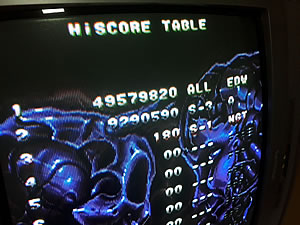
In the high score screen below I reached stage 2-5 on Normal difficulty. Those stats are a nice touch but don’t make much sense in the end. Let it be known that my cartridge is a conversion – the authentic one was and still is an extremely overpriced item for AES collectors.


Thursday, December 31, 2015

Sonic Wings 3 (Neo Geo)

Vertical
Checkpoints OFF
4 Difficulty levels
8 Stages (loopable)
Ship speed fixed, selectable at start
- - - - - - -
Developed by Video System
Published by Video System in 1994


There’s one single truth about many long-running shmup franchises: despite all the efforts and sacrifices of brave pilots from all around the world (or galaxy), evil will never really subside. At least this was the rule back when shooters were real and profitable for developers. No matter how successful we were at defeating those hideous monsters there was always an ominous villain lurking in the shadows, waiting to strike again in the inevitable next chapter. Sonic Wings 3 is no exception to the rule, since it follows its predecessor Sonic Wings 2 with that same vibe and a backstory that, well… doesn’t really matter in the end.

Who cares about story anyway? Let them alien baddies come!

What matters is that, for those who thought the second game was too hard for its own good, Sonic Wings 3 – or Aero Fighters 3 in its Western incarnation – is far less punishing and a tad more approachable than Sonic Wings 2. I say that based on how much I had to suffer to loop part 2, whereas part 3 caved in after only two sessions of relatively relaxed play. Blame it on the more easygoing pace, the reduced aggressiveness, the slower bullets and the new assortment of planes and pilots. If you’re a fan of Spanky don’t worry, he’s back with all his lovely dolphiness to cheer you along the way. Unfortunately Baby Bobby must’ve had to go to school or something, since he’s not to be seen anywhere in Sonic Wings 3.

Dat dolphin!

There are ten pilots distributed across five countries (USA, Japan, Russia, Germany and UK), with some new faces joining well-known characters like the stern ninja Hien, everybody's favorite viking Kohful and Rafael's darling dolphin pilot Spanky. They all use two buttons only (fire and bomb), but this time the differences between them are even more pronounced and polarizing, to the point where it practically breaks the game depending on your adopted approach.

The greatest departure from the old formula is a branching feature that allows players to choose the next stage (or stages) in certain levels. Once some bosses are defeated a harmless helicopter-like enemy will materialize: the choice of level depends on which wing of this helicopter you destroy first. Different paths lead to distinct bosses and might result in easier or harder campaigns of eight stages in each loop. By the way, don't expect levels to be exactly the same in the second loop. Not only enemies become more aggressive and start shooting different bullet patterns, but bosses can be completely replaced and bonus levels totally disfigured when compared with what you see in the first loop.

For each choice of pilot the player receives a very particular type of shot as well as bomb. Pick up P items to power up shot, and B items to increase bomb stock. Three Ps will max out firepower, but after a while the plane will revert back to the power it had with only two Ps; then you need to take another P to max out power again. Ps taken before this power-down time window expires (which actually depends on how much you shoot) are converted into 2.000 points each. The only pilots/planes that differ from the norm are Spanky (Russia) and Malcolm (Germany), which have special charge shots activated just by holding and releasing the fire button. Regardless of the ship you choose, chances are you'll need to rethink most of your strategies once you change characters because they all behave differently in firepower, bomb effectivess and power-down times.

I'm playing a credit of Sonic Wings 3 (recorded form a cell phone, hence the hiccups)
Turn English subtitles ON for great justice

For a game that's so old-school in nature, Sonic Wings 3 does incur in serious faults with regards to scoring. The medal/money collecting scheme is back and preserves the idea that the closest to the top of the screen you collect a money icon the highest value it will have. Anything below that will decrease the value down from the maximum of 10.000 points to only 200 points if the medal is taken in the lower half of the screen. However, unbalance raises its ugly head as soon as you reach the first boss, since the money fountains on both bunkers besides the capitol can deliver varying amounts of medals. It's unnerving to get less than 200.000 points prior to the boss fight, when you know sometimes it should give you more than 300.000 points. 300.000 points, by the way, is where you earn your only extra life in the whole game.

Scoring quirks however run deeper than that. With the branching system it's natural to expect some levels to give you more points than others, even though they're not as fun to play depending on the selected character. On top of that, with regular final bosses being replaced for stupid variations all of a sudden your score might be severely compromised (note the homage to Darius if you get to fight the mahjong doll). The greater variety of bonus levels can also lead to areas with a relatively low amount of medals or power-ups. This opens up another can of worms for scoring, especially if you consider Mao Mao and her time-freezing bomb in the bonus level of the two large planes (3rd stage if you take the right route after first boss). Considering that her ship is a weak piece of junk, this scoring advantage does require players to have a lot more skill if they decide to use her and exploit that particular milking technique. And no matter how much I don't like to admit, indeed she is the best choice for score-chasers.

When I started playing the game I was appalled by the music, which I found to be completely atrocious except for the song in the first level. After a while it started sinking in, and now I believe it fits the action quite well. Character interactions remain very humorous throughout the game, and different endings await players who are brave enough to face the game in co-op mode.

My best high score on Sonic Wings 3 is below, playing with the Blazers plane on the MVS difficulty and using a turbo controller for proper autofire (tapping is okay though since firing is achieved in very short bursts). In this run I reached stage 2-4.


Saturday, November 21, 2015

Pulstar (Neo Geo)

Horizontal
Checkpoints ON
8 Difficulty levels
8 Stages
Ship speed by icons
- - - - - - -
Developed by Aicom
Published by Aicom in 1995


And here we come to the behemoth checkpoint-based outer space adventure Pulstar, directly inspired by the golden pillars set by Irem, the company that defined a whole branch of the shooting genre in its R-Type series. Some people consider it a rip-off, others hail it as a homage. I tend to agree with the compliment since Pulstar is different enough to stand on its own even though you can spot many design similarities with both R-Type and R-Type II. The strongest asset that warrants the comparison is the presence of an invincible force pod that protects the ship. This pod, however, is not detachable like in other shooters built upon the same mold, such as Xexex or Ironclad.

Regardless of origins or influences, Pulstar comes off as one of the possible natural developments of Irem’s prime formula. Prerendered graphics intertwine with exquisite pixel art to deliver longer levels and provide an experience that borders the epic. I’m also very fond of the music, which opens with breezy, uplifting themes and evolves to ethereally ominous, truly dark pieces by the time you reach the last stages. I’d also say Pulstar is one of the most beautiful shooters of its generation, if only for the eye candy and the impressive scope of its design. But hey, it’s not without faults, and that’s the reason why it doesn’t top the finesse of its forefather.

Front line on the Earth

A lovely animated intro shows the heroine of the game departing for battle. As the most basic input, button A is used to fire. Firing can be accomplished by either tapping or charging, both actions gauged by the cannon meter positioned at the bottom of the screen. Hold down the button until the meter is full to the right and release it to fire a powerful blast (partial charges are possible at the expense of power). Likewise, the quicker you tap the button the more you fill up the left side of the power meter, a feature that adds almost nothing of real use to the gameplay (keep reading). Little robots act as carriers for power-up items, which come labeled in roman letters and greatly affect gameplay.

Essentially, taking any of the five available weapon types creates the pod at the nose of the ship. The first pod is small and offers little protection, but as soon as the second power-up is taken it grows to its normal size. Weapons types consist of N (wave shot), P (bouncing lasers), T (trailing homing lasers), R (straight laser) and F (electrical shield, damages by contact but doesn’t stop bullets). The only weapon that emphasizes tapping instead of charge shots is F, since the purple electrical shield is only generated and held at its nominal radius if you keep the tapping gauge full (charge shots still work but without any extra firepower). Now this is where Pulstar starts to lose some of its shiny glow: due to how the developer has shaded the weapon items it’s impossible to differentiate an F from a P. For a long time I wondered why some Ps gave me lasers and others gave me the purple shield. Thankfully there are only a few Fs throughout the game so it’s easy to avoid them if you want.

Remaining items consist of S (speed-up), C (charge speeder) and I ("bits" that hover above and below the ship and grant a little extra directional firepower). Cs are extremely important to kill bosses and tricky enemies faster. Bits are free-aiming by default, but to lock them in place all you have to do is press button B. However, beware not to do this while you're pressing A because A + B sacrifices the force pod in a panic attack whose effect depends on the weapon you're using. This works as a last resort on the face of imminent death since you'll be invincible as the pod detaches and explodes in front of the ship. I find this feature particularly useless, and the only times I did it were either when I was learning the game or when I pressed the button by accident.

The good news about the S pick-up is that the maximum speed is perfectly manageable – I’d even say necessary – so you don’t need to avoid any S while playing. Additionally, the hovering bits of Pulstar are also capable of blocking regular bullets, unlike in R-Type! As you can see, a ship equipped with a force pod and two bits has its frontal hull very well protected. Handling this protection is crucial for survival in the second half of the game, regardless of the weapon you decide to use. Speaking of items, score chasers must be aware that every single one is worth a few points. Note that simple score techniques such as checkpoint exploitation must be done very carefully because the stage bonus of 50.000 points is reduced the more you die in a level. Die once and get 30.000 points, die twice or more and get only 10.000 points. The only stage where checkpoint abuse might be a good idea is the last one, but be warned that all recoveries at that point in the game are extremely tough.

Pulstar intro and attract mode
(courtesy of YouTube user adventkamen)

While fairly amusing from start to finish, Pulstar has a few quirks that only become apparent when you spend more time with the game. Slowdown, for example, is a constant companion that has its pros and cons. It definitely helps during busy sections that demand heavy crowd control, but on the other hand it factors into the numbness that takes over the first half of the game. No matter how awesome the opening to the 3rd stage is – with flaming arches crossing the screen while lovely backgrounds scroll by and enemies approach from both sides – the battle against the huge organic battleship almost brings the game to a halt. Half the 4th stage being the destruction of another large spaceship doesn’t help either, which in the long run hurts the flow of the game to the point where it will take a greater deal of shmupping love to persevere into the following trickier levels.

In between the several throwbacks to R-Type in stages 5 and 6 (robot showers, dismantling snakes, blocky creatures travelling within a tight maze) and the memorization nightmare of the last stage, the developer has also included minor homages to Gradius (the indestructible spider) and Darius (the giant moon surfaces of stage 7). I absolutely love it when the screen shakes as if the very fabric of reality is being torn by the destruction brought about by the player, like in the demise of the spaceship in stage 4 or the waterfall passage in stage 5. As a side curiosity, the abundance of phallic imagery in Pulstar is remarkably explicit. The tip of the organic battleship, the weak spot of the 7th boss and the series of pink cocks trying to crush you in the last stage easily top anything included in other seriously themed shooters like R-Type II and Wings of Wor.

On the default difficulty (4) the extend routine is 300.000 points for the first extra life, then successive extends at every 200.000 points. Milking key enemies and bosses is possible, but this doesn’t really add much in the final score. There are mysterious techniques to get more points on the last boss, but I haven’t bothered with those because they involve suiciding.

My 1CC score is below, playing on difficulty 4. Note: developer Aicom morphed with a branch of SNK into Yumekobo, the company that made Blazing Star years later. If only on aesthetics, Blazing Star is considered by many as the spiritual successor to Pulstar.

Tuesday, July 8, 2014

Last Resort (Neo Geo)

Horizontal
Checkpoints ON
4 Difficulty levels
5 Stages (loopable)
Ship speed by icons
- - - - - - -
Developed by SNK
Published by SNK in 1992


In the history of the greatest horizontal shooting games of all time, both R-Type and Gradius are always somehow present in any relevant discussion. However, many of those who also consider them to be difficult games have a hard time dealing with the checkpoints and the painfully slow default speed of their respective ships. Assuming that these people would still be game for this particular shooting style, I can now attest that Last Resort is the compensation they certainly need - especially for R-Type fans because, to put it simply, Last Resort is by all means an easier take on R-Type. It's just as fantastic in graphics and sound, but the decent starting speed of the ship and the absence of excessively hard checkpoint recoveries are very attractive if you want something more bearable challenge-wise.

As is the case with the later Pulstar, some people believe that part of Irem's staff also worked on Last Resort. The graphic design is definitely to blame for this assumption, even though there's a uniqueness to the overall style of the game. Particularly amusing are the tiny men/pilots ejected from pretty much every destroyed enemy, which lends it a singular feel and further deepens its shadowy relation to Irem. The inspiration drawn from the anime film Akira is also evident as you start the game amidst a busy rendition of its Neo Tokyo setting. As the stages unfold, scary bosses try to stop you while you pilot that pointy ship through rain over the ocean, face an emerging submarine, weave across laser-infested corridors and battle a huge spaceship before entering the final enemy's lair.

Where have I seen this snake creature before?

With only two buttons to be used, the gameplay is pretty straightforward and requires very little to be learned, basically expanding on the classic scheme of R-Type. Kill specific enemies in a wave or a particular carrier to release speed-ups (S), speed-downs (mirrored S) or colored power-ups. These power-ups are defined by their inner characters (G, H or L) and their cycling colors (red or blue). Take any of them to activate an invincible satellite that remains permanently attached to the ship and can be used both for offense and defense, since it blocks all regular enemy bullets.

Moving the ship causes the satellite to rotate around it, and at the press of the B button you can lock it in place or release it to continue rotating. As soon as the sattelite is activated the player is also entitled to use the charge shot by holding the fire button (A). Once charged and released, the satellite will dart forward from its initial direction with great destructive power, and the longer you hold the button the more powerful the attack is. The color of the last power-up collected is also important for the charge attack because it defines how the satellite behaves upon hitting a wall. Red will make it trail along the surface, blue will make it bounce around. In both cases the satellite will automatically return to the ship once the attack is done.

Upon collection of the second power-up the letter inside it activates its corresponding weapon: G is a set of two napalm bombs with trailing capabilities dropped above and below the ship, H is a set of straight missiles with very slight homing ability and L is the classic straight laser. It then takes just two successive power-ups (regardless of letter type) to max out the ship's attack power. You can cruise through the game with any of these weapons, but at certain spots the ground bombs (G) are certainly more helpful. Some examples are the turret corridor in stage 2, the initial laser cannon area of stage 4 and the whole scramble around the large battleship of the last level + last boss. I use missiles mainly against the 2th boss, and laser on the 4th boss due to its piercing ability making it possible to hit the little turrets on the other side of the boss's body.


More gauge, more strong!
(courtesy of YouTube user superdeadite)

No matter how you look at it, you can't really say there's something technically special about Last Resort. Not only is the gameplay derivative from R-Type, but it even copies some of that game's traits - like the way your ship gets drawn to the center of the screen as the bonus of 10.000 points gets computed. Slowdown can be heavy during boss confrontations, as well as flicker. What Last Resort does, and does really well, is keep a steady flow of action from beginning to end while allowing the player to get back on his knees upon death with no heavy work/practice required. I daresay you can beat the game without taking any speed-ups, such is the ease provided by the default speed of the ship. Furthermore, the game is finely suited both for a stock joystick with no autofire (abuse charge shots to win) or an autofire-enabled controller where you pretty much don't need to charge. It's a fun ride in whatever form you take it.

Another aspect where Last Resort shines is in its amazing soundtrack. Diverse and pumping with lots of cool bass, it matches the graphics with outstanding results. I can imagine people complaining that the game is too short, but it must be known that SNK designed it as a shooter with two loops. Of course the second time you play enemies and bosses become more aggressive. There is no intricacy in the scoring system whatsoever, and the only extends are achieved with 60.000 and 130.000 points. Last Resort is also another example of a game with a considerably steep default highest score.

Other than on the Neo Geo AES and its CD version, players are also able to enjoy Last Resort on the PSP, PS2 and Nintendo Wii by means of a compilation titled SNK Arcade Classics Vol. 1. It includes 16 Neo Geo games, of which only Last Resort appears as a representative of the shmup genre. Prior to playing it on the AES I practiced and credit-fed the game on the PSP. In the high score below I reached stage 2-3 playing on MVS difficulty with a turbo controller for proper autofire (I didn't use charge shots at all).

Thursday, January 23, 2014

Twinkle Star Sprites (Neo Geo)

Vertical
Checkpoints OFF/ON
8 Difficulty levels
7 Stages
Ship speed fixed, selectable at start
- - - - - - -
Developed by ADK
Published by ADK in 1996


It was another lazy afternoon. I took the AES out of the box again in order to test two newly arrived games, and half an hour later I was ready to return it to the shelf when I thought “well, it wouldn’t hurt to spend some leisurely time with Twinkle Star Sprites”. Based on the previous experience I had with the Saturn version, my thinking was that it would take little to no sweat to beat the game with two or three different characters. And it was also the chance to finally try it in its original incarnation – the only thing that wasn’t original in my case is the cartridge, a flawless conversion that saved me an arm and a leg (for those who don’t know, Twinkle Star Sprites is the rarest and most overpriced AES shooter).

It turns out the 1CC task wasn’t as easy as I had envisioned, in fact it was pretty much the opposite. I tried playing with the weakest characters to see if the fights would last a little longer, but soon enough it became clear that Mevious and Memory were quite a diabolical couple. Long story short, I was forced to leave my leisurely intentions aside and dedicate serious time into plowing my way through the game. Granted, it was still a fun ride, maybe more fun this time around playing solo, even though I would love to have a coleague around to taste the Competitive Mode in its full glory.

With its versus-oriented gameplay, Twinkle Star Sprites is definitely one of a kind (there are others like it but none of them as charming). The objective in each of its seven stages is to defeat the opponent on the other side of the split-screen. Everything is extremely colorful and cheerful, the design dominated by a cutesy anime style from start to finish. I was thrilled to finally be able to understand the snippets of dialogue in between levels (all text defaults to English - or hilarious Engrish - in a Western console) and because of that I even felt compelled to try the game with different characters in order to find more about their behavior.

It's raining Nanja Monja!
(courtesy of YouTube user Kae De)

Only two buttons are needed to play the game, but it’s possible to activate an additional function for main shot with autofire. When this is enabled you get main shot on button A, bomb on button B and auto-shot on button C. Bombs have limited stock and charge shots can be fired in three power levels by holding down and releasing A. Both players are faced with the same enemy (golem) waves in order; each destroyed golem produces a minor explosion that affects all nearby golems, and if they get popped in groups of three or four a fireball is launched into the other player’s area for a basic attack. If an incoming fireball gets sufficiently shot at it's possible to send it back to its creator, and if it gets caught in an explosion it might return as a more potent fireball or the character’s specific attack (which can also be generated by firing charge shots at level 2 or 3). Some fireballs descend from the top in a straight line, others develop an aimed arching trajectory. This second type leads to a very important and strategic aspect of the gameplay, the one related to positioning and the ability to lure enemy fireballs for better dodging opportunities.

Destroying golems in a row gets progressively trickier because their health is color-coded. Red enemies take one hit to destroy while purple ones take five (the complete health scale is 1-2-3-4-5 for red < yellow < green < blue < purple). At some point they start coming with colored shields that must be broken before you can actually hit them. Successive explosions and reflections are registered into a hit count that gives out score bonuses, and the resulting mayhem can be heightened by two factors: boss attacks and fever. Boss attacks can be generated either by a full level 3 charge shot or by achieving an extraordinarily high hit combo. Fever is what happens when you explode a glowing orb within a golem formation: the character moves faster and the amount and speed of fireballs going to the opponent’s side is increased considerably. The fever orb is always preceded by two exclamation marks (!!) that can also mean you’ll be getting a coin that flies around flipping between two of the following items: extra bomb, star (eliminates all golem shields on screen) or $ (successive bonuses of 10, 100, 1.000 and 10.000 points while you keep getting the same item – get a different one and the next $ will be worth 10 points). A PERFECT is achieved when a golem wave is destroyed with the minimum amount of shots possible, and getting many of them in a row results both in more points and faster appearances of the !! symbol.

How many blows do you need to kill an opponent? All characters start with a health bar of five hearts. Bumping against a golem takes away one heart, getting hit takes three hearts. Every time a competitor is hit half the damage is refilled in the opponent's health bar. Whenever you bump into a golem you get stunned for a few seconds, and during this time you’re completely at the mercy of your foe because you can’t even bomb (dying quickly by getting bumped twice and then toasted is really rage-inducing). Also when stunned the character's power and speed are kept at a lower level for a few seconds (getting hit by a projectile doesn't have the same effect though). You can't die by being stunned when you have one or half a star left.

For each completed round you get bonuses for maximum hit count and clear time. If the fight drags for too long a death golem appears alternately for both players, gradually increasing in speed as he gets killed and respawned. Getting touched by him means instant death.

Nanja!

There are three modes of play in Twinkle Star Sprites. Character Mode lets you choose between nine goofy competitors with varying attributes for speed and power (they all share the same health). In Story Mode you play exclusively as Load Ran, the protagonist Sailor Moon-esque blonde witch. And Competitive Mode is where you want to go for some head-to-head shooting combat. In both Character and Story modes you play four levels with randomized opponents before facing the trio of final bosses: Dark Ran, Mevious and Memory. Character voices abound and music themes are nice overall, with more than one BGM for some of the initial stages. It’s obvious that the real value of this game lies in the Competitive mode. Playing the solo variations can be either delightful or infuriating: relax and enjoy the ride for a tour de force on opponent reading and reflex testing, play for score and see yourself go nuts with opponents dying for nothing or fiercely walling up for no reason. Extends are earned at every 500.000 points, and for each life in stock upon completion you get 100.000 points.

In revisiting this game I tried to play exclusively with the weakest + fastest characters (1/3 power, 3/3 speed). Arthur Schmitt was the first, and the one thing I didn’t like about him was how weak and slow his shot is. In later levels it’s really tough to handle things when under pressure. Then I switched to Kim, whose shot seems to be slightly more powerful. His bomb also lasts a little longer and often causes slowdown (which, by the way, is a constant companion but never hinders the gameplay in any way). Regardless of the character chosen, Twinkle Star Sprites offers an intricate shooting engine where timing and anticipation might matter more than the actual dodging. Pursuing a 1CC with the highest possible score can be particularly painful due to the nature of the AI: I defeated Dark Ran with 5 seconds of play once, but I lost count of how many times Memory fried all three lives I had in stock when reaching her. After a while I couldn’t help but think about Takashi Miike's Audition, that movie where a cute girl tortures, dismembers and slowly kills the protagonist with the sweetest smile on her face. Memory is the same, all cute and sweet while raping her opponents to shreds. While Mevious is at least evil-looking although not nearly as tough, Memory is so cute it hurts!

I assume having a tougher final boss is good for scoring in the long run (meaning for very experienced players), but I was really surprised by how harder the Neo Geo original is when compared with the Saturn port. Was it maybe the amount of slowdown? The stock Neo Geo stick I used? Or maybe I’m just too old for this shit, who knows? Well, by his last appearance Roger Murtaugh had been too old for his shit for more than 10 years so there’s still hope for me, right? I wonder how I'll fare when I have the chance to try out the ports for the Dreamcast and the Playstation 2...

Anyway, the 1CC mission was accomplished with Kim on difficulty setting 4 (MVS):

Friday, July 19, 2013

Zed Blade (Neo Geo)

Horizontal
Checkpoints OFF
5 Difficulty levels
8 Stages
Ship speed fixed, selectable at start
- - - - - - -
Developed by NMK
Published by NMK in 1994


Until very recently I knew nothing about Zed Blade apart from its famous “love-it or hate-it” techno soundtrack, composed by the now celebrated Manabu Namiki (Battle Garegga, DoDonPachi Dai-ou-jou, Mushihimesama). Also known as Operation Ragnarok in Japan, the game was originally released on the MVS arcade platform, but soon found its way to the Neo Geo AES home system thanks to the cartridge converting wizards. That’s how I was able to enjoy it.

You don’t need to know the story to realize that as soon as the game starts you’ll be drifting away from Earth into the heart of the Solar System. All levels and bosses have names, and I guess that’s one of the easiest and yet most efficient ways to carve key aspects of any game into the player’s memory. If you play Zed Blade to the end I bet you won’t forget how it depicts names such as Constrictor, Loki and Yggdrasil. And what about a boss whose title is none other than Insane Ship? Unfortunately, the curious names and the great soundtrack represent the peak of whatever personality you will find in Zed Blade. I won't complain about the challenge as well, since it's actually of decent caliber.

Three different pilots define how fast you’re able to move. Uncle Beard is slow, Ms. Charlotte flies at middle speed and Swift Arnold is fast, and while their ships have different sprites they all seem to posses the same hitbox areas. Once the pilot is chosen you must configure the ship’s weaponry in three steps: (1) shot, (2) missiles and (3) rear. There are three options for each weapon, and these include common types such as spread/3-way, wave, straight/twin or homing, as well as a variation with vertical reach for the shot/frontal weapon. I believe that configurations like 3-way/A-S/2-way are the reason why many people see a similarity between Zed Blade and Darius Gaiden. That’s absolutely not true for the rest of the weapons or the game itself, which does not resemble Taito’s epic shooter at all.

Are you ready for the battles?

A single button is used to fire all weapons at once. A secondary button is used to deploy the bomb, a powerful energy outburst that makes the ship invincible as long as it lasts. Upgrade items and extra bombs appear inside certain enemies, which must be destroyed for you to take them. Power-ups cycle continuously through P (shot), M (missiles) and R (rear). All items, including extra bombs, will bounce on the left border of the screen and disappear to the right. The blue bomb item is special because it upgrades all bombs to “hyper” status for the current life (all icons in the bomb stock switch to a shiny green H). It takes three power-ups to max out each respective weapon, and the good news is that you’re downgraded only one level for all of them when you die. Upon every death two random items will appear from the right, so if you’re fast enough it’s possible to regain maximum frontal power almost at once.

The odds you’ll face when armed with the arsenal and resources described above will depend on your life stock, for that’s primarily what defines rank in Zed Blade. 1UPs will automatically come into the screen as soon as you reach 200.000, 800.000 and 2 million points, and if you go on without dying each extra life adds an extra layer of aggressiveness to the enemy behavior. This increase in difficulty results in a much higher bullet density combined with increasingly faster bullet spreads, to the point where deaths almost often happen due to sheer overwhelming and inevitable cornering. Performing well in the first half of the game is a safe pass to a second half filled with tighter patterns and overlapping enemy attacks. The only way to deal with that is to rely on methodical memorization (beware of enemies coming from behind) and panic bombing (don’t be greedy!).

Occasional slowdown might kick in depending on how crowded the screen gets, but it's much more common when two people are playing together. While the basic gameplay and the challenge rules complement each other well, the same cannot be said about two important aspects in the game. The first one is the graphic design. NMK tried to infuse dynamism through several layers of parallax, but when you have stages 3, 4, 6 and 7 with basically the same backgrounds (bar a few asteroids here and there) you can’t help but feel the stench of laziness and lack of creativity. That makes the game seem longer than it actually is and leaves all responsibility for any graphical appreciation on the enemy gallery's shoulders.


Zed Blade's auto demo
(courtesy of YouTube user narox)

The second aspect that kinda falls apart in Zed Blade is the scoring system. Besides the extra points gained for every surplus power-up collected (5.000 or 10.000 points), it relies heavily on the fact that every hit you land on an enemy/scenery results in even more points. That opens lots of possibilities for milking, and while valid this technique just comes out as boring and stupid. Just to have an idea, to score higher in the first stage it's always better to avoid all enemies and focus on hitting the ground only! During boss fights simply avoid hitting their weak spots and point-blank their bodies to no end (bosses don’t time out but at least react on abusive milking by firing unexpected extra bullets). And here's where things get really dumb: rewards for the hit-based scoring vary according to the character used. Uncle Beard gets 50 points per hit and Ms. Charlotte 30 points, while Swift Arnold gets shafted with only 10 points per hit. This is the first time I see a shmup with multiple characters render some of them totally useless for score chasers, and in my opinion that’s just complete fail.

Even with all the aesthetical and functional shortcomings there’s no denying that Zed Blade is a fun shooter, provided you can play it with autofire. At its core the game offers an engaging mix of strategic/twitchy dodging, with a reasonable learning curve that duly considers the seemingly huge ship’s hitbox and keeps players on their toes all the time once you're halfway into the game. Late bosses are cheap (6th on high rank, 7th at all times) and disappointing (last one), but the action in the levels themselves more than compensate for that. And the soundtrack? At some points it might make you want to shake your body a little. It’s awesome.

My 1CC score was achieved with Uncle Beard on the MVS difficulty setting of an AES cartridge conversion, with the ship configured as 3-way/homing/twin (S/M/R). I had autofire enabled (PS2 turbo controller + Tototek adapter) and didn’t do any extensive milking… Just a little to get the first 1UP prior to the first boss and a short beating spell on Lunar Walker’s body.

Thursday, October 4, 2012

Blazing Star (Neo Geo)

Horizontal
Checkpoints OFF
7 Difficulty levels
7 Stages
Ship speed fixed, selectable at start
- - - - - - -
Developed by Yumekobo
Published by Yumekobo in 1998


Although not a proper sequel to Pulstar, Blazing Star often receives the title for its graphical similarities with the former. Both games exude excellence and are regarded as highlights of the Neo Geo hardware. However, whereas Pulstar blatantly rips off the style of Irem’s R-Type, Blazing Star adopts a more straightforward approach towards the horizontal shooter formula, free of checkpoints and with a nice array of different spaceships to choose from (among these is Dino 246, the solo protagonist from Pulstar). It also allows 2-player co-op, something the previous game lacked.

Blazing Star for the Neo Geo AES is an extremely rare item, the only rarer shmup for this system I can think of is Twinkle Star Sprites. These days it's easier to play the game since it's also been made available for the Playstation Network and tablets/smart phones. It was originally released only in Japan, and much like Zero Wing part of its old fame comes from the Engrish that plagues the game from start to finish. There’s even a line of thought claiming that the word FAIL is the popular noun/interjection that we know today because of Blazing Star. Check it here, but note that the article is wrong when it states that the meme origin relates to a GAME OVER message. The text actually refers to a taunt displayed when the player fails to kill a stage boss within the allotted time limit.

As we all (don’t really) need to know, an intergalactic war was waged between planets and a powerful enemy enslaved humans for its evil deeds. Hope is once again alive as six pilots regain consciousness and get ready to exert great justice against the alien scum. Your mission, should you decide to accept it, is to take on the role of one of these pilots and fly through seven stages guarded by giant transforming machines of doom. Pre-rendered sprites create a swift 3D look on several backgrounds, colors are used and abused with awesome taste and the scrolling speed/direction shifts back and forth as you go. It’s pure and intense 16-bit shooting bliss. Another fine aspect of Blazing Star is the female announcer. At first listen she might be a little annoying, but soon enough I got used to her cheering. POWER-UP! BONUS! WO-HOO! The character art/treatment could’ve been a bit more fleshed out during the game, but considering this is a shooter the animated intro does a fine job with them.

Hell-Hound takes on the 3rd boss

Players need to use only two buttons to unleash the power of any of the ships selected. The first button shoots and activates a charge shot. The second button is only used to “break” the charge shot during its animation, making it behave in a totally different manner and imposing a brief recharge delay. Power-ups (Ps) will increase firepower up to four levels, further ones are worth 300 points each. All other items in the game have explicit influence on scoring, such as the character panels that form the word LUCKY, the winged orbs/spheres and the blue gems. The implicit influence of all items in the game, on the other hand, is what makes Blazing Star an intricate dynamic challenge that needs to be thoroughly learned if you want to extract the most from its scoring system.

Here’s a rundown of all ships and their weapons:
  • Hell-Hound – regular fire: wide shots with mild spread, top and bottom home on enemies; charge: straight power stream; break: stream turns into a spread shot;
  • Windina – regular fire: wave shot; charge: 3-way cluster bomb; break: homing clusters;
  • Aryustailm – regular fire: straight shot; charge: flare; break: flare turns into a Darius-like shield;
  • Peplos – regular fire: 3-way spread shot; charge and break: slightly smaller variation of Hell-Hound's weapons (note: Peplos does not power up!);
  • Dino 135 – regular fire: 3-way straight shot with directional pods (pods will get fixed in place with fast tapping); charge: wave blast; break: wave pattern scatters out;
  • Dino 246 – regular fire: single shot with missiles and directional pods (pods will get fixed in place with fast tapping); charge: single power shot; break: cluster explosions.
All ships have distinct speeds, with differing details as to how their weapons behave. Aryustailm's charging time is longer and its break shield needs considerably more frames to be activated after the flare is out. Dino 135's break is useless. Pulstar's Dino 246 has a permanent R-Type force on its nose, but is not allowed to fire during the cooldown period after the break. Everything considered, Hell-Hound and Windina are my favorites but any of the ships is fine if you just want to blast your way through the game mindlessly. The real deal will only show up when you decide to score higher, and that comes with a healthy amount of techniques and secrets. Basic scoring devices involve (1) killing multiple enemies with the charge shot in order to apply multipliers to their base value and (2) collecting all blue gems to increase their value from 300 up to 81.560 points. It takes a lot of gems to reach the maximum bonus, and unless you’re already maxed out for a while you can’t miss a single one or else their value will go down one step for each missed gem. The rule of thumb is that a blue gem will appear for every 8th enemy/bullet destroyed.

Now we come to the more intricate techniques, the ones related to increasing the number of on-screen objects and bullets. Spheres with wings, known as event items, are the answer for this. Event items appear from time to time and are apparently useless, but there are two ways of exploiting them. First method: release a sphere (any color), take it and refrain from shooting until you hear a sound cue as it leaves the screen; the next sphere will be larger and will contain a kanji inside; take it and all enemies destroyed with the regular shot will be converted into power-ups. Second method: keep releasing spheres but don’t take them; each successive color represents a multiplier that grows from ×2 (yellow) to ×128 (rainbow); take the rainbow sphere to apply the highest multiplier on all destroyed enemies. Long story short, rank is the answer to get more enemies/objects on screen. Rank is influenced by everything but is more affected by collecting successive power-ups. The more Ps you take the higher the aggressiveness of enemies and bosses. Therefore, method one above (the kanji event item) is the main source of rank boost because it allows lots of Ps to be collected. Allied with strategic use of the rainbow sphere, high rank play is the only way to achieve higher scores. It takes lots of practice and environment control because sometimes those damn items will float into walls or out of the screen before you can get to them.

Hey, poor player, get it more!
(courtesy of YouTube user SuperJobijoba)

Unfortunately, when you go for all power-ups and high rank play there is a serious point of concern in Blazing Star. Whenever you milk the first boss for power-ups sprite flicker kicks in heavily, making it hard to see his bullet spreads. Later on flicker assumes a new dimension as you reach the last form of the 6th boss: the first few streams of pink homing bullets are invisible! The only remedy is to anticipate their trajectory as they’re spawned from the turret. Hardware abuse or deliberate design choice? The good news (?) is that aside from these two instances (1st and 6th stages) I did not run into any other flicker issues in the game, but do you want to know what’s more aggravating? There are no extends in Blazing Star. It’s just those three lives, so GET SERIOUS, DON'T BE PANIC and don’t allow yourself to die before getting to that invisible fire curtain of death.

Even with the problems above Blazing Star strikes me as a superlative shooter. The difficulty curve is somewhat unbalanced (level 5 is a breeze while levels 3 and 6 are hard-hitters) but that’s not enough to hurt the impressive attention to details, the pop-fuzzy soundtrack or the sheer intensity of the game as a whole. Let’s not forget about the little secrets, such as the process of getting the last character panel in stage 3 or the blue gem walls that are triggered if you perform certain actions. These are not intuitive at all, the best way to learn is to watch someone do them. Upon completing a stage you’re awarded a few bonuses, and if you succeed on getting LUCKY there’s an additional reward as well. However, as you make progress you'll notice that these end-of-stage rewards have little weight in the overall score.

My 1CC run was done with Windina on the MVS difficulty setting. With Windina it's possible to play the game without any autofire because gentle tapping is enough to get a decent firing rate. That's absolutely not true with the Dino ships, for instance. In any case autofire does help, so I had it available to use in certain areas (PS2 controller via a Tototek adapter – a killer combination that’s nothing less than perfect). Note how the occasional slowdown (mostly on explosions and boss fights) makes it easier to get a fast firing rate just by regular tapping. Once the credit is over a few cool stat screens are displayed, showing data such as a performance table for all stages and your final power-up level. I didn’t get to photograph them, but I noticed I had maxed out the power-up counter (255) in the credit below.