Showing posts with label PSP. Show all posts

Tuesday, April 22, 2025

TwinBee Da!! (PSP)

Vertical
Checkpoints OFF
2 Difficulty levels
5 Stages
Ship speed by icons
- - - - - - -
Developed by Konami
Published by Konami in 2007


Originally released for the Japanese Game Boy handheld in 1990, TwinBee Da!! has the distinction of being the 4th chapter of the long running bell-juggling franchise by Konami. Besides an European port that appeared a few years later with the title Pop'n TwinBee (not to be confused with the homonymous Super Famicom chapter), the game was revamped into a full-blown colored version included in the TwinBee Portable compilation that came out for the PSP in 2007. Also known as the "Powered Up Arranged Edition", the PSP entry comes with a little bit more than the color makeover you'd expect for a monochromatic older and rather obscure video game.

The first aspect that pops to mind when booting up TwinBee Da!! is how good it looks. The arcade-quality cute'em up graphics are nothing short of awesome, as is the music featuring arrangements of tracks from previous games led by well-known composer Manabu Namiki. Some sources cite the involvement of M2, yet I could not confirm that anywhere from the in-game information. The only feature that did not reach the heights of an arcade entry is the challenge, which is of course understandable. On the other hand, since the game does not loop the carrot on the stick here is the possibility of maximizing your score throughout five stages.

Pink windmills over fluffy clouds

Basic gameplay is very similar to other chapters of the franchise. One button is used to shoot (with native autofire) and another to drop ground bombs (can be set to autofire if desired). By shooting at clouds you release bells whose color can be changed if you continue shooting at them. Mainly colored yellow, they will eventually cycle through blue (speed-up), white (double shot), green (trailing options) and red (shield barrier). If you hit them bells for too long they eventually get wrecked and fall down the screen for good in the form of a deadly bug.

Besides bells, there are also ground items to be collected. Most of them are fruit that give you some points, but you can also come across a star (clears the screen of airborne enemies and bullets), a milk bottle (extra life) and a candy (3-way shot). Collecting the candy a second time makes the character shoots an extra candyball that bounces around the screen. Note that you can't have the double shot (white bell) and the 3-way shot (candy) at the same time, so collecting one disables the other. The same happens with the green and the red bells, which means you are forced to choose between the options or the shield. All items collected are shown in a large status bar on the left side of the screen.

A staple of the series, the ambulance item also returns. If both your arms get shot (the ones that drop the ground bombs), the ambulance will cruise the screen for you to recover them. Miss it and you won't be able to drop bombs for the remainder of the level, being granted new arms only when the next level starts. Also note that the ambulance item appears only once per stage.

Each yellow bell collected in succession without any of them falling off the screen increases in value until maxing out at 10.000 points, in what represents the main source of score for those who shoot for the best possible performance. In a nutshell, it's the same mechanic that's present in every TwinBee game or variation thereof, such as the ones from the Parodius franchise. Juggling bells for points can be spoiled by greed as usual, but TwinBee Da!! behaves a little differently from the other games in the series. For example, it takes several shots to make a bell change its color instead of just one. And instead of disappearing from the color cycle, all bell colors keep coming even if their function is maxed out. Each surplus bell collected is worth 10.000 points.

A brief look into how TwinBee Da!! looks on the PSP
(courtesy of YouTube user Now Loading Please Wait)

With only five stages, TwinBee Da!! is quite a short game. Instead of parading in their own level, the boss rush lifted from TwinBee appears right at the end of the 4th stage, meaning the PSP version is one stage shorter than the Game Boy original. The gameplay in general is very easy to grasp yet the game becomes a royal mess by the time you reach the 4th stage. There's so much going on by then that it's virtually impossible to keep a steady combo of yellow bells, with absolutely no slowdown to be seen anywhere. Hint: since it takes three blue bells to max out the flying speed and maximum speed isn't that fast, it's advisable to just max it out as quickly as possible.

There are other differences between TwinBee Da!! and the original Game Boy title, such as the absence of the Queen Bee boss, the lack of the stage select feature at the start of the credit, the reordering of some boss themes and the fact that it's 1-player only. Does the eye candy compensate for that? I guess in the end it depends if you're a die hard Game Boy fan. For me it was just another basic diversion to be had during a short flight. It's also a rather easy one, especially for those who have some knowledge of other games in the series.

My best 1CC score is shown below, playing in the Normal difficulty. A charming collection in its own right, the TwinBee Portable disc has elementary features such as button remapping and saving.


Monday, November 11, 2024

Cho Aniki Zero (PSP)

Horizontal
Checkpoints OFF
3 Difficulty levels
5 Stages
Ship speed fixed
- - - - - - -
Developed by Extreme
Published by GungHo Works in 2009


Even though Masaya wasn't really behind the design of Cho Aniki Zero (also known as Rei Cho Aniki), it's interesting to see how new copyright holders Extreme and GungHo tried to reuse and merge some of the assets from recent chapters of the franchise, with an approach that harkens back to the very first game released for the PC Engine CD in 1992. It sort of makes sense, after all this is a prequel to the whole series. In terms of gameplay, however, it certainly tries to offer a little more than the straightforward shooting with bizarre graphical elements, as was the case with prior entry Cho Aniki - Seinaru Protein Densetsu, previously released for the Playstation 2.

While Cho Aniki Zero preserves the wacky visuals with homossexual undertones, it doesn't really push the boldness envelope, at least not as the 32-bit entries did. With the exception of the animated introduction and a few panels here and there, there's not much in the way of creepy designs. Infamous bodybuilders Adon and Samson are all over the place here, but they take the back seat and serve as sidekicks to warrior Idaten, lady Benten and a third new character called Shoten, a contender for the best bodybuilder of the galaxy. Initially Shoten cannot be selected though, there are certain criteria that must be met.

Cho Aniki Zero is remarkable for being the first game in the series released out of the Japan, in a digital version with full English translation for the Playstation Store named Cho Aniki Zero - Muscle Brothers. The Japanese language in the PSP retail release isn't much of a problem though. Upon selecting the difficulty/course, you'll then choose the main character. In the case of Idaten, you can also select between secondary characters Adon and Samson. Benten is stuck with cherubs Mika & El, whereas Shoten is accompanied by Balan, a green version of Adon/Samson who's actually their older brother. Note that the Easy course only allows you to play three stages, so if you want to experience the whole game you'd better go straight to the Normal route.

Watermelon boss

By default, basic inputs in the gameplay consist of shot (□), bomb (×), fixed/free movement of the auxiliary character (○), special attack (∆), turn left (L) and turn right (R). All of them can be reamapped in the options and are self explanatory, except for the special attack. Once ∆ is pressed, the screen freezes so that you can select which attack level you'll unleash, based on the meter on the top of the screen. This special attack depends on the secondary character you have chosen, and varies between two (Samsom) or three power levels (Adon, Balan, Mika & El). In order to replenish the special attack gauge it's necessary to collect blue pills labeled as M (men's protein) that are left behind by defeated enemies.

Besides the blue M, items released by enemies can also be a yellow P (protein, power-up for the regular shot), a red B (extra bomb) or a pink L (extra life). It takes many Ps to get through all five upgrade levels of the main shot, and for each death you're downgraded by one level. Finally, tiny men, labeled in the instruction booklet as 'machos', also appear in four different colors and point values. Releasing the shot button briefly makes them get sucked into the character automatically. All items are also automatically sucked into the character when the last form of a boss is defeated. In every other occasion the player needs to be wary where to move since some items will randomly drift to the right.

Beneath the seemingly straightforward gameplay lies a series of intricacies that are very important for survival and scoring. It all starts with the choice of characters. Idaten's shot is stronger but lacks coverage, which is the opposite of Benten's. Shoten incorporates the strengths of both of them though. All secondary characters are able to absorb and protect the player from small bullets, but you need to position them well in order to not let any stray bullets get by. This is why Benten's cherubs are the best choices for frontal protection. On the other hand, Benten's special attack is the weakest. Also of note is the fact that no special attack makes you invulnerable, so you can never rely on them to get out of hairy situations. Only the bomb can save you! There's no real impact of dying with bombs and special attacks in stock though, after all they're independent from the number of lives. 

The single most important element of the scoring system is the amount of times you're able to 'guard' or absorb bullets. It doesn't appear anywhere during the level itself, but after the boss is beaten it will be used as a multiplier for the stage score. Deaths do not interfere with this guard count. On a final note, collecting as many tiny machos as possible is also important because they're worth much more than regular enemies.

Idaten is lost in the first stage already!
(courtesy of YouTube user Tio Jugon)

Despite being fully devoid of obstacles, which is unusual for a methodical horizontal shmup, the bidirectional nature of Cho Aniki Zero is refreshing, as are the great amount of bosses. Each stage has at least three sections and three bosses. The only exception to this is the final level, which makes you fight all previous bosses prior to facing the final enemy. The challenge slope is reasonably steady and it's possible to exploit a good number of safe spots against bosses, at least prior to the ones you fight on the 4th level, which serves as a great homage to the creepy design of 16-bit shmup classic Wings of Wor / Gynoug. There are a few problems with the use of color in the game though. At certain points it incurs in bad bullet visibility, as in the garden area of the 3rd level. The confusing background makes those black bees really hard to see.

Option menu translation for Cho Aniki Zero on the Japanese PSP

Cho Aniki Zero is engaging and fun for most of the run, and not overly hard if you're able to manage the extra life offerings given out during boss encounters. I think it preserves the legacy of the series with decent results, on top of offering good variety in the scoring system. It's a much better job than what was done in Sengoku Cannon, for example, which continued another famous franchise in a similar fashion on the PSP.

The requirements to unlock a few extra features, such as extra character Shoten and a sound test, seem to be related to at least reaching the last form of the final boss (as denoted by a golden badge shown in the high score table). However, only when I beat the game I unlocked the Hard mode/difficulty. My final 1CC result in the Normal course playing with Benten is below. Somehow I suspect this inflated score can be broken if the final boss is properly milked for bullet guarding, but I'll leave this check for a future opportunity.


Saturday, May 28, 2022

Dariusburst (PSP)

Horizontal
Checkpoints OFF
3 Difficulty levels
5 Stages
Ship speed fixed
- - - - - - -
Developed by Pyramid
Published by Taito in 2009


With the Darius series on a hiatus since G Darius (1997), in 2009 Taito tried to bring it back to the shmup spotlight with Dariusburst for the PSP. I believe longtime fans were caught by surprise not only by the release itself, but also by the new direction the company applied to the gameplay. Developer-for-hire Pyramid introduced fresh ideas that certainly proved successful, as hinted by the several revisions/sequels that came out on the trail of the PSP game. Dariusburst also plays a particularly important role for me since it was the reason why I finally purchased a PSP, the first ever handheld system in my personal collection.

Storywise the events of Dariusburst take place after Darius II, with the ongoing war of planet Darius against the Belser army prompting the Silver Hawk engineers to devise a powerful weapon deployed with the so-called "burst system". This new element is the game's defining gimmick and sort of replaces the capturing mechanic last seen in G Darius, squeezing the most out of the spectacle provided by contemporary pseudo 3D backgrounds. Granted, lasers and laser battles aren't as huge anymore but now they can be used in a more flexible way, adding new layers of strategy both for survival and for scoring.

When first starting up the game you'll only have Arcade mode to tackle (all other modes are unlocked first by beating it and by fulfilling a few other requirements). Perhaps due to the limitations of the PSP hardware this main game mode has only 5 stages, with the first couple of them fixed. Only after you've completed area B the famous branching system will kick in, allowing players to choose from areas C or D and so on and so forth. Each stage has the same boss regardless of the selected branch except for the final level, in which you might fight four different end bosses. These final formidable creatures are definitely easier in the upper route, getting harder the lower you go in your chosen path.

Release trailer for Dariusburst on the PSP
(courtesy of YouTube user ndsfans2009)

Only one ship is available upon start in Arcade mode, the Silver Hawk Legend. Once you've beaten the game once (continues allowed) you'll unlock the Silver Hawk Next. Beat Arcade mode once more in a different path and you'll unlock Mission mode, and a third time with another different path to unlock Burst mode. Finally, by clearing Burst mode you unlock the Silver Hawk Original, the official ship from the first Darius. This series of unlocks is obviously aimed at providing replayability and more value for money, but it's at least arranged in a way that makes sense challengewise.

All three ships share the same classic routine for upgrades. Destroying colored enemies releases colored orbs that upgrade three distinct aspects of the ship's firepower: main shot / missiles (red orbs), bombs (green orbs) and shield (blue orbs). The evolution of each element goes through missile → laser → wave, bomb → twin → multi and arm (green shield) → super (silver shield) → hyper (golden shield). Secret icons can also be found by shooting the terrain: grays orbs grant random bonus points, golden orbs act as screen-clearing smart bombs and the small ship gives you an extra life. There are differences between ships: Legend and Origin have the same arsenal except for the burst system, which is absent for the Silver Hawk Origin. On the other hand the burst system is also present on the Silver Hawk Next, which is clearly more powerful than the other ships and even comes with homing bombs. The good news for all ships is that this time around there's no need to worry about powering down upon death, as was the case with all previous games in the series.

In addition to the input for shot, in Dariusburst players have at their disposal another input for the burst attack. The burst gauge fills up automatically as you destroy enemies and gets empty whenever you're using the laser, which can be deployed in two different ways: by holding the button the laser is unleashed with the ship, by double tapping it the laser is dropped in place while you're free to move around. A detached laser behaves differently, consuming the burst gauge more slowly and allowing itself to be rotated up or down. Basically it works like this: if you stop shooting the laser will move towards the ship (Next) or away from the ship (Legend). Since shooting plays a pivotal role in dealing with the burst laser, learning how to properly use this special weapon certainly takes at least a little practice.

The advantages of of using the burst laser isn't of course relegated to sheer firepower increase. It ties in with the brand new scoring system that applies multipliers of up to ×16 as you keep on destroying enemies without getting hit (each hit takes away one multipier point). The catch with the burst laser is that the multiplier increases faster when you use it to annihilate the incoming waves. In the first level, for instance, there's no way to reach a ×16 multiplier just by regular shooting. The use of the burst laser, however, will certainly make it possible. It's interesting to note that even though you still get additional bonuses for extra lives when completing the game, the scoring you're able to achieve with the multiplier mechanic far outweighs these final rewards.

These Gluttons are hungry, very hungry

Two additional details on the use of burst laser are important. There are times when the amount of enemies and bullets is so high that the laser can sustain itself indefinitely (several sections full of asteroids and the whole fight against Hungry Gluttons are prime examples). The second detail is a much more intricate resource and is, quite frankly, the only dwindling aspect of the gameplay. As expected, bosses are also capable of firing their own powerful lasers several times throughout the fight. If you manage to deploy the burst laser just a split-second after you get hit by the laser from the boss, the burst attack will acquire a golden hue and become even more powerful, on top of granting the player with an extra multiplier boost over whatever is destroyed. Unfortunately this golden counterlaser is quite difficult to pull off, and if your timing isn't right you'll lose precious multiplier points by getting hit (the shield protects you but the hits are still registered). 

Everything mentioned above applies to all game modes. Arcade mode is of course the one you should play first. Full of throwbacks to previous chapters in the series, it offers a steady difficulty slope that culminates in epic boss battles by the time you reach the 5th stage. Burst mode is a special campaign locked in the Hard difficulty with different enemy patterns and only one life/ship that's already maxed out in power (orbs will all be of the gray type). On the other hand the burst laser takes longer to deplete and you get new input buttons that let you switch the main shot type (missile, laser and wave). Mission mode is a collection of short sections where you must fulfill simple tasks such as beating a level, a boss or a combination of both (with more bosses on occasion). The music will sometimes switch to the classic tunes from previous chapters, which adds a touch of nostalgia to this particular game mode. As for the main game modes, you can expect another great soundtrack full of engaging and operatic moments alike.

My guess is that completing the challenges in Mission mode will unlock the remaining material included in View mode. Normally you can see your high scores in there, as well as watch the replays you've saved (they can be saved whenever you finish a game without continuing), but you'll also have access to event animations, character close-ups and design illustrations. I did complete all missions in levels 1 and 2 (out of 8), and it was enough to at least have access to all branches of the main menu. Speaking of which, even though the game was only released in Japan the interface is completely in English, with Japanese text reserved for general descriptions that do not affect navigation at all.

On top of being one of the best shmups released for the PSP, in terms of graphic design and gameplay Dariusburst definitely represents a soft reboot of the franchise. Later on it was revised and retouched perhaps beyond what some people would consider acceptable, but there's no denying that Taito and Pyramid were successful in leading the series into new territory. The evolution after Dariusburst is rather complicated, but I'll probably tackle Dariusburst Another Chronicle EX+ next.

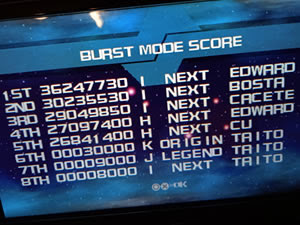
All the highest scores for each ship in the photo below for Arcade mode are 1CCs obtained in the Normal difficulty (a 1LC in the case of the Silver Hawk Next in spot #1 through toute ABCEH). Since it's a lot harder than the regular game, I only really tried to 1CC/complete Burst mode with the Silver Hawk Next, succeeding in route ABCEI.


Friday, June 28, 2019

Neo Geo Heroes - Ultimate Shooting (PSP)

Vertical
Checkpoints OFF
5 Difficulty levels
5 Stages
Ship speed fixed, selectable at start
- - - - - - -
Developed by MOSS
Published by SNK Playmore in 2010


As a gaming platform, the Neo Geo was the birthplace of many famous franchises and characters. It was also notable for a library formed by games designed almost solely by its own creator SNK. Neo Geo Heroes - Ultimate Shooting pays homage to their heritage by presenting a roster of ten handpicked characters from several Neo Geo titles battling each other in pure shmup fashion. The game was developed exclusively for the PSP and might be seen as either a sequel or a rearranged take on King of Fighters - Sky Stage, which hit the arcades and the Xbox Live Arcade service just a few months before the handheld release.

Even though it lacks the English translation for the main game story mode (which is available in the digital version), the retail Japanese edition at least keeps the English interface and is therefore totally friendly towards Western players. Amongst the different modes from the main menu there's even a port for King of Fighters - Sky Stage, so the disc actually bundles two games in a single package. The changes made on the Sky Stage version regarding game speed and difficulty are also extended to Neo Geo Heroes, in a porting/development job that properly adapts the bullet hell style to the handheld format. I just wish the framerate had been kept at 60 fps, but alas! It's fine as it is though.

The motive for all characters coming together to have fun flying and shooting stuff in Neo Geo Heroes - Ultimate Shooting is a guy named Dr. Brown, who uses a time machine to summon them from their timelines in order to defeat final boss Geegus (both characters from World of Heroes). Joining the ensemble of six fighters from Sky Stage (Iori, Kyo, Terry, Athena, Mai and Kula Diamond) we now have Iroha (from Samurai Shodown VI), Marco Rossi (from Metal Slug), Akari Ichijo (from Last Blade) and SYD-III (the ship from Armored Scrum Object / Alpha Mission, piloted by a cute silver-haired lady). Just like in the original game, the new characters all differ a lot in shooting styles and special moves.

Kula Diamond versus first boss Marco Rossi

The 4-button gameplay works with shot, bomb, special move and provocation, all configurable as you please in the PSP button layout. Bombs are given for the credit, not for lives (meaning that you don't get a new bomb stock when losing a life). Each character can use three special moves defined by how long you charge the respective button: a single press results in a level 1 attack, with subsequent charging times resulting in a level 2 or level 3 (most powerful) special move. Once any of these moves is completed the corresponding gauge is automatically refilled for another use. You can't shoot when a special move or its charging is in effect, so take that in consideration in the heat of the battle.

With the exception of the scoring system, which is exactly the same as in KOF Sky Stage, Neo Geo Heroes changes things around a little bit, such as the way stages are organized. There are still five of them, but this time you must always choose the next one in a branching arrangement that grants several variations for levels/bosses and five distinct final stages with no loop (there's no invitation letter gimmick this time around). In Neo Geo Heroes you also know which boss you'll be facing prior to selecting the next stage. All bosses from KOF Sky Stage return in different parts of the game, which in general has shorter levels that reuse the enemy gallery of the original title in the most diverse ways. As usual, no ground targets are to be seen anywhere. The soundtrack recycles old themes while adding new ones to the mix, in a final result that's probably not as cohesive as in KOF Sky Stage but still decent nonetheless. There are times where it just lacks the punch of the original, such as the theme that plays in the stage tallying screen.

Now for scoring. Every destroyed target releases one or more medals whose value depends on how close you are to the enemy. Up close medals are worth 2.000 points, the next ones give either 1.000 or 500 points. They are also color-coded, which helps in identifying them even though they come labeled as "100 Mega" (red), "Neo" (yellow) and "Geo" (blue). Whenever you beat a level the medal count since the last time you got hit (in the level) is converted into extra points (red ×2.000, yellow ×1.000 and blue ×500). Whenever the provocation button is pressed the difficulty increases for a little while and all blue medals will come out yellow, thus increasing the scoring potential as far as medals are concerned.

The other important component of the scoring system is the chain/combo, a counter that increases if you manage to destroy enemies in succession with no more than approximately 3 seconds between each kill. As you enter a boss fight, the maximum combo you have since the last time you got hit is buffered in order to be multiplied by 2.000 points for the end-of-stage bonus.


Trailer for Neo Geo Heroes - Ultimate Shooting
(courtesy of YouTube user and developer snkGame)

Most of the initial fun of playing Neo Geo Heroes - Ultimate Shooting is in trying the different characters and seeing which ones adapt better to the player's style. That said, it's no wonder the silver-haired pilot of the SYD-III ship is at the foreground in the game cover. She's by far the best character to use thanks solely to her level 1 special move, which renders her invincible for a precious few seconds and allows her to ram into anything unscathed, bosses included. There are boss phases, for instance, that yield with just two of her "shield" attacks. At least the characters from the new roster are more balanced than the original six, except maybe for Iroha's stupid level 3 special move. Both Marco Rossi and Akari Ichijo possess nice attack/defense capabilitities.

Even though Neo Geo Heroes never reaches the difficulty of the original or even the port of KOF Sky Stage that's included in this disc, the game still packs a certain degree of challenge that varies according to the chosen character. Extra bombs are awarded at 2 million and then at every 4 million afterwards, and you might even run into a very rare extend item if you happen to be in your last life. The stakes can be daunting in the long run, but at least the branching stage layout provides a little more variety and replay value to the whole experience. Some great fan service can also be seen in the art design for the story and the panels that show character interactions.

Besides the main game in Story mode, the UMD also includes a special Challenge option with two variations: in Subject mode the chosen character must complete little challenges as the game unfolds, whereas Survival mode presents 3 ranks/routes (beginner, middle, higher) for you to play a boss rush. Co-op is available in Multi Play, as long as your friend brings his/her own PSP. Sky Stage mode gives access to the special port of King of Fighters - Sky Stage and Museum allows you to check art/music galleries and ranking tables for all applicable modes. Both Neo Geo Heroes and KOF Sky Stage have stage select and the possibility of activating an Infinity switch that makes you invincible while denying entries in the high score rankings. And if you fancy turning the PSP on its side a TATE display is also available.

My character of choice for Neo Geo Heroes - Ultimate Shooting was SYD-III. I beat the game on Normal by going through the upper route (1-2A-3A-4A-5A) and fighting Orochi Yashiro prior to final boss Geegus. Note that the restart function sends you back to the start of a level but doesn't reset the score, so be nice and don't rely on that to achieve a high score.


Wednesday, January 10, 2018

TwinBee (PSP)

Vertical
Checkpoints OFF
4 Difficulty levels
5 Stages (loopable)
Ship speed by icons
- - - - - - -
Developed by Konami
Published by Konami in 2007


The birth of one of Konami's most famous franchises is finally here. While I can certainly understand the reasons why it made such success in Japan (not so much in the rest of the world though), coming to grips with its gameplay is always a process that tends to take a long time for me. Born in the arcades in 1985, not only did TwinBee prove to be the most accomplished evolution to Namco's Xevious, but it also spawned a series of arcade and console sequels that fleshed out the original idea in several different ways. Besides that, lots of additional non-gaming material would be created around its characters, which is something that to me sounds as interesting as watching paint dry.

With the exception of a few downgraded ports such as the one released for the Famicom, the first arcade TwinBee remained untouched in the console realm for years until it got included in the TwinBee Portable compilation for the PSP in 2007. The UMD also has all other main arcade entries in the series plus Pop'n TwinBee (SNES) and a rearranged TwinBee Da! (Game Boy), so it's only natural that the first chapter comes out as the least interesting game of the bunch. This happens because despite the depth in its gameplay, which is rather impressive for 1985, it's visually a quite drab vertical shooter that can't really be called a cute'em up in my opinion.

Regardless of how cute you think TwinBee is, playing it often causes a completely different reaction. I didn't get along with it at first, but thanks to the wise advice of a fellow shmupper I was finally able to deal with the aggressive rank progression in the game, an aspect that can pretty much kill the fun factor if taken for granted.


Juggle bells, juggle bells!
(courtesy of YouTube user Lyra's Gaming Channel)

Just like in Xevious, TwinBee allows players to fire a main gun and drop bomb shots to destroy ground targets. These ground bombs come from the character's arms, which can be both lost if they get hit but soon recovered with a special ambulance item that cruises the screen only once (miss it and you'll be blind for ground enemies for the rest of the current life). These basic inputs aren't any indication of how hectic the gameplay can get, regardless of the player's inclination be it for survival or for scoring. In essence, they serve as basis for a primitive yet quite solid risk/reward mechanic that strongly left its mark within Konami shooting games.

Truth: everything in TwinBee revolves around bells. Or better yet, bell juggling. These are released by shooting clouds, and even though their color is primarily yellow shooting them again will eventually change that color to a different one: blue (speed-up), gray (double shot), green (shadow options) and red (shield). Getting these special items isn't necessarily easy, since the very next shot the bell receives will already change its color back to yellow and you'll need to bombard it again to get a different color. Considering that there's some randomness in the bell spawning routine, it definitely takes practice and patience to hone the ability to get the item you want. However, the game really shines when you're succesfully collecting maxed out yellow bells for 10.000 points each. It's a great rush indeed.

Enemy bullets in TwinBee aren't too fast, as they tend to overwhelm players by quantity while the enemy themselves try to ram you all the time. Therefore, in order to move around and dodge stuff decently at least two speed-ups are needed. Ground enemies comprise all sorts of turrets and moles, sometimes alone or in flock configurations that should be taken care of as quick as possible. When destroyed they are turned into fruit (oranges, strawberries, onions) or special items such as a star (screen-clearing bomb) or a static yellow bell (3-way shot, then a bouncing baseball if you still have the 3-way shot activated). These special items are extremely important because they're all benign and go a long way in helping you survive.

PSP

Frequently a combination of ocean, green/desertic hills and an occasional airplane landing field, TwinBee's landscapes are simple and not so colorful. Aerial foes will always arrive in waves whose behavior depends on the player's position and movement. While the game's natural difficulty slope naturally makes things harder, a single pick-up in the item roster can make it skyrocket: the green bell for options. Yes, it's seemingly a nice upgrade, but it should be avoided like the plague if you intend to at least loop the game. Strangely so, the way it's implemented always bugged me because in order to distribute the firepower you need to be on the move all the time (the options sink into the character when you're not moving). This means that besides making the game a brick wall the green bell also makes it harder to consistently juggle bell colors.

Even though this doesn't turn TwinBee into a cakewalk, sticking to the double shot, the 3-way shot and the shield is the way to go, with as many speed-ups as you see fit. Though gigantic, the shield can take lots of hits before shrinking and finally depleting. Once you're conveniently powered up it's the single most important item you can get, so don't hesitate to juggle them bells for a new one if necessary. The loss of an arm cuts your bombing capability in half, however it's not that much of a hindrance if you position yourself nicely before dropping bombs, after all they have a minor aiming ability and will always try to hit targets within a certain radius.

There are only two extends gained very soon in the game, but watch out. As obvious as it might seem, the worst thing that can happen besides picking up the green bell is dying, just because you become a sitting duck at the default speed and need to count on sheer luck to get back on your knees. Perhaps that changes when playing in co-op, which brings us to the main reason why TwinBee was originally so successful. In co-op play partners can push each other in order to create a spread shot, as well as hold hands to shoot a powerful fireball. To my knowledge this was a first for arcade shooters.

Besides being arcade-perfect, the port in this compilation has all the basic options you'd expect from a good console release: autosave, autofire, configurable inputs and game/screen resolution tweaks, as well as a music gallery. SELECT adds a credit, and during the game START is used to call the options menu. Just note that the default/starting difficulty is Easy. In the picture below I managed to loop the game and reach stage 16 (4-1) on Medium/Normal. There are no credits whatsoever when the game loops, in a neverending sequence of asymmetrical levels and enemy formations.


The next chapter in the arcade series is Detana!! TwinBee, which came out six years after this first installment.

Sunday, November 26, 2017

Salamander 2 (PSP)

Horizontal / Vertical
Checkpoints OFF
8 Difficulty levels
6 Stages (loopable)
Ship speed by icons
- - - - - - -
Developed by Konami
Published by Konami in 2007


I'm not the one to seriously tackle a twitchy game on any handheld console for a very simple reason: the screen is too small and I often drift my fingers on the d-pad or analog stick after a while, which in the case of shmups can make controlling the ship a real chore. So whenever I take out the PSP for serious play, for instance, I always send its signal to a TV so that the PSP itself functions as a different kind of controller.

On the case of Salamander 2 I did not do the above. I played exclusively on the tiny console for some hours late at night for three days, in order to participate in a friendly competition from a Whatsapp group. I had the earphones on, and by my side my daughter was sound asleep (yes, I'm her guardian knight).


The game is one of the titles included in the Salamander Portable compilation, an absolutely mandatory item in everyone's PSP collection whether you're a shmup fan or not. I never really thought I'd be able to loop it while lying down (sometimes uncomfortably) or sitting on a sofa in the quiet night, but I managed to pull it off so here I am, writing about it for the third time. You can click here for the first instance and here for the second one. They have descriptions of the gameplay, so I'll skip this part in this quick essay. As for the quality of the PSP port, everyone can rest assured it's arcade perfect.

Introduction of Salamander 2 on the PSP, horizontally stretched
(courtesy of YouTube user King Arthur Pendragon)

Besides saying that Salamander 2 is awesome, I could also add something in the lines of "Salamander 2 is Gradius for the lazy". As much as I'd be upsetting a few die-hard Gradius fans we all know this statement isn't that far from the truth (at least those who played this great game know that). You got speed-ups, missiles, lasers, options, shields and even half-options (option seeds) at the catch of a single item. Screw those endless capsules and the possibility of catching too many of them and missing the activation moment for that precious shield... If you've ever played a Gradius game and that doesn't ring any bells then Gradius certainly isn't for you.

On top of the unique pick-up items Salamander 2 also grants us with a neat homing attack that sacrifices half-options in exchange for an elegant way to deal with too many enemies or enemies behind walls. In many occasions, especially when I was learning how to play the game, I took this feature for granted or simply forgot about it, venturing into hairy situations that could've been solved more easily. Why perform stunts when such a great resource is at our disposal? Greedy players take note (myself included most of the time), all you lose for using this awesome attack is only half an option. Okay, you need to take the remaining option seed back , but you know what I mean.

Flames of death in stage 2

Was making the game harder when playing with Vic Viper (player 1) a nice touch by Konami? Well, it depends. It's tough to go with Vic Viper once you figure out the challenge gets a lot more manageable when choosing Super Cobra (player 2). Red over blue meaning extra items on bosses and less aggressive enemies sounds irresistible, right? I did try to play with Vic Viper for a little while, but with so much room for error due to my slips on the d-pad I soon returned to good old Super Cobra.

And that reminds I oughta finally tackle Super Cobra on the Playstation. I've been delaying that one for years, trying to make it get chosen in the selection windows of several friendly competitions. I should wait no more, I guess. Hopefully soon?

My score for the first loop of Salamander 2 on the PSP is below, playing at full defaults and dying on the first stage of the second loop. I had a few more runs after that but never came close to beating it again, and since my shmup mates moved on to another game I also decided to say goodbye. However, I do intend to come back to Salamander Portable for that lovely Gradius 2 release for the MSX, which had its choppy scrolling duly adjusted in this compilation.


Wednesday, April 23, 2014

Space Invaders Evolution (PSP)

Vertical fixed
Checkpoints OFF/ON
3 Difficulty levels
13 Stages (loopable)
Ship speed fixed
- - - - - - -
Developed by Marvelous Interactive Inc. / Taito
Published by Rising Star Games in 2006


Already dead in arcades and survived only by dodgy compilations and controversial entries for the Playstations, in 2005 the Space Invaders series saw the beginning of a revival with two distinct titles released for the two mainstream handheld consoles. The Nintendo DS was granted with Space Invaders Revolution while the PSP received Space Invaders Evolution – as known in Europe, in Japan it came out as Space Invaders - Galaxy Beat and there was no release in the US. Throughout all the attempts made to modernize the concept of Space Invaders since it first hit the arcades, it’s fair to say that most of the time Taito was able to deliver the goods, if only for real fans of the series. Unfortunately, both Revolution and Evolution seem to have failed even among them, and the massive success of the subsequent Space Invaders Extreme certainly helped to sink them further into obscurity.

I can’t vouch for how Revolution plays (yet), but this last holiday I took a bunch of UMDs with me and gave a chance to Evolution. I guess coming out with a 1CC on my first try says a lot about it, at least on the challenge side of things. Surprisingly, the rhythm elements inserted in the gameplay aren’t to blame for why the game doesn’t live up to the standards of the series. The problem is that the rhythm-based ideas received too much emphasis, whereas most of the aspects that used to define a Space Invaders title were neglected or severely toned down. As such, Evolution ended up being more of an experience than the actual alien-shooting challenge most people know and love.

Inside the package there are actually four game modes. Classic is nothing more than the arcade original, pure and simple. Match-up is an interesting take on a Versus mode, where each player is supposed to hold one side of the PSP itself (the second player uses buttons as directionals). Future is the proper Space Invaders Evolution, and comes adorned by a cool animated intro to get the player in the mood for some rhythm shooting. An optional tutorial precedes the game itself, offering a brief look at how it plays and how the overhead dials and gauges work (it should be enough as a quick replacement for the instruction manual). The fourth game option is Wireless, which allows up to four people to compete while playing in Future mode.


Three modes of the Space Invaders Evolution UMD
(courtesy of YouTube user Spooks)

Let’s take a look at the command inputs first. × is normal shot, □ is rapid shot, ○ is beat shot and ∆ is the charge breaker. Beat shot and charge breaker commands can only be used if you activate them in synch with the music, as shown by the first of the four gauges or the horizontal bar graph, which basically share the same function and show all four beats of the accompanying song. In order to use these attacks you must also have items in stock, whose number is displayed by the third gauge. “Items” are simply the number of destroyed invaders, there are no real items to be collected anywhere in the game.

Beat shots are more powerful shots that must be fired at the 2nd and 4th beats of the song. Trying to fire a beat shot at any other time only results in a beep sound. As its name implies, charge breakers are charge-based attacks: press ∆ during the 1st beat of the music tempo and release it on the 4th beat for a devastating explosion that destroys every nearby enemy and reaches beyond the farther invader lines. Besides marking the rhythm, the first dial also shows the power level of beat shot and charge breaker attacks, which gets automatically upgraded the more you use them. Notice, however, that each attack consumes the number of items related to the current power level (example: at level 7 triggering any of them takes away 7 items, as opposed to 1 when you start to play). Beat shots and charge breakers are the only attacks that can damage and destroy the UFOs that spawn new invaders while cruising the screen behind them. UFOs can be tracked down by means of the fourth dial, a small map showing their location in relation to your rotating position. Last but not least, the second gauge displays your current health.

Starting on Pluto, the player’s mission is to travel across the Solar System and reach Earth. Every “chapter” corresponds to a planet except for Saturn and Jupiter, each one spanning three levels. Keeping track of the rhythm is essential to play the game, otherwise you won’t be able to kill UFOs and advance to the next levels. Since the player moves around a closed perimeter, a stage can last forever if you’re just killing small invaders without targeting the UFOs. The surface over which you move isn’t always a cylinder, appearing later on with a handful of sharp turns.

There's the UFO running away!

There’s a fleeting, genuine sense of fun once you nail down the rhythm aspect of Space Invaders Evolution. But alas, soon it gets replaced by boredom due to repetition and lack of real challenge, both derived from two factors. Firstly, the invaders do not descend upon the player, thus eliminating the pressure that frightens 10 out of 10 people who dare face the invaders since 1978. The invaders from Evolution are devoid of character and just stand there, moving up and down like sacrificial pawns as little blocks float and disappear in front of you. Secondly, whenever you’re energizing or firing the charge breaker you’re invincible (even though you’re frozen in place). After a while you realize that clearing a level is just a matter of (1) killing a few invaders to get a couple of items, (2) charge breaker-ing a bunch of them as you aim for the UFOs and (3) moving away as soon as the blast from the breaker attack wanes. Everything else becomes irrelevant, even for scoring. Clearing a stage within 3 minutes is worth 100.000 points, a huge bonus that gets reduced the longer you take to dispatch all UFOs. Taking a few hits is okay, you can take more than six hits before dying and restarting the level.

There are also other minor gripes with the game, such as the spaceship kinda disappearing off-screen at times or the map dial being too small and confusing when there are too many UFOs to kill. With the exception of songs with faster tempo and the higher amount of shots fired by the invaders, there’s no real change to the basic gameplay in later stages. UFOs always move from left to right only. Sometimes faster, as if they’re speeding away from something. When you complete a level an animated sequence shows the departure of the ship to the next planet, and once the game is beaten you’re presented with a nice performance report for each stage. Then the second loop starts with slightly more aggressive invaders and UFOs responding to any damage with the main attack from mother UFO, the final boss in the 13th and final chapter.

Since rhythm is such a considerable part of the package, how does the music fare in Space Invaders Evolution? Well, I'd say it's decent. Most of it is in the line of electronica/techno, but the rockabilly that takes over during the last levels is a little overused. Three game views can be switched with buttons R and L: a slightly bent orientation that's closer to a normal vertical screen and two tilted planes. I usually played on the default tilted view, the other one is too aggressive with its behind-the-cannon perspective.

The results of two full credits on Normal difficulty are shown in the picture below. The highest score ended at stage 2-10.

Saturday, October 26, 2013

Let's Go! Burunyanman Portable (PSP)

Horizontal
Checkpoints OFF
3 Difficulty levels
9 Stages
Ship speed fixed, selectable at start
- - - - - - -
Developed by DigitalCute
Published by Alchemist in 2012


Originally a mini-game included in a Japanese PC visual novel called Musumaker, Let's Go! Burunyanman was beefed up by developer DigitalCute into a full-blown shooter. Heavily bent into a risqué anime style, the Portable version for the PSP is probably quite tame when compared with its PC counterpart, which bears the Hardcore!! subtitle and aims at adults with its +18 eroge rating. In the case of the PSP, character design is incredibly cute yet daring at the same time, maybe inappropriate to some but never explicit in any way. It’s definitely reminiscent of Parodius in the way it looks, but it plays with a mild bullet hell atmosphere that’s actually very attractive gameplaywise, especially for beginners.

Attractiveness relates to the ease of entry into the game mechanics, which involves focused firepower, grazing and medal collecting, three well-known staples in the danmaku subgenre. Bullet density, however, does not get taxing until much later in the game. Burunyanman slowly builds up steam by luring the player with a few easygoing levels, then starts demanding more from our dodging abilities as soon as the most visually audacious boss appears (the chick with the laser-firing crotch). It’s a well designed difficulty slope, and one that benefits from the presence of a proper practice mode that allows training in any stage that’s been already reached in the regular game. The only problem is that the game is entirely in Japanese, from the menus to all the spoken/written dialogue, so if you somehow care for the storyline you’d better understand those kanji for great justice.

Following one of the most catchy intros I’ve ever seen in any anime-based shooter (it’s really awesome), the first option in the start screen of Let's Go! Burunyanman Portable sends you directly into the game. Type your Japanese name, choose the difficulty level and select one of three cat-girl characters: Burunyan (slowest + spread pattern), Sukunyan (fastest + very wide spread pattern) or Maynyan (middle speed + straight pattern). All of them are rather balanced in firepower, so the choice criteria falls pretty much over movement speed. Somehow I adapted better to Suku, the other girls are too slow for my taste. They’re all invested in a fight against rat enemies, and this old rivalry is what seems to drive the story from start to finish.

Deadly spirals in the cemetery

All characters are able to use a normal shot (∆), a hold shot (○) and a bomb (×). While normal shot differs for all of them, they all share the same hold shot, a focused attack that reduces the character speed while deploying a thick laser beam (actually tapping hold shot results in normal shot). Whenever you get close to an enemy bullet (grazing) the action slows down and firepower gets boosted to new levels: normal shot is upgraded to an "adrenergic" shot and the laser from hold shot is thickened even further. The act of grazing also discloses the character's hitbox (the mouth in a heart-shaped form) and allows for better inch-dodging. Bombs make the player invincible, damage every on-screen enemy and generate coins at random in small explosions. Coins, by the way, are released by every single defeated enemy and head directly to the character’s hitbox in a straight line. If you’re close enough to them they are absorbed and increase in value from 200 to 2.000 points in steps of 2. However, if you lose at least one coin this value is reset to 200 and you have to build it up all over again. This is the bane of the scoring system, so a score-driven player will always strive to fully "chain" a stage without any coin loss.

As a rule of thumb, the larger the enemy the more coins you get from its demise. Large explosions convert all nearby bullets in coins, and whenever a boss form is defeated all bullets will turn into coins. Bosses are all gigantic and have three forms each, with the exception of the fifth karaoke boss and her single health bar (much like the karaoke girl-boss in the arrange mode of The Game Paradise). Every form of a boss has a specific behavior/pattern, and the first one generally enters the screen throwing stuff all around as if coming from below the ground: buildings, knives (!), houses, trees and tombstones are some of the things thrown at the player. Mid-bosses are smaller and closer to the character’s size, sometimes you can’t even see them well because they’re engulfed by the glow from the focused laser.

Given the nature of how weaponry works, the absence of power-ups in the game comes as no surprise. You do get options though, in the form of up to two cats that follow you around in a trailing fashion (normal shot) or in a character-specific formation (hold shot). Option cats, extra bombs and extra lives, as well as cat food cans for a few extra points, are released by killing specific enemies. All items keep bouncing around the edges of the screen, so there’s no need to rush to get them. Once the stage is over you get a few bonuses based on the amount of lives, bombs and options you’re currently carrying. However, these bonuses are kinda irrelevant when compared to the rush you get from coin chaining. If you want you’re better off detonating those bombs for the extra coins rather than keeping them for any final bonus.

Complete intro and first stages of the PSP version
(courtesy of YouTube user HCKStudios)

What makes Let's Go! Burunyanman a neat little title is the lighthearted tone of the game and the juxtaposing intensity you can extract from it when playing for score. Give it some time, understand how it works and soon enough you’re leaving enemies survive only to graze their bullets for more coins and more power to defeat tough enemies (such as the cute girl who throws candies in stage 5). Bosses do not time out and some of them offer lots of opportunities for extensive milking, but be warned that they start firing different patterns after a while. When things get out of hand bombing is definitely needed, after all the game does get harder than what it shows in its early levels. Fan service reaches its peak when bombing because you get six successive special background images of the character for six successive bombs used if you don’t die. Note: the later the bomb the more risqué the image.

Fact: high quality cartoony animation abounds in Burunyanman. All cat heroines move their tiny legs when flying, bosses attack with varying degrees of liberty across the screen and something’s almost always happening in the tiled backgrounds. Tiled backgrounds aren’t as bad as it seems here because everything’s very colorful, parallax is all over the place and there’s a lot going on at all times (graphical themes include highway, beach, cemetery, flower fields, an amusement park, volcano, rainy forest/above the clouds and rat city). For a shooter with such good animation, the soundtrack definitely matches the overall cuteness of the package. Although uneven, it’s really outstanding at certain points – the opening theme is awesome, some boss themes are great and most songs with singing are unexpectedly fitting. The gallery of sound effects is equally decent, with several different in-game voices alongside the impressive amount of dialogue that takes place during character interactions (skip them all by pressing ×).

Click for the option menus translation for Let's Go! Burunyanman Portable (work in progress)

In quite an original twist, once the game is beaten the player can destroy the end credits for more points as they scroll up. Beware though, those kanji start shooting after a while and can kill you (the first time I got there I died). Since this credits section unfolds like a regular stage and you can die there, I guess it's okay to consider that Let's Go! Burunyanman Portable has actually 9 stages of fun horizontal shooting action. Beating the game with different characters unlocks various extras in the album and replay galleries, as well as a series of short animations which unfortunately are totally in Japanese. The three tutorials are also rendered useless if you can't understand the language, but at least the option to remap controls is a little easier to find and use.

The limited edition of the game comes in a DVD-sized package that also includes a soundtrack CD, a booklet and fan cards. I even received a large poster showing Burunyan and Sukunyan taking a feline bath! My final 1CC result with Sukunyan is below, playing on Normal.

Wednesday, September 4, 2013

Balloon Bomber 2005 (PSP)

Vertical fixed
Checkpoints OFF
1 Difficulty level
5 Stages
Ship speed fixed
- - - - - - -
Developed by Taito in 2005
Published by Taito in 2006


Last Saturday I had to wake up early to go through another glucose tolerance test. The objective of this test, in my case, is to measure the tendency I have to develop diabetes. Those who’ve been through this know that you need to collect two blood samples separated by a period of two hours. Now bear with me… Two hours doing nothing in the medical lab on a Saturday morning? You see, that’s what gadgets like the PSP are made for. It wasn’t hard to choose the game I would take with me to keep me busy, since I had just received Taito Legends Power-up in the mail a few days earlier. Out of the rather unimpressive shmup roster included in the package, a particular and unexpected game grabbed my attention: the remake of the mediocre Balloon Bomber, aptly titled Balloon Bomber 2005.

The original Balloon Bomber was as primitive as it gets. A sleep-inducing experience to say the least, and a failed attempt at developing on the Space Invaders idea. The exclusive PSP remake, on the other hand, bursts with color and detailed sprites while offering expanded gameplay and a finite number of levels. In a nutshell, an irresistible way to spend two hours with old school gaming.

Getting acquainted with the new game shouldn’t take less than five minutes. The player controls a tank on a flat surface while a bomber plane crosses the screen dropping balloons in straight lines. Each balloon carries a bomb, and all of them must be destroyed so that you can proceed to the next wave/level. By default the tank is able to fire only one straight shot at a time (button □) and turn around itself to switch the offset position of the cannon (button ○). Power-ups brought by extra balloons can be taken, stocked and activated when needed (button ×), while cycling through them is accomplished with the shoulder buttons (R/L).


Full intro to Taito Legends Power-up and two stages of Balloon Bomber 2005

Bombs hang from balloons like pendulums, and depending on how they’re hit you might either pop the balloon and make the bomb fall (hit the balloon only) or destroy the bomb and the balloon altogether (hit the bomb). Straight missiles are dropped by bombs themselves (they open up briefly), and arching missiles are released in groups of three by extra bomber planes. Both types of missiles can be destroyed just like anything else. When a bomb or a missile touches the ground it creates a crater that blocks the tank from crossing its path, thus reducing the maneuvering area. Tighter spaces and bombs that fly very close to the ground are the main causes of death in the game - the only good side of dying is that the terrain is completely regenerated afterwards.

Targeting bombs is definitely the best way to clear the screen faster, but remember that all power-ups have the same behavior as bombs, meaning you can also destroy them. Therefore, in order to get a power-up you need to pop its balloon first. Beware though, the last bomb/balloon in a wave works like a screen-clearing device, destroying everything in sight including any power-ups still hanging to their balloons or lying on the ground. Power-ups might appear as temporary speed-ups, ground regeneration (deletes the craters on the side the tank is facing), a single cluster missile, fast shot or increased firing rate (three shots at a time). Unfortunately, all power-ups last for a brief amount of time only or as long as the current balloon wave isn’t wiped out.

Since the game has five stages with five sections each, the variation in graphics, zoom level and basic gameplay help avoid the stench of repetition. There are cool effects applied over the castle backgrounds, such as fogging and rain, but Taito also added more meat to the bone by giving balloons and bombs three strength levels. As the game starts they all go off in a single shot, but soon enough yellow and blue balloons start replacing the initial red ones. Yellow targets take two hits to go down, whereas blue targets take three. Especially tricky are the blue waves that appear very close to the ground and the ones that are zoomed out the most. In the first case it’s always best to target the bombs, in the second case maintaining a close free area is essential to avoid getting dangerously stuck between craters. Aiming is an essential part of Balloon Bomber 2005, and goes hand in hand with the generally slower pace of the game, which isn't that hard and is most suited for relaxing purposes. There are no continues, but extends are granted with 50, 100, 200 and 400 thousand points.

It's snowing in the land of bombing balloons

If you crave the Space Invaders style of shooting there’s no denying that Balloon Bomber 2005 is visually great. I just wish Taito had spent the same amount of dedication on other aspects of the game such as the music, which is restricted to a single boring circus-themed song from start to finish. The complete lack of bosses might also be a bit frustrating for some people. Even though the game tracks best scores, best firing rates and best completion times for each section, there’s no extra bonus for beating these sections faster. In fact, you can milk those arching missiles forever in the very first screen if you so wish. All of this hints at the game being just another lazy rehash of an old idea, or maybe it’s just the fact that Taito has lost touch with its own arcade expertise over the years. In any case, Balloon Bomber 2005 is fun regardless of its limitations and more intricate oversights.

Compared to its Japanese counterpart Taito Memories Pocket, the Western release of Taito Legends Power-up has more games and should be the preferred version if you’re aiming at getting the best package. However, both of them are a disappointment. While Capcom and Konami have made their most recognizable shooters available in similar compilations, Taito stuffed these discs with very old fixed shooters only – apart from Balloon Bomber 2005, the newest one in Taito Legends Power-up is Return of the Invaders, released in 1985 (I'm not counting the unscrolling multidirectional Kiki Kaikai). The compilation fares a little better in other genres, with deluxe/revamped versions of Cameltry, Crazy Balloon and Legend of Kage, but the absence of shmup classics such as RayForce or at least one Darius is a big letdown.

And below is my final 1CC result in Balloon Bomber 2005. I played the game aiming for the quickest possible completion time and had good fun for two hours. For an obscure handheld title hidden in a poor compilation disc, it was a pretty neat diversion.


As for the glucose tolerance test, the results showed I'm okay. :)

Thursday, February 21, 2013

Strike Witches (PSP)

Arena
Checkpoints OFF
5 Difficulty levels
6 Stages
Ship speed fixed, selectable at start
- - - - - - -
Developed by Cyberfront
Published by Cyberfront / Kadokawa Games in 2012


Fans of the Strike Witches anime that are also gamers must have been really happy when Strike Striches - Hakugin No Tsubasa found its way to the PSP after a first incarnation on the Xbox 360. Though not a stinker in its own rights, the original version was a bit of a letdown given the amount of "air" in the graphic design. Therefore it isn't so surprising that shrinking the screen and the resolution to PSP standards gave the game a bit more dignity. The experience is almost the same, differing in the obvious lack of twin stick controls and a few mild gameplay enhancements. The PSP port also includes all additional download content not originally available on the Xbox 360 disc, thus making the expression "fan service" even more suitable for those who enjoy portable gaming.

I read about the story to Strike Witches somewhere but I don't remember anything now. What matters is that a bunch of cyborg girls with the ability to fly are waging war against an alien race called Neuroi. Yes, that's it, teenage girls with cute faces armed with machineguns must save the world. The player takes control of teams of three of them and faces six stages of increasingly harder multidirectional shooting, arranging them ladies in different flight patterns as the alien technology sends wave after wave of enemy planes and drones. One girl acts as the leader and dictates movement speed, and while she fires her weapons at nominal power the other two will always contribute with reduced strength. There are no power-ups to be collected, but don't complain about this. So does Ikaruga, right?

Shoot the [huge] core!

In Story mode character interaction plays a large role and halts the game from time to time, but fortunately these interruptions are promptly skippable. In this mode you can only choose from predetermined teams, but upon completing the game all characters you played with are unlocked for selection in Arcade mode. Arcade mode is exactly the same game with no interruptions and the possibility to hand-pick your team at the start of a credit. On both modes you’re allowed to select the starting stage, provided you’ve reached them in previous attempts. The health bar has eight cells that are shared by all girls and get refilled at the start of a level (no in-stage refills). Some enemy attacks, especially of the laser type, drain more health than others, and if you lose all health the game ends. Besides the danger imposed by bullets and lasers, collisions are the biggest threat since enemies often dart into the screen or just like to ram into you.

Of all available control schemes in Strike Witches, the only one I consider decent is the "Arcade style". The other two are too cumbersome, but might please people who’re keen on holding the PSP in awkward positions. In Arcade style you can perform the act of shooting in two ways: with □ you shoot freely with the characters moving along as you press the d-pad, with ○ shooting direction is locked. L changes the leader girl and ∆ cycles their formation between triangle forwards, trailing and back-to-back (leader facing forward, followers facing the opposite direction). Finally, R unleashes the special attack, an essential device both for survival and for scoring. Note: Arcade style is the closest you get to the control setup from the Xbox 360 version - if you’ve been exposed to the original first you might be in for a hard time getting used to the new button layout.


Official trailer for the PSP version of Strike Witches
(courtesy of YouTube user KADOKAWAanime)

Scoring is based on collecting crosses left by defeated enemies, which are automatically sucked in if you’re close enough to them. Once you get more than 100 crosses they go from bronze to silver and increase in value from 1.000 to 10.000 points. After 200 all crosses are golden and worth 100.000 points each. The catch is that killing an enemy with a special attack (button R) generates twice more crosses than usual. Special attacks are fueled by the energy of each girl in the team, as depicted by the small gauge below their faces in the HUD. If the energy gauges are full a special attack comes with invincibility for as long as you keep button R pressed. After you release the button you need to wait for the gauges to start refilling in order to use the special attack again. Remember that there’s no invincibility if the special attack is triggered before the gauges are full (besides the visual indication you’ll also hear a characteristic sound cue).

Using the special attack wisely takes a little time. Reaping more crosses only comes with memorization and good timing. Different combinations of characters result in varying firepower efficiency, as well as different recovery times. Reaching the end of a stage comes with a bonus composed of the number of crosses collected × enemies destroyed × 10.000 points, minus a factor determined by the number of times you got hit. Once you start understanding how this works chances are Strike Witches will get more enjoyable, and pushing for a higher score soon becomes second nature. However, even though it starts easy enough the game is definitely no pushover in the last couple of levels. Continuing won’t allow access to the TLB (True Last Boss).

 Click for a larger picture of the menus translation for Strike Witches, PSP version
(many thanks to Jorge)

As I mentioned above, Strike Witches fits the PSP much better than it did the Xbox 360. All download content originally released for the Xbox 360 version appears by default in the PSP port. That includes a 12th character (Nakajima Nishiki), a fifth team/scenario in Story mode and an additional Time Attack mode (a boss rush where it’s impossible to die – getting hit adds 10 seconds to the counter, each cross collected decreases the counter in 1 second). Everything else is pretty much the same despite a few minor improvements in the main game, such as sound effects for the leg propellers during stage debriefing, damage indication on enemies (they start flashing red as they’re about to die) and no more loss of crosses during transitions (in the Xbox 360 version you lose your crosses on a screen transition, i.e. the 2nd stage mid-boss). As for the packaging variations, the only extra in the limited edition of the game is a Nendoroid miniature of character Lynette Bishop in a swimsuit outfit.

Once I finished Story mode with three teams and got used to the new controls I went straight to Arcade mode. I fiddled around a little and decided on Erica Hartmann, Yoshika Miyafuji and Perrine Clostermann as my official cute army of three. The clear didn’t come easily, in fact I'd been carrying the PSP with me during a few trips/flights since I beat the game on the Xbox 360, finally succeeding during the last Carnival holidays. No play on the TV this time, yay!