Showing posts with label Saturn. Show all posts

Friday, August 29, 2025

Battle Garegga (Saturn)

Vertical
Checkpoints OFF
6 Difficulty levels
7 Stages
Ship speed fixed, selectable at start
- - - - - - -
Developed by Raizing
Published by Electronic Arts in 1998


When digging into the history of shmups, it's not uncommon to notice a few polarizing games that in time became legendary. Radiant Silvergun and its spiritual sequel Ikaruga are prime examples of this statement, but while Ikaruga rose to fame and was subject of incredible hype during the Dreamcast era, my feeling is that Radiant Silvergun tends to be left aside due to the emphasis on chaining if you want to survive and see the game to the end. It's a mechanic that's not everyone's cup of tea, yet Radiant Silvergun has an ardent fanbase of course.

I'm drawing this comparison because in lots of ways Battle Garegga suffers from the same fate of Silvergun. While revered by many as one of the best arcade shmups ever designed, it's also heavily criticized due to the need to cope with a very special kind of challenge if you want to survive and see the game to the end. The magnum opus of Raizing, one of the companies that flourished from the ashes of Toaplan during the 90s, Battle Garegga comes with an enormous amount of intricacies that hide beneath a seemingly normal military/sci-fi themed design. In shmup hardcore circles the game is also synonym with its creator Shinobu Yagawa, who took upon himself and his company the task of making an arcane shooter with a strong visual influence from Taito's Gun Frontier.

Crisp sprites and an overwhelming attention to detail are one of the strongest assets of the game, as is the awesome soundtrack. Enemies explode in puffs of shards and smoke that vanish on screen in the most diverse ways, and such as the gameplay itself never in the same exact fashion. It gives a special vibe to a title that's very pleasing to the eyes and ears, but playing it as you would play any regular shmup won't cut it if you're the kind of gamer who likes to abide by the 1CC rule. You will be punished hard for that. And the only way to escape utter and excruciating failure is to learn how to deal with rank.

Silver Sword and the approach towards the 4th boss

First, the basics. Button A shoots, button B activates the so-called weapon (also commonly referred to as bombs, which is understandable depending on the chosen ship) and button C switches the formation of whatever options you have. All ships have very specific characteristics related to speed, firepower and weapon types, and depending on the button used to activate your choice you'll also get increased speed (button B), smaller hitbox (button C) or both (either A+B+C or selection timeout), with button A giving you the default speed+hitbox. What's particularly interesting is that each ship variation comes with a different color and has its own name! My ship of choice when playing the Sega Saturn port, for example, is commonly known as Wild Snail (A), with variants called Iron Mackerel (B), Rust Champion (C) and Golden Bat (A+B+C).

A plethora of items will appear from destroyed enemies, falling down the screen if coming from aerial foes. Small and large power-ups, small and large weapon icons, options (you can have up to 4) and medals for points. The main shot has five power levels, and the more powered-up you are the more small items you need to upgrade the ship. 40 small weapon fragments will result in another full weapon in reserve, which is also obtained by taking the large weapon icon. You can of course deploy partial weapon attacks with whatever fragments you have in stock. Options can be arranged in 5 regular formation types: spread, tail, front, rotate and trace (point to the opposite of player's movement). There are, however, special formations achieved by collection items in a certain order.  

Medals increase in value as long as you collect them before the next medal(s) appear and you don't lose any of them without having another on screen. Maxed out medals are worth 10.000 points each, but if the medal chain is lost then the next one will be worth its initial value of 100 points. That's the main source of scoring, along with a few tricks that help you achieve more points faster if you're able to pull them off.

Picking up the relevant items and powering up the ship as fast as possible would be anyone's expected strategy, as well as getting all icons in excess for a few more points. And this is where normal conventions absolutely do not apply. Rank in Battle Garegga is directly influenced by how long you survive, how much you shoot, the amount of items collected and how many lives you have in stock, among a few other minor things. This means that powering up too fast and picking up all items the game throws at you will increase the difficulty to the point the game becomes unmanageable, be it for the density and speed of bullets, the increased stamina and aggressiveness of all enemies or the absolutely random behavior of some bosses.

The start of a wild ride for Wild Snail
(courtesy of YouTube user The VideoGames Museum)

Adapting to all the constraints mentioned above is something every player needs to learn and cope with, there's absolutely no going around that. That said, the only action that effectively works to reduce rank is dying, so the most important thing to have in mind is to suicide regularly, keeping your reserve at no more than two lives – at least during the first half of the game. At the same time, regular suicides demand some dedication to scoring because the more extra lives you get the more suicides can be properly planned. Besides the extend interval of 1 million points, a single extra life will appear if you destroy the large ship that appears in stage 3 when it fully parks at the end of the level. Interesting details about deaths is that you lose only one shot power level when dying, the weapon stock is preserved when you die and you get 20 weapon fragments upon respawn.

Valley, Plateau, Factory, Plant, Cloud, Base and Airport. These are the names of the stages, each one of them putting up a harder challenge than the previous one. By the time you reach the Base in stage 6 the game is already really difficult no matter how low rank is, and that's where resources should be maximized for what's coming ahead in the final stretch of the game. Blink and you'll be toast. I lost count of how many times some very good runs ended there because I got sloppy. Just for the record, I wasn't bothered at all by the tiny thin bullet sprites. Bullet visibility is after all a common complaint from many people about Battle Garegga.
 
Click for the option menus translation for Battle Garegga on the Sega Saturn

Whatever your objective is when approaching this game, soon it becomes clear how deep the gameplay actually is, especially when you decide to try out different ships. After all, it's also possible to use four secret characters from Mahou Daisakusen / Sorcer Striker, either via a code or simply by changing a setting in the options of the Saturn port. Gain, Chitta, Miyamoto and Bornnam do have variants based on the selection buttons, only with no name changes (they are then referred to, for example, as Gain-A, B, C or ABC). For an in-depth, comprehensive description of all the subtleties about characters and gameplay, the Shmups.wiki webpage is a wonderful, if not mandatory, source of information.

It took me a long time to come to grips with Battle Garegga. It wasn't easy for a series of reasons, but mainly lack of time and stamina to practice. Slowly I warmed up to it though, spending whatever time I had to finally pursue the 1CC with the Golden Bat ship. It's got a piercing shot, a decent weapon and reasonable flying speed. My main strategy was to suicide twice on the first boss, once on the second boss and depending on how much I was able to score do it again prior to the fight against the third boss.  By then I'd have all 4 options, maximizing the weapon stock and suiciding as required to keep a low life reserve. Then from stage 6 on it was all out war. Tough as nails, but always engaging and never quite the same as the previous credit.

The port for the Japanese Sega Saturn is great and has all you need to enjoy the game to the fullest, including TATE mode, an arranged soundtrack, nice configuration tweaks and the previously mentioned ability to easily choose the secret characters. It was the only home version available for almost two decades until the joint release for the Playstation 4 and the Xbox One, titled Battle Garegga Rev. 2016.

Here's my final 1CC result, playing with Golden Bat in the Arcade difficulty. Arcade is the default setting selectable from the main option menu, and is the same as difficulty 4 when you activate the Simple options.


Sunday, August 27, 2023

Kyūkyoku Tiger II Plus (Saturn)

Vertical
Checkpoints OFF
4 Difficulty levels
6 Stages
Ship speed fixed
- - - - - - -
Developed by Takumi
Published by Naxat Soft in 1997


One of the defining titles in the shmup portfolio of Toaplan is Kyūkyoku Tiger, also known everywhere – with a few gameplay changes – as Twin Cobra. Given the amount of exposure and ports the game continues to receive even today, it’s only natural that many players are still unaware of its sequel. Add to that the fact that Toaplan went bankrupt before it could be completed, thus handing over the project to newly formed company Takumi (with the blessing of powerhouse publisher Taito, of course).

Following the trend of the original, Kyūkyoku Tiger II is also known as Twin Cobra II overseas. I guess we can measure the success it gathered by the number of home consoles that followed. There is only one so far, released for the Sega Saturn in Japan roughly two years after the arcade game appeared. Named Kyūkyoku Tiger II Plus, this version includes a special mode made for Sega's console (hence the Plus in the title), which comes with a new soundtrack, color palette changes, an exclusive new stage and lots of cut scenes fleshing out the story.

Many elements of the first game were kept in this sequel, and are mixed with new aspects that try to give it a fresh take. A mid-sized chopper is still the carrier of all power-ups and bombs. Power-ups cycle colors and switch or upgrade the main weapon between red (straight vulcan), blue (spread shot) and green (the "thunder claw", a combo of straight laser bursts and homing side shots). Bombs are stocked up to five, with every further icon upgrading bombs in stock to hyper bombs, a much more powerful version of the regular bomb. As for power-ups, it takes three of the same type to max out your firepower.

A very warm reception over a dark ravine in stage 5

All game modes in the Saturn port use a simple controller button layout of shot (A or C), bomb (B) and credit insert (R). Pause and press A+B+C to revert back to the main menu and switch game modes. The shot input has autofire by default, which despite not being that high still gets the job done so there's no need for a turbo controller. Bullets and lasers are almost always aimed and come in various patterns, but it's possible to "seal" enemies in order to avoid their attacks (stand very close or directly over them if we're talking ground targets). Tapping and sweeping is the bread and butter of survival, but getting sniped is still a possibility later in the game. However, if enemies can't see you they can't shoot, and for that reason sometimes it's better to just stick to one side of the screen in order to avoid unnecessary risks.

Even though the overall level of accomplishment might be questionable, Kyūkyoku Tiger II has interesting dynamics that sort of succeed in addressing some of the most dire traits of its predecessor. It's still harder than its world counterpart Twin Cobra II due to more resilient and more aggressive enemies, but it certainly takes it easy on players during the first couple of levels when compared with Kyūkyoku Tiger. When deployed, the bomb provides instant invincibility instead of leaving you vulnerable for a few seconds. The assortment of bombs is also much higher in the sequel since every carrier releases one power-up and one extra bomb. And if you die you're respawned with the same weapon you were using instead of reappearing with the vulcan shot.

Another striking feature of the sequel is the constant use of sprite scaling to convey the sensation of flying at different heights and diving into deeper and deeper layers of the enemy headquarters. My impression is that visually the game bears a strong resemblance to Donpachi, which is also the first game from another offshoot company that formed from the ashes of Toaplan. However, unlike Cave's perennial debut, Takumi's first game was never able to carry the Kyūkyoku Tiger/Twin Cobra torch into new grounds. Perhaps that wasn't their intention at all since the company decided to focus on Giga Wing instead.

As a result of the lack of development zeal, Kyūkyoku Tiger II ended up halfway into being a truly great shmup. One of the reasons for that is the dreadful unbalance of the weapon system. Once you realize how much more powerful the green shot is you'll certainly feel stupid whenever you take red or blue by mistake, with the obvious exception of the chopper taking off with the red shot at the start of the game. On the other hand, the green weapon is the worst one to die with since it's probably the least useful in a default condition. Depending on where you die you'll be in severe trouble because power-up carriers might take too long to appear, so don't get stingy with bombs if necessary. 

Quick fun with the Sega Saturn mode in Kyūkyoku Tiger II Plus
(courtesy of YouTube user ShiryGL)

Speaking of bombs, avoiding to use them is one of the key aspects of the scoring system. At the end of the level each spare bomb is multiplied by 5.000 and by the stage number, whereas each hyper bomb gets multiplied by 20.000 and the stage number. A full stock of hyper bombs in the final level, for example, results in a reward of 600.000 points. Good luck getting that though, especially if you keep collecting repeated power-ups for progressive bonuses, an act that eventually makes the speed of enemy bullets skyrocket. Once max power is achieved, each power-up builds up in steps of 10.000 points until a maximum of 100.000 points per item is obtained (if one power-up leaves the screen the next bonus is reset to 10.000 points though). Finally, ground and aerial stars released by enemies increase in value in steps of hundreds and then thousands until maxing out at 10.000 points each. Dying sends both the dynamic rank and all these bonuses back to their starting values.

So what would you choose, avoid surplus power-ups all the way for an easier game or get them all for higher bonuses at the expense of a much harder journey? In this port you can do it in Arcade mode (a direct TATE conversion of the arcade game), Sega Saturn mode (wobbling YOKO) or Arrange mode (just like Saturn mode but with the added features mentioned at the start of this post). The game has automatic saving while Arcade and Saturn modes share the same high score table, but note that Takumi or Naxat Soft unfortunately messed up with the scoring system by adding a few extra points for the blue helicopter (player 1 side) until max power is achieved. The red helicopter (player 2 side) isn't affected by this, but if you decide to play with it you need to cope with a highly unreliable replacement for the green laser. It's downright awful, honestly one of the weirdest weapons I've ever seen in a shmup.

Regardless of what scoring purists might think of the above and some odd design choices, Kyūkyoku Tiger II is still decent shooting fun, with plenty of action and fairly suitable music. Since it lacks checkpoints, it's also remarkably easier than Kyūkyoku Tiger. Fans of the first game should try the sequel, if only for the new elements related to scoring and the new approach towards rank. I played in Arcade mode (TATE) with the red chopper (player 1) in full defaults, which means Normal difficulty and Power Up set to A. Don't mess with this setting unless you want to tinker with the behavior of weapons when respawning.


Sunday, August 20, 2023

Sexy Parodius (Saturn)

Horizontal
Checkpoints ON or OFF
8 Difficulty levels
7 Stages (+1)
Ship speed by icons
- - - - - - -
Developed by Konami
Published by Konami in 1996


After the console venture of Jikkyou Oshaberi Parodius, originally released for the Super Famicom, Konami turned back to the arcades for the 5th chapter of the series in Sexy Parodius. While no big aesthetic changes are to be seen here, the company did tinker with the gameplay a little in order to bring new elements to the well-known style established since Parodius Da!. As a consequence, even though it looks like more of the same from the outside, Sexy Parodius comes packed with deeper mechanics aimed at pleasing players of all skill levels.

Does it succeed? I believe it does, but it took me quite a while to figure out why.

The game's also supposed to feature a sexy or risqué design but I didn't notice much of that at all. To be honest, the only real moment I thought could get some attention from a bystander, for example, is the final lady boss, which indeed appears in a very sexy manner and probably acts in the most comical way out of the whole series. That's quite fitting actually, seeing that Sexy Parodius is the final title in the franchise and it fades out, as expected, with a wacky bang. This Saturn port is pretty much arcade-perfect, down to the absolute lack of slowdown, and as far as I know there's no reason why the Playstation version shouldn't be of the same caliber.


Koitsu and his new sexy adventure
(courtesy of YouTube user The VideoGames Museum)

The main idea behind the story of  Sexy Parodius is a rather funny one, which players will eventually get to know due to the panels that appear in between levels. They show regular characters Takosuke (the octopus) and Pentaro (the penguin) running an enterprise that hires agents (the playable characters) in order to fulfill missions for special clients. There is a preamble to this in the attract mode animation, which also shows Takosuke dreaming about scantly clad girls everywhere (tentacles!). Anyway, that's the reason why you can't play with them this time around. The character roster includes eight pilots and their 2P counterparts with the possibility of co-op fun. Familiar faces such as Vic Viper, Michael, Koitsu, Mambo and Hikaru are back, with a couple of newcomers in the form of Option/Multiple (self-explanatory for Gradius fans) and Shooting Star/Black Viper.

Classic characters like Vic Viper still adhere to the weapon rules originally defined by the Gradius franchise, but newer additions to the roster are so unique that only the speed-up and the shield seem to be relatable to the old upgrade styles. Everything in between might be the most diverse combination of missiles and shots/lasers, which are still upgraded by taking orange capsules and activating the desired slot in the weapon array. This can be completely manual, but you can also select semi-auto and auto modes after the character is chosen. In semi-auto the game does the upgrading for you but allows players to do it as well. In auto mode the game completely dictates how the character should evolve, and you can't even trigger a new speed-up. On the other hand, auto mode eliminates checkpoints, gives you a bell shower upon death and does away with roulette capsules. These are special capsules that make the weapon array go crazy, cycling very fast until you press the upgrade button just like you would in a slot machine.

Speaking of input buttons, they work with (rapid) shot, (rapid) missiles and power-up. Shot also activates bell powers across all game modes (manual, semi-auto and auto) whenever applicable. At every four shots fired on regular yellow bells they change their color so that you can use special powers: brown (3 vertical barriers), purple (turns all minor enemies into capsules), blue (super bomb),  green (inflate + invincibility) and white (Alex, a special option/minion that helps you out in several ways). Yellow bells are only useful for scoring: if you don't let any of them go by they increase in value from 500 to 1.000, 2.500, 5.000 and finally 10.000 points.

Alex is one of the new features of Sexy Parodius, as is the mission gimmick applied to all stages. In each level you're given a task (collect a certain number of coins, kill a certain number of enemies, destroy bosses within a certain time limit). For stages 2 and 3, failing to accomplish the missions will send you to alternate levels with completely different layouts and bosses. A successful mission in alternate stage 3 sends you back to the main stage 4, but regardless of your results in any variation of stage 4 (main or alternate) you'll continue playing in a single route through stages 5 and 6. Additionally, a random level with bosses from previous games can appear anywhere between stages 2 and 6. Finally, if you complete all missions succesfully you'll also play a special stage after the end credits, which just like in Gokujyou Parodius ramps up the difficulty to ridiculous heights.

You will only see this lovely boss if you fail the mission in stage 2

An interesting note about the missions is that they add to the feeling that the game is longer than it actually is. With only six main levels (not counting the special stage), Sexy Parodius is actually the shortest game in the series since the very first Parodius. Another noteworthy aspect of the mission mechanic is that the biggest contributor to rank is the act of completing all of them. Maxing out your power, surviving longer and abusing bells for scoring certainly make the game harder, but there's a clear difference in enemy aggression if you continue to succeed in the missions proposed by Takosuke. I was brutally decimated with little to no fanfare when I got to the last stage a couple of times after being 100% successful in my missions, and once I tested the game in MAME I knew it was too high a price to pay just to access the special stage.
 
Then I got back to the Saturn game and cleared in on the very first time I completely ignored some missions. By failing to destroy the required number of geisha in stage 3 and failing to collect the minimum number of coins in stage 5 (don't get Alex, he'll definitely try to help you achieve that), the final level became much more approachable. This also leads to the conclusion that for players with normal skill levels such as myself it's perfectly possible (and maybe even easier) to get decent scores by not pursuing the special stage at all. Bells don't appear as frequently as in previous games, but still represent the primary means of scoring and are certainly easier to deal with when you're not focused in completing missions.

In a nutshell, Sexy Parodius is a shmup that can be made as hard as you want. Fun is likewise relative, and it might take some while to figure out the right amount of dynamic difficulty you're able to cope with, but the game's charm is undeniable. For my taste it goes a little too far with aggression just for fulfilling the proposed missions though, with the added albeit debatable drawback of the most pleasing versions of stages 3 and 4 being relegated to the failure route (I always died by mistake due to the exaggerated colors of the main 4th level, the girl factory). Minor details such as health gauges for bosses and colored bells showing descriptions when appearing are very welcome, but I missed not having a dedicated button to activate bell powers.

Once I saw how Mambo's awesome piercing laser behaved I had to have him as my character of choice, so most of my attempts at beating the game were with him. As I mentioned above, the highest score below (difficulty 4, auto mode) was achieved in my very first run after deciding to not fulfill all missions, thus refusing the see that ridiculous special stage.


Even though the Parodius series ends with Sexy Parodius, some of its traits lived on in Otomedius, which got an improved home version in Otomedius Gorgeous for the Xbox 360.

Sunday, July 16, 2023

Radiant Silvergun (Saturn)

Vertical
Checkpoints OFF
5 Difficulty levels
6 Stages
Ship speed fixed
- - - - - - -
Developed by Treasure
Published by ESP in 1998


Already established as a revered developer for the console market throughout the 90s, Treasure took to themselves the task of making their first arcade game with Radiant Silvergun. And my friends, what a debut! How many companies come up with such a hit in their first try, I wonder? Anyway, the similarity of the arcade board and the Sega Saturn architecture soon led to a port to Sega's 32-bit system that became extremely sought after and rare, further cementing the game's reputation as one of the most desired titles in the platform. Of course there are more noble reasons for that, after all the game is a masterpiece that challenges players in a way very few shmups do, with outstanding production values and incredible cinematic elegance.

It doesn't take long to at least understand the hype behind Radiant Silvergun. Just a few credits are enough to realize how different it is, from the enigmatic stage structure to the fact that you have 7 weapons at your disposal from the get go. It's all tied up into a detailed backstory and controls built upon a layout that originally uses only three buttons but in the port takes full advantage of the Saturn controller. With an ambitious soundtrack and a slew of graphical effects it's all about spectacle, but spectable backed up by an elaborate leveling up system that many consider akin to RPGs. I can't say I agree with that, in my opinion what makes this game unique is an intricate puzzle element that's rarely seen anywhere else in the genre.

And instead of just porting the arcade game Treasure went beyond the basics and added an extra Saturn mode that expands the original structure while cleverly giving less experienced players the chance to see the whole game without resorting to infinite continues. Gameplay basics are the same for both modes though, as are those ominous but nonsensical messages that appear during boss warning announcements, of which the most famous one is definitely BE ATTITUDE FOR GAINS.

Getting circled by Nasu, the boss of stage 2C

The three fundamental shot attacks consist of vulcan (button A), homing (button B) and spread (button C). The combination of these inputs lead to extra shot types that are mapped to the other buttons in the controller, which results in homing spread ring (button X, or B+C), backwide (button Y, or A+C) and lock-on plasma (button Z, or A+B). Finally, at the press of all basic inputs A+B+C or button R you activate the radiant sword, a short-range moving appendix that's also capable of blocking/absorbing regular bullets. If you absorb 10 bullets, as indicated by the gauge below the score counter, the next sword activation will be the hyper sword, a devastating attack that deals great damage and also makes you invincible.

The amount of weapons at the player's disposal is overwhelming up front, but they are all effective in their own way. Vulcan and spread are great for immediate offense, whereas the lock-on plasma and the homing ring can reach through walls. The current power of each basic weapon is shown in cycles right beside the score display, but in a game that has absolutely no power-ups how exactly are we supposed to upgrade our weapons? That's when chaining comes into play, and everything about Radiant Silvergun assumes a whole new level regarding strategy. It's not about haphazardly killing everything anymore, and there's simply no way around this if you want to have a chance at succeeding in the long run. If you ignore it completely there comes a point when your weapons start to lack power and bosses become virtually invincible.

Chaining in Radiant Silvergun is color-based. Except for bosses, every single enemy is either red, blue or yellow. The basic rule is that these enemies must be destroyed in successive groups of three of the same color, without killing anything else that bears a different color. By doing that the multiplier over the base values increase dramatically, additionally powering up all weapons used in the process. Dying or destroying an unwanted enemy resets the chain/combo value. Another source of upgrades is the act of correctly dismantling bosses. Almost all of them have multiple parts/components that can be destroyed independently. Managing to get a 100% destruction ratio yields a lot more points and faster upgrades, but if you go straight for the kill and leave the extra parts intact this destruction bonus of course won't be as good.

Extra scoring methods can be squeezed in depending on the enemy layouts. A secret chain, for example, is obtained when you destroy at least one red enemy, hit a blue one and then start targeting only yellow ones. Chain values skyrocket quickly and soon reach the maximum of 100.000 points for every three enemies destroyed. Despite the difficulty to actually pull it off, stage 2B is a great example of when to exploit the secret chain technique. Other ways to score more points is by standing close to bullets and lasers (grazing), landing multiple hits with the same weapon and finding the "merry dogs", which are hidden in specific places and can only be unlocked by using the homing ring (B+C). They come in three types, but increase in value progressively.

Long story short, the upgrade progression is directly related to the weapons you use and to how well you're able to score. As I hinted above, the puzzle element related to chaining is one of the defining features of Radiant Silvergun, as well as the amazing sense of style and grandeur evoked by the game's scope. The stage structure, for instance, is quite unorthodox. In Arcade mode the game starts in stage 3, which is comprised by 5 sections. After that you must choose between stages 2 or 4, both also comprised by 5 sections. Then you proceed to stages 5, 6 (where you face a humanoid final boss named Xyga) and 1 (where you can't shoot and must survive the attacks from the evil crystal behind everything in the story). Since each section has its own boss, it's as if the game had 13 stages. Each stage also has a name that ties into the story (Return, Reminiscence / Evasion, Victim, Origin and Link), an aspect that's fully developed in the new Saturn mode.

Original trailer for Radiant Silvergun on the Sega Saturn
(courtesy of YouTube user SegaSteve)

Specifically tailored for this port, Saturn mode spices things up with extensive backstory animations and Japanese narration while making players go through all levels from start to finish (after stage 3 you advance to stage 2 and then stage 4). There are also four extra bosses in stage 6 prior to the final showdown against Xyga. More merry dogs than usual can be found, and minor graphical tweaks were applied to make the game a little more colorful. Since this mode is longer, the upgrade progression is a little slower than in Arcade mode. In any case, the most important feature of Saturn mode is that you're given the option to save your game so that you'll always start with the power-up levels you had in your last run. Eventually you'll max out all weapons at level 33, thus making it a lot easier to defeat bosses and reach the end of the game. The only initial challenge of Saturn mode is that continues are limited and get unlocked as you play, whereas you can just add credits at will in Arcade mode (with the L button). You can always play Saturn mode on a clean slate at any time, of course. 

Given how the gameplay works, it's reasonable to consider Radiant Silvergun to be one of the most methodical vertical shooters out there. It sure has its share of hairy moments, with true bullet hell sections and pressure mounting against some gigantic bosses the less powered up you are, but for the most part the rhythm of the game is clearly dictated by slow moving bullets. That said, for the majority of players the deadliest enemy for a good while is the confusion regarding weapon usage. Missing a hyper sword charge or triggering it in the wrong occasion, for example, can throw everything off in any run. That's why planning ahead, applying good crowd control and devising safe strategies for bosses are so important. This process might take longer than usual for a shmup, but the journey is decidedly worth it.

Arcade and Saturn modes are quite distinct between each other, as I mentioned above. They do share the same extend routine though, with score-based extra lives granted at 1 million and 5 million points. Other than that, all credits across both modes have incredibly detailed stats that can be seen in the options screen, which is also where you switch between game modes. You can even unlock special menus that allow stage selection, for example. The only features that I really missed in this outstanding port is a replay save function and some decent practice options. Unlockable stage selection is nice but doesn't cut it, especially with the frequent deaths of my back-up batteries.

I focused on Arcade mode after I came across a working MAME rom. I used it to practice until stage 2C, where it unfortunately crashed, so I had to learn everything after that the hard way. It was a memorable undertaking, but certainly not as memorable as Saturn mode, which I'll leave for a future opportunity. A common misconception about Radiant Silvergun is that the game is too long, but that's only true about Saturn mode, which takes over an hour to be completed. As we can see from the photo below, I was able to 1CC Arcade mode in less than 27 minutes in the Normal difficulty, going through the stage 2 branch (stage 4 is too evil). My back-up battery was dead during this run, so all the history from a previous 1CC and other attempts were sadly gone.


Now I can finally say I'm ready to move on to Ikaruga.

Sunday, May 8, 2022

Dezaemon 2 [Daioh P!] (Saturn)

Vertical
Checkpoints ON
4 Difficulty levels
5 Stages
Ship speed by icons
- - - - - - -
Developed by Athena
Published by Athena in 1997


Continuing with the exploration of the sample games included in the Japanese Dezaemon series of shmup-making titles, let's now take a quick look at Daioh P!, the final episode in the consolized and heavily toned down version of a very tough arcade shooter. The previous chapter is Daioh Gale Ver. 2 on the Dezaemon Plus disc, released for the Playstation in 1996.

Daioh P! is one of the five sample games included in the Dezaemon 2 shmup-making title for the Sega Saturn, accessible by choosing the S3 option in the start menu (it's the second sample game I'm playing on it, the first one was Biometal Gust). The "P" in Daioh P! stands for polygons, which means that every visual asset in the game uses this technique, from ships and crafts to terrains and explosions. Since it has five stages, the basic mold upon which it's based seems to be Daioh Gale Ver. 2, yet there are one or two aspects that date back to the first Daioh Gale, originally released for the Super Famicom in 1995.

Daioh P! maintains the general stage layouts and enemies from Daioh Gale Ver. 2, as well as an updated version of the same soundtrack. The main additions include the primitive electronic preamble prior to the start of each level, several new sound effects that give the action a slightly different feel from previous entries, the scrolling speed that varies from time to time and the fact that all bosses have two or three distinct phases instead of just a single attack routine throughout the fight. Other than that, the graphic design is extremely simplifed and lacks details, which is sort of expected for a game developed using standard predefined polygon tools.

Chasing the second boss over a blocky polygon ocean

Playing the game requires basically two inputs, rapid shot in button R and bomb in button C (for those interested, the single shot is mapped to button A). All items are released by destroying a specific carrier, starting with the colored icons for weapon choice: red (spread vulcan), blue (straight shot with homing missiles) and green (homing shot). In order to increase weapon power you need to collect the P (power-up). The remainder of the item gallery consists of SP (speed-up), SH (1-hit shield), B (extra bomb) and a medal that's worth 5.000 points. Weapon icons and medals fall off the screen right away when released, whereas all other items float around for a while before disappearing.

The last aspect of the core gameplay is bomb usage. Bombs work according to the weapon you're currently using. For the red (vulcan) you get a round blast that damages everything around you, green shot (homing) results in a more powerful homing attack with increased damage and the bomb for the blue shot (straight + missiles) consists of a frontal attack that funnels inwards as the bomb energy dissipates.

Most of the time Daioh P! flows at a nice pace, with almost no threats imposing any sort of pressure on players. That said, the only moments where bullet spreads start to become more dangerous are during boss fights, which are now preceded by warning messages inspired by Darius (a huge battleship is approaching fast!). Their final phases can take you off guard with sudden attacks or close-range overlapping blows, and for that the best strategy is still good old memorization. Never mind the spiralling sand columns of the 3rd boss though, the effect is kinda reminiscent of Soukyugurentai but it's harmless, just for show really.

Even though at least one speed-up appears every time after you die, which makes boss fights fair and tougher sections manageable, the final boss is no pushover and requires lots of movement to be defeated. It's also important to note that you're always respawned with the weapon you were using when you died, which in some cases can lead to extremely dire situations because you can't switch to another weapon. Facing the last boss with the homing weapon is such an example since you never know when the homing shot will start chasing the boss itself instead of the drones he drops or the central deadly bullet, which can be destroyed even by a level 2 vulcan shot.

The first stage of Daioh P! (easy difficulty)
(courtesy of YouTube user The VideoGames Museum)

Since you get a few extends in a regular run, starting with 100.000 points and then for every 300.000 points after that, Daioh P! naturally allows checkpoint milking if you feel inclined to do so. I guess it's just a matter of finding the best checkpoints for that, which is something I didn't try to do. One such part of the game, however, is definitely the last boss due to the drones he drops in his first form (as I mentioned above). Marginal score contributors consist of loose projectiles from turrets, but it's also important to not let any medal go by. Medals are the only items that can be dropped not only by carriers but also by specific enemies, so keep an eye out for them.

Although sympathetic thanks to the full polygon design and the ability to play in co-op, overall Daioh P! is very short and doesn't have enough substance to warrant a lasting impression. It's okay but it's certainly of more interest to those who care about the works by Athena or the possibilities to tinker with all sample games, as is usual with the Dezaemon titles. Since I didn't venture into ckeckpoint milking, my best score for Daioh P! was achieved in a no-miss run (Normal difficulty).


Sunday, February 13, 2022

Commando (Saturn)

Arena
Checkpoints ON
2 Difficulty levels
8 Stages (loopable)
Ship speed fixed
- - - - - - -
Developed by Capcom
Published by Capcom in 1998

I won't delve into the reasons why I never even considered giving a chance to Commando in any of its forms whatsoever until a few weeks ago, when I had some spare time during the final days of my hard-earned vacation.

Suffice it to say it was out of stubborness more than anything else. And perhaps because it doesn't scroll automatically.

Originally released in the arcades in 1985, Commando is the forefather of all pedestrian shooters, i.e. games with a human-like character walking and shooting on ground levels/surfaces, the vast majority of them vertical. With the success of war and military-based movies released throughout the 80s, it's no wonder Commando became such a huge hit wherever it was installed. Besides a few versions to less powerful systems, the game eventually received faithful ports starting from the 32-bit generation. One of them is included in the Capcom Generation 4 compilation released for the Sony Playstation and the Sega Saturn. My first contact was with the latter, yet both discs are practically identical and should provide the same experience should you decide to try it.

A quick credit of Commando
(courtesy of YouTube user laspacho)

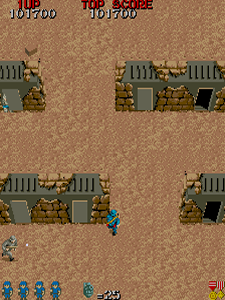
In Commando (Senjō no Ōkami in Japanese) you take control of a soldier aptly named "Super Joe" and make your way across enemy territory after being dropped in the jungle by a chopper, armed with a rifle that comes with unlimited ammo and a limited stock of hand grenades. It's the classic one-man mission where you'll be facing hordes of enemy soldiers throughout several types of terrain. The game is structured in two campaigns of four stages each, starting over with a marginal increase in difficulty once you beat the 8th level.

By default, buttons A and C are used to shoot and button B is used to throw grenades. If you don't want to tap the shot button like crazy just head to the options menu and set rapid fire to "high". There you can also select between three screen modes (of which the third one activates a TATE orientation), as well as choose a special soundtrack if desired among other regular tweaks you'd normally expect from a decent arcade port (button remapping and saving). The alternate music isn't that distinct from the regular one, a basic set of military tunes that puts you in the right mood to perform heroic exploits in the line of duty.

Landscapes range between areas that resemble a jungle, a desert, a bunker field and an airport base. There are no main bosses in Commando, but at the end of each level the screen stops and you must face a series of soldiers that come out in higher numbers from a fortress. Halfway into the level you'll need to pass below a bridge where an enemy will often park a vehicle over it and start shooting out grenades while soldiers close in from the other side. If you get shot a life is lost and you'll restart at a previous checkpoint. Stepping into water ponds and falling into ground holes or ridges/ravines will also cost you a life.

With no power-ups in sight, the only items available for collection are grenade refills. The small crate adds one grenade to the stock, the larger one adds three grenades. Don't worry about feeling guilty if you die with a substantial grenade stock in your hands, it isn't reset when you die (unfortunately this feature became quite rare as the genre evolved).

What lurks behind these walls and doors?

Since it's such a primitive game, Commando boasts a limited number of colors and might look repetitive on a first glance. What it lacks in design assets, however, is duly compensated by non-stop action with just the right amount of animation needed to back it up. You're allowed to fire in all 8 directions, but since you can't strafe or lock the character in place you must always be moving in order to aim your rifle and use your shots wisely (they only travel a certain length before disappearing). As for grenades, note that they will always be thrown upwards no matter where you're facing.

The worst thing that can happen is getting overwhelmed by enemy soldiers and enemy fire. A simple strategy that works most of the time is to just dart forward and avoid lateral enemies as much as possible, especially when going under bridges. In areas where vehicles approach from the sides you must either memorize their spawning locations or keep your movement restricted to the center of the screen. Finally, grenades dropped by enemies will always target your current position, so try to be alert and avoid to stay put if they're coming towards you. The scoring system is basic and bare bones, but watch out for a cowardly officer dressed in green that crosses the screen from time to time. He's worth more than the usual soldier, as well as those officers who are holding a hostage in the first stage.

It's easy to underestimate Commando going only by pictures or if you're just a bystander. It is however quite an addictive game for several reasons: gameplay is fair and tight, stages are short and the action moves at a brisk pace, with a full credit clocking at just above ten minutes. This formula was copied to exhaustion in future games, yet not always as successfully. Direct sequel Mercs (also included in  the Capcom Generation 4 release) expanded on the original concept with great results.

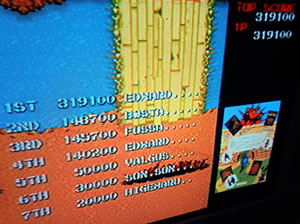
My best result in Commando on the Sega Saturn in the Normal difficulty ended in stage 2-6.


Sunday, October 10, 2021

Sonic Wings Special (Saturn)

Vertical
Checkpoints OFF
4 Difficulty levels
9 Stages
Ship speed fixed, selectable at start
- - - - - - -
Developed by Video System
Published by Mediaquest in 1996

For various reasons, many video game development houses quit their activities after years of successful operation during the 90s. Video System was no exception to this closure wave, but before finishing their business they delivered a final game for what certainly was the company's highlight series: Sonic Wings Special. Direct follow-up to Sonic Wings 3 / Aero Fighters 3, it was developed and released for the main 32-bit consoles with an arcade counterpart named Sonic Wings Limited. I couldn't find precise info on which version came out first, but suffice it to say that even though they're visually similar Special and Limited have fundamental differences that completely set them apart gameplaywise.

The strongest distinction about this game is that it's actually a remix of Sonic Wings, Sonic Wings 2 and Sonic Wings 3. Aspects of all previous chapters are represented in levels, enemies, available pilots and firing patterns, which means that shmuppers with previous knowledge of the series will definitely feel at home when playing Sonic Wings Special. The ensemble brings back well-known faces such as the Japanese duo of Hien and Mao Mao, as well as the all-American pilot Keaton, Swedish viking Kowful and Whity/Spanky, the most intelligent dolphin pilot of all times.

So brace yourself for the final entry of the saga, complete with a TATE mode that brings the game closer to the roots of the franchise. Mind you, even though you can still play it on a regularly oriented TV, the use of a vertical monitor definitely provides the best experience you can get in Sonic Wings Special. The game is just as fun as the previous entries, maybe even more due to the amount of characters available and the more balanced gameplay.

Opening movie and first stage with Mao Mao
(courtesy of YouTube user The VideoGames Museum)

The choice of planes and pilots is still associated with countries (or organizations in the case of PKF, which stands for UN PeaceKeeping Forces). Two characters are available for each nationality/agency, and each one has his/her own features regarding plane type, speed, firepower and bomb stock capabilities. Overall the game tries to offer some sort of equivalence across the character roster, in that slower planes will have more powerful weapons and vice-versa. The efficiency and the amount of bombs you can carry also vary between planes, often representing the deciding factor when you're trying to select the character that suits your sensibilities the most.

Inputs haven't changed from previous games. By default button A is shot, button B is bomb, button C is rapid fire and button R hides/shows the score display, all inputs fully configurable as you wish in the options. Items available consist of P (power-up), B (extra bomb) and F (full power-up, appears only once prior to the final boss). The number of necessary Ps to max out the firepower isn't the same for all planes, and once maxed out all of them will degrade to a lower power level after a while if you don't get another P. Note that some planes also have charge attacks when at least one power-up has already been taken, so don't forget to try this when testing out the characters.

Sonic Wings Special preserves the splitting path mechanic introduced in Sonic Wings 3 while still randomizing some of them. Once the first stage in Tokyo is beaten three out of four random levels must be played (Mato Grosso, Paris, New York and "Dark Forest"), then you go through stage 5 in the Syrian desert. In stages 6 and 8 you must choose between two paths that also define the following levels (7 and 9), then proceed to the tenth and final level. The three randomized stages are easier the earlier they appear in the game, with the third one being the hardest. After that the difficulty remains somewhat the same, but you still have to consider a very noticeable rank mechanic that makes the game harder the more powered up you are and the longer you survive.

Every enemy and destructible bullet or boss part gives you points, so performing a wee bit of milking whenever possible is of course good for scoring higher. The biggest chunk of points however comes from collecting capsules in excess (2.000 for power-ups and 10.000 points for bombs), as well as picking up the currency medals released by destroying ground targets. When taken at the very top of the screen they're worth 10.000 points each, quickly decreasing their value to 200 points if collected from the middle of the screen or lower. Going for 10K medals is quite risky though, that's why it's so convenient to get the Dark Forest or Mato Grosso as second or third levels. As for extra lives, there's only one single extend granted after you score 50.000 points.

The skies above Paris were never this dangerous

I really like the difficulty progression in Sonic Wings Special compared to the previous games. It's not ridiculously hard as Sonic Wings 2, not as indulgent as Sonic Wings 3 and certainly not as cruel and in-your-face tough as the similar output from stray company Psikyo (namely the Strikers 1945 series). Sure, the first stage might soon put you to sleep, but everything after presents a gradual difficulty slope that never feels overwhelming even at high rank. Choosing a crappy pilot makes everything a tad harder, but the game spices things up a little by adding secret planes that are only available after you complete it with the default ones (continuing is allowed, just note that in the final stages you need to restart the level when doing so). 

When a secret plane is unlocked a medal will appear over the character in the selection screen, prompting you to pick the desired plane once the pilot is chosen. If you manage to get all secret planes two new teams will be unlocked: the NATO team (also with unlockable secret planes) and two secret characters accessible by pressing UP from the USA team or DOWN from the NATO team (no extra planes for them). That means the game offers a whopping 26 different characters to play with, cumbersome unlocking criteria notwithstanding.

Another aspect about secret planes is that the game throws a completely different set of stages for them. Considering that Sonic Wings Special does not loop, it's as if the absent second loop levels were reserved especially for the unlockable planes, so be aware that you'll be facing a much harder game if you decide to play with one of them. Finally, a data save function can be used only once per credit when the pilot image appears between levels: press L + R and START to save, then return to this saving point from a fresh new entry in the start screen. The Sega Saturn edition also comes with an extra mini-disc with three songs dedicated to Mao Mao.

My pilot of choice for the 1CC on Normal difficulty was Kohful the viking and his default plane the AJ-37 Viggen. As for the splitting paths, I chose Panama in stage 5 and Mexico in stage 7. Other characters I enjoyed playing with were Volk and Keaton. Unfortunately good old ninja Hien was botched by too much spread in his daggers and an annoying effect that makes them stick to larger enemies before exploding, causing much visual confusion at least for me. Maybe I'll try to use a secret character when I get the chance to play the Playstation version, we shall see!


Saturday, March 27, 2021

Jikkyou Oshaberi Parodius - Forever with Me (Saturn)

Horizontal
Checkpoints ON
8 Difficulty levels
8 Stages (loopable)
Ship speed by icons
- - - - - - -
Developed by Konami
Published by Konami in 1996


For those people who wondered what Konami was thinking when developing and releasing the fourth chapter of the Parodius series for the Super Famicom in 1995, the answer actually came quite quickly. As usual, the game was just too good to be restricted to a single console platform, so the company soon ported it to the 32-bit generation with the added subtitle of Forever with Me, whatever that's supposed to mean. On the outside it looks and plays just like the 16-bit original, albeit with a few standout changes in the core game that are obviously aimed at turning it into a better experience overall.

The aspect that gives Jikkyou Oshaberi Parodius - Forever with Me its name is a comical announcer who’s always babbling random stuff (in Japanese) as the game unfolds. An extra female announcer is also present in the cooperative 2-player mode, which is one of the most prominent novelties of both 32-bit ports since there is no co-op in the Super Famicom version. Being able to tag along with a partner probably makes this particular chapter the best one for sheer co-op fun because of three things: a character roster that allows for great combinations of powers and abilities, the complete absence of slowdown and the difficulty level being the same as in the 16-bit original.

Doitsu on manual power-up mode
(courtesy of YouTube user The VideoGames Museum)

On top of the nonsensical and colorful design that had its details touched up a little bit, the Saturn version also comes with a few other changes (keep reading). The core gameplay remains intact of course, as defined by the classic mold first introduced in the Gradius series. If you decide for manual power-up mode after selecting the character (the lower option), you'll have to press a dedicated button in order to activate the upgrade that's highlighted in the weapon array, which gets shifted to the right as you collect power-up capsules. By choosing auto power-up mode the game does the upgrading automatically for the player, but it's still possible to activate the upgrade yourself if desired, such as when you want to have more speed. The other inputs are shot, missile (which can be combined in the same button, of course) and bell power.

As all Parodius fans know, rules on the use of bell powers are inherited from the TwinBee franchise. They are either generated periodically in between capsules or released in batches by mid-sized enemies, and come in the following colors: yellow (score), blue (bomb), green (instantaneous inflation + invincibility), white (bullet-cancelling kanji shot), red (three energy barriers) and purple (turns all weak enemies into power-ups and/or bells). Shoot the bells to juggle them and switch their colors, just note that it takes four shots to change from yellow to the other colors in sequence. As one of the main sources of scoring, yellow bells collected in sequence soon max out at 10.000 points each, provided you don't let any bell get past you.
 
In between regular power-up capsules and bells you also get gray capsules that work as smart bombs. Don't use them if you want to get the scores from the kills though, because all enemies wiped out with the gray capsule yield no points at all. That said, the other main source of points besides bells are the secret fairies that must be uncovered by shooting at their locations. Each one is worth 10.000 points, and if you're the type of player who cares about completing extravagant achievements you can strive to collect all 70 fairies to unlock secret character Dracula-kun, and then a whole new set of 70 faiires to unlock its sibling Kid Dracula. Fortunately it's possible to take a shortcut by means of a secret code if you want to add these extra characters to the default 16.

Relatively easygoing when compared with the arcade games in the series, Jikkyou Oshaberi Parodius does not deny its console sensibilities and is probably the perfect chapter for immediate "pick up and play". Inspirations from several Konami titles abound, and not only related to the shoot'em up realm. Tokimeki Memorial, The Legend of the Mystical Ninja, Lethal Enforcers and Taisen Puzzle-Dama are used as themes for complete stages, with the later two being reworkings or completely new ventures on the Saturn and Playstation versions. New details on enemies and bosses, minor graphical enhancements and a few shifts in the CD-quality music are also in place.

Pentaro to the rescue

Going beyond the basics, high level play also involves the convenient use of the purple bell, which was introduced in Gokujyou Parodius but is absent from Jikkyou Oshaberi Parodius on the Super Famicom. Another important alteration in this regard is that the extend routine is not interrupted when you score more than one million points. The first extend comes with 20.000 points, with new ones awarded for each 100.000 points afterwards. It's not uncommon to amass a huge amount of extra lives if you play well enough, which obviously helps in reaching higher loops more easily. Since the difficulty increase after you beat the game is also a tad tamer than what you'd get in any of the arcade titles of the franchise, chances are you'll be facing a dedicated Parodius marathon type of challenge on the first two rounds/loops at least.

As expected, this port also preserves the checkpoint-based save function. When you pause and press L, the middle option contains three save slots while the upper option is used to load them at any time. Pausing and pressing R, on the other hand, allows you to return to the title screen on the lower option. A tiny in-game improvement appears in a new display just below the indication for the hi-score, which shows the current difficulty level and loop. In the title screen you also have the choice of two new special game modes: Omake 1 is a completely new single stage where you're supposed to get high scores, whereas Omake 2 works as a racing mini-game where the objective is to get to the end of the area as fast as possible. 

Click for the main menu translation for the Normal game in Jikkyou Oshaberi Parodius - Forever with Me on the Sega Saturn

Even though on a first glance both 32-bit ports are very similar, there is a specific switch in the options screen that alters the gameplay significantly. In the case of the Saturn version, this tweak is called "Extra". Its function is to change enemy formations completely, an alteration that makes the game a tad harder than usual. On the Playstation port this is replaced by "Accident", which adds polygonal-based bonus areas to the end of each level. Besides these interesting tweaks to the base game, both ports allow the OH! bogus power-up to be replaced by a slot machine for bells if you turn "Slot!" on. As for "Duet", "Ikari" and "Nage", they are specific tweaks for co-op play.

Once I got re-acquainted with the game I decided to play with Upa (the baby boy) and got the result below in one of my first serious credits. I played with auto power-up on full defaults (difficulty 4, Roulette ON, Slot!/Extra/Revival OFF, Oshaberi ON) and reached stage 3-6. I had great fun and felt so comfortable with the automatic handling of my upgrade capsules that I didn't even try to play the game with manual power-ups. I did activate a second speed-up right after the first one though.


Now I guess I'm ready to move on to one of the ports for Sexy Parodius!

Thursday, September 17, 2020

Blast Wind (Saturn)

Vertical
Checkpoints OFF
4 Difficulty levels
6 Stages
Ship speed fixed, selectable at start
- - - - - - -
Developed by Technosoft
Published by Technosoft in 1997


Something weird must have happened inside Technosoft's headquartes as the 90s came to an end and the 32-bit generation was beginning to fade. By 1997 the company had somehow failed to keep the momentum since the arcade and home releases of Hyper Duel, and Thunder Force V would still take another year to hit Japanese shelves. Blast Wind came out with little fanfare in a very low print run, surrounded by rumors that it was actually supposed to be released in the arcades before the Sega Saturn. The game made little impact and its rarity soared, soon becoming a cherished prize for players and collectors alike. 

The reason why Blast Wind doesn't share the same appreciation as, say, Hyper Duel, which is equally sought after as a collectible, can certainly be attributed to a few aspects that aren't usual for a game developed by Technosoft. Being short and easy, for example, isn't a nice combination for a full-blown 32-bit title. The game also lacks the graphical edge you'd expect from such a powerful platform. It kinda feels like a 16-bit game at its essence, only polished by the power of superior processing. Many of its graphical assets and sound effects, for instance, are a throwback to Thunder Force IV. And while typical Technosoft and decent in its own right, the soundtrack doesn't make the lasting impression you'd normally expect from such a beloved developer. Besides, the sound balance is off and the music is almost totally engulfed by the sound effects.

On the other hand, Blast Wind does offer more than the basic shooting thrills of old, expanding a little upon the regular Technosoft completion bonuses well known by fans since Thunder Force II put the company's name on the map.

First stage of Blast Wind with the blue ship on an easier setting
(courtesy of YouTube user MAX 300)
 
A nifty intro shows a little bit of the story about two pilots being sent to battle an alien threat known as Gorn. Two ship variants can be used by choosing pilot/player 1 (Kyo, blue ship) or pilot/player 2 (Forn, orange ship). They both use two types of weapons, the "switch" shot and the homing shot, which by default work with buttons A and B respectively, with button C reserved for bombs (all inputs are fully configurable in the options). Shot types, however, behave differently for each ship/pilot: Kyo fires a wave shot that can crawl over surfaces and an X-shaped homing pattern, whereas Forn fires a laser and an aiming spread vulcan. Playing with Kyo is definitely easier than doing it with Forn, whose weapons feel all around weaker.

Regular upgrade items materialize as power-ups (P), extra bombs (B) and trailing shields (S). Picking up a power-up not only increases your firepower, but also creates a horizontal barrage of energy that gives you momentary invincibility (the accompanying visual effect is quite cool but odd at first sight). Some enemies will also release coins worth 100 points each. These coins – which look very much like the power chips you see in Compile games of the Aleste series – are very important in the long run because for each 50 you collect the next one will fall as a 1UP (be quick to grab it or you'll see it fall away like an ordinary coin). You can also achieve two score-based extends at 400.000 and 2 million points.

Blast Wind's claim to fame appears in the splitting path mechanic implemented by switches that lead to alternate paths containing different enemies and boss forms. All you have to do is touch the switch with the ship to activate it. Some switches release random items instead, but these are clearly identified so that you know which switches to actually trigger.

Path splitting does provide some degree of replay value, but when you start to play for score you'll often be restricted to specific paths in order to get more points and coins. After all, coins are the means to extra lives and each life remaining gives you 100.000 points when the game is beaten. Other than that, everything else about the scoring system is related to preserving resources. End of stage bonuses are given for the amount of bombs you have, while items in excess grant either 3.000 or 5.000 points each. Certain spots can also be shot at to uncover varying rewards of 1.000 or 5.000 points (signalled by $ and stars). Lastly, some bosses can be exploited by targeting destructible parts before going for the main kill.

Push to bypass
 
If there's any rank in Blast Wind, that might only be noticeable during boss fights and even so it isn't quite clear how it works. Sometimes one of the side turrets of the first boss just takes a lot longer to be destroyed for no apparent reason, but I also saw some odd unexpected behavior on the third boss. Deaths take away one level of firepower, but fortunately the supply of power-ups is so rich that soon you're back to max power again. Shields are great to block some boss attacks, as long as you remember that after taking too much damage they deplete and turn into a regular power-up.

Another feature that adds to the ease of completion here is the absence of harm when touching walls and scenery. That doesn't mean you'll feel no pressure when navigating those quick levels though. I had many annoying and unexpected deaths because I got stuck in a tip of the scenery, for example. Even though the vertizontal orientation feels a little offset by the side HUDs, some bullet patterns still feel cramped and are better off completely avoided instead of dodged with twitch movements, at least when playing with the blue ship. It just feels a little too fast for my liking. This impression changes when playing with the slower orange ship, which is also the better choice for collecting coins because it lacks those small homing missiles that come with the blue ship weapons.

So which ship to choose then? What is more important, more power or better mobility? The funny thing about this is that unless they're told or they pay attention to the attract mode, many players aren't even aware that you get a ship with completely different weapons on the player 2 side.

The Saturn disc includes automatic save and optional tweaks, also allowing all sorts of button customization. My best final result playing on Normal difficulty with pilot Kyo is below (blue ship, player 1). Yes, Blast Wind is relatively easy fun but you'll feel a lot more pressure when trying to no-miss to maximize your high score. I always ended up screwing somewhere and couldn't get it. Maybe next time!