Vertical Checkpoints ON 4 Difficulty levels 6 Stages
Ship speed fixed
- - - - - - - Developed by Taito in 1988
Published by Taito in 2005
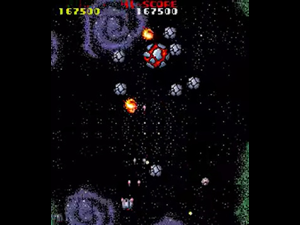
If it weren't for Fighting Hawk being included in a Taito compilation, many people would certainly think the game was yet another product from Toaplan. Of course there are some underlying signs that don't exactly click, such as the soundtrack that slightly resembles Master of Weapon and that typical font Taito used in pretty much all their arcade games of the time. But everything else screams Toaplan, in an explicit homage that's perhaps even more pronounced than that of Gekirindan.
Taito Memories II Vol. 1 "Joukan" on the Playstation 2 is where you can find a port of Fighting Hawk, also available in full TATE glory. My impression is that this game is quite obscure even among Taito's connoisseurs, a commercial failure that got lost amidst the glut of shmups that took over the scene in the end of the 80s. Although averagely competent, it stands in the shadow of heavy hitters such as Kyuukyoku Tiger / Twin Cobra and Hishouzame / Flying Shark, which in turn are its main sources of inspiration. This means, of course, that players who enjoy the gameplay of these Toaplan shooters will feel right at home with Fighting Hawk.
Splitting tanks halfway into the 1st area
Getting used to the gameplay is as simple as it gets. One button shoots and another triggers a salvo of homing missiles while melting all on-screen bullets, acting like a variation of a life-saving bomb. As is customary in this series of Taito compilations, both inputs can mapped as you please in the controller, just remember that a turbo function is definitely needed for the shot button unless you'd like to mash the controller (and your wrist) into oblivion. Then it's all a matter of learning enemy and boss patterns, their reload routines and memorizing a few sections in order to get through them with less hurdle.
With six levels of relatively long duration divided in 149 "areas", Fighting Hawk plays out as if it had been designed between Tiger-Heli and Twin Cobra, only with a much less aggressive difficulty progression. And once you get your shot powered up by taking the upgrade items, the game also starts to resemble Flying Shark / Hishouzame. The difference here is that when maxed out the firing stream acquires a spread opening that's very handy to take care of enemy waves approaching from all sides. Besides the power-up, the item gallery also includes extra bombs, bonus medals (1.000 points each) and 1UPs. Extra lives are also awarded by scoring, the first with 60.000 points, the second with 180.000 points and then further ones at every 100.000 points you're able to achieve.
Besides regular memorization, in shooters like this one the most important thing to have in mind is to beware of sniping tanks taking you off guard. Most of the danger in Fighting Hawk comes from below, either from tanks approaching in parallel tandem or from large bombers that enter the screen with no warning whatsoever. That's why from stage 3 onwards it's only safe to hug the bottom of the screen if you know beforehand what's coming next. And in the last stage a sequence of 25 jets arriving from below must be destroyed before facing the dragon bat final boss.
Fighting Hawk's attract mode (courtesy of YouTube user Replay Burners)
The path to the dragon bat spans all sorts of terrain. Forests, rivers, snow fields, urban and industrial terrains, sea. Enemies include all sorts and colors of tanks, turrets, floating rafts, boats, helicopters and battleships. The overall emphasis is on a military background, yet weird stuff appears every now and then, such as the race cars in the snow stage.
The notion that the game is a much tamer variation of the Twin Cobra formula is definitely helped by the generous assortment of bombs. There are checkpoints, but with five fresh bombs for each new life any of the bosses or mid-bosses can be easily bomb-spammed if you don't want to take any chances. The only advantage of preserving bombs is to take the end-of-stage bonus of 1.000 points for each bomb in stock. In addition to that, whenever you have shot or bomb maxed out (5 bombs in stock), any respective in-game item is automatically spawned as a medal.
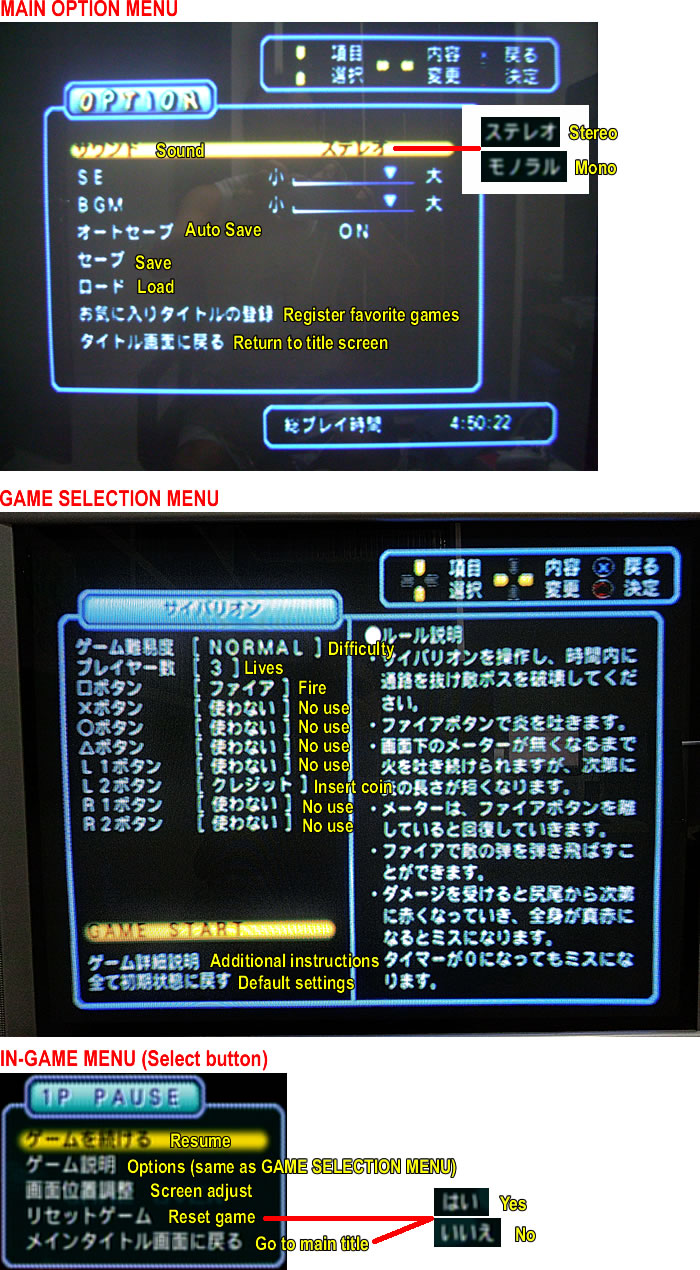
Click for the option menus translation for Fighting Hawk on Taito Memories II - Vol. 1
In the balance between survival and scoring, there's also the possibility of exploiting checkpoints, but this has to be well planed. Some of them send you relatively back, others allow the progress of the credit in an easier fashion. In the end, Fighting Hawk grants a final bonus of one million points for completing the game.
Below is my final 1CC result for this mild Toaplan copycat. It was fun for the ease and the diversion, definitely a recommended break of similar style if the likes of Twin Cobra or Flying Shark seem temporarily insurmountable.
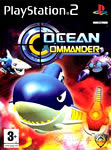
Arena Checkpoints OFF 1 Difficulty level 21 Stages Ship speed by icons - - - - - - - Developed by CyberPlanet Interactive Published by Phoenix Games in 2007
I little while after I started collecting shmups in physical form, Ocean Commander for the Playstation 2 proved to be one heck of a challenge to get. Originally released for the Windows PC, it came out for the PS2 in very low quantities only in Italy, which meant it wasn't as readily available as the secondary port for the Nintendo Wii (there's also a version for the Nintendo DS, but let's not go there). Anyway, at least it wasn't an expensive find back then. I have no idea how it stands today in terms of rarity.
And lo and behold! I finally took the time to play it after all these years. I was kinda looking forward to it because this serves to end my run of crappy beatable shmups released by Phoenix Games for the Playstation 2, the most legendary company to dish out all sorts of stupidities upon the market during and long after the PS2 was commercially gone.
But hey, is Ocean Commander that bad?
Unfortunately it is. With the crappiest of honors and with no 60Hz mode in sight, meaning you're stuck with that typical shimmering of the native 50Hz European frequency. Graphics and music aren't that bad for a cheap title, but the gameplay...
Ripping through one of the poor bosses
Ocean Commander is an arena side-scrolling shmup where players control a futuristic submarine and battle waves of enemy vessels, water-propelled crafts and mechanical threats in an underwater setting. The idea looks great on paper and in screenshots, with definite vibes from old school classics such as Seaquest and Sqoon. Your mission is to protect territorial waters as a special arms commander, fighting against an evil empire that has been making attempts to conquer the underwater city. You must stop dr. Shark’s evil plans to conquer Federation Earth before it's too late.
Playing the game is a bit weird, but soon you'll get used to it. Move the submarine with the left analog stick and use the right stick to control the target, pressing button R2 to fire. Provided you have it in stock, press R1 to trigger the "thunder strike", a bomb that inflicts damage all over the screen and melts bullets. It's odd that they just didn't transform the game into a twin-stick shmup, which would make a lot of sense, but I guess the developer didn't want to fiddle with the controls devised for the original PC game.
There is a single life bar that gets refilled in every level. If the life bar is gone the game is over. Green orbs randomly dropped by destroyed enemies can be taken to recover lost energy, whereas red orbs increase the stock of thunder strike bombs. Besides the regular score, there's also a counter for money that can be used in between stages to purchase permanent enchancements to the submarine. These include three upgrade levels for maneuvering speed, power-up, shield, rapid fire, torpedoes, homing missiles, laser, defensive orbs, bouncing spheres, lightning, ground missiles and spread shot. Prices increase with each purchase.
Upgrade mechanics are very similar to games like Heavy Weapon, also available for the Playstation 2 and more modern platforms. However, while Heavy Weapon does offer real thrills and challenge, Ocean Commander is nothing more than a repetitive snoozefest that's prone to put anyone to sleep after some time. It doesn't take long for the submarine to turn into a powerhouse that destroys everything across its path with almost no damage taken from eventual hits. Bosses have a few phases as you tear them down, but their patterns are extremely predictable and one or two bombs are enough to leave them on the brink of defeat. Since every level gives out at least two to three spare bombs, you'll only die during a boss fight if the controller fails or if you fall asleep.
A taste of Survival mode in Ocean Commander for the Playstation 2 (courtesy of YouTube user GXZ95)
Regardless of how cheap the whole experience gets after a while, from my brief time playing Ocean Commander it was clear that the best weapons to acquire and upgrade first are the homing missiles and the laser. In general, there's no need to worry though. As if the core game wasn't easy and tedious enough, getting through all sections of that map takes pretty much two hours in Mission mode. At least you're given the chance to divide the torture into shorter sections by choosing "Back" in between the levels, resuming the credit later by selecting "Continue". Just note that successively continuing doesn't reset the score. And if you beat the game the Continue option stays there forever, always giving access to the fight against the last big boss.
Besides Mission mode, a Survival mode allows you an endless session where torture gets escorted by an utter lack of firepower. If you live long enough blue orbs will fall to start granting you a few power-ups.
The Hall of Fame high score table in Ocean Commander is as stupid as the game itself, since it doesn't allow you to enter initials and keeps adding whatever score you get for PLAYER. The screen below is the final tallying after I dispatched the last boss, the single enemy to be defeated in the 21st and final stage of another unspeakable experience in gaming mediocrity.
Good bye, Phoenix Games! But wait, if you spot any other shmup made or published by them that I haven't tried yet please let me know. I'm a sucker for torture sometimes. :)
Horizontal Checkpoints OFF 3 Difficulty levels 10 Stages Ship speed fixed - - - - - - - Developed by X-Nauts and Psikyo Published by Global A Entertainment in 2003
After two very similar shmup entries for the Sony Playstation and the Sega Saturn in 1996, the Cho Aniki series received an RPG game for the Bandai Wonderswan, a weird sports title for mobile phones and then this exclusive chapter for the Playstation 2 called Cho Aniki - Seinaru Protein Densetsu, whose subtitle translates to something like "The Legend of the Sacred Protein". Given how visually crazy the 32-bit shmups were, trying to top that was a hefty challenge that somehow gets accomplished here, and by a different development team no less.
With Masaya gone, the series was taken over by X-Nauts and Psikyo. The graphics changed to an almost undescribable mix of weird 3D backgrounds mashed with stupid enemies in the foreground, as if the intern had pasted half-assed random sprites over the game. For PS2 standards it's honestly ridiculous, but after a while you realize that at least the enemy placement has a purpose, which means that the forté of Seinaru Protein Densetsu is definitely in the gameplay. A little patience is needed, of course, but if you stick with it you might be pleasantly surprised. Yes, pleasantly. At least I was.
If you refrain from doing anything after turning on the console a lengthy intro will show our favorite bodybuilders Adon and Samson doing their thing to the sound of a silly song. However, they're not in the center of the action even though they're on screen at all times. Players control "the legendary protein", a glob-like thing that serves as the single hitbox of the group. Adon and Samson are positioned according to the selection you make when starting the game. You can choose two out of four configurations: covering the sides, trailing, frontal stance and rotating. Alternating between both formations is done with button ×, firing is accomplished with button □ and button ○ is used to trigger a bomb (if you have one). Button remapping is not possible.
Intro sequence to Cho Aniki - Seinaru Protein Densetsu on the Playstation 2 (courtesy of YouTube user Niels Van Glas)
An unusual aspect of the game is that the left analog stick can't be used to control the protein blob, which somehow frightened me, but fortunately I have a controller with a remarkably decent D-pad. The right analog stick, however, is an essential part of the gameplay since you must use it to "shake your hips and spin" as the instruction manual puts it. If you move the stick quickly in a circular motion the meter in the lower left fills up, and by pressing it you'll unleash a super powerful man's beam whose strength depends on how full the meter is. I'll leave all funny interpretations related to this manly beam to the reader, but suffice it to say it's a sight to behold, on top of being a great means of killing bosses faster. Mind you, whenever the right stick is being wiggled you're not allowed to fire, so my advice is to plan ahead if you want to do it in the heat of the battle.
Each enemy leaves behind a protein orb that powers up the character. This is where the gameplay starts to get interesting. Each part of your team can be powered up separately. By taking the orbs with either Adon or Samson their silhouettes are filled up, representing their ability to fire more powerful shots and take hits for you. If their energy is depleted they enter a resting/sleeping mode and refuse to go into formation, only waking up by taking another protein orb. On the ther hand, if one silhouette gets completely filled you add one bomb to your bomb stock. Orbs absorbed by the holy protein are used to upgrade the main firing stream, and once you reach max power (20 orbs, or 5 orbs per extra firing stream) each consecutive orb taken will increase in value in steps of 1.000 points, maxing out at 10.000 points. These scoring chains are carried over to the next stage, but they're broken if you die or at least one power orb is absorbed by Adon or Samson. Sound cues help with keeping track of orbs taken.
What I described above is the reason why Cho Aniki - Seinaru Protein Densetsu has the best gameplay in the series so far. You do start with no bombs in stock, but since bombs are completely independent of life stock you can just hoard as many bombs as you want to tackle tricky parts of boss fights. By playing defensively a clear isn't that far off no matter how cheap the game gets (those falling enemies in the cave stage are really annoying). Beaming also represents an important aspect of defensive gameplay since both the holy protein and Adon/Samson are invincible whenever you're doing it. Playing aggressively for score is a whole different story though, often requiring players to kill enemies a certain way or to avoid orbs in order to keep the chain going.
A final detail in the gameplay is related to the small ghosts released by specific enemies at certain points in the game. Each one has a different effect depending on its color. The blue ghost gives you full power, the green ghost gives you 10.000 points, the white ghost gives you an extra bomb and the pink ghost fills up the beam meter immediately. None of them results in an extra life, but two score-based extends are obtained when you reach 1,5 and 3,5 million points.
Eyes without a face my ass!
Even though most stages are rather easygoing with few hard sections to deal with, the influence of Psikyo is definitely present here and there. The order of the first four levels is random, for example, just like in Strikers 1945 and Gunbird. Another Psikyo trademark is in the dense bullet spreads most bosses are able to fire. They all have at least two phases with differing attack patterns and intensities that vary as the fight drags on, with the occasional cheap ramming that's bound to take players off guard. The good news is that there's no rank at all, so it all boils down to memorizing patterns in order to survive. Just note that bombs cannot be used whenever you're deploying the powerful beam attack. Another aspect to consider, especially during boss fights, is that if you want to use a certain formation when beaming (such as the full defensive frontal position), switch to this desired formation before Adon or Samson are about to enter sleep mode, otherwise the beam will only be effected with the default side/resting formation.
With 10 stages, Seinaru Protein Densetsu has a decent length and enough variety to quench fans of kusoge. An abundance of manly and childlike voices can be heard throughout in complement to a relatively conventional soundtrack. The most risqué homoerotic designs are reserved for the panels in-between stages and the most ludicrous bosses, which besides just being downright weird often take creepy positions when firing their bullet patterns. During the last level you'll have to face them all over again before confronting the final boss.
My final 1CC score in the Normal difficulty is below. It was definitely a fun ride despite the initial perception of just another mindless shooting schlock. My formations of choice were default/sides and frontal/defensive. My playing strategy: once I got one extra bomb in the first stage I focused exclusively on scoring except for stages 6 and 8, where I hoarded bombs for the bosses I found problematic, mainly the 9th and the final boss.
Next in the series is Cho Aniki Zero, a.k.a. Rei Cho Aniki on the PSP.
Vertical fixed Checkpoints ON 1 Difficulty level 1 Stage (loopable) Ship speed fixed - - - - - - - Developed by Nichibutsu in 1980 Published by Hamster in 2005
When people ask me what I think about the original Space Invaders game, more often than not it's hard to disguise my disdain. Of course I do understand the importance of the game to the history of this hobby, but I cannot fathom the idea of spending hours playing such a drab shmup that has no ending. But why am I talking about the original Space Invaders anyway? The reason is that I kinda had the same impression of Moon Cresta until very recently, i.e. the idea the game was actually so primitive that it didn't warrant any serious attention.
Yet here I am, writing about it after playing the port released for the Playstation 2, no less. Moon Cresta is in volume 5 of the Oretachi Game Center budget series, a Japan-exclusive collection dedicated to emulated versions of old arcade games. Regardless of the fact that it just sounds dumb to have a full disc dedicated to this little game, at least it comes with a few nice extras such as the folder with info on the arcade board and a pair of mini-discs with original/arranged versions of the soundtrack and sample runs with extra material about this particular series.
You can get a lot of fun and thrill in this trip to the space war!
In order to differentiate themselves and present some evolution to the idea pioneered by Taito, Nichibutsu added a few tweaks to spice up the experience. Besides taking extra inspiration from Namco's Galaxian (in the way some enemies split and/or descend upon the player), Moon Cresta has a unique mechanic based on three ship sizes and a docking maneuver players are supposed to pull off in specific points of the game. Despite the simplicity of it, it's actually an ingenious way to make things more addictive and lure people into wanting to try that next credit in an era where each extra coin spent mattered in arcade centers.
The basic rule in the gameplay is that you're given exactly one shot at a time fired by a single button (any face button of the PS2 controller can be used to fire, SELECT enables the credit to be started). You get three lives, and each life comes with a different ship, or "rocket" as the game calls it. The first rocket (I) fires a pea shot, the second rocket (II) is a little larger and fires a double shot, and the third rocket (III) is even larger but fires a triple shot. If you don't die you'll be required to connect all ships during the docking parts mentioned above, which takes place for the first time after the 4th enemy wave.
During docking the mission aim is to align your current rocket with the next rocket that appears at the center of the screen during an alloted time window. The rocket falls down naturally, but if you need extra space or time to complete the maneuver just press the fire button and use the directionals to help out. A successful docking will result in a combined rocket formation that's naturally more powerful, as well as bonus points for time remaining. Failure will result in the explosion of the ship and the loss of a life. After the 7th wave, where you face a series of meteors that don't need to be fully destroyed, a second docking sequence happens for another chance at further enhancing the ship's capabilites. Note that you can lose two lives at once if you have an arrangement of two rockets and fail to land correctly over the third rocket piece!
Once the purple enemies of the 9th wave are fully destroyed a FAR OUT! message is displayed and the game loops at a higher difficulty with the smallest rocket you have in formation or in stock. In the case of a three rocket formation, for instance, the loop will start with rocket I.
A quick credit of Moon Cresta on the Playstation 2 (courtesy of YouTube user ZetaMage)
All waves of Moon Cresta are so short that it's pointless to consider each one a separate level, so I always think of it as a single-stage loopable game that can be completed in around three minutes if you play well enough. A word of attention for score chasers is that scoring higher is directly related to the time bonuses of the docking sequences. That's why even though rocket III seems great for survival, it just isn't good for score because you won't get into any docking sequence with it. Achieving 30.000 points gives you a complete free game for your current credit, which means you preserve your score and start the game over from the first wave once your last ship is destroyed (the message ENJOY ANOTHER GAME appears as a signal of this unique feature).
Despite the relatively disjointed nature of the first couple of waves and the rudimentary mix of music cues and sound effects, the looping feature and the embrionary but engaging stage design presented in Moon Cresta definitely puts the game in a different category from Space Invaders and its several endless copycats. It's one of those classics that haven't aged that bad, and while not as flashy or loud as Konami's Scramble it still stands on its own in terms of immediate and quick fun. Several home ports came out besides this PS2 version, the PS1 being a particularly interesting iteration that deserves special attention (more on that in the near future, I hope). Moon Cresta was followed by pseudo-sequel Terra Cresta, in an unexpected series that went on across several systems and platforms.
Click for the option menus translation for Moon Cresta on the PS2
No functional difference exists between the Japanese and English versions of the game that are included in this PS2 release. As you can see from the Options translation above a TATE orientation is included, so that's obviously the best way to enjoy the game if possible, even though fullscreen YOKO is just fine for what the game has to offer. That's how I played it for a couple of evenings to get the high score below, finishing the credit in loop 4.
Vertical Checkpoints ON 2 Difficulty levels 3 Stages (loopable)
Ship speed fixed
- - - - - - - Developed by Capcom
Published by Digital Eclipse in 2005
Another first from another important developer, let's go!
Yes, every company has to start somewhere. I'm not saying that Vulgus was the first game designed by Capcom. It was however their first shmup, and as such deserves at least a bolded footnote in the history of the genre. Many would argue with that, and even more people simply ignore it because it was soon overshadowed by the games that followed. Fortunately Vulgus wasn't (and shouldn't be) forgotten, seeing that it was included in all of those compilations backed up by Capcom ever since the 32-bit generation hit the gaming world.
That said, It's possible to play Vulgus on the Playstation 2 by means of the Capcom Classics Collection. Unfortunately this compilation does not offer any option to play it in TATE, but that isn't that much of a loss if you've got a decently sized TV/monitor. The game's primitive mechanics don't require much as you're invited to attend the coming out party thrown by giant insect mutants from a planet callled... Vulgus. Basically it's just a relentless series of enemy waves attacking the player in random formations throughout three ever-looping ground levels separated by outer space intermissions.
Starting the fun with Vulgus on the Capcom Classics Collection (courtesy of YouTube user VideoGaming4U)
In the world of Vulgus your tiny round spaceship is equipped with a regular shot and a more powerful and limited attack akin to a cannon, missile or torpedo. It drills straightly forward destroying all minor enemies, only stopping against those bigger bugs that cross the screen from time to time. It's mostly indicated against enemies that appear and enter into line formations after a brief while, kinda like those classic patterns first seen in Galaga. The difference here is that you also have other enemies flying around everywhere, which sometimes makes it difficult or impossible to aim the torpedo and kill complete enemy formations to get more points (the more you kill with a single blow the higher the bonus).
Another visual influence here is Xevious, particularly during the forest planet of the second level thanks to the simliar terrain and the appearance of revolving blocks that become invincible and scroll downwards if you fail to destroy them. The difficulty picks up accordingly from the crater planet of the first stage, quickly peaking as soon as you enter the icy planet in the third stage. Enemy movement patterns get more and more complicated, and since their shots are all directly aimed at the player it soon becomes clear that you absolutely can't stay put. Does this sound familiar? Of course it does, after all this is the same gameplay behavior seen in 1942 and Exed Exes, two spiritual successors in the Capcom shmup timeline.
Vulgus is also where you'll first see some trademark icons in the Capcom shmup lore, such as the Pow item and the yasichi (the colored lollipop). The Pow appears randomly as you defeat enemies, and each one adds an extra cannon/torpedo to your stock. The yasichi, on the other hand, is actually an enemy that approaches the ship and darts into its location. Other items show up in the form of letters D, E and S, which seemingly don't do anything. I don't think they affect enemy behavior to a noticeable extent (decrease quantity, increase number, increase speed) as seen in the hint included in this very same collection. What I noticed is that if you take many of them during the same stage without dying you'll eventually be able to collect a yellow star that's worth 10.000 points.
The loop boss!
An interesting aspect of the gameplay that might not be that intuitive in the beginning is that the quicker you take Pows and letters the quicker they will appear. If you fail or refuse to collect an item it will keep showing up until you take it, and only then the item spawning sequence will be resumed (most frequently it's a random letter for every two Pows). Items don't appear in outer space areas, but whenever they're on screen note that if you move left/right and leave it out of sight it might just disappear, as will some of the enemies.
For a quick burst of shooting action Vulgus is quite a decent diversion, given that it doesn't take too long to be looped. At the end of the 3rd stage a bigger enemy with rotating rocks appears, in what could be considered the loop boss. There are a few odd choices in the rudimentary mechanics, such as the cannon stock being retained even if you die and the routine for extends and extra lives. Extends are normally achieved at 20.000 and 60.000 points, whereas 1UPs come from destroying certain enemies and quickly vanish amidst the mayhem. No worries though because they get duly registered. And whatever your life stock is, the maximum amount shown in the life indicator is 4.
My final verdict on this game is simple. If you fancy the style of 1942 and Exed Exes but can't cope with their excruciatingly long campaigns and difficulty, which is my case, then Vulgus is certainly a nice option to try. It's just as relentless, but three stages is all it takes to add it to your 1CC achievement list. Both input buttons can be configured at will in the options screen, as well as rapid fire (a controller with turbo fire will give you better results though). The repetitive music is really the only atrocious aspect players need to endure, but there's a slightly less grating alternative in the Capcom Classic Collection disc. Just go to Options → Game Settings and switch on Sound Remix.
Here's my final result in the Normal difficulty, reaching the icy planet one more time on the second loop.
Horizontal Checkpoints OFF 4 Difficulty levels 7 Stages
Ship speed fixed
- - - - - - - Developed by Capcom
Published by Digital Eclipse in 2006
Three full-blown games in one single arcade title isn't something you see regularly. Three Wonders, also known as Wonder 3 in Japan, was Capcom's take on such an odd formula, featuring a platformer, a shmup and a puzzler. The elf characters of the platformer Midnight Wanderers - Quest for the Chariot (Roosters in the Japanese version) are the same ones that appear in Chariot - Adventure through the Sky, whereas the puzzler Don't Pull features a cute design reminiscent of Pengo and Bomberman. Since this is a shmup-oriented blog, the option I played last week was obviously Chariot. It's actually my second time doing it, since I had already spent some time with the port released for the Sega Saturn in 1998.
Capcom Classics Collection Vol. 2 on the Playstation 2 is one of the several ways you can experience Three Wonders in the comfort of your living room. It's a perfectly fine version that includes automatic saving, full button remapping with additional autofire and a few related extras. The game itself is extremely colorful with a sweet art design that kinda predates the visual style Capcom would later infuse in titles like Eco Fighters. It's also got a simple rank progression that makes the game slightly harder the longer you remain alive, which is something I didn't really notice back when I played the Saturn port.
First stage of Chariot (courtesy of YouTube user Oto Mitas)
As you take to the skies with any of the two characters (co-op possible) you’re allowed to shoot and to fire a "crash" attack based on your tail energy. There’s no autofire by default for the shot input but you can activate it the options (set rapid fire to ON). Shot type is dictated by colored power-ups released by floating chests. The wide shot (red, default) has a good spread coverage and generates a single straight blast as crash attack, whereas the straight/rapid shot (green) is totally focused but fires a wide staggering blast for crash attack.
The basic and most important strategy to succeed in Chariot is to power up as fast as you can. Four consecutive items of the same color are necessary to maximize the shot power level, but chests also release other essential upgrades such as the option that increases the size of your tail (up to seven segments), the bomb (B) that activates a ground projectile (a second B adds a trailing effect that extends the reach of the bomb) and the emblem that gives you a 1-hit shield in the form of a golden chariot (appears only once in selected stages). Regarding tail size, it’s important to mention that the larger the tail the more crash attacks you can fire in succession. Each one consumes 3 tail segments, but fortunately tail energy recharges rather quickly over time. Tail energy is also consumed when you use the tail to deflect bullets and damage enemies coming from behind, so take note of that if you're surrounded by enemy flocks closing in from all sides.
Remaining items related to survival and scoring can come either from chests or from destroying particular enemies or enemy waves. The first one is the heart that adds to an extend counter: the small heart adds +1 and the big heart adds +5 towards milestones of 50, 70 and 90 for three possible extra lives. The second item is the coin, one of the backbones of the game’s scoring system. The common rule in every stage is that for each coin collected before the next one appears its value increases in nine steps from 100 to 4.800 points. Special situations happen after mid-boss encounters (always take the coin of highest value last) and during sections with lots of coins appearing at the same time, where coin value increases slowly no matter how many of them are on screen.
Throughout the level the most simple way to increase coin value is by killing the enemy waves that give out coins, that's why you need to avoid destroying turrets that spit out said waves (each stage has its own type of coin-generating turret). A few other simple scoring techniques allow for easy extra points if you play well enough, such as speed-killing bosses and collecting all surplus power-ups once everything is already upgraded. Each one is worth 5.000 points, but another extra chariot on top of an active one yields 10.000 points. Finally, upon completing the game each remaining life is worth 50.000 points and all hearts in stock are also added to the score.
Choose your destiny
Within its classic structure and the somewhat uneven duration of stages, Chariot is certainly a charming fun shooter that's bound to please those who enjoy fantasy themed games. While it doesn't really fall into the cute'em up realm, the diversity is refreshing and bosses are a sight to behold with some incredible designs that evoke – or try to evoke – astrology signs. The item shower they spit out when dying is an amusing detail as well. On a broad assessment the game isn't overly hard, but rank does impose more pressure later on because it causes enemies to fire more bullets and bosses to become more aggressive. Remember that it's not harmful to touch walls and surfaces.
Even though the naming of the game is confusing with Three Wonders, 3 Wonders and Wonder 3 being thrown out there without much ceremony, it's clear by the name of the platformer (Midnight Wanderers) that I have played the World/Western version of Chariot. I noticed a few differences here and there when comparing my runs with footage of the Japanese version, such as the smaller size of bullets, slightly diverse movement/placement patterns for enemies and one noteworthy difference in the absence of debris from the moving blocks in stage 2. Some sources state that the Japanese version is harder, but I'd say there's not much to warrant any heated argument on difficulty differences.
My 1CC score was achieved in the Normal difficulty on the player 1 side. If you feel the continue feature is annoying because it registers automatically if you press the shot button during the continue countdown, just switch continues to NONE in the options screen.
Vertical Checkpoints OFF/ON 5 Difficulty levels 6 Stages Ship speed fixed, selectable at start - - - - - - - Developed by SNK Playmore Published by SNK Playmore in 2004
An unexpected sequel that nobody thought was coming in 2004, Twinkle Star Sprites - La Petite Princesse is actually one of the first games released by SNK Playmore, which was formed from the ashes of the old SNK. Despite carrying the style of the predecessor in its veins, this sequel came out completely under SNK Playmore since the company had by then acquired the rights to all titles developed by ADK, including of course the first Twinkle Star Sprites.
Since almost nothing was changed from the core gameplay of the first game, many people hesitate or even refuse to consider La Petite Princesse a proper sequel. I for one can surely remonstrate this perspective, after all the game adds brand new characters while bringing a few old faces from the original, on top of applying a full 3D makeover to the cute approach to graphic design. In fact, the game is a real treat for anime fans since it's almost unbearably cute, it's just a little underwhelming that all voices and interactions are conveyed in Japanese only. Honestly, even character names are difficult for Western people to figure out.
Players can have fun in three game modes. In Story mode you take the role of a witch named Time Buttermint, fighting six adversaries in order to save the world from a dimensional star distortion rift. She flies a broom and is always followed around by her faithful dog, who also determines the behavior of her magical powers. Time Buttermint takes over the protagonist role from Load Ran, which is now only available in Character mode along with 14 other cute competitors with the most diverse stats for power and speed. However, from my experience no matter which mode you choose La Petite Princesse is definitely easier than its predecessor. Finally, Versus mode is only applicable when two people get together to face each other in glorious shooting combat mayhem.
Riding a powerful guitar to reap the spoils of victory
Even though shooting is the basic input as usual, combat is the core element of the gameplay in La Petite Princesse. In a nutshell, it's exactly the same as in the original Twinkle Star Sprites. The few differences are in the number of levels in Story and Character modes, which is now 6 instead of 7, a new item that can show up in the flipping coin (P), a few new golem wave formations and one single extend registered with 500.000 points (previously it was one extend at every 500K).
You can shoot indiscriminately at will, but that might just not cut it to defeat the opponent on the other side of the screen. Default inputs consist of shot (□ and ○), rapid shot (△) and bomb (×). Gameplay 101: several different waves of colorful minions/golems cruise the screen; destroy them in order to send fireballs to the player on the other side; popping all of them together/faster creates more fireballs; you can deflect enemy fireballs by shooting at them or engulfing them in your own golem explosions, which is even better; if the amount of aggression increases you automatically begin sending character-related special attacks to the other side, inclusing boss attacks; these attacks can also be triggered by using charge shots (hold □/○) powered by an energy gauge that fills up automatically; charge shots at max power (3) trigger boss attacks; when hit, fever orbs preceded by two exclamation marks (!!) increase the efficiency of your attacks for a short time; bomb to clean your own screen and survive impossible odds.
Each character gets a health bar of 5 hearts. Damage comes from getting hit by enemy fire or by touching a golem, which also stuns you for a few seconds and reduces your speed/firepower. The fight is lost if the health bar depletes. If the fight drags for too long cute grim reapers will appear alternately for both players and chase them around the screen, killing at contact regardless of the status of their health bars. Grim reapers can be killed though. Some golems are endowed with shields that add to their health, but these shields can be instantly broken if you collect the star item that comes on a flippling coin. In addition to the star, this coin can also appear carrying an extra bomb (B), extra points ($) or extra charge power (P). Health is recovered partially by successfully hitting your adversary.
Besides head-to-head shooting combat there's also an scoring system in place for Story and Character modes, which share the same high score tracking. Everything you hit lands some points, but you can use several techniques to score higher. Destroying golem waves without wasting a single shot, for example, starts a PERFECT chain that can be sustained for as long as you keep doing it. After each victory you get bonus points for max chain achieved and the time taken to beat the level. Time bonus is trivial though, after all sustaining longer fights is obviously better for scoring, it's just hard to do that in the starting levels because opponents will practically kill themselves.
A cute introduction to an even cuter game (courtesy of YouTube user Hell Tantrumbull)
All the above techniques are familiar to those experienced with the previous game. However, Twinkle Star Sprites - La Petite Princesse brings a new element that makes all of them pale in comparison. This new element is the $ money sign in the flipping coin: the first one is worth 10 points only, but each subsequent $ you take multiplies the previous value by 10. This means the 6th one will be worth one million points, and so on and so forth! The catch is that this is valid only for the current fight/level, provided you continue getting $ signs consecutively without collecting any Bs, Ps or stars in between. Note: if you're wondering about not seeing the score counter during the fight, just press L1 to toggle its appearance.
Although not outstanding in terms of extras, the PS2 disc is at least competent on a basic level and includes automatic saving, vibration, input configuration, an art gallery and a few special contents to be unlocked. On the first contact with Character mode you'll notice three empty slots at the bottom, which are reserved for Realy Till, Load Ran and Mikoto, the new final boss. To unlock them all you need to do is beat them in Story mode, then complete the game afterwards (Realy Till is the only one that appears randomly in stage 4, so keep trying until you get the chance to fight her). A nice treat is that if you beat Character mode with these three competitors you'll then unlock the original Twinkle Star Sprites, which will be accessible from the start screen. All unlocks can be achieved with continues, so at least there's no 1CC grinding involved in any of this.
Time Buttermint is a nice replacement for Load Ran in Story mode, but except for Memory I admit I didn't try playing with any of the other characters besides the ones needed to perform the unlocks. My best 1CC score was achieved with Mikoto in the default difficulty (3).
Vertical Checkpoints OFF 4 Difficulty levels 4 Stages
Ship speed fixed
- - - - - - - Developed by Taito
Published by Taito in 2005
I’m a real fan of the Playstation 2. An amazing system full of great games for all ages and tastes, it will certainly remain a powerhouse of fun no matter how old it gets. And as far as old school arcade ports go, in terms of sheer value for money there are very few discs capable to go toe to toe with any of those Taito Legends or Taito Memories compilations. They’re simply amazing, and the game selections hardly fail in delivering a handful of interesting titles across all video game genres.
Of course there are exceptions to the above expectations. One of them is Asuka & Asuka, included in the Japanese Taito Memories II - Vol. 1 collection and serious contender for the most annoying vertical shmup the company has ever put out in its entire history. Granted, one of the purposes of these compilations is to somewhat showcase Taito's evolution throughout the years, but Asuka & Asuka certainly takes the cake as the black sheep here. Rayforce, Scramble Formation and Fighting Hawk are the other verts in this particular Taito Memories disc, all of them of clearly higher caliber with regards to gameplay and fun factor.
Well, to its defense let it be known that a few online sources say that the actual developer of Asuka & Asuka was Visco, not Taito. You can definitely see graphical similarities with Ashura Blaster, for instance, but unfortunately Asuka & Asuka lacks the same punch and is far less exciting.
Travelling back in time to meet wild dinosaurs
Anyway, the premise of this primitive shooter is quite interesting, at least on paper. In the near future, alien invaders manipulate space and time to attack Earth in several different timelines. Enter the Asukas, the newest military marvels able to time travel, sent to battle to defeat the enemy and save the planet from an impending doom. Prepare to fly over a modern day metropolis, a jungle filled with dinosaurs, a demon-ridden ancient landscape and a military area with remnants of a World War. Suffice it to say that this idea found a much better rendition in Taito's own Gekirindan, released six years after Asuka & Asuka. By the way, I wonder if this weird title might be related to the fact that you can't play solo with the secondary jet (on the right side of the screen), which means you need to insert two coins to play a mandatory co-op credit if you want to see what the second jet looks like.
Your jet/plane is capable of shooting and bombing, actions that can be configured at will in the PS2 controller. Two types of upgrade items appear floating from the top. The power-up (P) increases your current firepower by one level, whereas the other icon cycles very slowly between S (straight shot), L (laser) and B (wave beam), also serving as a power-up if you stick to the same weapon type. Three upgrades max out weapon power, but while S is the strongest one it also has a shorter reach when compared with the others. Since there's no autofire available, a turbo controller is definitely recommended if you can afford to have one. As for bombs, even though they can nullify nearby bullets they offer no panic function and can't be completely trusted for defense.
The only single ground item you might eventually find is the B for extra bomb, but it's unfortunately very scarce. It doesn't help that the playing field is wider than the horizontal screen span, which demands players to sweep left and right in order to scoop the area for extra bombs or just to get a few more points from killing enemies. That's when the problems with Asuka & Asuka start, for enemies do not care if they can see you or not. They just go about their schedules and shoot non stop, often taking you by complete surprise if you happen to move in front or close to their bullet sprays. This can be really infuriating at first, but on the other hand players can count on the fact that enemy spawning routines are always the same no matter what. This means there's no way around thorough memorization, or the lazier strategy of sticking to one side/area of the screen and absolutely avoiding to venture sideways.
Watch as the game itself cheats in the attract mode for Asuka & Asuka (courtesy of YouTube user Replay Burners)
Some vivid inspirations from Dragon Spirit and the back catalog of Toaplan aren't enough to give Asuka & Asuka any edge whatsoever. With no extends of any kind, unremarkable sound design, uneven difficulty (the 3rd boss is harder than the last), simplistic but unpredictable bullet patterns and lots of cheap death mine fields, the game can be considered a true representative of shmup kusoge. Besides a sorry lack of real intensity and fun, it throws a half-assed bonus area once a boss is defeated (you can still die and perfect destruction ratios give no extra points at all). And I don't know if it's an issue related to the porting job, but the controls tend to be slippery and unreliable at times, with directionals sticking randomly for no apparent reason. I also came across a few events of complete disc freeze, which didn't happen once with any of my previous Taito Memories experiences.
Just like with all other vertical shooters from Taito Memories II - Vol. 1, at least it's possible to play Asuka & Asuka in TATE mode. Then you might have a better view of when you are unfairly blindsided by enemy fire.
Click for the option menus translation for Asuka & Asuka on Taito Memories II - Vol. 1
For a brief while the enigmatic ending made me believe I could've dealt with the first boss differently, since he's the only one that escapes no matter how damaged he gets. But alas, as much as I tried and bombed him he'd still flee like a real coward. My best 1CC score in the Normal difficulty is below, playing with a turbo controller for great justice. A final note about this PS2 version is that the Normal difficulty is clearly harder than the default setting of the ROMs I tested in MAME. Bullets are definitely faster, thus requiring a higher degree of attention from those brave enough to try it.
Vertical Checkpoints OFF 7 Difficulty levels 8 Stages (loopable) Ship speed fixed, selectable at start - - - - - - - Developed by Psikyo Published by Taito in 2004
As is usual with companies that aren't ashamed to squeeze everything they can from their brands, Psikyo didn't hold back when deciding to grant the Playstation 2 with collections of its shmups. Three official volumes were released (plus a special edition for the Gunbird series), with the first one highlighting Strikers 1945 and Strikers 1945 II, two sci-fi military themed shooters that had already been out for the previous generation of video games. Having both titles in a single disc is a nice way to experience the classic Psikyo gameplay, even if this particular release fumbles certain aspects in the most awkward manner.
Strikers 1945 is an obvious evolution to Psikyo's earlier Gunbird, sharing many of its features while boosting the challenge level a little. Half the game has shuffled levels, rank increases steeply the more powered up you are and a second loop proves to be in a completely different level as far as difficulty goes. An assortment of planes is available to the player in a mission to stop an alien race from taking over the planet, in a divergent World War II timeline that urges pilots from the most powerful nations to unite. Co-op is possible, which makes things even more insteresting if you care about the historical details of these once very powerful planes.
Experimenting with all planes is essential to find out the one that suits your play style. Each plane behaves differently in terms of hitbox, firepower and speed with controls provided by three fully configurable inputs: shot, rapid and bomb. The purpose of the shot button is to activate a charge attack when you have collected at least one power-up, giving the option(s) a more powerful and useful formation. It’s possible to collect a maximum of four power-ups (P), thus increasing the plane’s firepower and acquiring up to four options. Extra bombs (B) can be stocked up to a maximum of six, while gold ingots at ground level provide extra bonus points.
Japanese plane Shinden takes on the evolved Doramascher mecha
Since this is my third time having fun with the game I didn’t want to choose the Spitfire or the Messerschmidt Bf-109 again, so I decided to go with the Lockheed P-38 Lightning, the same fighter plane made extremely popular by the 19XX series from Capcom. It even has the same type of looping animation on the bomb. It’s got one of the quickest charging times of the bunch, even though the charge shot lacks defensive capability and concentrated power (options are evenly spaced in a fixed straight arrangement). That’s why at times it’s better to just fire at will due to the extra homing shots provided by the options, kinda like the homing bunnies from Gunbird’s Marion.
One of the most distinctive features of Strikers 1945 is the random order of the first four levels. This of course wouldn't be anything special, however the progressive difficulty makes these stages play out much harder the further they appear. Bullet speed, bullet density and bullet patterns from bosses get increasingly harder. The only way to tone down rank is by dying (not acceptable) or by colliding against a flying enemy, an action that doesn't kill you but rather takes away one power level, instantly reducing enemy aggression. It's a valid resource alright, one that I used whenever possible against bosses during the second half of the game.
On the subject of scoring, this is also another game that has an interesting mechanic based on item collection. There's a varying shining effect on all gold ingots, and if you take them when they're the most bright you'll get 2.000 points (a different sound cue will be heard instead of the regular sound effect when you get 200, 500 or 1.000 points). Timing the collection of gold bars amidst the evergrowing barrage of bullets brings up an interesting risk/reward ratio. Another more simple source of points is collecting power-ups and bombs in excess for 4.000 points each. Don't get greedy on bombs though, it's better to use them than die with a full bomb stock, furthermore they don't amount to any bonus whatsoever at the end of the levels. On a last note, a single extra life is achieved when you score 600.000 points.
Unless you're going for the crazy hard second loop, bombing specific boss patterns is a good strategy to conquer the first loop, especially when you start to encounter those random midbosses in the last couple of stages. During the second half of the game continuing sends you back to the start of the level, which seems cruel but is actually good for practicing and coming back stronger next time.
Strikers 1945's Original 1 mode on the Playstation 2 (courtesy of YouTube user Arcade Forever)
Originally released for the Japanese Playstation 2 market, Psikyo Shooting Collection Vol. 1 - Strikers 1945 I & II eventually appeared in Europe with a shady art design under the title 1945 I & II - The Arcade Games. The box artwork for the Japanese package is rather beautiful to look at, and if you manage to snag the first edition you'll also get a special DVD with five superplays. The ports themselves are very bare bones with no saving functionality, mirroring the same display modes found in the standalone versions for the Playstation or the Saturn. In the case of Strikers 1945 it's Original 1 (fixed YOKO), Original 2 (wobbling YOKO) and Arcade (real TATE). Strikers 1945 suffers from an incredible oversight though, which is the activation of an immediate continue if you keep any of the shot/rapid buttons pressed when you lose your last life. That's certainly annoying because then you can't register your initials at all. Continues add a single point to the score, which keeps counting when you continue the game. Weirdly enough, this problem doesn't happen with Strikers 1945 II.
Below is my final result with the P-38 plane on Arcade/TATE mode in difficulty setting 5 (Normal), dying in stage 2-1. I know I should focus on the next titles in the series from now on, but if I'm still urged to play this one again there is at this moment at least one more Psikyo compilation waiting for a little bit of shmup love. But more on that when (and if) the time comes.
Arena Checkpoints OFF 4 Difficulty levels 5 Stages
Ship speed fixed
- - - - - - - Developed by Taito
Published by Taito in 2005
Surely controlling dragons isn't unheard of in the history of shmups, but here's a game that's definitely deserving of the unique qualifier. After all, the dragon in Syvalion is a golden metallic creature whose segments expand and contract as you move around gracefully breathing fire inside mazes. The idea in itself is quite interesting, but the enormous size and hitbox of the dragon, the procedural generation of level layouts and the trackball controls were quite a novelty when the game hit the arcades back in 1988. As I said, unique, and certainly ahead of its time. Just like many of the endeavors put forward by Taito such as Darius and its triple-screen cabinets.
Syvalion is in fact a part of the Darius universe, with a few direct connections and many design elements for enemies/characters shared between both. Even the story is linked somehow, but be my guest finding these links in more than one hundred different possible endings to Syvalion. Unfortunately the version included in the Taito Memories Vol. 1 (Joukan) for the Playstation 2 is completely in Japanese so the story bits were unbeknownst to me. Players who own the Western release of Taito Legends 2 for the Playstation 2 can experience the game with a full English translation though (sadly the Xbox and Windows versions of this compilation don't have Syvalion included).
Once the credit is started you have to choose between two game courses. The upper choice is the "basic series" and comes with predefined levels, enemies and bosses. It's often referred to as a tutorial mode because it's a nice way to learn the game's mechanics. The lower choice is the "real combat series", where stages are generated on the fly and respond to the actions of Syvalion the dragon. Graphical themes, music, enemies and bosses are random and change from one credit to the next, so the experience is never the same. As a rule of thumb, the better you play the harder the game becomes, increasing the aggression and often making boss attacks more dangerous.
Justice comes in the way of fire (courtesy of YouTube user Arcade 60fps Attract Mode)
There's no automatic scrolling. The screen only moves when you move, and as you make your way across the level a large arrow points to the direction you're supposed to go within the maze. A single input is used to breath fire, but its reach is diminished after a while according to the red gauge at the bottom of the screen. It's refilled when you're not firing, but it recovers even faster if you're moving. While initially painted in gold, for each hit the dragon takes the segment closest to its tail loses its shiny golden hue and turns red. After six hits the dragon is completely red and totally vulnerable, dying horribly in a big explosion on the next blow. Hit detection is remarkably cruel in Syvalion, the whole dragon is a huge target and no grace period exists after it gets hit, that's why a string of tough hazards can quickly kill you. It takes some time to confidently move the dragon around, but what's important to have in mind is that all dragon segments go through the exact same path taken by the head.
Defeated enemies leave behind two types of items. The molecules are solely for scoring purposes, and the more you take within a certain time frame the more valuable they become. The second and less usual item is a triangle that provides +1, +2, +3 or even full health recovery if you're lucky. Items tend to drift down and away in varying speeds, and since health is not replenished in between levels there are moments when it's very tempting to get out of your way to pick up those precious triangles. Even considering that the dragon's breath can deflect almost all enemy bullets (not lasers), it still is quite risky to do that.
A full run of Syvalion takes around 10 to 12 minutes, depending on how fast you decide to get through the stages. Since they are all timed, exploration is out of the question and a good balance must be found between haste and caution, a relation that also applies to the scoring system. The less hits you take and the quicker you complete a level the higher the bonuses you get. Beating a stage without getting hit, for example, yields a special bonus of 2 million points in real combat mode (all points and bonuses are cut in half in the basic/tutorial mode). Of course that's easier said than done. Some bosses are just naturally harder than others, for example, and you might even face Syvalion itself as the final enemy. Additionally, all hazards that have a blue aura are invincible and must be completely avoided, such as spikes, bending plants, laser-firing turrets or those skulls that chase you around if you procrastinate for too long. The only blue enemies affected by dragon fire are the floating spores, which shrink quickly and disappear when hit.
"On my way to morph with Dark Helios"
Besides the randomized levels and the possibility of getting higher scores, real combat mode also allows players to get special enhancements whenever a new stage starts (except for the 1st level of course). The requirements to get these upgrades are a mystery, so when it happens you'd better make the most out of them because they're gone when you die. Players might be awarded with a long spell of invincibility, exploding balls, homing missiles, a trailing shooting orb, a rotating barrier or even a gold Silver Hawk that flies behind you and provides extra firepower. Since the game is so unpredictable, receiving any of these special powers can be a lifesaver and might ultimately represent the difference between failure and success.
Although unforgiving and claustrophobic most of the time, Syvalion is also extremely addictive once you get the hang of it. The action is always intense and never slows down, the music is catchy and the inherent weirdness is a real treat for those who enjoy different kinds of challenge. The feeling of being at the mercy of the game only subsides with lots of practice though. Once you realize that levels are created in familiar chunks connected one after the other the gameplay starts to make more sense. The next step is paying close attention to the threats ahead and how to best evade them without taking too long (timeout = life lost + 300 additional "seconds").
Click for the option menus translation for Syvalion on Taito Memories Vol. 1
Despite the innovative gameplay, Syvalion didn't evolve into anything other than sparse participations or mentions throughout the Darius series. It did however have some sort of visual influence in later shmups such as Saint Dragon or Dragon Breed. The game is perfectly emulated on MAME but being able to play it in a home console is a real kicker, so kudos to the ever-so-awesome existence of Taito Memories. The only weird detail is that the default number of lives in the Taito Memories Vol. 1 disc is 2, so I switched it to 3 to keep it in line with the arcade default. Regarding in-game extra lives, there's only one single extend awarded when you score 1,5 million points.
The high score table shows the best results for both game modes. Scores for real combat mode are on the left, scores for the basic/tutorial mode are on the right. I hammered the game for a couple of days until I got the clear in real combat mode, and only then had a few credits in the basic mode. Since the game is so short I might try to improve the high scores below if I have the chance, but first I'll probably tackle the port released for the Super Famicom in 1992.