Showing posts with label PC Engine CD. Show all posts

Sunday, January 12, 2025

Macross 2036 (PC Engine CD)

Horizontal
Checkpoints OFF
4 Difficulty levels
6 Stages
Ship speed fixed, selectable at start
- - - - - - -
Developed by Masaya
Published by Big West in 1992


Immensely popular ever since its creation in 1982, the Macross anime spawned so many related products that keeping track of all of them is certainly a daunting task. Video games based on the series are one such example, yet for natural reasons most of them are shooters. When speaking about home consoles, I believe that The Super Dimension Fortress Macross 2036, or just Macross 2036, is the second release after the rudimentary but surprisingly fun Macross game on the Famicom. It came before Macross - Scrambled Valkyrie for the Super Nintendo and serves as a good preamble for that game in particular. It's not as accomplished, but it's quite decent in its own right.

With the advent of the CD format, it's clear that the story turns into an extremely important part of the game if you're a fan of the show and would somehow want to know how the cut scenes unfold, after all they're supposed to take place after the Macross: Do You Remember Love? movie released in 1984. If you're like me, however, it's good to know that it's possible to turn off all animated cut scenes at the first selection screen before starting the game, along with the difficulty and the desired ship speed. All you'll see then are quick images of bosses prior to the beginning of the level and, of course, the ending animation and final credits.

Another differential of Macross 2036 is the soundtrack, now boasting the unmistakeable franchise motif and a collection of equally fitting tunes. In essence, we're talking about decent fan service here. But what about gameplay?

Macross 2036 - Stage 1
(courtesy of YouTube user dfw1234)

As a sidescroller, the gameplay in Macross 2036 is competent. One button shoots, and while the other one seems to do nothing, it finds its purpose in the second stage since in-between levels you can choose a special weapon based on the amount of points you have scored so far. Then this secondary weapon is fired with the second button. Its use is limited though, as indicated by the overheat meter in the lower left corner of the screen. If it goes into the red zone the efficiency of the special weapon is severely reduced, to which you must wait for it to cool down. Different weapons have different heat and cooldown times. They also can't be used twice in a row, i.e., in successive stages.

In order to upgrade the main weapon power-ups are released from specific enemies, most of them with different colors from the others in any particular wave. Orange items upgrade the main shot, whereas blue items power up the missiles. Invisible items can also be uncovered by shooting at their locations, consisting of a Minmei face (extra life) and the shadow of the Valkyrie ship (quite a long invincibility period). It's very handy to know the location of invincibility items since they are an invaluable help in getting through some of the most intense sections in certain levels. As for extra lives, you also earn extends by scoring at the 100, 200 and 400 thousand point marks.

Intensity, by the way, appears in sparse doses. Most of the time enemies will come from the front, with quicker hazards being signalled by a crosshair that pops up over the ship, followed by an attack that can come from any direction (left or right). There are certain areas, however, where enemy attacks will overlap all of a sudden and push you into unwanted collisions and deaths. That's why standing in the middle of the screen is always the best approach. The fighter jet is powerful enough to handle pretty much anything despite the relatively slow upgrading process.

Even though Macross 2036 is a horizontal shooter, the game changes a bit during boss fights. The fighter jet assumes the battroid form, which fires continuously while both buttons are then used to turn the mecha around. The overheat meter becomes a health gauge, allowing you to take two hits before losing a life. It's an interesting concept that isn't that hard to grasp especially because bosses aren't really that menacing, most of them with easily readable attack patterns. The gerwalk form, that intermediate transition that acts as a VTOL unit or "chicken walker" mecha, appears in stage 5 as you navigate through maze-like walls.

Beware, jumping mechanical aliens ahead

With the exception of the 5th stage, all other levels are open areas with tiled backgrounds that in general scroll by really fast. The 4th stage is really short and has no boss, with the ship crashing against something whose nature is certainly explained in the cut scene that follows. As for the 5th stage, there's no harm in touching walls there, but it's important to select a secondary weapon that gives you some ability to protect yourself or to cover the screen while hitting enemies through walls.

Regarding the effectiveness of the assortment of special weapons, it was nice to notice that they're all useful somehow, even the ones that don't seem that effective in the beginning. I tried pretty much all of them, and the only one that felt weak was the one that fires a salvo of needle bullets. Unfortunately I didn't get to the point of using the last one, the guided laser. It's not easy to achieve sufficient points to be able to select it prior to the final stage, but since the game does not reset your score when you continue one way to at least get to see it is dying on purpose at the end of the levels to replay them after continuing (3 continues available).

I beat the game in the Normal difficulty (normal speed) with the result below. Unfortunately there's no score buffering anywhere and the final extra points you get by defeating the last boss will stay on screen for approximately one second only, so take that into consideration if you want to get a snapshot of your 1CC score when playing on a real console. As for the two extra options during the start screen (unrivaled and player), they're actually cheats and can only be accessed by means of a secret code.


Thursday, October 24, 2024

Jim Power in Mutant Planet (PC Engine CD)

Hybrid (Horizontal / Platformer)
Checkpoints OFF
1 Difficulty level
5 Stages
Ship speed fixed
- - - - - - -
Developed by Loriciel
Published by Micro World in 1992


Putting together run'n'gun and shoot'em up levels in the same video game seems like a very nice way to entertain fans of both styles. A true representative of this particular genre crossover, Jim Power, or Jim Power in Mutant Planet as displayed in the start screen, was first released for the Commodore Amiga before appearing in a few other platforms. I can't vouch for how the game behaves in comparison with the original, but the PC Engine CD version is considered by many to be one of the best pretty much on the account of the soundtrack, which is indeed the technical highlight of the game.

Upon a quick glance, however, the graphics and the animation for the main character are of course admirable. Colorful sprites and abundant parallax in the shmup levels give you the impression of a truly charming adventure, where a heroic young man named Jim is sent to another planet to rescue the president's daughter from an evil alien called Vulkhor. The game's European heritage is too strong though, and Jim Power in Mutant Plant is an authentic product of this dreaded development school. That's why players should expect to fight not only against the enemies, but also against wonky controls and a series of contentious design choices that aren't really the epitome of engaging shooting action.

The good news is that what seems like a painful ordeal is just a good old challenge in memorization. On top of the bullet count being actually very low, absolutely everything moves according to a fixed pattern and does not respawn. With a little practice and at least some minor degree of patience everyone can beat the game, regardless of the lack of continues. There's also a password feature that allows direct access to all stages, which is also good for training.

A voyage to a mutant planet to rescue a beautiful girl
(courtesy of YouTube user The VideoGames Museum)

Exclusive to this version is the extended intro that shows how Jim gets to the mutant planet. Once there, he must battle through five levels to get to Vulkhor. Stages 1, 3 and 5 are of the platforming type, whereas stages 2 and 4 unfold in a horizontal shooting fashion. All bosses are also fought in a shmup environment, and since they're all complete pushovers the bulk of the challenge lies in not dying during the levels themselves. In the platforming levels button II is used to shoot and button I is used to jump. Hold the shot button to charge and release a limited special attack, which the game erroneously – by well-known genre conventions – calls a smart bomb (SB). This resource isn't available during the shmup parts, where you're naturally only allowed to use the shot button.

As Jim gets through the platforming parts, it's very important to master the jump mechanic. It's definitely an awkward one, and requires specific timing to land over moving surfaces. And if you want to fire your gun while jumping, think twice. Doing so interrupts the jump movement, which more often than not makes you fall to an agonizing demise over deadly thorns. Also be on the lookout for enemies hopping happily where you're about to land, which is another way to die and feel stupid about yourself. A single touch from an enemy or an active obstacle (drops from the ceiling, spikes, etc.) is enough to kill you. It's possible to duck, but you're only allowed to shoot left and right, not up or at diagonals.

A series of items appears by destroying an insect-like container, or simply hovering at mid-air in certain points. The most important ones are the clock, which resets your timer to 1:59 (timing out means death), the 1UP (extra life), the key (which opens up doors along the way), EXT (extra, a.k.a. power-up) and very scarce symbols that alters your shot type later on during the game. A couple of items resembling fruit give you some points, in the same way the green and the golden crystals that pop up everywhere do. The aforementioned smart bomb (SB) has a purpose, but I much prefer to just activate a turbo funtion and rely on regular shooting from start to finish. Finally, a somewhat useless invincibility item works for some seconds only, so my advice is to not trust its effect at all. Fortunately it's not necessary to get out of your way to get any of these items. They're all naturally placed to be easily collected as you move along.

Shooting sections are shorter but initially a lot more treacherous because your hitbox is huge and lives behave like health. Jim doesn't disintegrate in a skeleton animation like in the platforming areas, instead the hit just takes away one life and he keeps on flying. Once again, memorization is key to get through all those waves of drones, insect flocks, flying mushrooms, stray leaves and jumping fish. Everything gets by really fast, and at least in stage 2 you're severely underpowered, a situation that demands an active approach to avoid the successive loss of lives. Strangely enough, stage 4 is a little easier since you'll have better firepower once you get there. Not a single bullet is fired against you in these shmup parts, so the enemies themselves behave as "bullets" (Deep Blue, anyone?). The only items found in both shooting stages are a clock and a 1UP.

A powerful jetpack and lava rivers

Jim Power in Mutant Planet looks nice but completely lacks the beautiful parallax effects of the platforming sections seen in the Amiga original, but this actually provides less confusion for those who might have a hard time with the visual overload of multiple planes scrolling at different speeds. Judging by videos, it's also clear that this version simplifies other important aspects such as the enemy diversity in shooting stages, which in turn are less dynamic, and boss battles, which take place in a dark empty room. Besides, all bosses were turned into crippled creatures that aren't even able to shoot. Final boss Vulkhor at least fires one large fireball, if that counts for something.

The uneven difficulty perception combined with the awkward controls is what ultimately keeps this game from achieving the expected results hinted by the cool graphics. As I mentioned above, the initial difficulty wanes fast once you start to memorize stage and enemy layouts, hoarding extra lives to get through any part of the game that might be considered tricky. That's why Jim Power in Mutant Planet becomes less of a chore with time despite all the unfriendly gameplay elements. The great soundtrack by Chris Huelsbeck definitely helps in that regard. The BGM that plays in stage 3 is awesome.

I managed to defeat Vulkhor and save the president's daughter with the final result below. I like to think she was eager to spend a good time with Jim in her trip back to Earth!


Pseudo-sequel Jim Power - The Lost Dimension was released soon after for the SNES. A canceled version for Mega Drive was finished and eventually released decades later for several video game platforms, along with a brand-new retro port for the NES.

Sunday, February 20, 2022

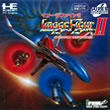
Image Fight II - Operation Deepstriker (PC Engine CD)

Vertical
Checkpoints ON
3 Difficulty levels
10 stages
Ship speed selectable
- - - - - - -
Developed by Irem
Published by Irem in 1992


Even though it was relatively well regarded within the circle of arcade connoisseurs, Image Fight unfortunately wasn't able to kickstart a long-running series as its horizontal sibling R-Type did. Sure the game had its share of ports at the time, of which one of the most faithful was the version released for the PC Engine in 1990. The experience for developer Irem on NEC's platform must have been a good one though, after all the PC Engine CD add-on was home for the exclusive sequel Image Fight II - Operation Deepstriker, which still stands today as the last we've seen from this particular gaming franchise.  

With an animated intro subtitled in English and lots of intermissions with Japanese dialogue between stages, Image Fight II is one of those treats of the 16-bit era that catered to the sensibilities of gamers who wanted a little more story to justify the extra space provided by the storage capabilities of the CD media, as was the case of R-Type Complete CD, another Irem offering in the same platform. Fortunately all cut scenes in Image Fight II can be quickly skipped or even made completely absent by switching the correct option on the configuration menu (set Visual Scene  to OFF). What's left is a new outer space adventure that's strikingly similar to the first Image Fight, sharing main themes and environments for most levels but with a more balanced design in terms of gameplay (busier from the start, not overly claustrophobic, single-loop only).

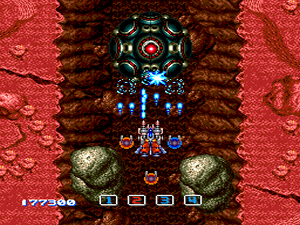
Boss inside the rock planet in stage 6

Since this second chapter mirrors the first in lots of ways, it also requires players to achieve a certain destruction ratio during stages 2 to 5 in order to advance in the second part of the game without having to go through a penalty area. The idea is that you're in a simulation environment during the first half and in real battle from stage 6 onwards. Why the first level was left out of the 90% destruction average requirement is probably explained during the animated intermissions, I just couldn't figure it out because they're all in Japanese. Another intriguing aspect is that you're completely stripped off your power-ups when starting certain stages (2, 4, 6 and the penalty area).

Speaking of power-ups, the rules remain the same as in the original. By destroying floating crates you uncover two types of upgrades. The first one is an orb that switches colors between blue and red: it adds a floating satellite that hovers around the ship, in a maximum of three; the first one appears on the right, the second one on the left and the third one in the rear position; blue adds a pod that fires straight up, red adds a pod that fires in the opposition direction you're flying to. As you grab the initial orbs you can mix colors, but once all three are in place any further orb applies its respective color to all pods.

A second type of power-up adds a frontal attachment armor that creates a completely different form of attack, in a gallery that includes more powerful firing streams and several variations of spread shots and lasers. Most of them are similar to those seen in the first Image Fight, but there are also a few new ones such as a seemingly useless smoking gun that's actually quite helpful against the second-to-last boss. Another important armor is the one that fires a single powerful exploding shot that's essential if you want to blow the 8th boss away in a snap. The catch is that in order to replace armors you need to destroy the current one to collect the next, an action that's achieved by allowing them to receive damage either by swallowing bullets or by touching a wall.

Touching or scraping walls is more reliable when you're moving at lower speeds, of course. Button I switches back and forth between four predefined settings. Button II shoots and the SELECT button sends the lateral orbs forward in a special attack (the same effect of pressing buttons I and II at the same time). The exhaust flare of the ship when changing speeds doesn't cause any damage anymore, but in a nice visual twist the ship now has four different sprite appearances, one for each speed setting. Image Fight II comes with autofire by default.

Introduction and first stage of Image Fight II - Operation Deepstriker
(courtesy of YouTube user The VideoGames Museum)

With the exception of the relatively busy first stage, levels 2 to 5 are basically softer rehashes of the same levels seen in the first game. Image Fight II only feels like a real sequel afterwards, with levels that feel completely different in design, tone and bosses. The orb mine field in stage 8 is particularly tricky to navigate, and the attacks of the huge spaceship in stage 9 do require some knowledge to be properly avoided. All stages have two checkpoints except for the last one, which actually feels easier than previous levels. Speaking of easier, the ship's hitbox is now more lenient than in the original game, which makes navigation in tight spaces less demanding and allows the abuse of safespots against a few bosses.

Since the game doesn't show your life stock unless you die, it's hard to pinpoint the exact point where you gain extra lives by score. Suffice it to say that during a full credit you get two of them. As for the scoring system, the checkpoint structure does favor checkpoint milking as the main source of extra points. Minor projectiles are worthless, so there's no point in trying to prolong boss fights to destroy more of them.

Regardless of the fact that this sequel was developed from the ground up for a home console, Image Fight II - Operation Deepstriker certainly lives up to the original game. Graphics are just as sharp and the music fits the action nicely, as do the sound effects. It does feel slightly less difficult in terms of pure challenge, which is of course no reason for complaints whatsoever. By reaching the end of the game (continues allowed) an Omake selection is unlocked in the options screen. It allows you to play the game with R-Type's R-9 spaceship or Gensan (a.k.a. Gen-San, the hero from Irem's own Hammerin' Harry platforming franchise). There's no change in weaponry for either character though, so it's just a cosmetic swap (I didn't check if there are differences in hitboxes).

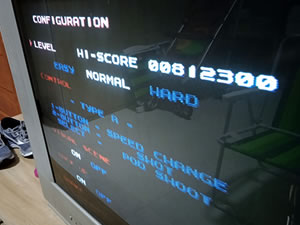
It wasn't my intention to milk anything in my 1CC attempts, yet I was forced into replaying a few worthy checkpoints in the final result below. The high score buffer in the options menu shows the result of your last credit only, so before trying again don't forget to check it out as soon as you achieve a score you want to immortalize in pictures.


Saturday, July 31, 2021

Spriggan Mark 2 - Re-Terraform Project (PC Engine CD)

Horizontal
Checkpoints OFF
4 Difficulty levels
8 Stages
Ship speed selectable
- - - - - - -
Developed by Naxat Soft / Compile
Published by Naxat Soft / Compile (Nazac) in 1992


When joining forces under the common label Nazac, Compile and Naxat Soft produced and graced the PC Engine CD with two shmups in the same series, even though they aren't anything alike. The sole aspect shared by Spriggan and its sequel Spriggan Mark 2 - Re-Terraform Project is a story-related detail about their mechas being built out of the same alien material from planet Mars. Other than that both games couldn't be more different in concept, execution and gameplay. The first one is a vertical shooter with lots of fantasy elements, whereas the second game veers into pure futuristic Gundam-style sci-fi territory in a horizontal shooting fashion.

Spriggan Mark 2 is also notorious for its lengthy story segments with plenty of cut scenes, narration and in-game dialogue. If you're the kind of player who likes these foreign elements in a shooter you'll be in for a treat, as long as you're able to understand Japanese of course. Everybody else can at least be content about the ability to disable all this mumbo-jumbo in the options, which then turns the game into a regular shooter where the general idea is to battle an enemy armada of mechas and mechanical bosses while controlling more advanced mechas of your own as you progress though the game.

The change in style comes with lots of visual flair since graphics are colorful, diverse and full of several layers of beautiful parallax without any slowdown. The soundtrack on the other hand is a little hit-and-miss, but in its best moments sounds very similar to the electronic style of Compile's own Robo Aleste. Sadly the audio balance is strongly biased towards the sound effects, making it hard to listen to the songs whenever there's any action going on.

Fighting on the surface of the moon

Controls seem simple on a first glance, but the gameplay goes a bit deeper than just pressing buttons. Button II fires your selected weapon, button I toggles shot direction and SELECT is used to choose the desired weapon. Weapon choice can also be done by pausing the game (button RUN), but the main purpose of doing it is to select your flying speed. All mecha variations are equipped with a basic cannon with unlimited ammo but the resources are limited for remainder of the arsenal. Whenever the ammo for a specific weapon is depleted you can't use it for the rest of the level. This alone requires at least a minor degree of strategy in order to get through the levels properly, even though the game isn't really taxing throughout most of its duration thanks to the shield/energy bar recharging slowly whenever you're not taking any damage. There are no items at all to be collected in Spriggan Mark 2.

Now here's the main catch: keeping the shot button pressed will not fire any of your non-basic weapons. If you do that you'll only get the basic cannon stream (with the glaring exception of the saber), so in order to trigger them you need to actually tap the button. Although weird, I must admit that this is a nice way to deal with the gimmick of limited ammo in a shmup. You can of course use a turbo controller to get regular autofire by holding the button, but then you'll be at the mercy of running out of precious ammo when you need it the most.

It's a fact that something still feels off in the gameplay, which tends to be clunky in regards to dodging especially during boss fights. That's why it's so important to memorize the order of the available weapons to better deal with enemies or enemy formations. Once you nail this mechanic the game becomes less of a mess, unless you absolutely don't mind pausing it to perform weapon choices. Another important realization is how efficient the saber is against enemies that allow you to get close to them without taking damage. It can even be used to block bullets!

Having allies fighting by your side is a great idea in sci-fi shmup with important story elements like Spriggan Mark 2, but the constant flow of mecha and ship allies that help you throughout the game is another source of confusion, at least upon a first contact. Since they often look like the enemy forces, it took me a while to get used to it and not lose precious time and resources trying to take them down. It's quite neat, however, to see some allies commit the ultimate sacrifice by ramming enemies and bosses in order to strike the final blow against them.

First stage of Spriggan Mark 2 - Re-Terraform Project
(courtesy of YouTube user Ryusennin)

Going by how intense the in-game dialogue is (the little I've seen of it), I bet the story details behind the abovementioned sacrifice moments must be quite engaging and extend much beyond what we get to see during the game. An example happens at the end of stage 3, when you are destroyed and start to control another mecha right away, an occurrence that precedes the choice you need to make prior to the beginning of every level afterwards. A total of six mechas will be available by stage 6, yet it's then obvious that the best ones are mechas E and F.

As an example of the style clash between Compile and Naxat Soft, Spriggan Mark 2 - Re-terraform Project isn't quite the experience you'd expect, especially considering how solid the first Spriggan was. My impression was that Compile had a bigger say in the actual gameplay, whereas Naxat Soft took care of the storyline aspect. It's interesting that the offensive option weapon, for instance, behaves just like the search option formation from MUSHA, targeting and chasing after enemies around the screen. The game's overall results are a mixed bag though, which is understandable seeing that this was Compile's only horizontal shooter. Unlike Spriggan, the game was left out of Naxat Soft's Summer Carnival series, so there are no score attack or time attack modes this time around.

My 1CC result is below, playing on Normal difficulty. Since the screen gets stuck after the end credits are over players are forbidden to see the high score table, so you have to be quick once the final boss dies if you want to get a record of your final score. The series continues with Spriggan Powered, released for the Super Famicom in 1996.


Tuesday, July 20, 2021

Side Arms Special (PC Engine CD)

Horizontal
Checkpoints OFF / ON
2 Difficulty levels
12 / 10 stages
Ship speed by icons
- - - - - - -
Developed by Capcom / Nec Avenue
Published by Nec Avenue in 1989


The whole point of having a cartridge or a HuCard game reappear in the CD format was always related to a major improvement in sound quality, at least during the dawn of CD gaming with 16-bit console add-ons. Little or no graphical upgrades were to be expected, so under this point of view Side Arms Special definitely belongs to a special category for going beyond the basic sound makeover of the Side Arms HuCard. While it does come with the same game with a remastered CD soundtrack, it also includes a special arrange mode that might be seen by some as a step-up from the original experience.

Integrating Capcom's early efforts in the horizontal shooter genre, Side Arms expanded on the ideas of Section Z by basically increasing the pressure around the concept of bidirectional shooting in a bare bones sci-fi setting. Players take control of a space mecha known as "mobilsuit", moving through several colorful environments outside and inside an alien planet in order to defeat an evil empire. That said, in Side Arms Special you're prompted to choose between two game variations as soon as the disc is booted: Standard mode is a relatively faithful port of the arcade game, whereas Before Christ mode shifts things around for a completely different Side Arms experience.

Standard plays just like the HuCard version albeit with CD-quality sound. Button I shoots to the right, button II shoots to the left and RUN allows you to switch between the weapons you have already collected (SELECT is used for just pausing). In order to activate or power up your weapons you must shoot at the items released by a destroyed carrier to make them change in a fixed order, picking up the desired one before the item settles into a star or a yasichi (looks like a candy/lollipop), which correspond to the "auto" shot and a few bonus points respectively. The order prior to the latter is Pow, bit (an orange orb), SG (spread gun), Pow, MBL (mega bazooka launcher), Pow, 3way, Pow and mirrored Pow (light blue color).

Stage 7 of Before Christ mode

Pow and mirrored Pow are actually speed-up and speed-down. You don't die by touching walls, but you can bite the dust if the mobilsuit gets squeezed by a scrolling obstacle. Upon death the currently used weapon is gone, so you need to pick it up again in order to keep firing it. Other special items might appear from destroyed enemies and by shooting specific locations: strawberries and barrels are worth 3.000 points, the cow is worth 10.000 points, the small mobilsuit gives you an extra life and the α/β icon endows the player with an exoskeleton that adds a constant 8-way pulsating shot to your arsenal while also providing a 1-hit shield. Hidden 1UPs can be found, but you also get score-based extends at every 100.000 points (they stop coming once you score half million points though).

While relatively frantic and even quite demanding at times, one aspect that always bugged me in Side Arms (either the Standad mode or the arcade original) is the fact that regular items block your firepower unless you shoot them enough so that they stop cycling. It's really annoying when you're heavily surrounded by enemies in the heat of the battle. Being a single uninterrupted mission from start to finish due to the lack of stage separation is also kinda weird, but an ultimately harmless deviation from the norm. Nevertheless the count of 12 bosses always meant 12 stages for me.

And then we come to the mode called Before Christ, where stage separation is one of the defining differences from the standard game. You'll see pretty much all original assets (graphics, items and music) rearranged in ten levels with new gameplay rules and brand-new bosses. Another important change is the adoption of checkpoints for the whole level and bosses themselves, but you also need to deal with weapon upgrades in a different manner. Flying speed is fixed and items now cycle automatically through Pow → straight shot → 3way → boomerang and back to Pow (the first item to appear is always random though). You don't need to restrict yourself to the same item to upgrade your weapon, so by the third one you'll already have it at a good level. It will eventually max out after picking up a few more power-ups.

Apart from the three available weapon choices you can also fire a charge shot that behaves just like the MBL (mega bazooka launcher) from Standard mode. This laser beam is the perfect attack to be used on bosses due to the concealed nature of their weak spots, which are only vulnerable at certain intervals. Sure you can inflict damage with your regular arsenal, but once you get the hang of the charge shot it's much better to use it. At least this was my case, so I was always switching the turbo function of my controller on (during the course of the level) and off (during boss fights). Playing with a turbo controller is a must because the only weapon with native autofire in Side Arms Special is the "auto" shot from Standard mode.

Introduction and first stages of Standard mode in Side Arms Special
(courtesy of YouTube user 8-Bit Days a Week)

Before Christ includes a few other interesting twists, such as the need to power up the mobilsuit from scratch in every single level. At first this isn't such a big deal, but since the game becomes more and more demanding as the stages unfold it's very important to find and collect the hidden yasichis whenever possible. Each one adds an option orb that not only gives you a little more firepower but also serves to absorb two hits (upon which it disappears). Up to two orbs can be activated above and below the character. Some boss battles are quite twitchy or bullet-laden, so the extra "health" provided by the option orbs certainly comes in handy.

All gameplay changes in Before Christ mode are definitely a breath of fresh air, but the greatest addition by far is the beefed up scoring system. Hidden bonus items are the same only with different values, and with each successive Pow item collected within the level you get progressively more points, starting with 200 and maxing out at 3.200 from the fifth one onwards. The biggest chunk of the score, however, comes from every remaining life being converted into 320.000 points when you complete the game. This means that in the long run the best strategy to score higher is to just not die. Besides the score-based extends (a total of eight if you manage to achieve at least 2 million points) there are also a few hidden 1UPs to be found along the way.

In all honesty, Before Christ mode is more interesting, fun and engaging than the main game itself, in whatever form you find it. It just makes the standard/original experience stale by comparison, in a rare case of a release with an arrange mode that's clearly superior to the core game.

My final 1CC results for both modes of Side Arms Special are shown below. Standard mode was played on Normal difficulty. The high score in Before Christ mode was achieved in a no-miss run (there's no difficulty selection in this case).


Saturday, October 3, 2020

Space Fantasy Zone (PC Engine CD)

Rail shooter
Checkpoints OFF
4 Difficulty levels
9 Stages
Ship speed by icons
- - - - - - -
Developed by NEC Avenue in 1991
Published by ? in ?


As two of the most famous franchises created by Sega, Fantasy Zone and Space Harrier certainly had their glory days, be it in the arcades or in console formats. There were always hints of both of them being part of the same universe, but Sega never really dared to mesh their concepts and characters in a single title. However, early in the 90s Nec Avenue dared to develop a bastard crossover in the form of Space Fantasy Zone, which would eventually be nixed by Sega on the account of publishing rights and concerns regarding the quality standards of the game.

Even though the official release of Space Fantasy Zone was cancelled, years later the ROM was found online for everybody to try it. It was complete and perfectly playable, yet not properly polished the way a final product should since it presents a few unbalanced traits in the gameplay and has little music variety (the same song is used in all levels) as well as a few audio glitches. Several fan-made physical releases started appearing afterwards, using the art taken from video game magazine previews of the era. I got my copy in 2010, and for what it's worth it's a decently-made bootleg that fits the collection nicely.

Pocarius stage from a different point of view

In simple terms, this game mirrors the original Fantasy Zone in a rail shooting fashion, with details from Space Harrier thrown in and music that borrows from both games. You see Opa-Opa from behind and most enemies and bosses are taken from Fantasy Zone, whereas obstacles and a few other creatures are inherited from Space Harrier. The first major change in the gameplay is that there are no coins to collect anymore, so all you need to worry about is blasting everything to oblivion as you move forward against incoming enemy waves and pillars. The second major change in Space Fantasy Zone is that you now have a life bar instead of regular lives. 

Even though there’s no need to collect coins anymore, players do have the chance to acquire upgrades in the Weaponald’s shop (!) that appears in between levels. The sympathetic lady offers players all sorts of items in different categories in exchange of some of their score. Speed-ups, power-ups, life recovery/extension items and special weapons comprise the bulk of what you can purchase there. All the accompanying text is in Japanese, but the icons should give you an idea of what to expect.

Autofire is implemented by default, and you even get the same shot bending effect from Space Harrier (where shots will automatically hit enemies that are close enough to the bullet’s firing direction). Since button II is used to shoot, firing the extra weaponry you get from the shop is done with button I. All extra weapons purchased are stacked for use one after the other, as seen in the indicator on the top right corner of the screen.

Just like in the game that is its main inspiration, the use of colors in Space Fantasy Zone is nothing short of excellent. The brief intro showing Opa-Opa departing for battle is a nice preamble for an experience that’s visually very charming. However, even though it doesn’t do anything wrong the gameplay does suffer from the poor frame rate in later stages. Things start scrolling by too fast, making dodges even trickier than they normally are. The design sort of deteriorates towards the end, and a clear sign of that is the lack of the traditional boss rush in the 8th level. You get a generic boss and then proceed to the final stage to fight the very last (and kinda lame) enemy. 

Three levels of Space Fantasy Zone
(courtesy of YouTube user Fukuten / ふくてん)

Besides getting used to the increasing scrolling speed you also need to cope with specific attacks such as those from missile projectiles, which seem to harm you regardless of their perceived distance. Getting hit over and over often ends up in disastrous results in any level, forcing you to deplete all your score in health recovery items after the boss is defeated. Memorization and continuous practice helps change that, as well as being wise about using your hard earned points in the shop. After a while I figured it was a lot better to just purchase the strongest power-up (level 4) instead of getting the intermediate ones. It makes it easier to kill enemies faster, including bosses. That’s great for scoring because the remaining time whenever you destroy a boss is cashed in as bonus points.

The only other scoring technique in Space Fantasy Zone – besides not taking any hits, of course – is killing complete enemy waves for extra points. Beware of ground obstacles when going for full wave bonuses, since they make you trip and leave you at the mercy of enemies for a few seconds. Despite the somewhat uneven and to a certain extent unfair challenge, the shop mechanic allows players to adopt all kinds of strategies, such as spending all your score in extra additional health and special weapons so that you can limp your way towards the end.

Space Fantasy Zone does come off as an interesting oddity for fans of the main franchise. It's worth a try, at least. Unfortunately my CD has a problem and always freezes once the screen fades after the last boss, so I couldn't see the ending in any of the clears I got in the Normal difficulty (the high score below was taken from pausing the game as soon as the final bonus registered after the boss kill). Note: perhaps as a leftover from debug resources, the SELECT button skips levels entirely; it's certainly useful to practice later stages if you feel like doing it.


Saturday, May 4, 2019

L-Dis (PC Engine CD)

Horizontal
Checkpoints OFF
3 Difficulty levels
6 Stages
Ship speed by icons
- - - - - - -
Developed by NCS / Masaya
Published by NCS / Masaya 
in 1991

Fantasy themes where characters are abducted to live a great adventure have always been present in video games since I can remember. One of the most noteworthy entries of this kind of story in the shmup genre is Dragon Spirit. Even though it didn't achieve the success or notoriety of Namco's arcade/console classic, Masaya's L-Dis also has a main character being drafted into a fantastic but perilous adventure, one that certainly does not disappoint if you're a fan of horizontal shooters in general. It's leaps and bounds above Toilet Kids, for example, another PC Engine quirky game that also uses the abduction motif.

Granted, L-Dis is quite an obscure title, and it could never aspire to anything more than that since it was never released out of Japan. The game's story starts when a boy and a girl are drawing creatures and objects on a wall, then the girl gets kidnapped by an evil guy and the boy boards a spaceship that looks like a fish to rescue her. The catch is that their drawings become the enemies across six increasingly longer levels that show lots of inspiration from the Gradius series. Does that get you interested? A word of warning though: L-Dis is inspired by Gradius but doesn't play like Gradius at all, and I mean this as a compliment.


The start of a dangerous journey
(courtesy of YouTube user Old Games Database)

A colorful, cutesy shooter on the outside, this game actually presents a few interesting challenges for the player. One of them is figuring out the upgrade items brought by harmless floating yellow balloons. Since they're only differentiated by kanji characters, it does take a while to know what you're getting. The good news is that they always cycle in the same order when spawned, with three types of items to consider. The first one is the power-up / speed-up. The second one is the auxiliary shot, which has three forms (a straight type, a bomb/missile type and a special shot that passes through walls). The third item is the bomb / 1-hit shield. Auxiliary shots are fired by trailing options (2 max, no upgrades), you can carry only one bomb (it trails behind the options) and a maximum of three shields can be stocked at any given time.

Before starting the game you can choose to watch a tutorial by pressing left or right (in the end of the message はい means YES and いいえ means NO). Then you must choose one out of three weapon configurations. The best advice is to try them all to check which one fits your play style better, but suffice it to say you're bound to see some weird shot sprites, such as women's shoes, hatchets, pointy fingers or crawling toothpastes. Once the choice is made you're ready to go: fire with button II, drop the bomb with button I. Autofire is there by default, as is the possibility of losing lives in a snap with almost no breathing room on respawn. You do get the chance to recover some of the lost power-ups though.

L-Dis holds the distinction of having lots of sections within a level, with one or more mid-bosses prior to the main stage boss. The adventure begins above a city landscape, then descends into street level prior to a scramble outside a huge battleship that leads to an encounter with a revamped version of Big Core. From then on the challenge picks up in an underwater level and inside a factory filled with walker mechas, lasers and tricky hatches, ending in a lengthy boss rush with lots of cramped passageways in between deadly moving cylinders. The sheer amount of variety (stages and enemies), the sudden shifts in scrolling speed (5th boss, escape to the final boss) and the constant need to navigate tight corridors provide a remarkable challenge that's somewhat detached from the cute aspect of the whole package.

Watched by green eyes and guarded by green mechas

While technically very competent, L-Dis chokes a little bit when the screen gets too cluttered with bullets. Though not common and mostly present in the final parts of the game, the slowdown in these moments is actually welcome for survival. The final stages are also quite stingy in upgrade items, so do you best to get there with a fully powered arsenal. An interesting fact about maximum firepower (besides the long time it takes to be achieved) is that while the main shot sprite increases in size its efficiency is actually diminished. It can't get through tight spaces and turns out slightly less powerful, probably due to the reduced firing rate and the appearance of two side shots whose nature depends on the chosen arms configuration. In any case, these late side shots are very helpful and certainly compensate for the main shot power loss. And just for some basic rank routine, note how those mechas in stage 5 start to shoot thicker laser beams if you get there on a single life.

L-Dis isn't overly hard, but does require a good knowledge of what's coming. There's something shady about the scoring aspect though. Bonuses are registered every time you pick up a surplus power-up or bomb, but they seem to be random. Sometimes you get mere 100 points, only to win 100.000 points in the next one for no special reason at all. At times I thought it was the yellow color of the item badges, but it doesn't seem to be the case. 100 grand is a great figure not only for the overall score but also because extra lives are awarded at every hundred / two hundred thousand points, with a couple also granted as you enter the chamber for the final boss. A few bosses might allow some milking, but it's quite tricky to pull it off consistently.

With intro and ending sequences that properly present/give closure to a story that's akin to an urban faery tale, L-Dis also counts with crystal clear voice works, lovely parallax effects in several places and a nice soundtrack to match the wackily cute but solid challenge level. My best 1CC score is below, playing on Normal difficulty with the arms-B configuration. I did not do any milking whatsoever in this run.


Tuesday, March 12, 2019

Steam-Heart's (PC Engine CD)

Vertical
Checkpoints OFF
3 Difficulty levels
7 Stages
Ship speed fixed
- - - - - - -
Developed by Giga / TGL
Published by TGL (Technical Group Laboratory) in 1995


A quick look from the outside won’t tell you that Steam-Heart’s is a special kind of shooter. Originally released for the NEC PC-98 series of personal computers, it gained its first port for the PC Engine CD practically at the end of the system’s lifespan. This port was actually the last shmup officially released for the platform, but this distinction is often overshadowed by the fact that the game's storyline is totally bent on a hentai approach. The same goes for the secondary Saturn port, even though that one has its own share of differences.

What’s interesting about the hentai in Steam-Heart’s for the PC Engine CD is that non-Japanese players might actually go through the whole game without noticing any of the sexually charged content. The problem is that the several pseudo-explicit cut scenes showing the game’s protagonists raping the defeated female pilot bosses take too long to load, have too much dialogue for too little imagery and can only be skipped in their entirety. In a nutshell, impatient pervs won't be too happy. Despite the cheaper production values, for example, Divine Sealing on the Mega Drive did a better job with its panel-by-panel skipping.

Anyway, when you exclude the hentai part from the game what’s left is a conventional shooter that draws inspiration from many contemporary titles for an uneven experience with above average difficulty.


Intro, unskipped pilot chatting and full 1st stage of Steam-Heart's
(courtesy of YouTube user 8-bit Days a Week)

There are two characters to choose from, a guy named Blow and a girl named Falla. They're both able to fire two types of shots selected with proper items, but their attacks differ a bit: Blow has a straight laser and his vulcan shot acquires some spread when upgraded, Falla’s vulcan has no spread but her thin laser gains two spread side shots later on. Vulcan (V) and laser (L) are powered up by always sticking to the same item. Auxiliary weaponry exists in the form of straight missiles and homing orbs, which have no upgrades and always disappear when a new level starts. Temporary shields and health/energy refills complete the item gallery.

As indicated by the HUD on the right side of the screen, the ship starts out with seven energy points that can be replenished with the abovementioned refill item. However, you also recover one energy cell in every transition (stage to stage and stage to the final boss chamber). If this health gauge is depleted the credit ends, but continues and stage selection are allowed for every level you have already reached. Besides shooting, which is accomplished with button I, button II provides a secondary input that's used to make the ship move very fast in a dash maneuver – it's the same gimmick of the Rayxanber series, only without the overheating limitation.

In terms of visuals, Steam-Heart's is a game with lots of highs and lows. The backgrounds of the first two levels are so bland that first impressions might be the worst possible. The first stage is also too long, which doesn't help either. Provided you're able to get past this initial lethargy you're in for a surprisingly busy third stage though. From that point on the game picks up both the pace and the quality of the graphics, peaking in stage 6 as you face a shower of indestructible asteroids prior to dealing with a series of drone waves and bulkier ships. It's nothing fancy but it works (there's no parallax scrolling, for example). In between you'll fly over alien bases and forests while avoiding tricky enemy fire. The dash mechanic certainly helps at times, even though crowd control and clever bullet herding are still the most important strategies for those who want to succeed.

Overall there's enough action to offset the average visuals, but all things considered the soundtrack is certainly the best aspect of the game. Since the challenge in Steam-Heart's is built around quick sprays of aimed bullets and multiple enemy waves that can't always be completely destroyed, staying alert at all times is essential to not deplete that energy bar in a snap. Still you can take a good number of hits because the game throws lots of those energy refill items in later stages.

Against the mechanized clutches of the third boss

In order to skip the in-game conversations that happen at the beginning of a level or prior to a boss fight you need to press START twice, which is quite odd. Some conversation bits cannot be skipped though, and in these cases it's always good to be ready for new boss phases with cheap, almost unavoidable surprise attacks. A few bosses have two or more forms to be defeated, ranging from the quintessential large ship with several cannons to mechas that tend to mix bullet spreads, lasers, homing shots and melee attacks. They might look familiar to PC Engine veterans because they're very reminiscent of other games such as Nexzr and the Soldier series. Note: you're forbidden from pausing the game during a boss fight.

An interesting quirk of Steam-Heart's is that the weapon upgrading process keeps happening until very late in the game. That's why it's not really a good move to switch weapons at will, at the risk of reaching the final enemy without maxed out firepower. On the other hand, every single item you take gives you 1.000 points, which actually mounts to a nice extra if you aim for a high score. Score chasers are also bound to blow up the destructible parts from bosses for a few more points, of course.

My best 1CC score on Normal difficulty is below. I played with Blow and used exclusively the vulcan shot, never switching to the laser weapon. The picture was taken during the escape sequence after you beat the final boss.


Monday, September 10, 2018

Daisenpu Custom (PC Engine CD)

Vertical
Checkpoints ON
3 Difficulty levels
7 Stages (loopable)
Ship speed fixed
- - - - - - -
Developed by Nec Avenue / Toaplan
Published by Nec Avenue
 in 1991

It's hard to picture it these days, but back in the 90s some games were definitely a product of the general infatuation with new storage media, more specifically the compact disc. The widespread love for the CD was such that the expectation created by the video game add-ons allowed companies to market them as a true revolution in 16-bit console gaming.  The main reasoning for that was better audio and the addition of fully animated sequences plus crystal clear voice-overs, improvements that often warranted re-releases of cartridge games in CD format.

However, most CD versions of 16-bit cartridge or HuCard games didn't really need to exist. With a few exceptions that either expanded the original game (such as Super Raiden) or fully embraced the capabilities of the new media (such as Spider-Man and Batman Returns for the Sega CD), the majority of the upgraded titles offered very little extra content except for the presumed CD audio quality. And even this audio upgrade can be a debatable issue. So the question we ask ourselves today is: did games like Daisenpu Custom really need to exist?

Daisenpu had been out for a year already. A port of one of the least famous Toaplan vertical shooters, it wasn't a standout in any way, yet someone inside Nec Avenue thought that the PC Engine library needed a CD version of it.

Boss duo in stage 4

The basic gameplay is unchanged from HuCard Daisenpu. Button II shoots with no autofire (get a turbo controller!) and button I summons a helper squadron of 6 planes. The mission is to slowly raid land and sea to eliminate nazi tanks/boats/turrets in a world war setting of methodical progression, in a shooting adventure that never picks up the pace. Each plane in the helper squadron flies and shoots alongside the player, plummeting towards the closest enemy once hit. If you press button I once they are in position they will all perform a kamikaze attack as if they were hit. By quickly tapping this button before the squadron is in place after the initial summoning you get a bomb blast that sacrifices all planes in a huge explosion that nullifies incoming enemy bullets.

Upgrades are obtained by destroying color-coded trucks and picking up the items. There's the quintessential power-up (orange), extra helper squadron (white) and extra life (blue). Green trucks are all bogus and don't give out anything. You can't see your score while you play (not even by pausing the game), but an extend routine is in place to grant you more extra lives seemingly at every 100.000 points, an interval that's extended once you reach 300.000 points.

In the world of Daisenpu / Daisenpu Custom all the enemy will ever see is the player's plane. Every single aimed shot or aimed bullet spread will target the player, which means you can always draw enemy fire away from your squadron while they fly peacefully and do their job. Managing to do that and keeping clever angles as you dodge is one of the tricks to survive longer. When facing a bigger enemy, such as one of the bosses, there are times when it's best to bomb than to risk dodging the overlapping patterns. Each new life comes with two full squadrons, which should be okay to handle any boss checkpoint.


Entering the forest, Custom-style
(courtesy of YouTube user Old Games Database)

What's actually different in this CD version, one might ask? I would say the main difference is its clear division into separate stages. In the original Daisenpu the game unfolded with no stops whatsoever, with music change being the only indicator of level progression. The four original areas were expanded to seven complete levels in Daisenpu Custom. Graphical assets were rearranged, some large enemies were promoted to bosses and most stages were split in two, in a customization job that doesn't do anything wrong but somehow lacks the cohesion of the original. An example of a botched part is the start of the 6th stage, which puts the player directly into the frying pan with enemies from all sides.

There was no attempt by the developer to steer away from the game's original concept of having absolutely no aerial enemies, which is good. The final level is still familiar terrain but brings a more powerful type of tank that's exclusive to this version. Unfortunately the original military-themed music received a flamboyant synth-based makeover that doesn't always gel with the slow paced action; it's as if the soundtrack to one of those cheap war movies made by the Cannon Group in the 80s had been slapped onto the game itself. That would’ve been nice if only Chuck Norris or Michael Dudikoff had also been included in nice animated cut scenes, but alas! Daisenpu Custom didn't receive any special treatment in that regard.

While the game isn't essentially better or worse than its original mold, the shortage of new material and the minimal changes made for Daisenpu Custom are barely enough to qualify it as an expensive arrange version. After all it came out in a separate CD during an era when arrange modes were a rare treat in console gaming. The few ones that got it right appeared for the competition instead, as seen in Slap Fight and Grind Stormer.

The best 1CC score I got on the game is below, playing on Normal and reaching stage 2-7. Enemies fire more frequently in the second loop. Medium-sized boats coming from behind even fire as they become visible, so don't hug the bottom of the screen if you don't want to lose a precious life there.


Saturday, December 30, 2017

Terraforming (PC Engine CD)

Horizontal
Checkpoints OFF
4 Difficulty levels
8 Stages
Ship speed selectable
- - - - - - -
Developed by Right Stuff
Published by Right Stuff 
in 1991

Considering that terraforming is the hypothetical process of deliberately modifying the atmosphere, temperature, surface topography or ecology of a planet/moon so that it becomes similar to the environment of Earth, it doesn't take long to see that Terraforming never really embraces this idea to make it an integral part of the game. It's quite the contrary actually, since it only borrows the word for its latent punch... Everything you do throughout eight linear stages is kill all sorts of strange earth-like creatures, thus crushing an environment that's already been sort of terraformed.

Thankfully shmups were never really known for their stories or faithfulness to story concepts. What does matter in the end is the amount of action and the thrill of blowing up stuff in all sorts of environments possible. Give us that in spades and you can call your game whatever you want. In the case of Terraforming, the action is fast most of the time, with players being thrown wave after wave of enemies with little obstacle interaction. Visually and aurally close to CD titles like Rayxanber II and Metamor Jupiter, the game is famous within certains circles for having enemies and backgrounds designed by Syd Mead, a well known visionaire responsible for the visual concepts of sci-fi movie classics such as Star Trek, Blade Runner, Tron and Aliens. Such was Mead's fame at the time that his name is in the title of the Western release for the Turbografx CD. His contributions can be considered an odd mix of Darius and Bio-Hazard Battle at times, which is interesting but can't really compensate for the fact that the game fails to live up to the solid standards of these particular mentions.

The asteroid shower of stage 7

A short animated intro shows the spaceship departing for battle, and what initially struck me most was that it looks like a pointy jet coming out of Captain America's shield. Yeah, I know, I can certainly be weird in my visual associations. Anyway, there are two types of power-up icons in Terraforming. The main one is a little green box with a thin line inside it, which is responsible for upgrading the primary gun. Items for auxiliary weapons are color-coded and must be released from the carriers as soon as they reach the right border after darting from the left (you die if you collide against a carrier that's travelling to the left, so watch out). This auxiliary firepower can be a double straight laser (orange), a bidirectional spread pattern (yellow) or a constant stream of homing shards (blue). The main gun takes three power-ups to max out, and auxiliary weapons also take three items to max out once activated. Note that the pair of options generated when you have an active ancillary weapon can block bullets (in a flimsy way, so don't count too much on that).

Each press of button I switches the flying speed up and down between three settings, while button II is used to shoot. Refraining from shooting, however, can be extremely helpful due to the charging abilitites of the ship when firepower is not in use. The charge gauge fills up rather quickly, and once it's full a press of the shot button delivers a powerful, concentrated blast whose effectiveness does not depend on the power level of your weapons. Due to the amount of enemies the charge shot is rarely an option during the stages themselves, but the situation completely changes when you're dealing with bosses. Some of them will go down in the blink of an eye if you release some well-timed charge blasts.

One of the aspects that undermines the fun factor of Terraforming is the uneven duration of levels and the repetitive nature of the enemy waves during the initial stages. Later on there are some overlappings that require a little more caution from the player so that you don't get hit and lose power. Each hit degrades the ship's arsenal to its previous power level, and you only die by getting shot at the default condition. This lifebar system in disguise offers a lot of room for error, but depending on where you die it becomes quite hard to get back up. Some bosses can be a bitch if you haven't got the proper weapon to deal with them, such as the debris mower of stage 3 or the medusa creature of stage 5.


A short demonstration of the 1st stage
(courtesy of YouTube user FunCade 64)

For a game that implements some heavy parallax scrolling I just wish Terraforming offered more terrain in its straightforward design. The stages where you're flying in open space are the majority, with real obstacles only appearing in the 4th and the 8th areas. The dark caves in the 4th level are complemented by one of the most eerie BGMs in the soundtrack, which otherwise is dominated by synth- or guitar-driven themes that work better with the fast-paced action pieces (note: the orange weapon is the only one that can pass through walls). As for the last stage, it's a perfect example of how to impose extra difficulty with cheap lasers and tricky turret openings. Since you need to go around a large battleship, no weapon is actually perfect for that area. In all honesty, it's one of the most annoying final levels I've seen in a while.

Extra lives are score-based and come at the following point marks: 50K, 100K, 300K, 500K, 1000K, 2000K. The scoring system is very simple, with no extra points gained by taking items, and also very unbalanced towards the last couple of levels. It's also theoretically broken, since you can forever destroy the debris during the 3rd boss fight if you so wish. Playing the game for fun is possible though, even if it's an uneven ride and a tad weird for the regular standards of the 16-bit sci-fi shmup. There's very little slowdown when the screen is too cluttered, but that's it.

My final 1CC result for the Normal difficulty of Terraforming is below. Remember to pause the game as soon as the last boss dies or you won't be able to take note of your score. I didn't bother checking the three higher difficulty settings available.