Showing posts with label PC. Show all posts

Thursday, May 27, 2021

Vastynex (PC)

Horizontal
Checkpoints OFF
1 Difficulty level
6 Stages
Ship speed selectable
- - - - - - -
Developed by Kigekiyahonpo / Zakichi
Published by Kigekiyahonpo / Zakichi in 2018


The horizontal shooter subgenre has come a long way since its formula was created and soon perfected in the golden era of the arcades. Gradius, R-Type and Darius can easily be considered the classic trio of quintessential horis, yet console games like Thunder Force IV were certainly responsible for cementing the genre's widespread recognition in the home market. What if we had a game that merged all of them in a single adventure full of action and accompanied by a kick-ass soundtrack? Well, the name of this game is Vastynex, and it's free to play in any PC if you just head to the developer's website and download it.

For those familiar with the titles mentioned above, Vastynex is certainly an amusing trip down memory lane. While it's basically a ripoff that would never get a commercial release due to copyright infringements, on the other hand it's truly a wild ride marked by the unique choice for huge pixelated sprites, always mimicking enemies and particular sections from classic games. The pixelated aspect might be an acquired taste for some, but I urge readers to give it a chance in order to check for themselves. Don't go by remarks such as the one made by my 4-year old daughter when she entered the room and caught me playing it, saying the game looked like Minecraft. :)

The main starting point for the structure of Vastynex is definitely Thunder Force IV, but pretty much all games in the series are used as basis for the design, especially Thunder Force III and Thunder Force V.

Pixels galore!

Once you run the executable, pressing ENTER will make it go fullscreen. Inputs are automatically assigned to whatever controller you have plugged in at the moment: for my Xbox 360 wired controller I got shot on button A, weapon select on button X, speed switch on button Y and pause on the right bumper (RB). The gameplay follows the same old rules from the Thunder Force games, where you must collect items to power up the ship. The main one is the claw/craw that creates two rotating orbs that expand your firepower, whereas other icons provide weapon activation or upgrades for blade, rail gun, snake/fire, wave and hunter (cool detail: each weapon is taken from a different chapter in the franchise). Shields provide protection against three hits and extra lives are scattered or hidden around the scenery (you also earn extends at every 2 million points).

Since Vastynex isn't graphically demanding and works on pretty much any PC, the game runs pretty fast with absolutely no slowdown whatsoever. The scrolling speed varies a lot and gets mixed with a wide range of explosions and several bits of short animation transitions, to the point of overwhelming players at first sight. Adapting to the speed of the game is essential if you want to achieve more points, after all the scoring system is based on speed-killing enemies just like in the mechanics used in Thunder Force V, albeit with a little twist.

In every level the base multiplier must be increased from ×1 to ×8 by killing enemies as fast as you can. Afterwards it's just a matter of continuing to dispatch enemies in a timely manner to maintain a high multiplier. Pretty much all mid-sized and larger enemies, however, offer higher multipliers if dispatched quickly, up to ×32 (they're all indicated by a lock-on reticle in their center). Finding the best weapon to use is, as usual, the key to a better scoring performance. Another important scoring device consists of maxing out weapons by taking two items of each one, which then makes all further items worth 10.000 points when collected. A red border in the weapon array indicates if said weapon is already maximized, and if at least one of them isn't red you'll get only 1.000 points for each surplus item.

A "no-miss" bonus of 100.000 points is awarded for each level where you don't take any damage whatsoever. A more accurate term woud be "no-hit" because if you're hit when using a shield you won't receive the bonus. Hovering the ship or flying though certain unsuspected areas is another source of points, so it's always good to venture in unusual places as the screen scrolls.

An exquisite self-imposed challenge on one of the bosses from Vastynex
(courtesy of YouTube user yoss88)

Each extra life is worth 10.000 points when completing the game, a value that seems to be quite low in comparison with any similar bonus you'd get from a Thunder Force game. As expected, deaths take away the current weapon you're carrying, but in Vastynex you can recover it at once by taking the special item that starts bouncing around afterwards (if it appears, of course). While the abovementioned extra life bonus doesn't seem like much in the final game tallying, it's important to note that dying resets the base multiplier and depending where that happens the overall score might be severely affected. 

It's quite clear that the scoring side of Vastynex adds an extra layer of joy to a game that's regularly not that hard, particularly for those who're familiar with the Thunder Force series. For example, many boss aspects and patterns are pretty much the same, while bosses themselves are mixed with enemies from other franchises such as Darius. There are stage sections modeled after Aero Blasters and Darius II, but the whole collection of references is a real delight for shmup fans. Some that spring to mind as standouts are the appearance of R-Type's Dobkeratops mixed with Thunder Force III's Gargoyle, Gradius II's Shadow Dancer in vertical form and the triad boss formation of Vic Viper, Silver Hawk and the R-9. Diehard conoisseurs will also spot minor details, such as the ice curtain from the first stage of Gradius Gaiden or the bomb animation of Darius Gaiden during the death sequence of Great Thing.

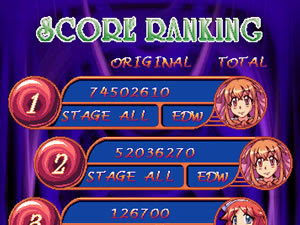
The picture below shows all the results of my credits on the latest update of Vastynex (version 1.2a), with the number one spot achieved in a no-miss run. During this quick burst of great fun I tried my best to take advantage of the scoring possibilities, but did not perfect routes and strategies on secrets and bosses. Maybe next time!


Sunday, March 7, 2021

Eden's Aegis (PC)

Vertical
Checkpoints OFF
1 Difficulty level
5 Stages
Ship speed fixed
- - - - - - -
Developed by X.X Game Room
Published by X.X Game Room in 2010


Eden's Aegis is the last PC free shooter released by the enigmatic one-man development institution known as X.X Game Room. It's easy to mistake it for Eden's Edge, which is actually one of his first attempts at creating a challenge for those who enjoy the thrill of dodging bullet curtains. For the record, 1.11 is the definitive iteration of Eden's Aegis, so that's what everybody's been playing for years now.

It seems the original page from the developer is offline at the moment, so just head to the download page and extract the downloaded file, plug in your favorite controller, run the executable, hit OK on all pop-up boxes and there you go, bullet hell action instantly available. With obvious influences from the works by Cave, Eden's Aegis can be defined simply as a shooter where your main objective is to destroy larger enemies in order to cancel bullets, thus turning them into precious gold and surviving the odds in the process.

Graphically the game is very similar to the other main work by X.X Game Room, Blue Wish Resurrection and its Plus variation. And that’s probably my main gripe with it, since apart from the choice of the avatar being a flying girl instead of a spaceship both games bear a strikingly undistinguishable appearance, which is very much defined by open space punctuated by raw textures for ground surfaces and a fireworks display of medals and bullet patterns. Of course this is alleviated by the fact that we’ve been given the chance to play these very fine shooters for free, so no big qualms about that.

One could say these games are all about gameplay, meaning 100% substance over style.

Beautiful purple bullet curtains!

Inputs work with shot, full auto, special attack and bomb. By holding shot you get a focused firing stream with reduced movement speed. The special attack adds a concentrated burst of power to your shot pattern that lasts a few seconds, which then recharges automatically for the next use as seen in the meter on the bottom left of the screen. The bomb is self-explanatory, granting instant invincibility to the character during its animation. Autoguard is a feature that’s turned on by default and sacrifices one bomb for every hit you take. “Wait” is initially also set to ON and means that you’ll always have slowdown whenever bullet count reaches a certain threshold (set it to OFF if you’d like to experience a much harder game overall).

In all game modes there are originally only two characters available. You can either beat the game with them to unlock the other two or just create an empty .txt file on the game’s directory named “yutori”. All four exhibit different traits for firing patterns, bombs and recovery times for the special attack. In general the further down they are in the selection screen the harder it is to control them, which means Nanathy is the character to go for beginners while Ridmie requires a deeper knowledge both for survival and for scoring.

The rules of gameplay are the same for all modes (Heaven, Original and Hell). Enemies release golden gems for taking, and if you kill them with special attacks all medals are automatically sucked into the avatar. Death explosions of larger enemies turn every nearby bullet into gems, in what’s the most obvious device in the risk/reward scoring technique: kill them right away to survive or let them live long enough in order to reap more points from on-screen bullets? The good news in that regard is that you'll see health bars for all enemies that are at least mid-sized. Gem counter increases during the level and decreases during mid-boss fights (faster) and stage boss confrontations (slower), getting cut in 1/3 for every hit you take. 

Hidden ground items, such as extra bombs and a solitary extend in stage 4, will only be uncovered by hitting them with the special attack. Bombs are also very important for scoring since they turn all on-screen bullets into gems. Score-based extends are granted with 7 and 30 million points.

Hell mode's first stage with Nanathy
(courtesy of YouTube user Vysethedetermined2)

Like all previous titles from the same developer, Eden's Aegis is a great pick-up-and-play shmup that provides instant fun from the get go, at least in Heaven and Original modes. Enemy projectiles aren't overly fast, the constant slowdown can be considered a nice exercise in tight bullet hell practice and you can even hold the special attack button so that it's repeatedly deployed after each recharge cycle. For a regular bystander the difference from relaxed survival play and high level scoring attempts seems to be trivial, but it actually requires thorough route/positioning choices and tight usage of the special attack. Never mind switching wait or autoguard to OFF, since they do not affect any aspect of the game with regards to scoring.

During the very short time I played the game I cleared it a few times in Original mode, improving my score a little without training any particular section. Eden's Aegis does include practice options though, as well as stage select and the ability to change the color of bullets and save replays – you just can't pause, for pausing denies replay saves and goes as far as not allowing you to write your initials in the high score board. The game does warrant a lot more dedication than the short spell I was able to devote to it, but at least I had good unrestricted fun. My character of choice was Nanathy.


Note: I didn't try Hell mode at all, which is the only one that has a TLB (True Last Boss) in the end, accessible by 1CCing and having at least one bomb in stock when the fifth boss is defeated.

Friday, August 25, 2017

Blue Wish Resurrection (PC)

Vertical
Checkpoints OFF
1 Difficulty level
5 Stages
Ship speed fixed
- - - - - - -
Developed by X.X Game Room
Published by X.X Game Room in 2006


Blue Wish Resurrection is the first PC freeware game I am covering in the blog, and for very good reasons. The main one is that it's loads of fun. And then there's the fact that you can run it on pretty much any computer, anywhere. Finally, in my opinion it represents a great starting point for people who want to get into the world of bullet hell shooters, and here's the direct download link if you want to check it before reading any further. Just unzip the file anywhere, find the executable and run it (for fullscreen change the first character of screen.txt from 0 to 1).

This game is an evolution to Blue Wish, which was released in 2005, and comes before a final iteration called Blue Wish Resurrection Plus, last updated in 2008. They were all created by the same one-man Japanese developer and owe a lot to the works by Cave, most notably Dodonpachi (treatment of weapons) and Ketsui (bullet patterns / scoring system), with lesser contributions by Mushihimesama (game modes), Espgaluda (Accel mode) and even Giga Wing (Blue Hope shot pattern similar to Sinnosuke's).

The inspiration sources mentioned above should be enough to warrant anyone's trust in the quality of this game, even though it doesn't shine in any particular way regarding the graphic design. As implied by its name, a blueish hue permeates the graphics in Blue Wish Resurrection, and while the humble art certainly gets the job done what really shines is the non-stop action dictated by an ever-growing amount of enemy bullets and a good deal of intensity, which of course represents one of the main reasons why Cave games are so rewarding gameplaywise.

Where do I go from here, boss?

First of all you need to configure three essential inputs: (focused) shot, bomb and full auto (autofire). By keeping shot pressed the speed of the ship will be reduced, whereas bombs behave differently depending on which type of shot you're using. If idle or using full auto a round bomb blast will be detonated right in front of the ship, while a bomb deployed when using shot will greatly enhance your firepower for a few seconds. Both bomb types make the ship immediately invincible during their respective animations. Cave fans will be right at home here, since this is the same scheme used in almost all vertical shooters made by the company.

Game modes consist of Heaven, Original, Hell and Accel. Heaven is aimed at beginners, Original is your regular bullet hell shooter and Hell is kinda like the Ultra mode from Cave games. Accel mirrors the effect of the kakusei overmode from Espgaluda, which makes bullets increase speed as they travel farther, and is chosen by pressing down when the cursor is over Hell. There are initially two ships to choose from, Blue Wish and Blue Hope, which differ mostly in the way the regular shot works. P items are responsible for upgrading firepower, B items grant you extra bombs and golden cubes add to the bonus counter at the top of the screen. Besides these basic gameplay rules a few common staples of the bullet hell shooter are also present in Blue Wish Resurrection, such as the ship's hitbox appearing as you play (focused shot keeps it on even when you're moving) and the presence of health bars for all large enemies so that you know how much damage you need to inflict in order to destroy them.

When talking about the amount of damage on large enemies we automatically go beyond mere survival and enter the domain of the scoring system, which is of course where all shmuppers are bound to arrive eventually. Anyway, the death of a large enemy cancels all nearby bullets (sometimes all on-screen bullets) and turns them into bonus golden cubes. Timing these events in order to convert the maximum amount of bullets must be one of the objectives for score-driven players. Also important and kinda related is point blanking, since the farther you are from the top of the screen the lower the value of the golden cubes will be. Finally, every level has several hidden ground fountains from which golden cubes emerge and are sucked into the ship as long as they're on screen. Just fly over the terrain and shoot these hidden spots to uncover them - obviously the sooner you uncover the chests the more cubes you'll collect in the end.

One of the features that makes Blue Wish Resurrection friendly to beginners is "auto guard". Activated by default, auto guard is a resource that prevents you from dying by sacrificing one of your bombs while wiping all enemy bullets. This means that if you have 5 bombs in stock you can get hit 5 times before biting the dust in the final blow. Even though using auto guard is perfectly okay and certainly helps players achieve the much desired 1-credit clear, it also brings a bit of laziness to the table because it inevitably reduces the importance of bombing. On the other hand, "guarding" is detrimental to scoring because each extra life upon game completion is worth 2 million points instead of the 2,5 million you get with auto guard set to OFF. Regardless of having it on or off there's a 1/3 penalty loss in cube count whenever you get hit, which of course leads us to the conclusion that bombing is always better than guarding when playing for score.

Blue Hope, Original mode, auto guard OFF
(courtesy of YouTube user Giest118)

As one can see, the risk/reward ratio is finely interwoven into the mechanics of the game. Speaking of Original, my chosen game mode, the jump in difficulty from one level to the next represents one of the most clear difficulty slopes I've ever seen in the genre, in that the leaps in bullet speed/density and enemy aggression require immediate stepping up from the player. There is no rank, no such thing as point blank safe zones exist and slowdown is nowhere to be seen (intentional or not, in Windows 10 at least). Halfway into the game you are already required to perform at least some minor crowd control in order to survive, let alone study realiable ways to come out alive from the most intricate boss/mid-boss patterns without bombing because, you know, at the end of the level you get several bonuses for number of lives, bombs and cube count, among others. Note: cube count starts decreasing during every boss battle, so a compromise must be made between speed-killing and timing the destruction of boss parts in order to finish the level with the maximum amount of cubes possible.

Besides the regular score-based extends granted with 4 and 10 million there's a hidden 1UP to be taken in stage 3, which is the only essential secret players need to know: uncover all 10 cube fountains within the level and fire in the middle of the screen right before the boss with regular shot. Other minor secrets consist of a different ship color (press bomb instead of shot at the selection screen), new ships unlocked by beating/1CCing the game in Heaven and Original modes and a true last boss only unlocked by 1CCing Hell mode starting at least in stage 5. For those who care, extra ships and the TLB can be accessed faster by means of a couple of cheat files provided by the developer (check them here). All other pertaining data regarding the game can be found here, whereas data on all games by X.X Game Room can be found here. It's all in Japanese, but Google Translate is our friend.

Make no mistake, this is the best free and fun bullet hell shooter you're bound to get. Even with the brutal action of its final stretch, Blue Wish Resurrection definitely has that one-more-go factor that comes with all great shooters, catered to all skill levels thanks to the different modes available. In the beginning I used to switch the songs in the game to my favorite rock tunes (just replace them in the correct folder), but ultimately decided to go with the original soundtrack, an energetic collection of tunes that perfectly fit the action. The ability to save/watch replays is very welcome (saving is disabled if you pause though), as well as a practice mode for all stages and bosses you're able to reach in a normal credit. Players can also change the color of enemy bullets and alter the volume of music and sound effects in the options.

My high scores for Original mode playing with Blue Wish are pictured below, with the best one achieved with auto guard ON. To my sadness only the analog pad of my Xbox 360 controller worked, but alas! At one point I had auto guard OFF for the sake of forcing myself to properly learn the game, then switched it back on so that I could have the leeway of not dying for common mistakes, a more advantageous condition for players of my skill level.

Friday, November 4, 2016

Astebreed (PC)

Horizontal / Vertical / Rail
Checkpoints OFF
3 Difficulty levels
6 Stages
Ship speed fixed
- - - - - - -
Developed by Edelweiss
Published by Edelweiss in 2014 (Steam)


I have always been a sucker for shooting games that dare to switch the scrolling direction or bend camera perspectives. Some of the most famous titles that did this with varying degrees of success include Salamander, Axelay, Galaga - Destination Earth, Philosoma, Einhänder and Thunder Force VI. In a way Astebreed is the apex of such deviations from the norm since it has everything I hinted at above plus a plethora of awesome cinematic transitions, and for story geeks a rather encompassing and convoluted sci-fi drama as well.

Suffice it to say when I downloaded Astebreed on Steam I was amazed at the graphics and the spectacle of particles, lasers and explosions. It was like seeing a crazy mix of Sol Divide and Raystorm, and this coming from an independent/doujin development team is nothing short of amazing. Sure many of the aspects that define Astebreed were inherited from Edelweiss previous effort Ether Vapor / Remaster, but the overload provided by the mecha motif and the boost in speed and frantic action lend the game an amazing sense of visual flair, something that's easily conveyed by trailers and all the footage available on the Internet. I heard that on top of some minor improvements the later version released for the Playstation 4 is even more polished.

Anyway, as we can see we're pretty covered in style when talking about this game. Lots of it. But what about substance?

It takes some time to see what the gameplay is about here. For a while I was completely lost amidst the chaos and the constant radio chatter of the characters, a feeling that subsided more or less when I was able to clear the game. Then I tried to learn it more properly and, if possible, ditch the idea that Astebreed is nothing more than a mess of a game in beautiful packaging.

Meteors ahoy!

The most important thing to do after starting up Astebreed is head straight to the tutorial section in order to learn how to use your arsenal. And then return to it once you think you have figured things out. In a nutshell, all you need to control your mecha is four buttons (I'll point out my Xbox 360 controller configuration). Two of them provide two shot / lock-on types: scatter shot / spherical lock-on (button A) and focus shot / conical lock-on (button B). Tap these buttons to fire your regular shots, hold them to throw your lock-on nets and release them to launch homing shots on the locked targets. The lock-on nets are reminiscent of Soukyugurentai, but it's important to note that despite being harder to use the conical net provides much faster lock-ons on stronger enemies.

With the blade attack (button X) players are able to draw the mecha's sword and inflict up close damage, as well as block most regular bullets. Keep tapping it for a combo or hold it while pressing a direction to perform a blade dash attack, a move that also makes you invincible as you zap from one point to the other. There's a brief recovery time after a full combo or a dash is unleashed, so you need to consider that in crowded situations. The last input is the EX attack (button Y), which can only be used when you have a full yellow gauge below the character. When no lock-ons are in place it triggers the spin EX attack, a powerful blade burst that leaves behind a golden barrier that protects the mecha from damage for a little while. If you activate the EX attack with active lock-ons the robot will target all of them himself.

The mecha will acquire a golden glow whenever the yellow gauge mentioned above is full. Note that this gauge is refilled automatically but can be refilled faster by destroying enemy bullets with the blade attack. The blue semicircle gauge that's below represents health, and if it gets depleted it's GAME OVER. Luckily the technology of the mecha suit is designed in a way that if you refrain from taking further damage it will automatically repair itself. And that's how you're able to survive the barrages of zakos, ships and alien creatures that flood the screen with the most diverse forms of attack. Speaking of which, as long as enemies don't display a red aura it's safe to touch their bodies.

Combining all the above inputs and resources can be a daunting task, one that will only become natural with a good deal of practice. Fortunately Astebreed is one of those games that comes with a wide array of practice aids and performance tracking devices that help you do that, especially if you want to achieve better scores.


Trailer for Astebreed
(courtesy of YouTube user GOG.com)

I don't know why anyone would turn off the score display, but it's possible to do that in Astebreed. It doesn't make any sense because how else would you measure your playing finesse credit after credit? The first rule for scoring in this game is to not get hit. Every time that happens the tension gauge in the upper right corner is emptied and the multiplier is reset. This tension gauge rises whenever you're shooting at or locking on to enemies, whereas the multiplier is applied only on enemies killed with blade and EX attacks, which in turn decrease the tension gauge (important: you can shoot and use the blade at the same time). The multiplier receives a shield bonus of ×2 whenever the shield gauge is full or recovering, maxing out at ×16. During boss fights it's mandatory to kill them as fast as possible in order to collect your scoring rewards, if the timer reaches zero you get no points at all.

Beautiful and fluid are two qualities the graphics of this game are often associated with. The entrance over the ocean below cloudy skies is as gorgeous as it gets, as is the camera shifts that guide the player from one area to the next. The difficulty curve is overall steady, making you deal with all sorts of hazards at different heights and distances. That's when you notice the rail shooting sections are actually the easiest ones because there's no need to dodge anything. Strangely enough, some enemies are dispatched by your mecha during the animation pieces, making you wonder why the game didn't allow you to take the matter into your own hands. Most cinema and conversation intermissions can be properly skipped, and those that can't kinda lose their purpose when you choose to disable the in-game dialogue, creating some odd empty spells here and there.

Even though Astebreed does not come out as overly difficult at first contact, beating it will require some careful play in its second half. Conquering the game, on the other hand, demands heavy memorization due to the constant damage you're prone to take from the increasingly tougher enemy swarms. In that sense the game strikes a feeble balance between casual and hardcore/dedicated play, as you can see from the scores in the online leaderboards. No matter what kind of player you are the experience is fast, furious and often exhilarating when you're able to connect a good string of attacks, dispatch a boss with a ×16 multiplier or get through a whole stage unscathed, which is of course easier said than done.

Extras in Astebreed include local and online leaderboards, achievements, playtime tracking, stage select, art galleries, the aforementioned tutorials, lots of visual/input/audio customizations and a separate special stage (the Prologue) where the very start of the story takes place while you have the chance to learn the gameplay foundations. Once the game is beaten a new mecha is unlocked for players to choose, but the differences are purely aesthetical (the default one is called Xbreed, the unlocked one is called Astebreed). As for my personal evaluation, at first I was knocked off by the amount of hits I could take and not die, then it slowly started to make sense the more I paid attention to the scoring side of things. It's an elusively devised carrot for dedicated players, and I salute the developer for doing that. I remained humble on my 1CC objective, which was to score more than 20 million on Normal difficulty, and here's the result playing with Xbreed:


Wednesday, December 9, 2015

Supercharged Robot VULKAISER (PC)

Horizontal
Checkpoints OFF
4 Difficulty levels
6 Stages
Ship speed fixed
- - - - - - -
Developed by Astro Port
Published by NYU Media in 2015 (Steam)


Rarely do I watch cartoons these days. Or animes. However, as I mentioned before some of the TV time in my childhood was spent on Japanese cartoon serials like Groizer X, which was notably the most famous one around here. And even though these kinds of cartoons are no more, we can still quench our nostalgia on video games with a real retro feel such as Supercharged Robot VULKAISER, a cheap and quick outing from Astro Port that embodies a lot of what made these shows so entertaining. Therefore nostalgic buffs take note if you're game for an undemanding passtime.

Supercharged Robot VULKAISER is as bare-bones as it gets, but it comes with a few stills where that fine Japanese anime art of the 1970s jumps off the screen thanks to characters standing in bold positions, their mouths opened as if they're about to shout a war cry. Of course their mission is to protect the Earth from the evil alien scum of the week, but who actually cares about that these days besides kids? The Steam version is so simple that it lacks any options for button mapping or even a pause function (ah, the desire to function as an arcade title!). Just launch the game and watch as it automatically recognizes your current control scheme - my Xbox controller worked perfectly with it, even allowing me to use the D-pad instead of that shitty analog stick.

Promo trailer for VULKAISER
(courtesy of YouTube user and publisher NyuMedia)

Players pilot the Vulkaiser, a giant robot that's supposed to restore peace to the Earth and "combines" with four different types of VulFighter enhancing crafts, each one controlled by a different character. Practically you just use one button through the entire game, since any other button in the controller activates the Ω weapon, a bomb that's specific to each VulFighter, is capable of melting enemy bullets and can only be triggered once for every new craft you combine with. An assortment of VulFighters appears twice in every level so that you can switch your current one for another if desired. These can be:
  • Rocket Kaiser - fires straight missiles; charge shot is an exploding bomb; Ω weapon is a short stream of more powerful missiles.
  • Thunder Kaiser - fires an open arch of electricity rays; charge shot is a thick laser beam; Ω weapon is a thunder shower that covers the whole screen.
  • Needle Kaiser - fires a needle-shaped spread pattern; charge shot is a more powerful needle spread; Ω weapon is an outward burst of energy.
  • Drill Kaiser - adds a close-range drill to the default shot; charge shot is a powerful drill that's dropped in front of the ship and slowly drifts forward; Ω weapon is a very large and deadly drill.

The act of firing your weapon automatically fills up a charge gauge, and to release the charge shot all you need to do is refrain from shooting from a second. It's a mechanic that works really well, and essentially all you need to do is wait for the graphical/sound cue to release successive charge shots. Charge times and overall weapon effectiveness varies between characters, but the most difficult one to use is definitely the Drill Kaiser, mainly due to the way its charge shot works. It's important to notice that there are different health bars for the Vulkaiser and the selected VulFighter, and that depleting any of them is a definitive loss (in the case of Vulkaiser it's GAME OVER, and for VulFighters you just can't use the lost one anymore). Losing a VulFighter sends the Vulkaiser back to its default condition, including the charge shot that results in the robot's fists being detached in a frontal attack. Pay attention to the hit spot in the character's chest, as pointed out as soon as you start a credit.

When I played this game I remembered a lot of Kiaidan 00. Both titles share the same cool avatar orientation, but Supercharged Robot VULKAISER boasts a less cheap and more straightforward scoring system. There's a simple multiplier scheme that's directly related to how fast you kill successive enemies, which makes Needle Kaiser my favorite VulFighter. At the end of every level all health gauges are converted into bonus points, while speed-killing bosses also grants a chunky amount of extra score. Every time a boss fight starts a counter starts coming down from 99, with the kill tag being multiplied by ×10.000.

Yukimasa-sama does not like the heat

Lighthearted and approachable, VULKAISER does not veer away from the staples of a quickly developed game. Earth stages have backgrounds with cities, forest landscapes and clouds. No obstacles or walls are to be expected. There are lots of enemies and battleships riddled with turrets and little mechas flying around, with the design highlights reserved for bosses. They usually morph into giant robots after being defeated in their rocket or spacecraft forms. Brief comedic dialogue snippets develop the story in the levels themselves, whereas the current VulFighter pilot gives a longer speech at the end of the stage. Using the same VulFighter in multiple levels actually makes the bond between characters stronger, with only one drawback in the gameplay: the more you stick to the same VulFighter the harder the game becomes. Pick a different one to lower the rank.

A last note about rank is that ramming attacks and enemy missiles drain more health from Vulkaiser. Then the most damage comes from red, purple and blue bullets, that's why sometimes the energy you lose when you get hit seems to vary. A fully customizable training option exists, and checking how you're performing is easy because the game saves replays for your best scores automatically across the four difficulty levels. On a last note, Supercharged Robot VULKAISER adopts a 4×3 aspect ratio, so it doesn't fill the whole space in a widescreen setup.

My best 1CC result on Normal is below, mainly having as co-pilot the lovely Kimiko, master of the Needle Kaiser. Click here if you want to know a bit more about the characters.

Monday, December 29, 2014

Satazius (PC)

Horizontal
Checkpoints ON
4 Difficulty levels
6 Stages
Ship speed by icons
- - - - - - -
Developed by Astro Port
Published by Capcom / NYU Media in 2011 (Steam)


One of the most vocal complaints I’ve been hearing for quite a while regarding shmups is that people don’t really dig the bullet hell style that seems to have taken over the spotlight in the genre for more than a decade. These people often state that they miss the shooter of old, where the emphasis on adventure still had priority over bullet count. Well, in seriously venturing for the first time into the world of PC gaming I have just found a shmup that’s capable of quenching their needs: Satazius. Released as a stand-alone disc in 2011 and soon made available through a few digital distribution systems, this game is a strong homage to the glory days of Gradius, and to a lesser extent Darius and R-Type.

“Strong homage” can be relative, for many might deem it a sheer rip-off when it comes to the amount of aesthetical inspiration this game draws from the Gradius universe. I won’t delve into the details, but suffice it to say that the more familiar you are with Gradius the more you’ll enjoy the references, subtle or not. The most important thing, however, is that Satazius takes this great influence and delivers a cohesive experience that sounds fresh and genuinely fun, on top of being a trip down memory lane and a swift slap on Konami’s face. Plus it’s got lots of green. Not so many shooters have green in them, and I love green.

Satazius puts the player in control of a spaceship in the year 2051 as it flees in the last minute while its cruiser mothership gets blown to pieces. Space pirate scum misbehaved badly, so it’s your duty to teach them good manners. Outer space, cylinder mazes, turret formations, giant snakes, cramped corridors, volcano debris, thick laser beams, teleport gates, exploding fireballs, high speed scrambles, closing gates, boss pursuits. Satazius offers a lot to behold if you’re a fan of horizontal shooters. The only staple that wasn’t covered is the huge battleship level, but with so much to tackle this absence isn’t really critical. The soundtrack is a mixed bag of nice tunes, some of them with wonderful bass, and a few grinding compositions that hurt the game’s appreciation a little, such as the theme for the 2nd stage.

Pink bullets? Hmpf... Pink lasers is where it's at!

Allowing the player to choose how he/she wants to attack the enemy is one of the aspects that stand out in Satazius. Prior to each stage you must choose one main weapon, two secondary weapons and a charge attack (both secondary weapons chosen are switchable at the press of a button during gameplay). Initially the only types of main weapon available are the mandatory straight and spread vulcan patterns, whereas the gallery for secondary weapons includes surface-crawling missiles, forward shots, horizontally-seeking lasers and homing shot. A powerful homing burst and a single two-way wave discharge appear as initial choices for the charge attack. For each defeated boss you unlock a new type of weapon or a new charge blast, which can then be selected as the next stage starts.

Weapon efficiency varies greatly depending on your choices, therefore it’s natural to define different strategies as you advance in the game. Equally important is the process of powering up these weapons, which is accomplished by taking the correct items from destroyed little containers: red P (main weapon), green P (secondary weapon) and yellow P (charge attack). Other items consist of speed-ups, speed-downs, 1-hit shields and stars for bonus points. As indicated by the HUD, each weapon can receive eight upgrades, but the last one is always temporary. It boosts weapon efficiency to its maximum power while active, leaving it at the upgrade level 7 once the MAX effect has passed. Now players who dread losing firepower upon death rejoice: dying takes away only two upgrade levels of each weapon, so no more starting from scratch like in old Gradius games. And if you die on a boss rush you don’t need to face previously killed bosses all over again. Yay!

Once you nail down how to manage your weapons Satazius gets relatively uncomplicated. I like the fact that the ship is decently maneuverable even at maximum speed, and how the game never leaves you without options to take the much needed speed items (as in the shaft descent inside the fiery caves of the third level, where you’re allowed to take two consecutive speed-down items in order to weave better in between the pillars of lava plus two speed-ups as soon as you come out of it). The charge attack can only be used when the charge gauge is full, but the charge rate is often fast enough so that you always have it ready for that tricky passage that needs some extra firepower. Nevertheless if you still want the charge bar to fill up faster all you need to do is refrain from shooting.

First stage of Satazius
(courtesy of YouTube user Metodologic)

Going beyond the basic gameplay into the realm of high scoring is directly related to how well you play and how many stars you’re able to collect. Each stage has 10 stars, and by taking them all the player receives a perfect bonus of 200.000 points per level (if one of them is missing each star is worth 10.000 points only). Every surplus speed-up or shield item also adds more to the score (5.000 and 20.000 points, respectively). Finally, upon completing the game the player is awarded with 100.000 points for each life in reserve (the extend rate is one extra life for every 300.000 points). This extend rate and all of these bonuses apply to the Normal difficulty and have increased figures whenever you play on higher difficulties – which must first be unlocked by clearing the game on the previous difficulty setting, continues allowed.

There’s a rudimentary rank system in effect that seems to be based on survival time and gets totally reset upon death. Stage 4 in particular is where enemy aggressiveness becomes more noticeable if you get there without dying. Playing on harder difficulty settings comes with a few twists here and there, such as different terrain, rearranged enemy formations or new boss attacks, so it’s not just a matter of increased bullet density or speed. And the coolest thing for score chasers is that each difficulty has its own high score display and every run can be saved as a replay file. There's also a very handy and fully customizable Practice mode.

Even though I managed to unlock the extra difficulties, my goal in the game was to finish it on Normal with one life while collecting all bonus stars (result below). As polished as it is, my only gripe with Satazius is that it didn’t allow me to use the d-pad on my 360 controller, forcing me to play with the analog stick. The game was savored by means of the Steam digital distribution platform on an HD TV with the following PC configuration: Windows 8.1, Intel Core i5-4210U @ 1.7/2.4 GHz and 4 GB RAM.