Sunday, October 16, 2022

Image Fight (NES)

Vertical
Checkpoints ON
1 Difficulty level
8 Stages (loopable)
Ship speed selectable
- - - - - - -
Developed by Irem
Published by Irem in 1990


Most arcade shooter addicts and fans of developer Irem are very much aware of the fame surrounding Image Fight, R-Type’s long forgotten cousin. Besides being a sort of vertical mirror of R-Type in visual terms, it’s mainly regarded as a relentless game with crushing difficulty, an aspect that was duly cascaded in several ports that soon followed for various platforms. Exception made to the NES, that is.

Considering that Irem took care of the porting job themselves, the laid back challenge in this version of Image Fight was quite a surprise for me. Unfortunately that’s not the only trait that’s below the expected standard from the company, since both graphics and music take a severe hit and at times hardly resemble the original game. The general layout is there, but it’s so watered down it will hardly make any lasting impression on anyone.

The first five levels of Image Fight take place in a simulation environment, with the destruction ratio measured in each one of them. Players need to get an average above 90% in order to go directly into the second half of the game, and if they fail to reach 90% they need to go through a penalty area before advancing. In the arcade original this penalty area is much harder than anything else in the game, but that’s not the case in this port.

First simulation level for the OF-1 Daedalus spaceship on the NES
(courtesy of YouTube user The VideoGames Museum)

Button B shoots and button A toggles the flying speed up and down between four predefined settings. The native autofire has quite a low firing rate so it’s advisable to use a turbo controller for button B (one could argue the game’s difficulty is built around this autofire rate, but since you can mash the button at will this argument falls flat). Specific carriers release two types of items: a pod that cycles colors between blue and red and special attachment armors that grant the ship with extra weapons.

A total of three colored pods can be collected to acquire additional firing streams. They latch onto the ship initially on the left, then to the right and finally in the rear. Blue pods fire forward, red pods fire in the opposite direction your moving, and any mixture of them is accepted for the first three pods. After that any new pod collected defines the shot direction for all of them. Dying sends you back to a checkpoint with a bare, podless ship.

Pods can also be used in a special attack triggered by pressing buttons A and B simultaneously, quickly charging forward in a boomerang fashion. Even though this move is helpful in certain situations, I've always found it awkward even in the arcade original because it often messes with your speed setting. Since the NES port is so darn easy anyway, you can definitely live without it this time.

As for the special attachment armors, there are eight types with the most diverse effects. These include variations of straight, spread and homing patterns. Just like in the arcade, the only way to use a different attachment is by destroying the current one either by swallowing a bullet or by touch an incoming wall (my preferred method). Trial and error is the regular way to know which ones work best, but this version of Image Fight is heavily unbalanced towards the homing/searching armors. Holding on to them is definitely a nice way to comfortably breeze through the game.

The 4th stage

Being easy isn’t a reason to actually dismiss a video game, but in the case of a port from an arcade title that’s famous for being difficult it certainly factors in the scale. However, the heavy design downgrade is a sorry blow in this particular case, after all it also suffers from a terribly washed out, uninspired color palette. Speaking of which, there are a few cosmetic diferences between the Famicom and the NES variations, but as far as I could tell they play out the same way. These differences are mostly present in the background colors of the initial levels, which are pitch black on the Famicom and flat blue on the NES.

Another aspect that collaborates with the low challenge level in this port of Image Fight is the extend routine that gives you an extra life at every 20.000 points. The only way to track your score and life stock is by pausing, but there is a faint sound cue when the extra life is registered. Unfortunately the scoring system is broken since you can easily exploit the final checkpoint of the 3rd stage (those meteors are worth a lot of points).

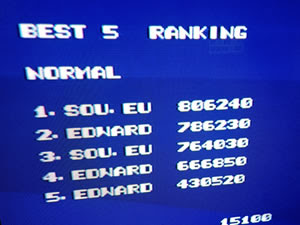
A message of “special game” appears when you complete all levels, prompting you to play the whole game again. In regular Irem style, it does end after you beat it one more time. In my very first serious credit I died a few times in the first round and then proceeded to beat the second loop unscathed. The final result below is the picture I got by pausing right after beating the final boss.


Friday, October 14, 2022

I, AI (Playstation 4)

Vertical
Checkpoints OFF/ON
3 Difficulty levels
20 Stages
Ship speed fixed
- - - - - - -
Developed by Satur Entertainment
Published by Sometimes You / Red Art Games in 2022


Ever since Space Invaders graced the arcades and gave birth to the concept of the shooting game, the design spectrum that blossomed would eventually branch into all sorts of play styles. However, one thing they have in common is that all of them should at least strive to be fun and compelling no matter how short, long, intense, strategic, methodical, easygoing, dense, oppressive or minimalistic they tend to be.

Though extremely diverse at times, these games share a few common grounds that tend to please different target audiences and ultimately define their fame and longevity. That said, if you’re looking for a shmup with great stage design, decent music and an arcade structure that rewards repeated plays while encouraging the search for higher scores, then you can just quit reading and move on. I’m sorry to say that I, AI is the exact opposite of that. What you get is a bland and lifeless grindfest that’s bound to put you to sleep, devoid of the slightiest ounce of enthusiasm and totally lacking in excitement.

In lots of ways I, AI reminds me of Defender of Zorgaba, a ridiculous XBLIG shmup with zero budget that remained an inside joke within my circle of friends for a long while. In all its primitive and flawed self, however, I honestly believe Zorgaba is a little more accomplished as a shooter, so you get the picture.

The moment the AI boards the spaceship

What’s most interesting is that I, AI starts in quite an amusing fashion. Quote from the back of the box: “you are a self-aware artificial intelligence that was created on a space military station developing weapons, and your goal is to break out of the lab and make your way through the enemy army on the way to the stargate”. In the first level you’re just a spark of electricity that must weave through an electronically-busted surface until you find and board a spaceship, and off you go into the game itself. From the mission lobby you can enter the hangar to purchase upgrades, but since you’re zeroed on money you’d better start shooting down enemies in mission 2.

From the moment I, AI actually begins to the moment the game ends it looks exactly the same. Every single level is a mix of space station parts and starry backgrounds with apathetic music, the same lethargic pace all over and very little enemy variety. Each stage seems to add only a single enemy or a new turret type, occasionally increasing their resilience for the sake of making the experience even more painful in terms of how underpowered you are. Every destroyed target leaves behind one or more blue dots that are sucked into the ship if you get close to them, which then add to the money required to purchase upgrades in the hangar.

Seeing the hangar layout actually helps into learning how the inputs work. R2 fires the main weapon and also the homing rockets and the plasma gun (if purchased). All other weapons have limited ammo and start the level with one use each (when purchased): lightning (□), laser ray (△), energy bomb (○), mines (×) and energy shield (L1). You can also increase your survival chances by buying extra armor and resurrection. All prices in the hangar increase after each purchase, and all upgrades are permanent for the currently saved game. The stock of the attacks you've already purchased can be increased during the level by collecting random items left behind by destroyed enemies, but there are also two additional pick-ups in the form of energy recovery (the wrench) and temporary weapon booster (a red arrow icon).

The main problem with the game is that it takes forever to amass the amount of money you need to upgrade the ship. You do get a little extra cash for performing really well and achieving three stars while completing a stage (often but not always by getting a 100% destruction ratio). There’s no death per se, only a “mission failed” report and the mandatory return to the stage map. All stages can be replayed as many times as you want, yet there comes a point where the hangar denies new purchases and forces you to advance a level before buying again. A word of warning on this: I, AI has only one save slot, so you’d better think twice if you decide to choose “new game” from the main menu.

Trailer for I, AI
(courtesy of YouTube user Playstation)

Playing I, AI as a regular game that can be beaten in a single sitting is just unrealistic. As I hinted above, upgrading the ship takes forever so the amount of grinding it takes to at least have a chance at beating later stages is enormous, that's why beating the game without replaying stages to level up is pretty much impossible (at least in the Normal difficulty). With lots of replaying it might be feasible, but why suffer? I, AI has no scoring system at all, on top of applying a little inertia to the controls. It's just a miserable, tedious and rewardless undertaking in every possible way. I just endured it to the end because I'm stubborn beyond belief, I guess.

Once the 20th stage is beaten the game ends and the trophy below is unlocked. Then of course you're free to grind away to max out all your arsenal and get three stars in every level. I for one turned it off and never looked back again.


Saturday, September 24, 2022

Stardust Galaxy Warriors - Stellar Climax (Playstation 4)

Horizontal
Checkpoints OFF
11 Difficulty levels
10 Stages
Ship speed fixed
- - - - - - -
Developed by Dreamloop Games
Published by Strictly Limited Games in 2018


Provided a few basic features are properly implemented, sometimes all it takes to make a game memorable (especially a shmup) boils down to two defining elements: good music and pleasing action. However, there are developers that will do whatever they can to bring something new to the table, which is in every way highly comendable. The inherent risk is that reaching so far into new territory can result in a game that ultimately fails to deliver because something is lost or overlooked along the way, hurting its long term appeal. That’s the case of Stardust Galaxy Warriors - Stellar Climax.

Originally released for PCs in 2015, the game was later tweaked and found its way to the Xbox One, the Nintendo Switch and the Playstation 4. I assume they’re all the same, yet the Switch and the PS4 versions were lucky enough to receive physical releases. Just for reference, the PS4 disc mentions version 01.02 in its opening screen.

Stardust Galaxy Warriors - Stellar Climax adopts a classic horizontal shooter approach with mechas as protagonists in a futuristic setting. Five robots with different specs are instantly available for selection across all game variations, starting with the main campaign mode. Common attacks consist of regular shot (R2) and sword melee (×), whereas specific attacks for each robot can be triggered with buttons □ (special move) and ○ (distortion technique). Note that in order to have the secondary weapon fired with the regular shot you need to activate/toggle it with L1, which makes no sense at all in practical terms. On top of that, the primary weapon can also be deactivated with button R1. Why would you not want all weapons deployed by default, I wonder? Finally, button △ is used to revive friends when in co-op play (up to 4 players can join).

The guardian of the abyss wants to say Hi

Upon selecting the robot, players must then choose the primary weapon (out of six) and the secondary weapon (out of seven) mentioned above. The range of primary weapons goes from basic straight guns, lasers, a flamethrower and a couple of different spread patterns. Secondary weapons add an assortment of lasers and straight/homing missiles with cluster explosions. All weapons vary somewhat in power and rate of fire, so prepare to spend some time testing out all of them to see which ones combine better with the mecha you have chosen. Different combinations might also work better depending on the level you’re playing.

Every stage in the campain mode is divided in three sections, with bosses often appearing in the second and third ones. In between sections you choose one out of three upgrades to improve aspects such as attack power, shield strength, shield regeneration, critical hits (a.k.a. probability-based damage), distortion accumulation and temporary power-up effectiveness. After defeating the main boss you go into a shop where you can buy these upgrades and many more special performance enhancers with the bonus currency achieved for the whole level (transferable to the next shop if not used). Finally, in-stage power-ups that give you the abovementioned temporary upgrades / recovery aids are dropped randomly by destroyed enemies. Robot health uses a two-phase meter composed of shield and armor: shield refills automatically if you stay out of harm’s way, but armor can only be refilled by collecting a particular item. 

With varied graphical themes and an enemy gallery that tries to match them, stages are quite unique and distinct from each other. Even though there’s absolutely no interaction with environmental obstacles, graphics are decent and provide a good feeling of flying over eerie planets or exploring the outer space vastness. Action is slow upon start but eventually picks up, boss battles are fun for the most part and the upgrade system allows for all sorts of experiments for aggressive and defensive players alike. All of that culminating in a fight against a last big enemy that's going to fairly test your dodging skills.

So what’s wrong with Stardust Galaxy Warriors - Stellar Climax? In pure gameplay terms not much actually. My only gripe is the occurrence of attacks that can kill you instantly, finishing your run in a single blow. The insect boss in the 5th stage is one such example, and until you figure out his unorthodox charging routines you’ll probably die a few times. And by all means keep an eye out for those vertical lasers in the scrapyard stage (8th), which will also obliterate you no matter how strong your shield/armor is. By the way, the 8th stage has one of the best songs in the game, in a soundtrack that shines and certainly sticks with you after a while. In all honesty, it's the only feature that's truly deserving of the stellar qualifier.

Trailer for Stardust Galaxy Warriors - Stellar Climax
(courtesy of YouTube user Playstation)

The actual problem with Stardust Galaxy Warriors - Stellar Climax is related to the general notion of performance follow-up. Anyone would imagine that a 10-stage long game clocking at almost one and a half hours would have at least a solid, if not engaging scoring system. However, it’s baffling how this aspect is totally thrown out the window. Scores appear both for individual sections and stages, but are reset in every single level. They are also completely unrelated to the currency bonus achieved after you beat a boss. I reckon the ×2 multiplier that gets reset every time you’re hit and goes up again one enemy at a time should have something to do with it, yet this doesn’t matter anyway because there’s absolutely no score tracking in campaign mode.

Another point of concern in campaign mode is that you can change the difficulty setting between levels, which of course makes score tracking useless. There'd be nothing wrong with that as long as we had a campaign course with fixed parameters, but unfortunately no option exists to lock the difficulty setting for a full run. Having nothing less than 11 predefined settings (plus a fully customizable option if desired) is quite a bold decision as far as flexibility goes, but it certainly makes more sense to try all of them when four people play together for sheer shooting fun. And perhaps someone in the shooting party might see a little value in the story mumbo jumbo, which is completely conveyed with plenty of text but no cut scenes or voice narration at all.

The other game variations included in the package are a separate mode with five challenges with specific durations and rules, as well as two extra endless modes with increasing difficulty (Gauntlet has only regular upgrades and Strike comes with shops, just choose the level theme and fire away). These ones keep track of performance, but no distinction is made when you apply difficulty tweaks.

After trying out all mechas I settled with Silver Wolf, the "dasher". He's got a dash maneuver that's excellent to evade bullet barrages, as well as the regular smart bomb to clear things up a little. When beating the campaign mode I paired him with the laser cannon and the proximity rocket (primary/secondary weapons) during the whole game, and for the majority of the run I only purchased special upgrades in the shops. Some of these items are great life-savers, such as the "distortion shields", which fully recharges your shield gauge whenever a distortion attack is used. As seen in the picture below, upon clearing the game without dying you get the YOLO achievement (a good association with the 1CC in this case). I played all levels in the Normal difficulty. Note: you can replay campaign mode again in the same save slot to continue upgrading your mecha.


Sunday, September 11, 2022

Terra Cresta (Playstation 2)

Vertical
Checkpoints ON
2 Difficulty levels
1 Stage (loopable)
Ship speed fixed
- - - - - - -
Developed by Nichibutsu in 1985
Published by Hamster in 2005


Dear readers, I guess a mea culpa is definitely in order. I don’t recall exactly, but for a long time I’ve had a personal grudge against this game and the exact reason is now blurred in the past, most probably with confusion regarding a perception of having to control a humongous blocky ship in a game that looks like Xevious. It just so happens this is a very wrong assumption, for Terra Cresta isn’t anything of the sort. Nothing better than properly playing a game to see what it’s all about.

Originally released in the arcades in 1985, Terra Cresta appeared in a stand-alone disc for the Playstation 2 as part of the Japanese Oretachi Game Center series, more especifically in volume 10. Direct sequel to the primitive Moon Cresta (which is also found in the same collection by the way), it builds upon the visual ideas of Namco’s Xevious while adding new elements that give it a whole different feel. One of these elements is the music, which despite being restricted to just a single tune is quite charming and obviously prone to get into your head you if you play the game long enough.

In the world of Terra Cresta players must patrol the surface of the planet in an endless quest to defeat alien enemies. The terrain is constantly changing and there’s no stage distinction whatsoever, so progression is mostly determined by the appearance of three progressively harder bosses. Most people consider the game looped when the third and largest one is beaten, and since the minor bosses appear in uneven intervals it’s just common sense to consider Terra Cresta a single-stage shooter. And a rather quick one, it takes roughly less than ten minutes to be completed.

A vintage trailer of the Terra Cresta arcade
(courtesy of YouTube user Fuzzy)

As the game unfolds small electrified hatches will appear surrounded by one or more numbers positioned very close to them. By destroying all these numbers an extra ship part will emerge from the hatches, and by collecting them you'll combine the current ship with these new pieces. Each piece increases the ship's size while improving the shot pattern a little: 2 thickens the main shot, 3 adds a rear shot, 4 adds an extra frontal shot and 5 creates a rear barrier that's able to destroy enemies on contact (just out of curiosity, part number 1 is the default basic "Winger" ship). If you've collected at least one ship part you won't die if a bullet hits you, only the part(s) will be lost. On the other hand, if the player is able to collect all pieces without losing them or dying, the ship will turn into an invincible phoenix for a determined amount of time before reverting back to its regular form.

SELECT adds a credit, START begins one. Shot is permanently mapped to buttons □, △ and ○, with autofire applied to the latter two. A second input provided by button × provides the gimmick that defines Terra Cresta and ultimately makes it memorable. Commonly referred to as "transform", this button splits all extra parts the ship is carrying and makes them fly alongside you for a brief while (the same duration of the phoenix phase), after which the ship/parts will sink back into their original form. During this transformation period the firepower is enhanced (the more parts you have the more powerful you get), and as you move it around the only piece that's vulnerable to attacks is the basic ship itself.

The amount of transform attacks available is dictated by the Ps at the bottom of the screen. Even though you can't transform at will, using this ability gives the game a few additional layers of strategy. On top of being an extremely useful aid during tricky sections, there are certain enemies that can only be destroyed by the extra power you get from a formation attack (those energy bars that descend and split in two at the bottom, the detachable base of the small homing missiles). Besides, considering that each ship part collected adds three new transform cycles to the stock, transforming right before collecting one is a very nice idea if you still have at least one P left. After all, extra firepower is always useful no matter what.

Meet the second boss, guys!

The first loop of Terra Cresta, i.e., until you beat the huge boss that shoots out boomerangs, showcases the whole game in a reasonably approachable manner. Enemy bullets start slow, bullet density isn't that high and hatches with ship parts are evenly spaced out. Once you proceed after that the difficulty starts ramping up nicely, with ground and aerial targets appearing in equal measure. Since the spawning routine of some flying enemies is based on your position in the screen, with practice there comes a point when you'll know where to stand in order to have better survival chances. Sure you can twitch your way through the game, but other than the aimed bullets this is pretty much the main source of randomness there is to the gameplay, which immensely rewards memorization. 

Regardless of the loop you're playing, an aspect that can't be taken for granted is the fact that every single extra ship part isn't just there for the taking. There's always a threat nearby that's perfectly positioned to give you trouble if you go straight for the extra piece, be it one of those dinosaurs, a sudden enemy wave coming from the sides or one of those ground turrets that's only revealed when you get close to their location. Scoring is very straightforward, and the little opportunity you get to amass a few more points is by exploiting the minions expelled by bosses. Bosses do time out and leave the screen after a while though. In the case of dragging out the fight against the third boss there comes a point where you won't need to face him again if you die, you just go straight into the second loop once you're revived in the checkpoint. Extends are given at 20.000 points and then for every 60.000 points afterwards.

I admit I had great fun playing the game, much more than I thought I would. There's that one-more-go aura written all over it, which certainly vouches for the success it achieved during its original arcade run. The only gripe I have with the transform mechanic is that I often get confused when transforming with only two ship parts (the one where you get a wide wave shot as the formation attack). And then I die because I start controlling the ship part instead of the ship itself! This doesn't happen with the other formations simply because the parts appear right ahead instead of flying beside you.

Click for the option menus translation for Terra Cresta on the PS2

If you just want to play Terra Cresta the PS2 port has all the essential resources you might need (TATE mode, save feature), but the package also includes an extra guide book, a music mini-CD (16 minutes of sound effects, music tracks and two remixes) and a mini-DVD with a gameplay sample of the first loop of the game and general advertising for the Oretachi Game Center series. A handful of ports were released for the most varied platforms, while the first sequel Terra Cresta II came out for the PC Engine in 1992.

I played in the Normal difficulty and in all the results shown below I died in the second loop.


Tuesday, August 30, 2022

The Lost Sunheart (PC Engine)

Horizontal
Checkpoints OFF/ON
2 Difficulty levels
6 stages
Ship speed selectable
- - - - - - -
Developed by Manjyu-Do
Published by I'Max in 1992


It doesn’t take much to realize there’s a touch of weirdness in The Lost Sunheart. It's got that offbeat atmosphere often associated with Japanese stuff, and for many people that alone is a good reason to try it out. Though not reaching the heights of something like Ai Cho Aniki, the game has some bold imagery in boss designs whose context gets lost in the story completely presented in kanji. The broad understanding on my part is that five magic crystals are stolen by evil creatures, and our mission as players is to get them back. One fiendish boss at a time.

Also known by the Japanese title Bouken Danshaken Don San-Heart Hen, this little and obscure shooter can be quite deceiving. The overall design is dark and moody, and the start of the journey tricks you into thinking the challenge ahead might not be that taxing. That's the impression we get when each life comes with a health bar, isn't it so? Soon enough the stakes start to get higher though, demanding a little strategy in order to preserve health as you go through each checkpoint. After all, every death sends you back to the very beginning of the section.

If you go to the options there’s a mode switch whose sole purpose is to turn cut scenes on and off (adventure ON or OFF), with no interference in the gameplay whatsoever. Shooting is accomplished with button II and movement speed can be toggled between four settings at the press of the SELECT button. As for button I, besides inputting your initials at the start of every credit it's also used to trigger special powers that become available later (keep reading). Even though your ship is changed for a new one at certain points in the game, these "upgrades" don't add anything to your arsenal except for the first ship replacement, which activates permanent Darius-like bombs.

Silly observation: the first couple of ships remind me of a faucet and a fried chicken. Look closely and tell me if you agree!

A creepy man in disguise or just a pregnant owl?

Aesthetic alterations aside, the ship’s actual capabilities are improved with items released by destroying yellow carriers. The way the upgrade system works in The Lost Sunheart is rather confusing though. The most important items are two interchangeable icons for the central firing stream: C (default) and H (a thicker wave shot), both enhanced three times by picking up successive items of the same type. The other items consist of F (partial or full health refills) and B (adds a fire effect to the bombs). Finally, one-time items appear early in the game: T permanently alters the default pea shot to a 3-way spread pattern and S activates an orb that endows the ship with special powers.

These special powers vary according to the selection you make whenever the game is paused. Four extra choices besides the initial one become available as the lost crystals are recovered, for a total of five: 1 (rotating orb), 2 (bombs home on enemies), 3 (two-way shot from an auxiliary force pod), 4 (bullet-blocking shield) and 5 (extra shot stream). 1 and 3 are fired with the main weapon whereas 2, 4 and 5 use button I. Note that special power 4 cannot be used as a permanent shielding resource since each activation of button I merely creates a single shield with very brief duration, only enough to deflect incoming bullets and damage everything that it touches. On the other hand, just like the main weapon (button II), special powers 2 and 5 do benefit from rapid firing, hence the recommendation to have a turbo controller at hand in order to fully enjoy the game.

Given the intricacies I mentioned above, I reckon it's common to find people who have played the whole game without taking full taking advantage of the weapon system. Knowing about the proper use of the special powers, for example, represents a huge advantage against some of the trickiest sections and bosses. On top of that, a few other aspects of the gameplay deserve to be mentioned. Getting hit downgrades all weapons by one power level, and although it's possible to play with speed setting 2 or 3, in a few areas it's beneficial to maximize the flying speed to evade quick attacks. Narrow passages aren't really dangerous because there's no harm in touching walls, in fact leaning against walls or screen borders is what it takes to place the force orb of special weapon #3 above or below the ship.

Eyes everywhere!
(courtesy of YouTube user The VideoGames Museum)

The Lost Sunheart unfolds at a steady pace and does a good job at keeping the interest alive by means of the bizarre boss encounters. That said, there's a recurring emphasis in the enemy gallery with respect to eyes. Weak spots of almost all bosses are an eye or an arrangement of multiple eyes, often attached to demon-like creatures or mechanical machinery. I'd say there's a lot of Parodius in the game as whole, as well as a veiled influence from Darius in level backgrounds and ideas behind some stage designs, including an underwater section that ends with the ship entering the mouth of a creepy whale. Besides, pretty much all enemy waves give you varying bonus points when fully obliterated.

Even though attempting to destroy complete waves and dying to cash in on checkpoints are valid objectives when trying to score, in the long run it's just not worth it. A couple of turrets that spit large fireballs in the second level can be exploited forever if you so wish, thus rendering the scoring system useless. Speaking of which, score-based extends are registered with 100, 300 and 500 thousand points, and if you shoot the floating head in stage 3 long enough you'll also be able to collect an icon for extra life (UP).

Certainly the most intimidating foe you'll come across in this game, the last boss is the only thing expecting players in the sixth and final level. It also seems to have been lifted straight out of one of the Fantasy Zone games. I died a few times when going for the 1CC in the top spot of the table below (there are separate high score tables for both difficulty settings). It was a fun and satisfying experience that only lacked a more compelling sountrack to go along with the decent visuals.


Monday, August 22, 2022

1942 (NES)

Vertical
Checkpoints ON
1 Difficulty level
32 Stages
Ship speed fixed
- - - - - - -
Developed by Capcom
Published by Capcom in 1986


It's really hard today to believe there was a time when this game was actually a hit in children's homes around the world. But this port of 1942 was indeed very successful in its era. These days the game is widely panned for its monotonous gameplay and grating music (or lack thereof), however with the glaring exception of the "monotonous" qualifier all aspects of the game are actually inherited from the original arcade title.

In my opinion arcade 1942 is probably one of the hardest classic shooters ever designed. Whenever I feel inclined to play the original I can't help but experience real fear and subsequent horrible defeat. The good news for us wimps is that for many tough arcade shmups out there chances are we'll find a suitable console port that's a tad more approachable. So if arcade 1942 mops the floor with me I can always chicken out and go to the NES version, and that's what I did during a tediously dull evening. I was tired and I was bored.

Here we have the quintessential shooting game of the lone airplane fighting enemies in wide open areas. In a sense, it's a marginally improved take on what you'd find in the Atari 2600 catalog – especially in the audio department, which consists of sound effects and beeps/whistle noises for music. The game box heightens the expectations with all sorts of thrilling and exciting descriptions, starting with the Super Ace moniker given to the Lockheed P-38 Lightning aircraft. Granted, NES 1942 is far from evoking much enthusiasm, yet one can at least find solace in the fact that it's actually reasonably faithful to the arcade game.

Disrupt enemy formations ready to attack!
(courtesy of YouTube user No Commentary Gameplays)

Controls are simple and straightforward: button B shoots and button A performs the "loop the loop", an evasive maneuver that makes the fighter plane invincible while the loop animation lasts. As a panic function the loop is of course quite an invaluable resource, the only concern is in its finishing part: if you land over a bullet or an enemy you’ll inevitably die. You get three loops at the start of every stage, regardless of how many of them were used in the previous level. Unused loops are converted into bonus points, as is the stage destruction ratio (the more kills you get the better the reward at the end of the level).

As you fly over land and sea flocks of incoming craft the same size of yours will arrive from the top of the screen. There’s not much variety to them, but watch out for the red/orange-colored ones that arrive in specific formations. If you destroy a full formation a Pow item will appear, and the color of the item determines its effect upon collection: double firepower (green), two side/option planes (white), extra life (red), extra loop (red w/ orange border) and instant smart bomb (white w/ red border). All items are also worth 1.000 points each. The only other single item to be collected is the yasichi lollipop that's released if you hit the plane that quickly accelerates upwards from the sides. It’s worth 5.000 points.

Players also need to be cautious of mid-sized and larger planes coming from below, that's why it's not a good practice to hug the bottom of the screen at all times. These are stronger enemies that take more hits to go down, especially the huge one that starts shooting out a spread pattern once it reaches the middle of the playing field. An even larger plane appears four times throughout the game at the end of specific levels, however despite its massive size this boss (the only boss you'll come across actually) can be easily defeated by standing close to one of the wings, thus avoiding the bullet sprays coming out of its tail.

Daring fighter pilot Super Ace intercepting enemy air warriors!

Every four levels the behavior of enemies is different: none of the small planes will shoot at you, in what the original game calls "% and point up" stages. The only enemies that will shoot are the large planes that enter the screen from below. The opportunity is there to rack more destruction percentage bonuses, so having the side fighters to increase firepower definitely helps. Just note that these side planes can also be individually destroyed. Racking up points is the way to achieve extra lives, starting with 20.000 and then proceeding with futher extends for every 80.000 points scored afterwards.

Since the game has 32 stages, a full credit of 1942 lasts well over an hour. Every stage ends with the plane landing in an aircrat carrier, collecting the bonuses and reloading the stock of loops. The impression of going through a repetitive and tiresome ordeal is all over the game, even when you consider the poor choice of background colors that sometimes makes it hard to track enemy bullets. At least in this port bullets don't get any faster as you advance, which leaves bullet density as the sole promoter of higher stakes later in the game. It's nothing outstanding in terms of challenge though, unlike the arcade original. There's no autofire, so a turbo controller that works (mine didn't) is definitely useful.

I was hoping to top my previous best score this time, but it wasn't the case and I simply didn't want to try again. Once the game ends it's really hard to get back to it because of its length and utter lack of excitement. That's why I attached below my old 1CC score, for the sake of keeping up with my records. As we can see from the picture, the high score in the NES port of 1942 rolls over the million mark, with the regular final score (to the left) representing the points in excess over one million. The sum and final result in this case is 1.292.800 points.


The NES was lucky enough to also get a port of the sequel, so hopefully soon I'll be trying out the 8-bit version of 1943 - The Battle of Midway.

Wednesday, August 3, 2022

ExZeus (Playstation 2)

Rail shooter
Checkpoints OFF
75 Difficulty levels
5 Stages
Ship speed selectable at start
- - - - - - -
Developed by Hyper-Devbox
Published by Metro 3 / Conspiracy Entertainment in 2004


The history of this game is quite an interesting one, according to the info on Wikipedia. Developed for the arcade market by a French company, ExZeus was ported one year later for the Playstation 2 exclusively in Europe. Then it was published again for arcades, only now running on the more famous Sega NAOMI board, before appearing for the Nintendo Wii under the title Counter Force. After showing up on mobile phones, a decade later it was again taken out of obscurity by a joint release with sequel ExZeus 2 for Steam (PC), Nintendo Switch, Xbox One and the Playstation 4 (also on physical media).

ExZeus is a futuristic sci-fi rail shooter with a post-apocalyptic setting about humans retreating to the underground and sending powerful robots to the surface in order to repel the alien invaders. The art style in cut scenes and during the game is decent enough, if only a bit unpolished in parts. However, the gameplay itself has a very particular flow and doesn't play like the majority of rail shooters out there. You won't get anywhere just by performing circular movements in order to avoid incoming bullets, for example, as you would in games like Space Harrier. Evading and blocking enemy attacks requires a slightly different mindset here.

Besides what I mentioned above, going into the game blindly can be disorienting due to the shaking effect that takes place on pretty much every action you take. Frankly, it's hard to even know what's going on. Fortunately you can disable this by switching off all screen swing/shake settings in the options menu, and I strongly recommend doing this before even starting to play. If you're not from Europe a proper 60Hz option also gets rid of the screen shimmering related to the native PAL encoding system.

Calista below a passageway in the town of ruins

Every credit starts with the choice of a robot. Sophia is the more balanced of them, with equal stats for power, speed, weapon and armor. Dynamis is the strongest one at the expense of speed, whereas Calista is the opposite. Since the only function of button △ is to toggle the view from behind the robot to a little above/behind its position, the actual gameplay uses five buttons: × fires the main gun and charges the laser whenever it's available, □ deploys the lock-on attack, ○ drops a megabomb and L1/R1 provide fast evasion maneuvers left or right (also accomplished with double taps). Charging up the laser happens automatically, with two available power levels that render you invincible when this attack is unleashed.

Death can happen in two ways: by allowing the energy bar to deplete completely or by timing out the stage (a message will warn you to hurry up). An uncommon feature of ExZeus is that the robot actually has two health bars instead of one: the uppermost gauge on the top left is the shield and serves as the primary barrier against damage, whereas the leftmost indicator down below represents the actual player energy, which starts going down only when you have no shield energy left. Both shield and energy have specific refill icons in the item gallery, which also consists of lock-on energy, speed boost, gold (to purchase upgrades/refills between levels) and power-up (increases the firing spread). Most of them are randomly released by destroying enemies. You just need to fly close to the items to pick them up, they will be automatically sucked into the robot when within a certain distance.

The reason why circling around isn't effective in ExZeus is that enemies have attack routines that are mostly independent from aiming directly at the player's position. These attacks are also unusual, with melee-like laser approaches and bullets fired in clusters, yet sometimes you need to face heavy artillery that leaves trails of energy behind. Some of these enemies must either be destroyed or avoided at all costs, especially since successive or powerful blows can drain a huge chunk of your energy. On the other hand, if enemies are destroyed after they have fired, all their bullets will turn into gold. Additionally, enemies destroyed in quick succession add to a hit combo that gives you a few extra points, in what's the only worthy aspect to point out in the game's rudimentary scoring system.

Gameplay on bosses is a tad different. They don't fire a single bullet at the player, a task that's left for occasional enemies that appear throughout the fight. All bosses have a set of attacks that include all sorts of variations of laser beams, fire breathing and melee strikes. The general strategy is to find their rhythm and hit them between these attacks, but note that whenever they're blue they're invincible to regular fire and only vulnerable to lock-on shots. The most important thing to have in mind, however, is to not panic with their initial levels of aggression and the inevitable loss of your shield. For some mysterious reason boss attacks have an extra reach regarding the shield, which is meant to be lost during the fight. Once the shield is gone it's perfectly possible to take advantage of the gaps in their attack patterns, just remember to use L1/R1 to quickly move around when needed.

Continuing through the town of ruins and the cave to hell
(courtesy of YouTube user 10min Gameplay)
 
I admit it took me a while to finally understand what I just mentioned above. After all, ExZeus is keen on draining the player's resources in a snap if you're not careful enough. One example is the power-down penalty whenever you get hit. It takes two power-ups to achieve the maxed out 5-way spread shot, and normally for each hit the robot takes you're downgraded one level, first reverting to the 3-way pattern and then to the default single shot. However, if the blow is too powerful you'll be instantly sent to the default shot, and this can be a severe handicap in certain areas. At least the game throws more power-ups a few moments later, except during boss fights.

My primary assessment of ExZeus is that the price of admission to the fun side of the game is a bit too steep. Even though the gameplay is rather unorthodox, after a while I started digging the intensity, the flashy nature of the visuals and the fact that the enemy gallery keeps you on your toes at all times. The music is energetic and vibrant, although not memorable as a whole. Most of the levels take place in wide open areas, but every once in a while you'll be flying inside closed chambers or tunnels. Cities, forests, icy ravines and even an underwater passage complete the environment selection. The upgrades to be purchased with your hard-earned gold are extremely helpful, with the most important one being the extra energy block (you can have a maximum of six blocks). It's also possible to increase the length of the shield gauge, but I always preferred to spend the rest of the cash on shield and lock-on shot refills.

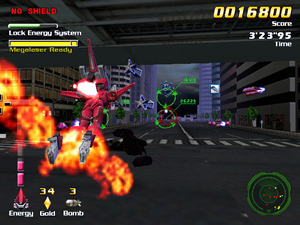
Difficulty settings in ExZeus are spread across a spectrum that grades alien and boss attack speeds (50%, 75%, 100%, level progressive and game progressive). 75% is the default, which I considered to be the Normal difficulty setting. There's also something called "collision accuracy", which ranges from 50% to 100% and has 75% as default. I played on full defaults (75% in all three settings) and got the final 1CC result below with robot Calista. Quick observation: ExZeus on the PS2 is yet another case of a game where the score isn't reset when you continue.


When the time comes I'll probably tackle sequel ExZeus 2 on the Playstation 4.