Saturday, June 30, 2012

Space Harrier II (Mega Drive)

Rail shooter
Checkpoints OFF
3 Difficulty levels
13 (15) Stages
Ship speed fixed
- - - - - - -
Developed by Sega
Published by Sega in 1988


Witnessing the dawn of a new video game system must have been the shit back in 1988. The expected leap in graphical and processing quality of the Mega Drive was meant to provide a much better gateway for more faithful arcade ports, but just doing ports wasn't enough in a few cases. Launch titles needed a punch so Space Harrier received a direct sequel instead of a conversion. As such, it develops over the ideas of the arcade game and provides new enemies, bosses and music to another adventure on the "fantasy zone". Never mind the fact that the story takes place in the "fantasy land" this time around, but who cares anyway?

As a launch title Space Harrier II was certainly able to showcase the power of the new video game system, even though it isn't as technically impressive as the original arcade game. On the outside it seems just like it, but the dubious attempt at providing scaling effects on a console that wasn't designed for it and the reduced frame rate are proof of the inevitable gap between both platforms. Yet the game is fun enough to warrant some involvement for those who liked the first chapter. After all, it isn't anything close to what happened to Thunder Blade's sequel Super Thunder Blade, one of the other launch titles for the Mega Drive.

Shiny sea creatures ahoy!

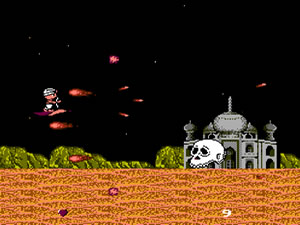
Harrier has the same abilities of the previous adventure, running and flying around with his plasma cannon over colored checkerboard grounds. Every now and then another checkerboard surface will appear above him to provide a slightly clausthrophobic experience. After areas 4 and 8 a new bonus stage appears: for obvious hardware limitations Falkor is gone, replaced by a hoverboard while the hero destroys harmless seashells and dragons. The last stage (13th) brings back the boss rush and presents the most visible improvement on game variety: all bosses are preceded by their names and a final enemy awaits, the Dark Harrier.

Despite having less stages than the first game Space Harrier II gives the impression of having the same length. Challenge level is a completely different story though. Every time the player scores 1,5 million points he/she receives an extra life. That's an awful lot of extends in the long run, which definitely helps everyone to beat the game and read its backstory (in a weird move Sega decided to reveal the in-game storyline right before the end credits instead of showing it up front). Space Harrier II also comes with more empty room, even during the heavy parts with lots of pillar barriers. With a lower number of sprites and enemies on screen, the overlapping of incoming waves isn't as frequent. When this happens the game's frame rate rears its ugly head and leads to painful deaths - the pseudo-scaling is far from perfect, and you often wonder why an enemy that was far from you suddenly hits you in the face. The golden rule for old school rail shooters still applies: provided you have room, keep moving and you won't get hit.

A good portion of the hazards in the fantasy land are new, and some of them are just simple sprite rearrangement. Bushes became seashells, for instance. Small spaceships, trees, orbs, robots and rocks are back, joined by toads, dragons/gargoyles, knights and flying men, among others. Tiny extra details such as the lightning that strikes the background prior to a boss's appearance or the Harrier's departure from inside the cockpit of a spaceship are unique to the sequel. They don't add anything substantial to the game, but it's still nice to see that Sega put them in. Contrary to what I would've expected, the most controversial aspect of the game is the music. Blame it on the BGM for the first stage... It goes a little bit against the atmosphere. Later on the music gets better and starts to resemble the first game, with some good new boss themes to boot. The famous voices for the character's death (AWWWWW and GET READY) are back.


Space Harrier is back into action!
(courtesy of YouTube user FMFlameNinja)

To access the options press and hold A at the start screen. There it's possible to activate autofire, a feature that may not be that helpful at times because the Harrier's rate of fire is limited to bursts of four consecutive shots. This becomes a problem in the busiest areas of the game, since it's quite common to get rammed by enemies who are right in front of your autofire-enabled plasma cannon and should've died already. Getting killed this way is probably the most annoying thing about Space Harrier II. Difficulty selection alters the extend interval: 1 million points for the Easy setting and 2 million points for Hard. The game itself plays the same way in all three difficulties. Upon start the player is allowed to choose the initial stage by pointing to the sides while Harrier looks at the horizon and the stage name is displayed on screen. You still need to play all other stages before going to the final boss rush though.

Die hard arcade lovers may look down on Space Harrier II and label it as a lesser and useless effort, but in the realm of sprite scaling rail shooters it's really not that bad. Heritage surely helps in its appreciation (it does for me), as well as the watered down difficulty that sets it apart from Space Harrier (which would receive a proper port for the 32X add-on more than five years later). I wish there was some kind of bonus for a large life stock at the end of the game but there isn't, so there's no need to worry too much about losing lives while getting there. My 1CC score on the HARD difficulty is shown below.

Monday, June 25, 2012

Varth - Operation Thunderstorm (Playstation 2)

Vertical
Checkpoints OFF
8 Difficulty levels
30 Stages
Ship speed fixed
- - - - - - -
Developed by Capcom
Published by Digital Eclipse in 2006


For all purposes Varth – Operation Thunderstorm can be considered an offshoot of the 194X series, one of the most emblematic series in the shooter genre. Points in common are the biplane protagonist, colored wave formations bringing power-ups and a very long game campaign with nothing less than 30 stages. The main departure from the old formula is the concept of using auxiliary “pods”, an idea that echoes somehow in Taito’s Grid Seeker. Full of detail and as tricky as it gets as far as a Capcom shmup goes, Varth is a beast of a game that definitely exists to teach players the meaning of failure. That is, until you conquer it and get the Ryu shower in the end credits.

Excluding the PSP compilation, the only port on home consoles is included in the second volume of the Capcom Classics Collection, available for the Playstation 2 and the Xbox. Even though the PS2 version lacks a TATE option, the game itself is virtually a perfect emulation of the arcade original, down to the inherent slowdown (based on my experience with MAME). If you’ve got a big TV set there isn’t a single reason not to play it on Sony’s console. The only note I can share to make it a better experience is that I had to reduce the contrast and color levels to improve visibility – for some strange reason the game appears to be more colorful than usual.

There’s a natural thematic progression in Varth, which starts on the city and evolves through skies, harbors, ocean, deserts, forests, railways and several different bases. The game throws every sort of enemy one would expect from a war themed title: tanks, planes, choppers, turrets, trains, ships, lasers, walls, missiles, bombs, flamethrowers, smoke, storms, sand storms, enemies coming from behind, huge bosses and secrets. Lots of them, to be exact. Varth can be made even tougher than it normally is if the player wants to take risks and find the goodies. Since the campaign is a long one, figuring out the secrets is also half the fun, so for most players it’s not just a matter of coming up with the best route to be followed in order to merely survive.

Wide shot, smart pods and missiles against Spider

Finding the weapons that suit you best is the best thing to do as soon as you start playing. The three main weapons are switched with dedicated icons: machinegun (starting weapon), wide shot or laser. The pod icon cycles between three choices, and taking it activates the pod while giving/upgrading the auxiliary firepower as missiles (M), homing (H) or napalm (N). Pods provide protection against all incoming regular bullets and can be either smart (they have a life of their own and move around the plane to block bullets, separated by a 180ยบ angle) or fixed (stationary pods that protect only the plane's front). Even though pod type can be switched with the pod icons, pod behavior is selected at the start of the game and cannot be changed.

Other normal items to be collected are the power-up and the extra bomb. The main weapon is also powered up if you take the icon of the same weapon type, maxing out at level 8, while pod power is increased only by taking another icon of the same type (3 upgrade levels). Bombs work according to the main weapon you’re using: machinegun generates a set of plasma bursts with homing capabilities, wide shot fires a double beam that ricochets and explodes on the top of the screen and laser creates a lightning mesh all over the visible area. They recharge over time until the default stock of three is refilled, but you can recharge them faster by wiggling the joystick. Extra bombs from icons can increase the stock temporarily, thus giving better bonuses if you can keep them at the end of the stage (5 bombs = 30K, 4 bombs = 20K, 3 bombs = 10K, 2 bombs = 3K, 1 bomb = 1K, no bomb = no bonus).

Regular items are released by destroying a characteristic helicopter, enemies with different colors or hidden ground spots. Hidden areas also lead to the discovery of secret items that either increase the score or provide an important aid to survival. Secret items can be:
  • a flag: worth 5.000 points each;
  • a falling racing car: worth 10.000 points each;
  • a blue helmet: worth 5.000 points each;
  • a tower station: hover over the location to uncover and destroy it for 2.000 points;
  • a miniature of the character from Side Arms: a screen-clearing smart bomb;
  • a green duck: after uncovering its spot in stage 20, it keeps changing into other items until it's taken (quite a useless secret, to be honest);
  • Ryu: yes, it's a cameo from Street Fighter's Ryu; uncover his location in stage 4 and hit him to get a shower of items as he performs a shoryuken.
There are times where a yasichi (looks like a lollipop) will appear if you die, granting maximum power for the weapon(s) you're carrying. Keeping the plane always at full power is good for scoring because every surplus power-up is worth 5.000 points. It increases rank dramatically though, making enemies much more aggressive. The evil helicopter that throws a pair of energy circles that follow you and latch onto the pods is the staple of a maxed-out rank. Those damn circles are awfully strong and nullify the bullet-blocking ability of the pods. My strategy is to atract them and bomb as soon as they latch. Besides rank, the unpredictable AI is the other factor that contributes to the insane difficulty you're bound to face: even though every stage seems to have the same patterns for enemy waves, every now and then the game will send a completely different wave to mess up the player's strategy. That's why it's never a good idea to stay in the upper half of the screen or too close to the sides, not even in the early stages. This unpredictable nature is also applied to the scoring system to a lesser extent, since sometimes different bonuses are awarded to certain waves and I have absolutely no idea why (example: first white waves of stage 5 are normally worth 10K each, but can randomly get down to 4K). The game does have a huge bug in the 4th boss: kill it within a certain time frame to get 27.000 or 29.000 points and watch this bonus get multiplied by ten (real score increase is 270.000 or 290.000). It takes some practice, but it's perfectly repeatable after a while.


Varth's co-op action (Japanese version!)
(courtesy of YouTube user ReplayBurners)

Another risky source of points is the absence of pods upon stage completion. The reward is 50.000 points and far outweighs any other bonus you might get. Playing the game without taking any pods is possible but requires an even higher level of commitment because it's necessary to avoid the pod icons at all costs, let alone deal with enemies without any pod protection. I've only tried to do it on the first stage, after that I'm always thankful to have my homing pods with me at all times. My favorite main weapon is the machinegun because of its much superior bomb. I can live with the wide shot, but the laser is downright awful. Since the icons take very long to leave the screen it's pretty common to get the wrong weapon by accident and ruin the credit. I was devastated when it happened to me once as I was about to face the last boss.

Varth is a lengthy, almost physically draining game. As you get closer to the end you start to realize that a full run clocks in at about an hour or more, so late failures tend to hit harder than usual. Thankfully both graphics and music are compelling, and the game never gets repetitive despite its massive duration and the boss/music recycling of its second half. At first I thought the plane was too slow, but once I sank some time into the game I realized it's adequate for the proposed challenge. It allows perfect manipulation of the plane's hitbox, which consists of its axis only and excludes the wings. Knowing where the hitbox lies is essential to deal with the lasers that flood the screen later on. Speaking of challenge, it's interesting how stages are unsymmetrical in length and intensity, alternating between true hell and relaxing moments and most of the time not even including bosses. Stage 6 is the first real soul breaker since it's common to get to it with rank at maximum level. Stages 9-10, 12-14, 16-18 and 26-28 must be navigated and dealt with with extreme caution, that's where most of the danger is. The remaining stages are either boss fights (each one appears more than once) or a bonus area (20). Extends are score-based and come with 600K, 2M and 4,5 million points. Every remaining life in stock is worth 100.000 points upon game completion.

I heard the Japanese version of the game has checkpoints, so everybody should feel fortunate that the one included in the PS2 compilation is the World version. When playing the game on the PS2 look out for the options. Leaving them at their defaults brings up one high score table, switching to the "hardcore" setting activates another different save slot and messing around with the options gets you a third save routine labeled as "custom". It's always good to turn off continues because the firing button will trigger them and ruin the score display for single credit purposes, therefore I was always using a "custom" high score table. The rapid fire option is neat but isn't really that good in the long run, so I used a turbo controller to get better autofire capabilities. My 1CC was achieved on the NORMAL difficulty, with fixed pod type.

Thursday, June 21, 2012

Prehistoric Isle 2 (Neo Geo)

Horizontal
Checkpoints OFF
7 Difficulty levels
6 Stages
Ship speed fixed, selectable at start
- - - - - - -
Developed by Yumekobo
Published by Yumekobo in 1999


It took ten years for a sequel to come out for Prehistoric Isle in 1930. The first one had its design firmly set in ancient surroundings dominated by dinosaurs and extinct creatures. Prehistoric Isle 2, on the other hand, puts the gigantic lizards as destroyers of modern landscapes and slayers of the contemporary human kind. It's a puzzling thematic shift that not only doesn't make sense but also sets both games apart in regards to gameplay and difficulty. Those who've been exposed to the first chapter, for instance, will find the second one a breeze to play as its challenge level was considerably toned down. Everything else received an aesthetical boost provided by prerendered graphics and nifty animation frames applied to practically all enemies across six stages of relatively straightforward shooting fun.

Prehistoric Isle 2 was originally only available for MVS arcade boards, but thanks to technical aspects of the SNK hardware it can be converted for direct play on an AES console. That's how I got to experience the game. I wonder what Yumekobo (Aicom) had in mind when making it at the brink of a new millenium, a time when most developers were incorporating more advanced ideas such as danmaku, polygons and overall a more aggressive approach to difficulty. The company was strongly swimming against the tide by squeezing such an enormous amount of prerendered pixels into an old school shooter. It's visually compelling, but not in the same level of excellence as Pulstar or Blazing Star, which were released by the same team before Prehistoric Isle 2.

Following a nice introduction that shows dinosaurs invading the city and the military coming into action, two choppers take flight to battle them. Type A is blue, faster and has a straight shot pattern. Type B is green, slower and has a spread shot pattern. Both are well rounded and balanced as far as their characteristics go, but we never get to know the names of the brave pilots. Once one of them is chosen the helicopter goes straight above a street raided by a tyrannosaur, and the building crumbling down under the attack of two pterodactyls perfectly establishes the mood for what’s to come.

YUM! Green chicken-lizards for dinner!

Enemies will regularly release stars that must be collected for points, and actual power-ups appear mainly from crates brought by a flying dinosaur. There are two main weapons to be selected with the icons that cycle colors (C=blue and G=red), as well as the type of missile to be used: M (straight), H (homing), N (napalm) and S (like the missile, but with a much more powerful rocket-like aspect). If you keep the fire button pressed you get a slower firing rate with occasional spread bursts that can be "directed" with the helicopter itself. Tapping the button adjusts the firepower to its fixed, more concentrated pattern. For all purposes tapping is better than holding, that’s why most people play the game with autofire enabled.

Sticking to the same power-up will increase the weapon's firepower until it maxes out. Smart bombs (instant detonation) and extra bombs complete the set of items to be collected. Each helicopter has its own animation for the bomb, which follows the nature of the main weapon (straight/spread).

When the main shot is at its maximum power the player is offered the chance to exploit one aspect of the scoring system: the next extra/surplus power-up of the same color will trigger a timer indicated by the hearts appearing below the score counter. While this special period is active the base value of every killed enemy is initially multiplied by ×2 and eventually maxes out at ×16. Certain parts of the game are key areas to trigger these bonus multipliers, and that’s where smart bombs come in handy. Smart bombs appear only during the sections where you have to DEFEND PEOPLE as they’re collected by a rescue chopper. Don’t take the smart bombs right away, wait until you have more enemies on screen: every enemy will be turned into an extra item, be it a star or – in the interest of a higher score – another power-up item to activate the bonus timer/multipliers.

Some people will signal with a large HELP sign and hang onto the helicopter with a rope once you fly over them. It’s possible to rescue up to 5 people in stages 1, 2, 4 and 5, and if you want to get the best end-of-stage bonus do not deliver them to the rescue chopper that appears before the boss with a TOUCH ME balloon. That chopper gives away items in exchange, but the score bonus will be severely reduced. People hanging on the rope don't add anything to the hitbox and give a very funny vision as you approach ground level: they won't let go of the rope, instead they keep walking after you! The remainder of the end-of-stage bonus comes from stage completion, stars collected and life count.


Dinosaurs are on the move, dinosaurs are loose!
(courtesy of YouTube user ImbuedGold)

Even though there’s a lot going on at all times and everything is extremely colorful, backgrounds are visibly flat with no noteworthy special effects. A few transitions will show the helicopter following creatures into crumbling buildings, and if you don't pay attention you might think parallax is completely absent (it's either very shy or just ugly, as in stage 3). However, what lacks in background treatment is duly applied to the animation, as I mentioned above. The fourth boss (killer bee) gives me the creeps every time its butt inflates to a horrendous size. It’s a short sequence that instills real fear in my mind, an awesome sensation that many shmups aren’t actually capable of achieving (or maybe it’s something about insects that bugs me, I can’t be sure). As for the music, it seems to have been lifted directly from one of those old sci-fi TV serials. The resulting mood is outstanding, and my favorite tune is the one that plays in stage 5.

What makes Prehistoric Isle 2 an easy ride, especially when compared with the first chapter, is the absolute lack of randomness to the gameplay, which is devoid of rank and cheap enemies. It seems as if the developer wanted to compensate for the excruciating difficulty of Prehistoric Isle in 1930. In the sequel, bullet count is never overwhelming and benefits those who are able to keep even a low degree of cool under the heavier curtains (the baby dinosaur at the end of the first stage, the tyrannosaur before the fifth boss). Mild slowdown is also to be expected. You don’t get score extends, but you even get to keep the bomb stock if you die (note: a single 1UP can be found if you manage to protect all 30 people in the rescue section of the fifth stage). This is of course based on the game running on US hardware; in Japanese machines life stock is replaced by a health bar, and aside from the game being the same I have no idea how lives/extends work in that version.

Dinosaur/history geeks and old school shmuppers should all play Prehistoric Isle 2, it’s a mandatory game that effortlessly caters to both fan bases. It’s fun and it’s not too tough, the only problem is that the entry ticket to see it running in real hardware is rather steep. Alternative solutions aside, it’s totally worth it. In my best run I scored the amount below, playing with the type A chopper (blue) on the MVS difficulty setting with autofire. I died one life on that huge laser beam from the last boss.

Thursday, June 14, 2012

Magic Carpet 1001 (NES)

Horizontal
Checkpoints OFF
1 Difficulty level
4 Stages
Ship speed by icons
- - - - - - -
Developed by Mega Soft
Published by Gluk in 1991


For a video game, being boring goes hand in hand with me being bored. Lately that's something I'm starting to firmly believe in: you have to be bored to some extent to play stuff like Magic Carpet 1001, an unlicensed horizontal shooter that perfectly fits the bill as a boring video game. Half an hour of shooting boredom was enough to see the end, and nothing changed about the general idea I have towards unlicensed games. I get the impression that this one caters to the sensibilities of children because of the arabian setting and the idea that you control a kid with a bow flying a magic carpet. Therefore it must have garnered a mild degree of exposition and success in the more underdeveloped corners of the world (it supposedly came out in 1991), even serving as the basis for a late Harry Potter-themed hack.

Gluk released the game in Europe under the title La Alfombra Magica (The Magic Carpet) without changing anything in the game itself. It still shows Magic Carpet 1001 in the title, and the instructions are printed in the back of the box instead of coming in a proper manual. Mega Soft, the original developer, was well known for its activities with unlicensed software, and apparently made no effort to stop the game from spreading in different ways throughout the market. Later on the game appeared in a 6 in 1 multi-cart published by Caltron, as well as in pirate cartridges under the alternative name Aladdin 3. Just like many other NES unlicensed shooters, all "official" releases of the game are quite rare.

A shadowy battle against the third boss

Deserts and outer space are the only backgrounds you'll see across the four stages of Magic Carpet 1001. There are no obstacles in sight so feel free to move all around if you want. Also feel free to refrain from shooting if you have no turbo controller and you're too tired of pressing the button like crazy to get that puny rate of fire provided by the character's bow. Why not shoot, you ask? Actually that's not the right question, for the game has no scoring system. I'm an adult now so I'm in my right to complain, but I assume I would take it for granted if was an innocent child. An unrelated example: I was deeply disappointed to find out, after all these years, that Decap Attack has no scoring system either... How picky do we get when we get older, huh? As with a handful of other cases, seeing the end is the only motivation you'll ever have to play this game.

Upon start it's only possible to shoot one arrow at a time (button A), but better firing rates and a three-way shot will eventually be available by taking successive P items. These power-ups are released randomly, just like speed-ups (S), extra lives and health hearts. Each heart allows the character to avoid instant death by granting 4 extra defense hits against bullets and 2 defense hits against enemy collision (a single heart is displayed on the lower left side of the screen, regardless of how many you've already taken). Dying strips the character off one power level, that's why collecting lots of hearts is important to survive difficult parts and quite essential if you get to the last boss, a disappearing Parodius-inspired mouth that fills the screen with bullets. Interesting information taken directly from the "manual": if by any chance you're lucky enough to get the treasure from the magical lamp in the last stage you become invincible. My guess is that this "treasure" is somewhere inside one of those enemy formations shaped as a big heart - you'll know you're invincible when the character keeps blinking non-stop. Talk about a cheap way to grant a free passage against the last boss!

Another unexpected tip given by the manual is that you can increase the "energy" by pressing SELECT + B. That means the shot power is increased to its maximum level, but in order to accomplish that the main shot button (A) must also be pressed. Even though it seems to be a good idea, pushing all these buttons at the same time isn't comfortable at all.


You go right and try not to die (Caltron 6 in 1 version)
(courtesy of YouTube user DarkMurdoc666)

Only a single song is used on all stages, and the bulk of the enemy gallery is comprised by insects, ninjas, birds, bats, rocks and meteors. It's a complete thematical mess given the middle eastern setting and the misleading opening screen, but at least it's a rather colorful one. Incoming bullets are on the slow side, and provided you don't allow enemies to live long enough the game never gets overwhelming. Regarding bosses, prepare to face a witch, an alligator in a flying jar, a skull and the aforementioned outer space mouth. A curious note: the death animation is taken directly from Toilet Kids, and the hero sprites seem to be a rip-off from one of the characters in Doki Doki Panic. We all know, originality is a trait often reserved to licensed games...

Without incurring in any disastrous aspect but an uneven distribution of power-ups (hit detection is okay, gameplay isn't compromised by the character's large hitbox, no jerky scrolling), Magic Carpet 1001 is a miserable but playable oddity. The lack of scoring is a shame and further cements its underground, collector-only status. It seems War in the Gulf (one of the other three NES unlicensed shooters by Mega Soft) shares the same fate, but that's something I can't and I'm not willing to figure out right now.

I had the honor of savoring the game in its Gluk incarnation, La Alfombra Magica. The ending sequence halts at the screen below after showing the reward given to the kid flying the magic carpet. Patrick, Julia and Ruth, thank you for half an hour of NES obscure shmup history. I won't thank Martino because he was already thanked.

Wednesday, May 30, 2012

MechFish (Xbox Live)

Horizontal
Checkpoints ON
1 Difficulty level
14 Stages
Ship speed fixed
- - - - - - -
Developed by Lethal Martini Games
Published by Lethal Martini Games in 2010


XBLIG shmups are a complicated matter in the world of virtual releases of today. It's getting more and more difficult to fish the good ones out of the ocean of mediocrity that plagues the service, so I'm moving on through the back catalog of shmups I have already downloaded in what I have baptized as my "2012 discovery campaign" (quick XBLIG shmups to rest my head from heavy bricks such as Raystorm). For the last relaxation sessions I chose a title that kinda suits the sentences above: MechFish is a horizontal shooter totally set in watery grounds. Close to but not really embracing the aesthetics of a cute'em up, this game is more of a methodical environment blasting than pure bullet dodging. "Relaxing" is a relative word to be applied here, for there is no room for sloppiness if you want to pursue a 1CC on this game. Looks may be childish but the challenge definitely isn't, at least for the XBLIG average shmup level.

The story goes like this: the plans for the MechFish - a remote mechanical recon device - have been stolen and used to create an evil counterpart named as the DeathFish. Armed with reflexes, a high powered vertical propulsion system and an unlimited supply of explosive bombs and missiles, MechFish must swim through dangerous enemy waters, dodging mines and destroying DeathFish along the way. Start a credit by choosing one of the save slots and get familiar with the basics in the mandatory tutorial. You can't start a new journey unless you play the tutorial, but that's okay since this "stage zero" is rather short and adds a few points to the final score.

MechFish makes extensive use of a very reduced set of sprites/enemies to deliver 14 levels (not counting the tutorial) of aquatic perils. It goes a bit overboard on its length and tends to get repetitive if you're searching for a quick romp. There are no bosses and graphics are of borderline Flash quality, presenting no variety at all during half of the game. All these aspects shouldn't be a good sign, but the mix of different obstacles, offbeat gameplay and the emphasis on a classic shmup structure offer an interesting challenge for those willing to take the plunge. People can still continue over and over after dying, but the score is reset every time you do this. With only four lives and no extends whatsoever, completing the game in a single session is a task reserved for persistent players with sharply trimmed reflexes.

A deadly encounter against a beautiful sunset

Though it might seem a bit weird, the use of both analog thumbsticks works really well in this game. The left stick is used to move the MechFish, while the right stick offers the abilities to jump out of the water (press up) or dive (press down, hold it to stay at the bottom). Shooting missiles is done with the right trigger, dropping bombs is achieved with the left trigger. Scrolling speed can be influenced by the player: staying at the far left will lower speed to a minimum, moving to the far right makes the screen scroll faster. The MechFish will only occupy the left side of the screen at any time, so that there's always some room for you to react to whatever comes your way. Faster swimming is rewarded by a better time bonus once the stage ends, but gets quite risky later on.

Assuming the DeathFish are mechanical creatures, there are absolutely no live beings in the enemy gallery. Deathfish can appear in straight or jumping patterns, shooting single bullets forwards. Icebergs and different arrangements of stationary and moving mines make up for the rest of the things you need to work around in order to survive by diving, jumping and moving carefully. Although it seems pretty boring in the paper, the idea actually leads to an entertaining reflex-driven, racing-hybrid shooting experience. Early stages can get dull with repeated plays, but the game motivates you to finish them faster for better time bonuses. Controls certainly get in the way in a few key areas, with obstacles that are apparently impossible to overcome. Active and large foes are preceded by green warnings overhead, while icebergs and mines generate absolutely no warning signs.

A few useful hints I came up with:
  • Don't try to move up after diving, just release the right stick after doing it (the MechFish will be quickly placed at a good level for the next move instead of dragging like a retard);
  • Starting in stage 5, mines that come from behind are the main cause of sudden death; when the warning for a mine pops up just stay still dropping bombs at surface level, this often destroys it before it even enters the screen; if the mine gets through, jump and let it pass below you; in later stages these mines pop up without warning, so it's good practice to keep that left trigger pressed at all times;
  • The best way to deal with the jumping DeathFish is to remain shooting at surface level; if they still manage to get closer just swim forward through one of the jumps; don't try to dive.
  • Stationary mine barrages can be destroyed by jumping close to them and dropping bombs on a higher level (mid-air, if possible); inertia should take care of the rest;
  • Supply bonus crates (worth 10 points each) are often a bait to get the player into tricky situations; beware of weirdly positioned crates.

Promo trailer for MechFish
(courtesy of developer and YouTube user LethalMartiniGames)

All stages display stats for best level scores and best time bonuses, and most of them must be unlocked one after the other to be played. The music is of a subtle nature and fits the theme well, often heightening the tension of patrolling deadly waters. Halfway into the game the first real wall shows up: once you complete level 7 (Earning Stripes 4-4) three stages are unlocked at once, two of them being labeled as "bonus challenges". Well, suffice it to say that the first of these challenges has no bonus at all from a survival standpoint... Missiles are disabled and you can only count on bombs to get through tight moving sections. It's probably the hardest stage in the game, but I suppose it's possible to make the journey less stressful by starting a credit directly on it (use one of the save slots with previously unlocked levels). My 1CC credit was done from start to finish in regular stage order though.

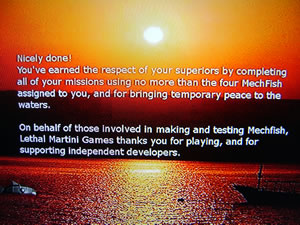
Completing the game on one credit will let you see a special ending screen. Kudos to the developer for having included this neat message, but thumbs down for forgetting to register the 1CC score in the high score table, an almost unbelievable oversight in a rather decently designed shmup. I was glad I had the camera at hand when the credit was over! Note: if the mild controller vibration becomes distracting try switching to a different profile - it seems the vibration is active only on the account that was used to download the game.

Sunday, May 27, 2012

Section Z (Playstation 2)

Horizontal
Checkpoints ON
4 Difficulty levels
5 Stages (loopable)
Ship speed by icons
- - - - - - -
Developed by Capcom
Published by Digital Eclipse in 2005


Some time ago I was thinking about playing one of the games from the Capcom compilations on the PS2. I realized that three of the shooters in them formed a kind of unofficial series: Section Z, Side Arms and Forgotten Worlds. Last week I took the PSP with me on a flight and finally dedicated some time to the first title, a pretty charming horizontal shmup that sucked me in completely. Section Z originally came out in 1985, but for such an old arcade game its fluidity and addictiveness are nothing short of outstanding. It's got an exquisite, creative design and provides instant, addictive fun. My first impressions revolved around the idea that the game kinda looked like a scrolling version of Dropzone.

All nine shmups emulated in the first volume of Capcom Classics Collection for the Playstation 2 belong to an early era of arcade games, where graphics and controls were more simple and the company was just another drop in the ocean of arcade developers. The idea behind Section Z is also simple yet very well executed: you are an astronaut sent on a mission to infiltrate an alien base. All areas inside the base are labeled after alphabet letters, starting in section A and ending in section Z. Every five sections the player must battle a boss, thefore Section Z has 5 stages with bosses awaiting in sections E, J, O, T and Z (the last stage is comprised of 6 sections). Once the game is beaten it loops in a harder difficulty.

I love the atmosphere in this game. It's a genuine sci-fi adventure with an old school charm that comes in a sleek shmup disguise - or is it the contrary? Graphics lack parallax and come with nothing fancy, but they're quite varied and get the job done. The atmospheric music is awesome and perfectly sets the mood for some deep underground action. Shmupping elements define the gameplay because the player's actions are restricted to shooting and turning left or right at the press of a button. The act of shooting will not only fire your shotgun horizontally, it will also drop bombs in a downward arch towards the direction you're facing. Enemies will appear from both sides as the screen scrolls in all four directions, and since there's very little room to breathe between one section and the next strategy and knowledge of the terrain and the enemies are essential to have a chance at survival.

Pinballs? What's next, furballs?

Following the descent into a surface hatch our hero finds himself inside a tunnel with some sort of mechanism with hose gears in the background. In the first section danger kicks in slowly, with only a few slow turrets here and there, a couple of flying drones and waves of spineless saucers. Then things start getting warmer. Green stacks expel smoke and more flying creatures approach from both sides as tricky-positioned turrets fill the screen with bullets. Turn right, turn left, shoot, be proactive and survive. Release items by destroying the small dome structures on the ground or on walls: P gives you more firepower, S increases the speed and B provides some bonus points. Speed and power can be upgraded in three steps (displayed in the upper right corner), but everything is lost when you die and get sent back to a previous checkpoint.

One of the refreshing aspects of the gameplay is the fact that you can touch and lean against walls with no harm. The astronaut is able to "land" on flat horizontal surfaces - while landed check out the cool animation when you fire and drop bombs. Landing and hiding behind walls often helps to hit special targets and herd or avoid incoming enemy fire, especially in the shaft descent of the 4th stage. Speaking of which, scrolling direction is what helps keep the game dynamic throughout: the first stage flows from left to right (A-E), the second stage flows upwards (F-J), the third stage scrolls from right to left (K-O), the fourth stage is the aforementioned descent (P-T) and the last stage (U-Z) resumes the initial scrolling direction. It works as a progressively dangerous spiral of death, with increasingly tougher sections with hardly any repetition in level design. The hardest parts for me are the stone barriers of stage 2 (wrong timing leads to frustratingly stupid deaths) and the second half of stage 4 (those sneaky moving eyes are a pain). The pinball area of section N is also tricky and often caught me off guard.

Despite the somewhat harsh difficulty that heavily rewards memorization, Section Z has an evenly spaced assortment of extends: first one with 30.000 and another for every 70.000 points afterwards. There's also a hidden 1UP that does not compute in the life stock counter (you don't see it decrease by one when you die). Just before section L is over there's this lower platform with a power-up dome that releases one of those tiny creatures. Keep hitting the dome spot to uncover a heart and destroy it to register the 1UP - my method is to stay in the upper platform and hit it with bombs. Some secrets for scoring include hidden objects which are also uncovered in a similar fashion in sections B (a head on ground level, 2.000 points) and H (a hand on the left wall amidst a group of four consecutive turrets, 5.000 points). Every once in a while you'll find a transmitter dish inside a dome that yields 10.000 points if you keep shooting at it for a brief while. Last but not least, speed-killing bosses results in better bonuses since they have a timer that's converted in points once they die.


A quick credit of Section Z
(courtesy of YouTube user ShadowTheHedgehog157)

Given the nature of the game it's safe to assume there are probably more secrets. I didn't get to find anything in the 4th and 5th stages, for example. There are lots of corners to explore, so maybe in a future endeavor I might dig it a bit further. As I mentioned above I first started playing Section Z by means of the PSP version present on the Capcom Classics Collection Remixed compilation, so when I fired up the PS2 disc I had a good idea of what was ahead of me. Both versions are pretty much the same, down to the minor graphical glitches in the emulation (if you kill something close to a side border you might glimpse its final animation on the other side). Other than that the game plays just fine, and the fun factor is definitely aided by an optional autofire switch, infinite continues and an alternating two-player mode.

I'm not sure if Section Z was the first horizontal shmup to allow bidirectional shooting, but it should certainly be included in the first batch of influential titles within the genre. I would love to see a proper sequel with the same mechanics, meaning a jetpack-propelled explorer fighting his way through non-stop auto-scrolling stages. But alas, all Capcom decided to do afterwards was release a port for the NES!

The picture below shows the reward from my best Section Z credit playing on NORMAL. Result: section S reached in the second loop (4th stage).

Tuesday, May 22, 2012

Over Horizon (NES)

Horizontal
Checkpoints OFF
1 Difficulty level
6 Stages
Ship speed selectable
- - - - - - -
Developed by Hot-B
Published by Hot-B in 1991


It came as a surprise to me that Over Horizon had a release outside of Japan, but on European shores only. I couldn't find much info on that one, but I assume it's just as obscure as the Japanese version. The Japanese cartridge is also a rare item, not often seen in auctions or retro game resellers. Developed by Hot-B, whose name I only associated with Mega Drive's Insector X, Over Horizon is an inventive horizontal shooter that clearly follows on the footsteps of the Gradius series while adding a few fresh concepts to the gameplay. As with many other shooters the title is somewhat cryptic because the whole game takes place in outer space environments. I guess a more suitable title would be "Beyond the Horizon" or something along those lines.

Check the resemblance both in the box cover and the game itself, the ship in this game reminds me of the ship from Toaplan's Zero Wing. That tiny and goofy ship would lend itself perfectly for a cute'em up, but this game has nothing of cute across six stages of well-crafted 8-bit shooting action. Vegetation ridden platfoms are followed by corridors with deadly turrets. Just before fire-breathing gargoyles appear ice blocks will need to be moved around so that you can safely pass, then a sewer-like factory will throw the ship around due to strong water currents. A mission outside and inside a huge spaceship leads you to the heart of evil in a final fight of cosmic proportions. Okay, you might take the cosmic part out of the sentence, but it's still impressive nonetheless. There isn't much in the way of color, the game's appeal is much more related to stage design and gameplay.

The first boss

Power-ups emerge from these tiny capsules that appear from the right. Destroy them to take an option or a character item that cycles and changes the weapon type: L stands for laser, M for missiles and H for homing. Up to two options can be grabbed, appearing above and below the ship. The control scheme in Over Horizon is quite original, in that you need to use both buttons in the controller to properly fire your weapons and choose the way options should be handled. Press A if you want to shoot to the right and B if you want to shoot to the left. While pressing one of these buttons push the other one to change the position of the options (either close or away from the ship). If the other button is kept pressed the options will keep moving up and down in circular patterns. In order to increase the weapon power stick to the same character item, eventually the shot from both options will also be powered up to the maximum level. Important: options can also block most enemy bullets!

The last aspect of gameplay is speed control. There are four speeds available but there's no clear indication of which one you're using (the screen is devoid of any displays whatsoever). You choose the speed by pressing SELECT, after which a brief burst animation is shown: if it appears at the ship's rear it means the speed is going up, if it appears at the front it means the speed is going down. The default speed when you start the game or when you're respawned after dying is 2. There are occasions where higher or slower speeds will be preferable, so keeping track of how fast you are and how fast you want to get is essential for better chances at survival.

Even though the control scheme is considerably rich and intuitive, it also tends to cause confusion when the screen gets too cluttered (and it will) and you want to take care of enemies from both sides of the ship. If you're shooting to the right and suddenly you want to shoot left you need to release button A first and only then press button B, otherwise you'll just move the options around if you press B while button A is held down. Over Horizon often calls for quick reactions and swift shot direction changes. The third stage in particular is a great example of this - you need to move the ice blocks around to get through, but it's also possible to crush enemies by doing that.

Pausing the game allows you to know your score and life stock. Extends are awarded with 100, 300 and 700 thousand points, and every stage has at least one extra life to be (easily) found. Scoring is straightforward and is ultimately made pointless by the fact that you can use one of the teleport doors in the last stage to loop back and score more points while getting a 1UP over and over. This teleport door is the lower one in that screen with two doors to the right. I guess it was left there so that you could power up the ship if you happened to be low on firepower, but they could at least have excluded the repeated 1UP appearances. The ending credits will halt on your final score for a brief while before showing the final boss's embryo fleeing and swearing revenge. The final message (YOU HAVE WON THIS TIME BUT I WILL BE BACK) only disappears when you reset the console, but unfortunately this also resets your high score.


A stage full of frozen blocks
(courtesy of YouTube user BrYaN5555)

Thanks to the varied design, the right degree of challenge and the unlimited continues, which helps practicing and successfully avoids frustration, Over Horizon is really fun and can definitely be labeled as a highlight of the NES library. The difficulty ramp is adequate and the game keeps you on your toes most of the time. Stages 5 and 6 come with extra bosses and will certainly demand some continues until you can safely deal with all the alien hazards. Level bosses are preceded by a WARNING message (one of the tiny bits of influence from Darius) and are often marked by easily recognizable movement patterns. Controls are spot-on, with built-in autofire and fair hit detection. The only possible gripe involves the weapon system - it's severely unbalanced towards the laser shot, so missile and homing are ultimately useless. A little bit of flicker and slowdown should be expected in key areas, thankfully with no negative impact on the game as a whole. If you stop shooting the music will gain an extra layer of bass, one of those smart moves to get the most out of the audio capabilities of the NES.

EDIT: there's an "edit" alternative at the start screen that allows you to reposition the ship's options to your liking, as well as mess around with the weapon's power levels.

My final score is the one below. Before entering the last chamber to deal with the brain boss (it's as if the final boss from a Gradius game could actually pose a fight) I warped back twice on that lower teleport door to max out my lasers.