Thursday, July 28, 2022

Jikkyou Oshaberi Parodius - Forever with Me (Playstation)

Horizontal
Checkpoints ON
8 Difficulty levels
8 Stages (loopable)
Ship speed by icons
- - - - - - -
Developed by Konami
Published by Konami in 1996


After its debut on the Super Famicom, it wasn't expected but it was certainly nice to see the fourth chapter of the Parodius franchise finding its way to both 32-bit platforms. Also unofficially known as "Chatting Parodius", 16-bit Jikkyou Oshaberi Parodius introduced a few new features while considerably increasing the character roster. Both 32-bit ports were released only in Japan but received the ~Forever with Me~ subtitle while applying graphical, audio and performance improvements with minor extras on the side. The constant chatting of the narrator is of course kept in all its comical (or annoying) nature, yet you can still shut him off with a specific switch in the options menu. 

This is the third version if this game that I play, having previously looped the SNES original with Soitsu and the Saturn port with Upa. This time I had the idea of just pressing START from the opening screen until entering the game, which naturally made me begin the adventure using the classic Vic Viper ship from Gradius, the primordial mold upon which the Parodius series is actually built. The level of parody and wack with Gradius and other Konami games has obviously gone a long way ever since the franchise started, so players can obviously expect all sorts of bizarre enemies and situations here.

The menu in Japanese is a bit intimidating, but as I mentioned above it's actually quite simple if you just want to dive directly into the game. Choosing the first option will lead you straight to the single player character selection (the second option activates 2-player mode, which now works in co-op as opposed to the alternate turns of the 16-bit original). By default there are 16 selectable characters, but you can also choose secret players Dracura (sic!) or Kid-D(racura) with the aid of a special button code to be inserted at the main Japanese menu (←, →, ←, →, □, ○, ↑, ↑, ↓, ↓, L2, R1, L1, R2, ○, □, ←, →). You could also do it the hard way, but that's just stupid and doesn't make any practical sense (keep reading).

Memim against Penkuro, the second boss in the nonsensical Boss Rush of stage 7
 
Once the character is chosen you must select between auto or manual power-up mode. In manual players are supposed to activate the desired upgrade in the weapon array just like in any Gradius game, thus having full control on how the character is supposed to evolve. Auto power-up mode, on the other hand, gives the game almost full control of the power-up process, leaving little to the player to decide. In a nutshell, it will activate only one speed-up (or two in the high speed stage) and prioritize laser over double, so if you want to have an extra speed-up or use the equivalent to the double shot just activate the power-up as usual. As always, upgrades in the weapon array are shifted by collecting orange capsules, while inputs consist of shot/missile (mapped to the same button by default), power-up and bell power.

What's mostly interesting in Parodius titles, and particularly in this chapter, is the fact that the chosen character can have a huge influence over the difficulty and the scoring potential of any run. This gap is somehow shortened with practice, but it's undeniable that characters like Soitsu and Dracura have the primary edge both for survival and for scoring. When they are maxed out in power bosses become less troublesome and hidden fairies can be found and collected more easily. Fairies are after all a great source of scoring since each one is worth 10.000 points. The same conclusion about the scoring aspect of the game sort of applies to the other main source of extra points: yellow bells.

Reminiscent of the TwinBee series, bells are released regularly in between power-up capsules and are mostly generated in the yellow color. However, at every four shots taken they will switch to a different color that endows the character with a special power: green (inflate+invincibility), white (bullet-cancelling kanji messages), brown (three bullet-blocking barriers), purple (turns all small enemies into power-up capsules or bells) and blue (screen-clearing bomb). Special notes: green forbids you to fire or collect any bells; green and white are instantly activated when collected and cancel all defensive upgrades; brown and blue bells are stored for later use and need to be triggered with the bell power button; whenever brown and blue are in stock you're forbidden from using the character's shield or force field.

Together with hidden fairies, yellow bells are the bread and butter of the scoring system. Don't let any bell fall of the screen and see the value from yellow bells quickly increase from 500 to 1.000, 2.500, 5.000 and then 10.000 points each. If one of them is lost this value is reset to 500. Juggling bells is obviously easier said than done, especially when you destroy those mid-sized enemies that often appear right after the pre-stage and explode into lots of bells of different colors, or during the whole high speed level themed after Lethal Enforcers. The total number of fairies collected can be tracked in a special option in the menu, and one of its purposes is probably to see how close you are to finding 140 fairies in order to naturally unlock secret characters Dracura and Kid-D. Damn it, Konami, at least we can thank you for the button code, huh?

Soitsu on auto power-up mode
(courtesy of YouTube user Tiza)

When compared with the 16-bit original, 32-bit Jikkyou Oshaberi Parodius (often abbreviated as JOP) is certainly a completely different beast. The complete elimination of slowdown is the obvious highlight, but the extend routine that goes beyond the million points is another important change since now you can amass many more extra lives as your score goes up (first extend comes with 20.000, then you get a new one after every 100.000 points). Since the game is much more easygoing than any chapter originated in the arcade platform and has a considerably mild rank progression, JOP is also the choice to go if you're new to the series and you'd like a more approachable starting point with many characters to choose from.

Just like with the other versions of the game, this port has a built-in checkpoint-based save function. Three save/load slots are available at the press of the SELECT button. In the title screen you also have the choice of two new special game modes: Omake 1 is a completely new single stage where you're supposed to get high scores, whereas Omake 2 works as a racing mini-game where the objective is to get to the end of the area as fast as possible. Even though both 32-bit ports appear to be very similar, there is a specific switch in the options screen that alters the gameplay significantly in each version. In the case of the Playstation this tweak is called "Accident", and its function is to add polygonal-based bonus areas to the end of each level. On the Sega Saturn this is replaced by "Extra", which changes enemy formations completely. Besides these interesting tweaks to the base game, both ports allow the OH! bogus power-up to be replaced by a slot machine for bells if you turn "Slot!" on. As for "Duet", "Ikari" and "Nage", they are specific tweaks for co-op play.

Click for the main menu translation for the Normal game in Jikkyou Oshaberi Parodius - Forever with Me on the Playstation

Despite the comical aspect of the ship, playing with this version of Vic Viper is actually very much like going back to the first Gradius. On the other hand I never thought much of its weapon set-up for a Parodius game prior to now, but it was interesting to notice after all these years how good it actually is against some of the bosses. I played on full defaults (difficulty 4, Roulette ON, Slot!/Accident/Revival OFF, Oshaberi ON) with auto power-up mode and reached stage 3-2 with the result shown below. Note: while you're playing you can always see your difficulty level and loop below the indication for the hi-score at the top of the screen.


Next in line is definitely Sexy Parodius.

Monday, July 11, 2022

Kiki Kaikai (Playstation 2)

Arena
Checkpoints ON
4 Difficulty levels
8 Stages (loopable)
Ship speed fixed
- - - - - - -
Developed by Taito
Published by Taito in 2005


I guess we can all agree that the shmup genre as we know it today was in its infancy back in 1986. However, this was a very special year in the history of Japanese developer Taito because that's the year when Darius came out. A huge accomplishment in itself, Darius definitely overshadowed everything that the company delivered at around the same time, including titles such as Bubble Bobble, Tokio / Scramble Formation and Kiki Kaikai. Easily overlooked back then, players were given a new chance to play these secondary arcade games at home by means of compilations such as the Taito Memories discs released for the Playstation 2. In the case of Kiki Kaikai, the edition you should look for is Taito Memories Volume 1 (Joukan).

The name Kiki Kaikai translates to something like "Bizarre Mysterious World". Drawing clear inspiration from Capcom's Commando, the game is an unscrolling multidirectional shooter rooted in Japanese folklore. It follows the adventures of Sayo-chan, a shrine maiden that goes out on a quest to free the seven lucky gods kidnapped by a mysterious villain. There's a strong characterization based on Japanese mythology, but given its primitive graphical assets it's fairly easy to judge Kiki Kaiki as another one of those dry, repetitive, bare-bones arcade romps of the 80s. This impression gets even worse if you venture into the game right after being exposed to the visual spectacle provided by modern games.

However, if you're persistent enough to get beyond the drab surface soon you'll find out that being simple in graphical terms is the only feature of Kiki Kaikai that might have aged. The gameplay is tight and the challenge is vicious, with a fun factor that lies somewhere between the punishing gameplay and the game's subdued natural charm. The soundtrack is rather limited and alternates between two tracks only across all levels, but the collection of sound effects is quite varied and diverse. As for the quality of this port, even though it lacks a TATE mode it's pretty much arcade perfect. Unfortunately there's no TATE option for any of the vertical games included in Taito Memories Volume 1, so playing on a large TV is definitely better if you want to get a hold of all the tiny details of Kiki Kaikai.

On the way to meet the fox demon to free god of wealth Juroujin in stage 6

First of all, Kiki Kaikai needs to be unlocked first if you're going to play it by means of the Taito Memories Volume 1 compilation, either by playing any game(s) for at least five hours or by entering the button code L1, R1, R2, L2, SELECT and START at the title screen (which also gives access to all remaining unlocked games). Seriously, Taito, why? Anyway, the game controls are quite simple: one button is used to shoot ofuda scrolls in eight directions, another button swings Sayo's purification rod directly in front of her. Both attacks can be used to dispatch the majority of enemies (there are exceptions), while pressing both buttons at the same time activates the special power related to any crystal ball you have in stock (these need to be found and collected).

Control inputs are fully configurable in the options, but if you have a turbo controller with you I strongly recommend its use. Considering that Sayo-chan is a fragile little lady that doesn't possess outstanding magical powers, autofire will certainly help her go a long distance. She's at the mercy of the gods when it comes down to resources and upgrades to be collected along the way, which leaves her severely underpowered most of the time. Items are released either by destroying a full wave of tiny brown enemies (otamas), by sweeping lit totems with Sayo's purifying rod or by shooting specific places in the scenery. Most of them will be the blue scroll that extends the reach of your regular shot, but every once in a while you might get more useful items.

Scroll item variations include red (piercing shot), yellow (larger/double shot) and double blue (increases the allowed shot ratio), but you can also find an icon that looks like a small house (oniguiri, worth 2.000 points), an extra life (very rare) or blue/yellow crystals. When activated by pressing both action buttons, the yellow crystal clears the screen from all enemies while the blue crystal freezes all enemies for a brief period of time. The only single item that appears out in the open is the golden key, which must be collected to allow your entry in the stage boss chamber. If you don't take it the boss fight will be denied and you'll have to go back all the way to get the key.

The problem with going back is that doing it (or refusing to move on) has a nasty effect in the gameplay. Besides some of the demons and spirits getting faster and more aggressive other dangerous foes might enter the screen, such as a jumping creature that reminds me of Q-Bert and the ring of supernatural fire that chases you around. Of course that doesn't mean the rest of the enemy gallery is less deadly. On the contrary, after the first couple of stages things get quite intense, demanding players to be on their toes at all times. By far the most dangerous enemy is that brown ghost that arrives in flocks and slows you down, only letting go if you're able to pass below one of the red archways. Since archways are far into the level more often than not you'll die horribly as if you were being dragged to hell like Rick Aviles and Tony Goldwyn in Ghost. You can get rid of them if you have a crystal in stock, which is actually the most important strategy to adopt prior to entering stage 4.

First couple of "scenes" of Kiki Kaikai on the Playstation 2
(courtesy of YouTube user PickHutHG)

Getting comfortable with fighting off all sorts of cute spirits in Kiki Kaikai certainly takes a while. Besides what I just described above, special attention must be given to creatures with odd behavior such as the demon head that suddenly pops out of large huts or the tombstones that follow you vertically, as well as enemies that can't be pushed back with the purifying rod (snakes, folded umbrellas) and environmental hazards such as bridges and pits (avoid getting close to their borders at all costs). At least normal walls aren't fatal, and since you can't strafe it's possible to lean onto them to direct your shots. Bosses are in a different league because you can only hurt them with the regular shot, and sometimes only when you're allowed to. They start quite easy, but later on some of their attacks become rather tricky to avoid.

An interesting twist here is that the final level has no boss, but you'll need to collect three hidden scrolls in order to complete the game. The good news is that these special scrolls are always in the same place, so it's just a matter of memorizing where they are. If you can't find them the stage just goes on forever, whereas in the case of success you'll eventually reach a corridor and the game will end as soon as you get through it safely.

Although not clearly noticeable, Kiki Kaikai has a built-in rank system related to the amount of surplus scrolls collected. Long story short, the more of them you pick the more health bosses will have (this is easily noticeable when you die and have to face the boss again). If you don't want to make bosses stronger just avoid collecting more than two blue scrolls or any extra scroll beyond the ones you've already applied to your firepower. In my experience I didn't care for this and collected them all because each scroll is worth a few points and boss battles become more manageable once you get used to their behavior. In essence, score chasers will take every single item the game gives, on top of killing everything that moves of course.

Click for the option menus translation for Kiki Kaikai on Taito Memories Vol. 1

Kiki Kaikai has absolutely no continues, with extends granted at 70.000 and 150.000 points. When the game is over a random counter will give you a three-digit number, and if it matches the last three digits of the player's total score you'll be awarded a new credit. This doesn't make much sense in the console world, but it must be great if you're playing the game in an arcade center. Speaking of consoles, Kiki Kaikai received a limited number of home ports and was followed by two sequels developed exclusively for the SNES. Out of Japan they were released with the name Pocky & Rocky, which is the most common title used for this series since the 90s. Later on a canned sequel was reworked and released for the Playstation 2 as Heavenly Guardian, but even though it shares elements with Kiki Kaikai the emphasis on exploratory gameplay pretty much excludes it from the shmup genre.
 
Once I beat the game I played a little further in the second loop and found my demise in the rematch against the second boss (scene 10). I did have fun with it, but I didn't feel inclined to play again to improve my score. For now let's leave it to one of the ports or sequels, starting with Pocky & Rocky!


Sunday, June 26, 2022

Project Starship (Playstation 4)

Vertical
Checkpoints OFF
2 Difficulty levels
5 Stages
Ship speed fixed
- - - - - - -
Developed by Panda Indie Studio
Published by Red Art Games in 2022


Second chapter of a confusing trilogy developed by tiny developer Panda Indie Studio / Arabong, Project Starship retools some of the elements of Red Death into a slightly more ambitious effort that preserves its minimalistic interface and roguelike approach. The game still feels rather bare bones in almost all aspects, but at least it chooses to focus on a full blown gameplay experience that literally floods the wide screen of HD TVs with colors and bullets, as opposed to the standard 4:3 vertical orientation of the prequel.

Before we move on it should be noted that Project Starship is completely different from Project Starship X. The latter is the third part of the series, yet in terms of physical media it was actually the second game to be published.

Another consideration to be made about Project Starship concerns the whole mindset behind the roguelike design. It is after all an acquired taste, which in this case is put to the test by an uneven balance between enemy patterns and resources and how they get randomized across the 16:9 screen ratio. The overall tone is cartoonish with large sprites, an extremely psychedelic enemy gallery, 8-bit styled music and bullets of all sizes that fly around at varying speeds. There's nothing special about the animations, yet there's so much going on most of the time that the game does feel overwhelming and deserving of the bullet hell moniker.

Release trailer for Project Starship on the Playstation 4
(courtesy of YouTube user PlayStation)

Pressing either ×, ○ or OPTIONS/START sends you into the game proper, then you must choose between a boy (Garret) or a girl (Gwen) and select the desired difficulty (Easy/Hard). The difference between the pilots is purely cosmetic, with no distinction at all between them besides ship color (blue/red) and in-game voices (male/female). On your last life the character also comically appears waving for help at the bottom of the screen, but that's it. Shoot with buttons ×, L1 or R1, fly slower by pressing ○, L2 or R2 (focus shot) and deploy the current special item in stock with button □. It's not possible to remap inputs or apply any changes to the game, which has just one single roguelike campaign with five stages.

Levels in Project Starship might differ in terms of environments and backgrounds, whereas enemies are completely spawned and placed according to the procedural generation routine. Level transitions happen when bosses go down and a big LEVEL UP message appears on screen. All stages have a mid-boss and a regular boss with 2 to 4 large health bars, but bosses can sometimes be replaced by a dark maze or by a fiery wall that shoots out almost undodgeable flame lasers if hit by one of the approaching space debris. As a rule of thumb, whenever a big enemy is defeated you get at least one item as reward, and if you're lucky it will be one of the special kind.

Item pick-ups are in a category of their own since they're one of the main sources of confusion when you start playing. There are three types: regular upgrades, weapon/ship enhancers and special attacks. Regular upgrades are denoted by alphabet letters and include P (power), T (rotating turret/option), R (ratio), M (missile), H (homing, very rare) and S (shield/life). Enhancers are denoted by symbols and might provide extra help in the long run or just alter your shot sprite into more powerful forms such as a shuriken, a black firing stream or a blue/red thick laser that's extremely powerful (the so-called "holy grail"). Examples of helpful enhancers include a full stock of spare shields, a small shard-like barrier that rotates around the ship and is capable of deflecting enemy bullets or a Super Mario-like green mushroom, which grants you another chance to succeed before the credit is finished (technically not a continue).

The final item type is the one that can be stocked for later use by pressing the □ button. Once collected they appear in the container at the top of the screen. Some of the most useful ones I can recall are "TV doesn't work" (blanks the screen with static for a few seconds and gets rid of all bullets and minor enemies) and the EMP (screen clearing blast), while "Ultra Mega Super Laser" and "President Button" send more powerful laser/missile attacks upwards.

Low production values aside, it's certainly possible to see the potential of the ideas behind Project Starship. The problem is that this potential is often buried by unfair procedural generation. Even though the hitbox of the ship is clearly shown at all times, it's common to get the feeling that the default speed is too fast and the focus speed is too slow. Tapping the focus button helps with that, you just need to get used to it. Players also need to cope with items that are best avoided such as the overload / lightning sign (it actually increases enemy aggression instead of your ship's firepower) and the skull (takes away one shield/life but only appears in the final level). I don't recommend picking up the large ring either since it splits your firepower in two less powerful firing streams, but you absolutely need to avoid the large red sword. Finally, remember that collisions against walls are fatal and mean instant GAME OVER. 

A red star full of anger

No matter how used you get to all items, I was still seeing new ones by the time I was done with the game. On top of all the confusion the plethora of items can make, Project Starship also throws several special sections called "mad events". These are brief interludes where you're faced with special challenges such as dodging crazy obstacles or evading large laser blasts with inverted controls. There's no logic as to when a mad event will kick in, but if you perform well enough a special item appears afterwards. Difficulty varies greatly in these parts, and evading some of them without losing lives can be quite tricky to pull off.

As for the scoring system, there isn't anything really important to be said about it since score meanderings are quite obtuse. Every shot landed and every enemy destroyed gives you points, but I don't know if there's any sort of hidden multiplier in place for not getting hit, for example. Suffice it to say that most of the points in any run comes from the final level.

Despite the constant feeling that Project Starship is being unfair, in all honesty it's quite hard to put it down once you're deep into a gaming session. In the end that's the best thing about the game, even though it might take a while to actually understand it to the point where success becomes more likely than failure. And though not clearly stated, success when playing in Hard mode earns a few interesting new items shown whenever you start a new credit. The first one is an H that stands for "hardcore" and takes away all your spare lives. Just ignore that and try to beat the game again: after the final boss you'll finally get the chance to face a true last boss with multiple forms that gives you a massive amount of extra points. If beaten, a new B item will appear at the start of every credit to turn the game into a boss rush, and on top of that you'll finally be able to see which level you're playing at the top of the screen.

Truth be told, I certainly had more fun with the game than I had initially anticipated. Since there's no high score table anywhere and no distinction between difficulties in the high score shown at the start screen, I just took the final snapshot at the end of my best run. I only played in the Hard difficulty, and after a while I settled with Garret because I felt more comfortable with a blue ship than with a red ship.


Wednesday, June 8, 2022

Silpheed - The Lost Planet (Playstation 2)

Vertical
Checkpoints OFF
2 Difficulty levels
6 Stages
Ship speed fixed
- - - - - - -
Developed by Game Arts / Treasure
Published by Working Designs in 2000


As the direct sequel to one of the most avant-garde shmups ever created, Silpheed - The Lost Planet must have generated high expectations during the first year of the Sony Playstation 2, both in Japan and in the US. In the case of the US version, for instance, it was supposed to come out on the console's launch date. Short delays notwithstanding, the Western disc includes a few nice improvements made by publisher Working Designs over the original Japanese version, namely the elimination of most of the slowdown and the addition of analog controls. Mind you, this is explicitly stated in the game's instruction manual, I haven't been able to try out the Japanese variant.

In the process of designing the game, developer Game Arts brought along the expertise of Treasure, then already quite famous for making Guardian Heroes and Radiant Silvergun. My best bet is that Treasure took care of the spectacle and the design of some of the largest bosses, with the rest of the game still at the hands of Game Arts. Eye candy aside, unfortunately it doesn’t take long to realize that the results of this enterprise aren’t up to the standards set by the original Silpheed, which is kinda baffling considering the powerful resources associated with the Playstation 2 hardware.

Alone in the galaxy against large enemy battleships
 
The story of The Lost Planet takes place three decades after the events of Silpheed, and is fully explained by a few animated sequences and several long texts narrated in English prior to each stage. Sci-fi buffs will be marveled at the amount of detail, whereas diehard shmuppers will feel relieved to be able to skip all interludes with relatively short loading times. As for the actual gameplay, what’s left is a very simple game since all you need to use is a single button even though there are three buttons in all configuration layouts. In the default configuration □ and ○ are responsible for shooting each of the side cannons, but there’s absolutely no reason to use any of them considering that button × fires both.

Upon starting a level the pilot has to choose the weapons to be equipped in each cannon. The initial weapon gallery is quite meager, but for every stage completed new weapons are unlocked for immediate selection. Halfway the level you have the chance to replace your choices during the reload cycle, which also refills four energy cells of the ship. Ship energy is arranged in two blocks of five cells, providing an initial health bar that lets you take at least nine hits before dying within the level. And once the next stage starts this health bar is completely replenished. How many shmups allow players to have so many lives, I wonder?

Having such a generous health bar for every stage isn't probably just about making the game more friendly to beginners. It actually factors into the risk associated with playing aggressively for score, which is by far the best thing about Silpheed - The Lost Planet. It lifts the game above the level of mediocrity. In essence, scoring is very simple and is based in proximity kills, which means that the closer you are to your enemy the higher your score over its base value will be. Proximity multipliers range between ×1, ×2, ×4, ×8 and ×16. Since enemies have no health indication at all, practice and good knowledge of their behavior is the best way to achieve those precious ×16 multipliers, especially against mid-bosses, bosses or any instance where you might be able to dismantle them piece by piece.

The only catch when going for proximity kills is that you can't just go on a rampage and sacrifice your health in order to get a ×16 multiplier on a boss, for example. If you get hit all your targets will result in ×1 multipliers for a few seconds no matter how close you are to them. Getting hit or touching the boss just before sending him into oblivion is the worst thing that can happen in every high scoring run.

3rd stage of Silpheed - The Lost Planet
(courtesy of YouTube user BelowAverageJoe)

There are two reasons for why this sequel fails to live up to its heritage. The first of them is the weapon gallery, which is full of gimmicky and useless unlocks from the second level onwards. Once the first stage is over, for example, I'll only use a combination of Optics Laser and Napalm Bomb for the rest of the game. The laser is great to deal with enemies from afar, and napalm is just devastating in close range. A few other weapons might get the job done if you get out of your way to learn how to use them, but I don't think they're worth the effort.

The second reason why the game doesn't reach its full potential is the lack of environment interaction, as aspect for which Silpheed is regarded as one of the best Sega CD games ever made. That feeling of flying across obstacle mazes at varying speeds as if you're chasing the core of a death star is nowhere to be found in The Lost Planet. Truth be told, some of the 3D backgrounds are impressive and have great textures, but the closer we get to interacting with obstacles is a few buildings slowly collapsing to the ground here and there in the second stage, which by the way drags.

Of course there's nothing essentially wrong about the game. The slanted perspective is still quite charming to look at, and the constant radio chatter seems to have been carried over unaltered from the first game. Although there are no real standouts in the music tracks, they at least get the job done and even evoke parts of the soundtrack of the original Silpheed in a few areas. The huge last boss is also back for a quick rematch prior to the real final boss in The Lost Planet, which is kinda neat, but there are also a few other large bosses that are quite creative in terms of design and attack patterns.

I tried to squeeze what I could from the proximity bonus system and got the best result of position 3 in the picture below. I think it's perfectly possible to top the highest score of 10 million, but for now I'm done... if only I wasn't constantly being stunned by a hit or just standing too far from a few bosses during the kill!


Saturday, May 28, 2022

Dariusburst (PSP)

Horizontal
Checkpoints OFF
3 Difficulty levels
5 Stages
Ship speed fixed
- - - - - - -
Developed by Pyramid
Published by Taito in 2009


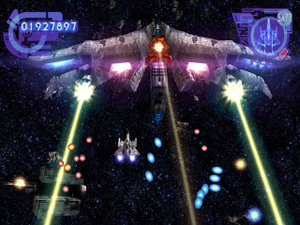
With the Darius series on a hiatus since G Darius (1997), in 2009 Taito tried to bring it back to the shmup spotlight with Dariusburst for the PSP. I believe longtime fans were caught by surprise not only by the release itself, but also by the new direction the company applied to the gameplay. Developer-for-hire Pyramid introduced fresh ideas that certainly proved successful, as hinted by the several revisions/sequels that came out on the trail of the PSP game. Dariusburst also plays a particularly important role for me since it was the reason why I finally purchased a PSP, the first ever handheld system in my personal collection.

Storywise the events of Dariusburst take place after Darius II, with the ongoing war of planet Darius against the Belser army prompting the Silver Hawk engineers to devise a powerful weapon deployed with the so-called "burst system". This new element is the game's defining gimmick and sort of replaces the capturing mechanic last seen in G Darius, squeezing the most out of the spectacle provided by contemporary pseudo 3D backgrounds. Granted, lasers and laser battles aren't as huge anymore but now they can be used in a more flexible way, adding new layers of strategy both for survival and for scoring.

When first starting up the game you'll only have Arcade mode to tackle (all other modes are unlocked first by beating it and by fulfilling a few other requirements). Perhaps due to the limitations of the PSP hardware this main game mode has only 5 stages, with the first couple of them fixed. Only after you've completed area B the famous branching system will kick in, allowing players to choose from areas C or D and so on and so forth. Each stage has the same boss regardless of the selected branch except for the final level, in which you might fight four different end bosses. These final formidable creatures are definitely easier in the upper route, getting harder the lower you go in your chosen path.

Release trailer for Dariusburst on the PSP
(courtesy of YouTube user ndsfans2009)

Only one ship is available upon start in Arcade mode, the Silver Hawk Legend. Once you've beaten the game once (continues allowed) you'll unlock the Silver Hawk Next. Beat Arcade mode once more in a different path and you'll unlock Mission mode, and a third time with another different path to unlock Burst mode. Finally, by clearing Burst mode you unlock the Silver Hawk Original, the official ship from the first Darius. This series of unlocks is obviously aimed at providing replayability and more value for money, but it's at least arranged in a way that makes sense challengewise.

All three ships share the same classic routine for upgrades. Destroying colored enemies releases colored orbs that upgrade three distinct aspects of the ship's firepower: main shot / missiles (red orbs), bombs (green orbs) and shield (blue orbs). The evolution of each element goes through missile → laser → wave, bomb → twin → multi and arm (green shield) → super (silver shield) → hyper (golden shield). Secret icons can also be found by shooting the terrain: grays orbs grant random bonus points, golden orbs act as screen-clearing smart bombs and the small ship gives you an extra life. There are differences between ships: Legend and Origin have the same arsenal except for the burst system, which is absent for the Silver Hawk Origin. On the other hand the burst system is also present on the Silver Hawk Next, which is clearly more powerful than the other ships and even comes with homing bombs. The good news for all ships is that this time around there's no need to worry about powering down upon death, as was the case with all previous games in the series.

In addition to the input for shot, in Dariusburst players have at their disposal another input for the burst attack. The burst gauge fills up automatically as you destroy enemies and gets empty whenever you're using the laser, which can be deployed in two different ways: by holding the button the laser is unleashed with the ship, by double tapping it the laser is dropped in place while you're free to move around. A detached laser behaves differently, consuming the burst gauge more slowly and allowing itself to be rotated up or down. Basically it works like this: if you stop shooting the laser will move towards the ship (Next) or away from the ship (Legend). Since shooting plays a pivotal role in dealing with the burst laser, learning how to properly use this special weapon certainly takes at least a little practice.

The advantages of of using the burst laser isn't of course relegated to sheer firepower increase. It ties in with the brand new scoring system that applies multipliers of up to ×16 as you keep on destroying enemies without getting hit (each hit takes away one multipier point). The catch with the burst laser is that the multiplier increases faster when you use it to annihilate the incoming waves. In the first level, for instance, there's no way to reach a ×16 multiplier just by regular shooting. The use of the burst laser, however, will certainly make it possible. It's interesting to note that even though you still get additional bonuses for extra lives when completing the game, the scoring you're able to achieve with the multiplier mechanic far outweighs these final rewards.

These Gluttons are hungry, very hungry

Two additional details on the use of burst laser are important. There are times when the amount of enemies and bullets is so high that the laser can sustain itself indefinitely (several sections full of asteroids and the whole fight against Hungry Gluttons are prime examples). The second detail is a much more intricate resource and is, quite frankly, the only dwindling aspect of the gameplay. As expected, bosses are also capable of firing their own powerful lasers several times throughout the fight. If you manage to deploy the burst laser just a split-second after you get hit by the laser from the boss, the burst attack will acquire a golden hue and become even more powerful, on top of granting the player with an extra multiplier boost over whatever is destroyed. Unfortunately this golden counterlaser is quite difficult to pull off, and if your timing isn't right you'll lose precious multiplier points by getting hit (the shield protects you but the hits are still registered). 

Everything mentioned above applies to all game modes. Arcade mode is of course the one you should play first. Full of throwbacks to previous chapters in the series, it offers a steady difficulty slope that culminates in epic boss battles by the time you reach the 5th stage. Burst mode is a special campaign locked in the Hard difficulty with different enemy patterns and only one life/ship that's already maxed out in power (orbs will all be of the gray type). On the other hand the burst laser takes longer to deplete and you get new input buttons that let you switch the main shot type (missile, laser and wave). Mission mode is a collection of short sections where you must fulfill simple tasks such as beating a level, a boss or a combination of both (with more bosses on occasion). The music will sometimes switch to the classic tunes from previous chapters, which adds a touch of nostalgia to this particular game mode. As for the main game modes, you can expect another great soundtrack full of engaging and operatic moments alike.

My guess is that completing the challenges in Mission mode will unlock the remaining material included in View mode. Normally you can see your high scores in there, as well as watch the replays you've saved (they can be saved whenever you finish a game without continuing), but you'll also have access to event animations, character close-ups and design illustrations. I did complete all missions in levels 1 and 2 (out of 8), and it was enough to at least have access to all branches of the main menu. Speaking of which, even though the game was only released in Japan the interface is completely in English, with Japanese text reserved for general descriptions that do not affect navigation at all.

On top of being one of the best shmups released for the PSP, in terms of graphic design and gameplay Dariusburst definitely represents a soft reboot of the franchise. Later on it was revised and retouched perhaps beyond what some people would consider acceptable, but there's no denying that Taito and Pyramid were successful in leading the series into new territory. The evolution after Dariusburst is rather complicated, but I'll probably tackle Dariusburst Another Chronicle EX+ next.

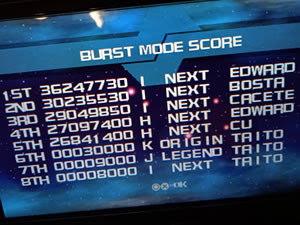
All the highest scores for each ship in the photo below for Arcade mode are 1CCs obtained in the Normal difficulty (a 1LC in the case of the Silver Hawk Next in spot #1 through toute ABCEH). Since it's a lot harder than the regular game, I only really tried to 1CC/complete Burst mode with the Silver Hawk Next, succeeding in route ABCEI.


Thursday, May 19, 2022

Starship Hector (NES)

Horizontal / Vertical
Checkpoints ON
1 Difficulty level
6 Stages
Ship speed fixed
- - - - - - -
Developed by Hudson Soft
Published by Hudson Soft in 1987


I don't have a nice recollection of Star Soldier. For a number of reasons I didn't enjoy playing it as I thought I would have, but regardless of my appreciation the game fortunately spawned a series that continued in the PC Engine platform with remarkable success. However, besides the main Soldier franchise a few spin-off titles were also released by Hudson Soft, and Starship Hector is one of them (the others are Star Parodier and – unofficially – Gunhed / Blazing Lazers). Known in Japan as Hector '87, it's probably the one with least similarities with Star Soldier, which is of course quite interesting in itself if you fancy the other games mentioned in this short paragraph.

With typical Hudson Soft tunes that fit perfectly into the Soldier universe, a creative boss gallery comprised of weird monsters and a difficulty level that doesn’t come off as extreme (provided you have a turbo controller, of course), Starship Hector is certainly bound to please NES shmup fans. All I can say is that I enjoyed it much more than I did Star Soldier, even with the occasional bouts of flicker and slowdown.

The setting is a mix of sci-fi and desolate landscapes. Your starship’s mission is to rid the Earth from alien biomechanical creatures that have dominated the planet after yet another world war. Each stage is labeled “history”, with levels that alternate between vertical and horizontal and are loosely based in ancient civilizations such as the Incan, Mayan and Egyptian empires. Gameplay sounds way more straightforward than any chapter in the regular Soldier series, even though the general pace is a little slower. There are no power-ups to be found in Starship Hector, and the only items you’ll come across are energy-refilling pills expelled by ground totems hit by your ground bombs.

Pillars of purple doom in History 2

Ground bombs have a crawling abilitity and are fired with button A, whereas the main shot is fired with button B. It’s a variation of the classic formulas first presented in Xevious (vertical) and Gradius (horizontal), with each type of level characterized by its own set of rules. Horizontal parts are often full of walls and obstacles you need to avoid, which are naturally absent from vertical areas. On the other hand ground bombs will only damage ground targets in vertical stages, but they can destroy everything in the horizontal sections. The most important thing about the firing inputs though is that Starship Hector definitely requires a turbo controller to be properly played. Mashing buttons will get you nowhere, on top of giving you serious wrist injuries if you insist on doing so.

Each life comes with an energy/health bar that gets depleted as you receive damage from bullets and enemies. Bullets take away two to four energy cells, but collisions are deadly because if they don’t kill you right away you’ll be left with no spare energy, which means a life will be lost on the next hit. Unless of course you’re able to retrieve and collect the abovementioned refilling pills from the ground fountains. Some enemies have the nasty habit of trying to ram into you either in frontal attacks or by flying behind the ship, so take that in consideration when establishing target priorities while applying at least a minor level of crowd control. Killing the most dangerous enemies quickly is also essential to manage bullet count, especially in the vertical stages. Just beware of exploding mines coming up from below in areas that resemble ravines. The safest strategy is to steer away from them, since they’ll kill you instantly if they take you by surprise.

Perhaps due to the fact that a lifebar is in place, whenever you die you're sent back to the start of the level even during a boss fight. Since stages get tougher as you advance and enemy behavior becomes increasingly more erratic, as I hinted above the best way to go the distance is to play aggressively while memorizing the most threatening enemy patterns. Of course long checkpoints lend themselves to milking once you’ve got used to the stage layouts, and you certainly can try it with the three extends achieved with 200.000, 500.000 and 1 million points. 
 

History 1 - The "Incaic" empire
(courtesy of YouTube user The VideoGames Museum)

Regardless of the amount of milking you can perform, the bulk of a high scoring run comes from the million points awarded to players who can uncover all characters from the name HECTOR, which are hidden exclusively in vertical levels below circular ground areas the same size of regular turrets. Hit these spots with ground bombs to reveal them, then hit them again to uncover the letters. There's more than one of the same character within the same level, which gives you the chance to collect the bonus in stage 5 even if you miss one of hidden spots. Another bonus of finding them is that they're worth lots of points.

Concealed ground targets are also important in another context. In vertical levels a few extra hidden spots work as triggers that destroy all turrets in the vinicity, thus making your life a lot easier. These aren't as easy to find as the HECTOR characters though, so try to remember whenever you happen to come across one of these precious secret locations.

The picture below shows my final 1CC score, which is kept in the "Score" choice from the start screen. If you pay close attention to the start screen once you've beaten the game you'll notice that it changes colors. If another credit is started right away you'll then be surprised by your avatar, which changes from the regular spaceship to an astronaut in a jetpack! It's just a cosmetic thing though, everything else about the game remains the same. Note: besides the main course in Starship Hector there are also 2 and 5-minute caravan modes for players who enjoy these extra scoring challenges.


Sunday, May 8, 2022

Dezaemon 2 [Daioh P!] (Saturn)

Vertical
Checkpoints ON
4 Difficulty levels
5 Stages
Ship speed by icons
- - - - - - -
Developed by Athena
Published by Athena in 1997


Continuing with the exploration of the sample games included in the Japanese Dezaemon series of shmup-making titles, let's now take a quick look at Daioh P!, the final episode in the consolized and heavily toned down version of a very tough arcade shooter. The previous chapter is Daioh Gale Ver. 2 on the Dezaemon Plus disc, released for the Playstation in 1996.

Daioh P! is one of the five sample games included in the Dezaemon 2 shmup-making title for the Sega Saturn, accessible by choosing the S3 option in the start menu (it's the second sample game I'm playing on it, the first one was Biometal Gust). The "P" in Daioh P! stands for polygons, which means that every visual asset in the game uses this technique, from ships and crafts to terrains and explosions. Since it has five stages, the basic mold upon which it's based seems to be Daioh Gale Ver. 2, yet there are one or two aspects that date back to the first Daioh Gale, originally released for the Super Famicom in 1995.

Daioh P! maintains the general stage layouts and enemies from Daioh Gale Ver. 2, as well as an updated version of the same soundtrack. The main additions include the primitive electronic preamble prior to the start of each level, several new sound effects that give the action a slightly different feel from previous entries, the scrolling speed that varies from time to time and the fact that all bosses have two or three distinct phases instead of just a single attack routine throughout the fight. Other than that, the graphic design is extremely simplifed and lacks details, which is sort of expected for a game developed using standard predefined polygon tools.

Chasing the second boss over a blocky polygon ocean

Playing the game requires basically two inputs, rapid shot in button R and bomb in button C (for those interested, the single shot is mapped to button A). All items are released by destroying a specific carrier, starting with the colored icons for weapon choice: red (spread vulcan), blue (straight shot with homing missiles) and green (homing shot). In order to increase weapon power you need to collect the P (power-up). The remainder of the item gallery consists of SP (speed-up), SH (1-hit shield), B (extra bomb) and a medal that's worth 5.000 points. Weapon icons and medals fall off the screen right away when released, whereas all other items float around for a while before disappearing.

The last aspect of the core gameplay is bomb usage. Bombs work according to the weapon you're currently using. For the red (vulcan) you get a round blast that damages everything around you, green shot (homing) results in a more powerful homing attack with increased damage and the bomb for the blue shot (straight + missiles) consists of a frontal attack that funnels inwards as the bomb energy dissipates.

Most of the time Daioh P! flows at a nice pace, with almost no threats imposing any sort of pressure on players. That said, the only moments where bullet spreads start to become more dangerous are during boss fights, which are now preceded by warning messages inspired by Darius (a huge battleship is approaching fast!). Their final phases can take you off guard with sudden attacks or close-range overlapping blows, and for that the best strategy is still good old memorization. Never mind the spiralling sand columns of the 3rd boss though, the effect is kinda reminiscent of Soukyugurentai but it's harmless, just for show really.

Even though at least one speed-up appears every time after you die, which makes boss fights fair and tougher sections manageable, the final boss is no pushover and requires lots of movement to be defeated. It's also important to note that you're always respawned with the weapon you were using when you died, which in some cases can lead to extremely dire situations because you can't switch to another weapon. Facing the last boss with the homing weapon is such an example since you never know when the homing shot will start chasing the boss itself instead of the drones he drops or the central deadly bullet, which can be destroyed even by a level 2 vulcan shot.

The first stage of Daioh P! (easy difficulty)
(courtesy of YouTube user The VideoGames Museum)

Since you get a few extends in a regular run, starting with 100.000 points and then for every 300.000 points after that, Daioh P! naturally allows checkpoint milking if you feel inclined to do so. I guess it's just a matter of finding the best checkpoints for that, which is something I didn't try to do. One such part of the game, however, is definitely the last boss due to the drones he drops in his first form (as I mentioned above). Marginal score contributors consist of loose projectiles from turrets, but it's also important to not let any medal go by. Medals are the only items that can be dropped not only by carriers but also by specific enemies, so keep an eye out for them.

Although sympathetic thanks to the full polygon design and the ability to play in co-op, overall Daioh P! is very short and doesn't have enough substance to warrant a lasting impression. It's okay but it's certainly of more interest to those who care about the works by Athena or the possibilities to tinker with all sample games, as is usual with the Dezaemon titles. Since I didn't venture into ckeckpoint milking, my best score for Daioh P! was achieved in a no-miss run (Normal difficulty).