Wednesday, June 8, 2022

Silpheed - The Lost Planet (Playstation 2)

Vertical
Checkpoints OFF
2 Difficulty levels
6 Stages
Ship speed fixed
- - - - - - -
Developed by Game Arts / Treasure
Published by Working Designs in 2000


As the direct sequel to one of the most avant-garde shmups ever created, Silpheed - The Lost Planet must have generated high expectations during the first year of the Sony Playstation 2, both in Japan and in the US. In the case of the US version, for instance, it was supposed to come out on the console's launch date. Short delays notwithstanding, the Western disc includes a few nice improvements made by publisher Working Designs over the original Japanese version, namely the elimination of most of the slowdown and the addition of analog controls. Mind you, this is explicitly stated in the game's instruction manual, I haven't been able to try out the Japanese variant.

In the process of designing the game, developer Game Arts brought along the expertise of Treasure, then already quite famous for making Guardian Heroes and Radiant Silvergun. My best bet is that Treasure took care of the spectacle and the design of some of the largest bosses, with the rest of the game still at the hands of Game Arts. Eye candy aside, unfortunately it doesn’t take long to realize that the results of this enterprise aren’t up to the standards set by the original Silpheed, which is kinda baffling considering the powerful resources associated with the Playstation 2 hardware.
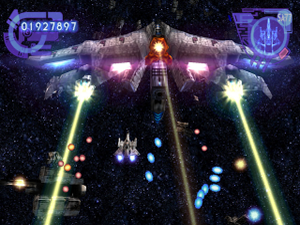
Alone in the galaxy against large enemy battleships
 
The story of The Lost Planet takes place three decades after the events of Silpheed, and is fully explained by a few animated sequences and several long texts narrated in English prior to each stage. Sci-fi buffs will be marveled at the amount of detail, whereas diehard shmuppers will feel relieved to be able to skip all interludes with relatively short loading times. As for the actual gameplay, what’s left is a very simple game since all you need to use is a single button even though there are three buttons in all configuration layouts. In the default configuration □ and ○ are responsible for shooting each of the side cannons, but there’s absolutely no reason to use any of them considering that button × fires both.

Upon starting a level the pilot has to choose the weapons to be equipped in each cannon. The initial weapon gallery is quite meager, but for every stage completed new weapons are unlocked for immediate selection. Halfway the level you have the chance to replace your choices during the reload cycle, which also refills four energy cells of the ship. Ship energy is arranged in two blocks of five cells, providing an initial health bar that lets you take at least nine hits before dying within the level. And once the next stage starts this health bar is completely replenished. How many shmups allow players to have so many lives, I wonder?

Having such a generous health bar for every stage isn't probably just about making the game more friendly to beginners. It actually factors into the risk associated with playing aggressively for score, which is by far the best thing about Silpheed - The Lost Planet. It lifts the game above the level of mediocrity. In essence, scoring is very simple and is based in proximity kills, which means that the closer you are to your enemy the higher your score over its base value will be. Proximity multipliers range between ×1, ×2, ×4, ×8 and ×16. Since enemies have no health indication at all, practice and good knowledge of their behavior is the best way to achieve those precious ×16 multipliers, especially against mid-bosses, bosses or any instance where you might be able to dismantle them piece by piece.

The only catch when going for proximity kills is that you can't just go on a rampage and sacrifice your health in order to get a ×16 multiplier on a boss, for example. If you get hit all your targets will result in ×1 multipliers for a few seconds no matter how close you are to them. Getting hit or touching the boss just before sending him into oblivion is the worst thing that can happen in every high scoring run.

3rd stage of Silpheed - The Lost Planet
(courtesy of YouTube user BelowAverageJoe)

There are two reasons for why this sequel fails to live up to its heritage. The first of them is the weapon gallery, which is full of gimmicky and useless unlocks from the second level onwards. Once the first stage is over, for example, I'll only use a combination of Optics Laser and Napalm Bomb for the rest of the game. The laser is great to deal with enemies from afar, and napalm is just devastating in close range. A few other weapons might get the job done if you get out of your way to learn how to use them, but I don't think they're worth the effort.

The second reason why the game doesn't reach its full potential is the lack of environment interaction, as aspect for which Silpheed is regarded as one of the best Sega CD games ever made. That feeling of flying across obstacle mazes at varying speeds as if you're chasing the core of a death star is nowhere to be found in The Lost Planet. Truth be told, some of the 3D backgrounds are impressive and have great textures, but the closer we get to interacting with obstacles is a few buildings slowly collapsing to the ground here and there in the second stage, which by the way drags.

Of course there's nothing essentially wrong about the game. The slanted perspective is still quite charming to look at, and the constant radio chatter seems to have been carried over unaltered from the first game. Although there are no real standouts in the music tracks, they at least get the job done and even evoke parts of the soundtrack of the original Silpheed in a few areas. The huge last boss is also back for a quick rematch prior to the real final boss in The Lost Planet, which is kinda neat, but there are also a few other large bosses that are quite creative in terms of design and attack patterns.

I tried to squeeze what I could from the proximity bonus system and got the best result of position 3 in the picture below. I think it's perfectly possible to top the highest score of 10 million, but for now I'm done... if only I wasn't constantly being stunned by a hit or just standing too far from a few bosses during the kill!


Saturday, May 28, 2022

Dariusburst (PSP)

Horizontal
Checkpoints OFF
3 Difficulty levels
5 Stages
Ship speed fixed
- - - - - - -
Developed by Pyramid
Published by Taito in 2009


With the Darius series on a hiatus since G Darius (1997), in 2009 Taito tried to bring it back to the shmup spotlight with Dariusburst for the PSP. I believe longtime fans were caught by surprise not only by the release itself, but also by the new direction the company applied to the gameplay. Developer-for-hire Pyramid introduced fresh ideas that certainly proved successful, as hinted by the several revisions/sequels that came out on the trail of the PSP game. Dariusburst also plays a particularly important role for me since it was the reason why I finally purchased a PSP, the first ever handheld system in my personal collection.

Storywise the events of Dariusburst take place after Darius II, with the ongoing war of planet Darius against the Belser army prompting the Silver Hawk engineers to devise a powerful weapon deployed with the so-called "burst system". This new element is the game's defining gimmick and sort of replaces the capturing mechanic last seen in G Darius, squeezing the most out of the spectacle provided by contemporary pseudo 3D backgrounds. Granted, lasers and laser battles aren't as huge anymore but now they can be used in a more flexible way, adding new layers of strategy both for survival and for scoring.

When first starting up the game you'll only have Arcade mode to tackle (all other modes are unlocked first by beating it and by fulfilling a few other requirements). Perhaps due to the limitations of the PSP hardware this main game mode has only 5 stages, with the first couple of them fixed. Only after you've completed area B the famous branching system will kick in, allowing players to choose from areas C or D and so on and so forth. Each stage has the same boss regardless of the selected branch except for the final level, in which you might fight four different end bosses. These final formidable creatures are definitely easier in the upper route, getting harder the lower you go in your chosen path.

Release trailer for Dariusburst on the PSP
(courtesy of YouTube user ndsfans2009)

Only one ship is available upon start in Arcade mode, the Silver Hawk Legend. Once you've beaten the game once (continues allowed) you'll unlock the Silver Hawk Next. Beat Arcade mode once more in a different path and you'll unlock Mission mode, and a third time with another different path to unlock Burst mode. Finally, by clearing Burst mode you unlock the Silver Hawk Original, the official ship from the first Darius. This series of unlocks is obviously aimed at providing replayability and more value for money, but it's at least arranged in a way that makes sense challengewise.

All three ships share the same classic routine for upgrades. Destroying colored enemies releases colored orbs that upgrade three distinct aspects of the ship's firepower: main shot / missiles (red orbs), bombs (green orbs) and shield (blue orbs). The evolution of each element goes through missile → laser → wave, bomb → twin → multi and arm (green shield) → super (silver shield) → hyper (golden shield). Secret icons can also be found by shooting the terrain: grays orbs grant random bonus points, golden orbs act as screen-clearing smart bombs and the small ship gives you an extra life. There are differences between ships: Legend and Origin have the same arsenal except for the burst system, which is absent for the Silver Hawk Origin. On the other hand the burst system is also present on the Silver Hawk Next, which is clearly more powerful than the other ships and even comes with homing bombs. The good news for all ships is that this time around there's no need to worry about powering down upon death, as was the case with all previous games in the series.

In addition to the input for shot, in Dariusburst players have at their disposal another input for the burst attack. The burst gauge fills up automatically as you destroy enemies and gets empty whenever you're using the laser, which can be deployed in two different ways: by holding the button the laser is unleashed with the ship, by double tapping it the laser is dropped in place while you're free to move around. A detached laser behaves differently, consuming the burst gauge more slowly and allowing itself to be rotated up or down. Basically it works like this: if you stop shooting the laser will move towards the ship (Next) or away from the ship (Legend). Since shooting plays a pivotal role in dealing with the burst laser, learning how to properly use this special weapon certainly takes at least a little practice.

The advantages of of using the burst laser isn't of course relegated to sheer firepower increase. It ties in with the brand new scoring system that applies multipliers of up to ×16 as you keep on destroying enemies without getting hit (each hit takes away one multipier point). The catch with the burst laser is that the multiplier increases faster when you use it to annihilate the incoming waves. In the first level, for instance, there's no way to reach a ×16 multiplier just by regular shooting. The use of the burst laser, however, will certainly make it possible. It's interesting to note that even though you still get additional bonuses for extra lives when completing the game, the scoring you're able to achieve with the multiplier mechanic far outweighs these final rewards.

These Gluttons are hungry, very hungry

Two additional details on the use of burst laser are important. There are times when the amount of enemies and bullets is so high that the laser can sustain itself indefinitely (several sections full of asteroids and the whole fight against Hungry Gluttons are prime examples). The second detail is a much more intricate resource and is, quite frankly, the only dwindling aspect of the gameplay. As expected, bosses are also capable of firing their own powerful lasers several times throughout the fight. If you manage to deploy the burst laser just a split-second after you get hit by the laser from the boss, the burst attack will acquire a golden hue and become even more powerful, on top of granting the player with an extra multiplier boost over whatever is destroyed. Unfortunately this golden counterlaser is quite difficult to pull off, and if your timing isn't right you'll lose precious multiplier points by getting hit (the shield protects you but the hits are still registered). 

Everything mentioned above applies to all game modes. Arcade mode is of course the one you should play first. Full of throwbacks to previous chapters in the series, it offers a steady difficulty slope that culminates in epic boss battles by the time you reach the 5th stage. Burst mode is a special campaign locked in the Hard difficulty with different enemy patterns and only one life/ship that's already maxed out in power (orbs will all be of the gray type). On the other hand the burst laser takes longer to deplete and you get new input buttons that let you switch the main shot type (missile, laser and wave). Mission mode is a collection of short sections where you must fulfill simple tasks such as beating a level, a boss or a combination of both (with more bosses on occasion). The music will sometimes switch to the classic tunes from previous chapters, which adds a touch of nostalgia to this particular game mode. As for the main game modes, you can expect another great soundtrack full of engaging and operatic moments alike.

My guess is that completing the challenges in Mission mode will unlock the remaining material included in View mode. Normally you can see your high scores in there, as well as watch the replays you've saved (they can be saved whenever you finish a game without continuing), but you'll also have access to event animations, character close-ups and design illustrations. I did complete all missions in levels 1 and 2 (out of 8), and it was enough to at least have access to all branches of the main menu. Speaking of which, even though the game was only released in Japan the interface is completely in English, with Japanese text reserved for general descriptions that do not affect navigation at all.

On top of being one of the best shmups released for the PSP, in terms of graphic design and gameplay Dariusburst definitely represents a soft reboot of the franchise. Later on it was revised and retouched perhaps beyond what some people would consider acceptable, but there's no denying that Taito and Pyramid were successful in leading the series into new territory. The evolution after Dariusburst is rather complicated, but I'll probably tackle Dariusburst Another Chronicle EX+ next.

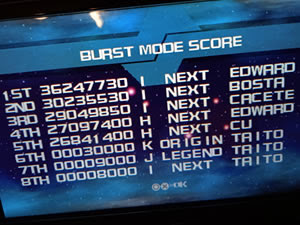
All the highest scores for each ship in the photo below for Arcade mode are 1CCs obtained in the Normal difficulty (a 1LC in the case of the Silver Hawk Next in spot #1 through toute ABCEH). Since it's a lot harder than the regular game, I only really tried to 1CC/complete Burst mode with the Silver Hawk Next, succeeding in route ABCEI.


Thursday, May 19, 2022

Starship Hector (NES)

Horizontal / Vertical
Checkpoints ON
1 Difficulty level
6 Stages
Ship speed fixed
- - - - - - -
Developed by Hudson Soft
Published by Hudson Soft in 1987


I don't have a nice recollection of Star Soldier. For a number of reasons I didn't enjoy playing it as I thought I would have, but regardless of my appreciation the game fortunately spawned a series that continued in the PC Engine platform with remarkable success. However, besides the main Soldier franchise a few spin-off titles were also released by Hudson Soft, and Starship Hector is one of them (the others are Star Parodier and – unofficially – Gunhed / Blazing Lazers). Known in Japan as Hector '87, it's probably the one with least similarities with Star Soldier, which is of course quite interesting in itself if you fancy the other games mentioned in this short paragraph.

With typical Hudson Soft tunes that fit perfectly into the Soldier universe, a creative boss gallery comprised of weird monsters and a difficulty level that doesn’t come off as extreme (provided you have a turbo controller, of course), Starship Hector is certainly bound to please NES shmup fans. All I can say is that I enjoyed it much more than I did Star Soldier, even with the occasional bouts of flicker and slowdown.

The setting is a mix of sci-fi and desolate landscapes. Your starship’s mission is to rid the Earth from alien biomechanical creatures that have dominated the planet after yet another world war. Each stage is labeled “history”, with levels that alternate between vertical and horizontal and are loosely based in ancient civilizations such as the Incan, Mayan and Egyptian empires. Gameplay sounds way more straightforward than any chapter in the regular Soldier series, even though the general pace is a little slower. There are no power-ups to be found in Starship Hector, and the only items you’ll come across are energy-refilling pills expelled by ground totems hit by your ground bombs.

Pillars of purple doom in History 2

Ground bombs have a crawling abilitity and are fired with button A, whereas the main shot is fired with button B. It’s a variation of the classic formulas first presented in Xevious (vertical) and Gradius (horizontal), with each type of level characterized by its own set of rules. Horizontal parts are often full of walls and obstacles you need to avoid, which are naturally absent from vertical areas. On the other hand ground bombs will only damage ground targets in vertical stages, but they can destroy everything in the horizontal sections. The most important thing about the firing inputs though is that Starship Hector definitely requires a turbo controller to be properly played. Mashing buttons will get you nowhere, on top of giving you serious wrist injuries if you insist on doing so.

Each life comes with an energy/health bar that gets depleted as you receive damage from bullets and enemies. Bullets take away two to four energy cells, but collisions are deadly because if they don’t kill you right away you’ll be left with no spare energy, which means a life will be lost on the next hit. Unless of course you’re able to retrieve and collect the abovementioned refilling pills from the ground fountains. Some enemies have the nasty habit of trying to ram into you either in frontal attacks or by flying behind the ship, so take that in consideration when establishing target priorities while applying at least a minor level of crowd control. Killing the most dangerous enemies quickly is also essential to manage bullet count, especially in the vertical stages. Just beware of exploding mines coming up from below in areas that resemble ravines. The safest strategy is to steer away from them, since they’ll kill you instantly if they take you by surprise.

Perhaps due to the fact that a lifebar is in place, whenever you die you're sent back to the start of the level even during a boss fight. Since stages get tougher as you advance and enemy behavior becomes increasingly more erratic, as I hinted above the best way to go the distance is to play aggressively while memorizing the most threatening enemy patterns. Of course long checkpoints lend themselves to milking once you’ve got used to the stage layouts, and you certainly can try it with the three extends achieved with 200.000, 500.000 and 1 million points. 
 

History 1 - The "Incaic" empire
(courtesy of YouTube user The VideoGames Museum)

Regardless of the amount of milking you can perform, the bulk of a high scoring run comes from the million points awarded to players who can uncover all characters from the name HECTOR, which are hidden exclusively in vertical levels below circular ground areas the same size of regular turrets. Hit these spots with ground bombs to reveal them, then hit them again to uncover the letters. There's more than one of the same character within the same level, which gives you the chance to collect the bonus in stage 5 even if you miss one of hidden spots. Another bonus of finding them is that they're worth lots of points.

Concealed ground targets are also important in another context. In vertical levels a few extra hidden spots work as triggers that destroy all turrets in the vinicity, thus making your life a lot easier. These aren't as easy to find as the HECTOR characters though, so try to remember whenever you happen to come across one of these precious secret locations.

The picture below shows my final 1CC score, which is kept in the "Score" choice from the start screen. If you pay close attention to the start screen once you've beaten the game you'll notice that it changes colors. If another credit is started right away you'll then be surprised by your avatar, which changes from the regular spaceship to an astronaut in a jetpack! It's just a cosmetic thing though, everything else about the game remains the same. Note: besides the main course in Starship Hector there are also 2 and 5-minute caravan modes for players who enjoy these extra scoring challenges.


Sunday, May 8, 2022

Dezaemon 2 [Daioh P!] (Saturn)

Vertical
Checkpoints ON
4 Difficulty levels
5 Stages
Ship speed by icons
- - - - - - -
Developed by Athena
Published by Athena in 1997


Continuing with the exploration of the sample games included in the Japanese Dezaemon series of shmup-making titles, let's now take a quick look at Daioh P!, the final episode in the consolized and heavily toned down version of a very tough arcade shooter. The previous chapter is Daioh Gale Ver. 2 on the Dezaemon Plus disc, released for the Playstation in 1996.

Daioh P! is one of the five sample games included in the Dezaemon 2 shmup-making title for the Sega Saturn, accessible by choosing the S3 option in the start menu (it's the second sample game I'm playing on it, the first one was Biometal Gust). The "P" in Daioh P! stands for polygons, which means that every visual asset in the game uses this technique, from ships and crafts to terrains and explosions. Since it has five stages, the basic mold upon which it's based seems to be Daioh Gale Ver. 2, yet there are one or two aspects that date back to the first Daioh Gale, originally released for the Super Famicom in 1995.

Daioh P! maintains the general stage layouts and enemies from Daioh Gale Ver. 2, as well as an updated version of the same soundtrack. The main additions include the primitive electronic preamble prior to the start of each level, several new sound effects that give the action a slightly different feel from previous entries, the scrolling speed that varies from time to time and the fact that all bosses have two or three distinct phases instead of just a single attack routine throughout the fight. Other than that, the graphic design is extremely simplifed and lacks details, which is sort of expected for a game developed using standard predefined polygon tools.

Chasing the second boss over a blocky polygon ocean

Playing the game requires basically two inputs, rapid shot in button R and bomb in button C (for those interested, the single shot is mapped to button A). All items are released by destroying a specific carrier, starting with the colored icons for weapon choice: red (spread vulcan), blue (straight shot with homing missiles) and green (homing shot). In order to increase weapon power you need to collect the P (power-up). The remainder of the item gallery consists of SP (speed-up), SH (1-hit shield), B (extra bomb) and a medal that's worth 5.000 points. Weapon icons and medals fall off the screen right away when released, whereas all other items float around for a while before disappearing.

The last aspect of the core gameplay is bomb usage. Bombs work according to the weapon you're currently using. For the red (vulcan) you get a round blast that damages everything around you, green shot (homing) results in a more powerful homing attack with increased damage and the bomb for the blue shot (straight + missiles) consists of a frontal attack that funnels inwards as the bomb energy dissipates.

Most of the time Daioh P! flows at a nice pace, with almost no threats imposing any sort of pressure on players. That said, the only moments where bullet spreads start to become more dangerous are during boss fights, which are now preceded by warning messages inspired by Darius (a huge battleship is approaching fast!). Their final phases can take you off guard with sudden attacks or close-range overlapping blows, and for that the best strategy is still good old memorization. Never mind the spiralling sand columns of the 3rd boss though, the effect is kinda reminiscent of Soukyugurentai but it's harmless, just for show really.

Even though at least one speed-up appears every time after you die, which makes boss fights fair and tougher sections manageable, the final boss is no pushover and requires lots of movement to be defeated. It's also important to note that you're always respawned with the weapon you were using when you died, which in some cases can lead to extremely dire situations because you can't switch to another weapon. Facing the last boss with the homing weapon is such an example since you never know when the homing shot will start chasing the boss itself instead of the drones he drops or the central deadly bullet, which can be destroyed even by a level 2 vulcan shot.

The first stage of Daioh P! (easy difficulty)
(courtesy of YouTube user The VideoGames Museum)

Since you get a few extends in a regular run, starting with 100.000 points and then for every 300.000 points after that, Daioh P! naturally allows checkpoint milking if you feel inclined to do so. I guess it's just a matter of finding the best checkpoints for that, which is something I didn't try to do. One such part of the game, however, is definitely the last boss due to the drones he drops in his first form (as I mentioned above). Marginal score contributors consist of loose projectiles from turrets, but it's also important to not let any medal go by. Medals are the only items that can be dropped not only by carriers but also by specific enemies, so keep an eye out for them.

Although sympathetic thanks to the full polygon design and the ability to play in co-op, overall Daioh P! is very short and doesn't have enough substance to warrant a lasting impression. It's okay but it's certainly of more interest to those who care about the works by Athena or the possibilities to tinker with all sample games, as is usual with the Dezaemon titles. Since I didn't venture into ckeckpoint milking, my best score for Daioh P! was achieved in a no-miss run (Normal difficulty).


Saturday, April 30, 2022

Eschatos (Xbox 360)

Vertical
Checkpoints OFF
4 Difficulty levels
26 Stages
Ship speed selectable
- - - - - - -
Developed by Qute
Published by Qute in 2011


Six years are almost a lifetime in the evolution cycle of a video game. That's the time span, for example, that separates Eschatos from Judgement Silversword and Cardinal Sins. It's fascinating to check out how one-man developer M-kai joined Qute in order to make Eschatos, which by all means is a direct sequel to Judgement Silversword except by name. One should try out the latter first in order to know what I'm talking about, but that's of course not important if you want to dive directly into Eschatos. What really matters is that the Japanese Xbox 360 release includes all three games mentioned in this short paragraph, in a complete package that serves as a perfect entry ticket to the flashy style of developer Qute.

Eschatos is of course the main title in the disc, a fast-paced sci-fi adventure where the player fights hordes of enemies brought by a triad of huge flying saucers that are threatening to take over the Earth’s moon. There’s an organic, seamless progression that unfolds with exquisite cinematic flair and takes you from futuristic urban sceneries to the depths of the enemy lair inside our natural satellite. Expect huge explosions, dynamic transitions and perspective shifts galore, some of them even with bullets and hazards to be avoided or dodged.

Gameplay inputs in Eschatos consist of a powerful straight shot, a less powerful wide shot with shorter reach, a shield that protects the ship against incoming fire (normally activated by pressing straight and wide shot simultaneously) and a switch that cycles back and forth between three predetermined speed settings. Knowing the strenghts and weaknesses of these resourses is essential, such as the dead area right ahead of the ship when using wide shot, the offensive use of the shield whenever possible or the fact that the larger the bullet the longer it takes for the shield to deplete it (yet the shield works against any sort of laser, even those huge blasts that appear later in the game, homing or not).

A quick glance at the blistering action of Eschatos
(courtesy of YouTube user and developer Qutejp)

There are three modes of play: Original, Advanced and Time Attack. Even though they share a basic structure and roughly the same enemy patterns, gameplay rules differ. And since most people consider Original to be the main mode, that’s the one I focused on. There’s a single icon to be found in it, a blue F that works as a flash bomb that melts all on-screen bullets and cannon fodder. Beyond its obvious benefits for survival, this flash bomb also factors into the scoring system due to the fact that speed killing enemies grants you better bonuses, so timing the use of the bomb to clear waves faster is definitely encouraged.

The next component of the scoring system in Original mode is the multiplier. Each wave that’s completely destroyed increases the multiplier by 1, and for every death or each enemy that flees the screen the multiplier goes down by 1. In the normal difficulty the ceiling to this multiplier ×10 (it’s higher in further difficulty settings) and during the course of the game it’s only reset after you fight one of the main bosses in stages 5, 11, 15 and 20. Speaking of stages, due to this structure of main bosses some people refer to Eschatos as a 5-level game, yet I prefer to see it with the full 26 areas/stages nonetheless.

Another component of the scoring system is related to the hidden icons known as “wonderwitches”, in a clear homage to the development kit that was used to create Judgement Silversword for the Bandai Wonderswan handheld. In order to reveal the wonderwitches players must shoot at their secret locations in stages 4, 9, 13, 16, 20, 22 and 25. With increasing base values, from 1.000 to 100.000 points, some of them require specific approaches to be found. Since they have the nasty habit of fleeing the screen if you rush to get them, just stay low and let them come towards you before making the move to pick them up.

Finally, a few expressive completion bonuses are granted once you beat the game. For the normal difficulty you earn 1,5 million points, as well as one million points for every life in stock. Several 1UPs appear throughout the game depending on the amount of destroyed enemies, bouncing once in the bottom before falling off the screen for good. Note that picking up the 1UP also grants you a split-second moment of invincibility, just like in Judgement Silversword. This is one aspect of many that’s similar between both games, which also share lots of bullet patterns and enemy behavior routines. Eschatos also throws a few nods to classics such as Xevious and Space Invaders, with the latter serving as the mold for one of the most intense moments of the game in stage 19. 

Choose your destiny!

A different sort of rush awaits players in Advanced mode. On the surface enemy placement and behavior is the same as in Original, but besides the blue F-bomb and the 1UPs this game variant also includes power-ups (P) and golden F-bombs. There's no time bonus anymore, but the multiplier still goes up by destroying full waves; what's new is that it also increases by 1 for each power-up you take, with the caveat that you get less shield energy the more powered up you are (down to 30% shield with max power). All shielded bullets are turned into purple crystals that start rotating around the ship as a barrier for as long as the shield is deployed, being absorbed as bonus points when you stop using the shield. The golden F-bomb also turns all on-screen bullets into crystals while decreasing the multiplier by 1, so the challenge is to find the balance between keeping a high multiplier and using the golden F-bomb to cash in on the purple crystals (normally the blue F-bomb is a no-go since it also affects the multipler negatively). In the normal difficulty the maximum multiplier is ×16.

Both Original and Advanced have four difficulties available and also an "endless" setting where the game has no end. On the other hand, Time Attack mode has no difficulty selection and presents a single challenge where you're supposed to get through the game as fast as you can. I guess the main reason for this is that this mode has adaptative difficulty, i.e. rank, which makes the game harder the better you perform. In a nutshell, beating levels quickly gives you extra time to fulfill your mission, while dying takes away five seconds of the ongoing timer. If the counter reaches zero the credit ends. 

Given the variety and the depth provided by the scoring systems across all game modes and difficulties, Eschatos is a mandatory title in whatever form you can find. Only the soundtrack doesn't quite cut it for me during the first half of the game, but once you're in outer space it gets much better. Otherwise Eschatos excels at offering a nice mix of fun and intensity with a smooth challenge curve that draws players in without much effort. Just beware that with so much incentive to be aggressive (Original mode) or to avoid F-bombs (Advanced mode), trying to score higher often incurs in restartitis if you die too soon. Continuous play grants option "levels" that unlock several extra adjustments in the options menu, which is already well served with resources such as replay saving, a handful of video/audio tweaks and online/offline leaderboards.
 
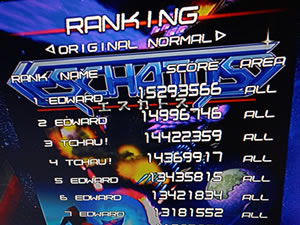
My best 1CC results in the normal difficulty of Original and Advanced modes in the Xbox 360 version are below. This edition comes with an extra disc with the original soundtrack, but the best thing about it is that it's region-free!


Sunday, April 24, 2022

Darius Extra Version (Mega Drive)

Horizontal
Checkpoints OFF
1 Difficulty level
7 Stages
Ship speed fixed
- - - - - - -
Developed by Taito / M2
Published by Strictly Limited Games in 2021


Well, it only took 30 years for this to happen: a port of the first Darius for the Mega Drive. The story behind it is nothing short of a fan-meets-developer's fairy tale. It all started with a fan-made conversion that was eventually picked up by Taito and M2, came out in the game roster of the Mega Drive Mini and was later fine-tuned for a last, definitive version released in cartridge format by a few different publishers.

Besides the absolute class of the porting job, this release allows players to experience the game in any of its three variants, which are directly based on the original arcade boards: Old Version, New Version and Extra Version. That’s the reason for the Darius Extra Version title, which by all means represents a step-up from previous ports Darius Plus and Super Darius, released for the PC Engine Hucard and CD formats a very long time ago.

For those who never played many shmups before or have lived under a rock in the last decades, Darius is an all-out space battle of the stylish spaceships called Silver Hawks against an enemy race empowered with huge battleships that mimic aquatic/marine creatures. Pretty much all aspects that define the series are presented in this first chapter, from the now famous WARNING messages prior to boss fights to the branching path mechanic that makes you choose different routes as you progress through the game - just remember to keep the ship off the centerline when the boss goes down or you'll crash against the rocky splits.

Darius for the Mega Drive as seen in the first release for the Mega Drive mini
(courtesy of YouTube user ElyPhanti)

Of course the basic gameplay does not change from one mode to the next. The Silver Hawk is able to fire a main shot and to drop bombs, naturally mapped to different controller buttons (A and B, respectively) or both to a single button (C). Buttons X, Y and Z have similar functions but with higher firing rates, just check the options to see how they differ. By collecting colored orbs released by specific enemies you're able to improve your ship's capabilities separately according to an upgrade bar that displays your current power level. Whenever each of these bars is completed you start a new upgrade cycle, and the default levels of the new bars will determine the ship's firepower when you are respawn after dying.

With red ords the main gun evolves from "missile" to laser and then wave. Green orbs make you go from bombs to twin (frontal bombs downwards and upwards) and "multi" (four-way bombs on both sides). Blue determines the efficiency of your shield, which goes from "arm" (green) to super (gray) and hyper (golden). Other orbs are hidden in the scenery and must be shot at to be released and picked up: the gray one gives a random bonus from 50 to 51.200 points (there's no logic behind it, don't even try to figure it out), the golden one serves as a smart bomb that clears the screen from bullets and cannon fodder and the orb with a tiny spaceship inside grants you with an extra life. By the way, scoring also grants you a single extend once you reach 600.000 points.

In terms of the overall design there's not much variety in the game's backgrounds, which recyle four themes over and over with different color palettes and textures (cavern, planet surface, inside fortresses and undewater). The music is equally restricted but what's there serves the game's motif very well. Fortunately these design limitations are duly compensated by all sorts of hazards from several types of enemy waves and huge bosses. Following the standard set by Super Darius, each stage has its specific boss so there's no repetition of bosses as is the case of the arcade original (the default setting in the options for BOSS TYPE is "26 bosses", as opposed to the expected 11 bosses of arcade Darius).

For every complete enemy wave destroyed you earn a few more points, in what represents the most important aspect of the scoring system in the Old and New versions of the game. Boss parts are also worth many points, so whenever possible try to dismantle them before going for the main kill. A mild degree of projectile milking is possible, just remember that the timeout cubes will eventually get angry and turn into extremely fast bullets that are nearly impossible to dodge. 

Tiat takes on boss Big Rajarnn at the end of stage D

And what's the difference between the three variants of the game included in the cartridge? The common ground between all of them is that there are no checkpoints, unlike the original arcade version. The main draw of the Old Version is that it has much stronger bosses, to the point where you must be really aggressive with some of them lest the fight drags until the timeout cubes become angry. New Version corrects this by toning down boss health and applying minor adjustments to the rest of the game. The definitive iteration is Extra Version, which completely reworks enemy formations in a few stages, alters some boss attack patterns and gives you one million points per spare life remaining at the end of the credit. Extra Verson is also the only one that allows the use of three continues.

The quality of this port is evident from the game itself but the people behind it certainly went the extra mile, as we can see from the boss rush campaigns for each mode and some nice functional aspects and tweaks you can apply to everything. Besides the choice for boss roster mentioned above, you can also alter rapid fire rates and choose from pilots Proco (default red Silver Hawk) and Tiat (blue Silver Hawk), which serves as an easy difficulty of sorts since it doesn't power down when you die. Note however that playing with Tiat doesn't allow players to register their results/initials. Finally, each mode has its own high score table and a soft reset function is available with A+B+C and START.

My best results in each mode of Darius Extra Version are shown in the pictures below, all of them one-life clears. For these runs I adopted the same route (ACFJOUV', always taking the lower path) so that I could better notice the differences between modes. Obviously beating the game in one life is only important for scoring in the Extra Version.


Final note: let's not forget that the Mega Drive has an awesome port of Darius II (a.k.a. Sagaia), which now makes for an amazing shmup duo with Darius Extra Version!

Saturday, April 9, 2022

Gyruss (NES)

Tube shooter
Checkpoints OFF
1 Difficulty level
39 Stages (loopable)
Ship speed fixed
- - - - - - -
Developed by Konami
Published by Ultra Games in 1988


One of the most interesting and unique types of shmups to appear in the 80s is the tube shooter, a subgenre that was kickstarted by Tempest in 1981. Despite Tempest's relative success in the arcades there weren't many games produced in the same style, but from the few that followed the same path Gyruss is definitely the highlight. The arcade game would eventually be ported to several systems, with special attention to Nintendo's 8-bit platform. First released for the Famicom Disk System, soon after the game also appeared worldwide in the more friendly cartridge format.

There are obvious reasons for the special attention over a port developed for a far inferior platform. And it all boils down to the tried and true concept of gameplay, which still is the most important aspect in any video game since the day Space Invaders came to this planet. That makes a lot of sense considering the limitations of the tube formula, which is nothing more than that of a folded fixed shooter. Long story short, the improvements NES Gyruss makes over the original game are the reasons many people prefer it over the arcade version.

In fact they are both very distinct experiences, each one with specific strengths and weaknesses. There are even rumors that the NES port is based on a prototype for Gyruss II that never came to fruition (a glimpse of this can be seen in a hidden Gyruss game in Contra - Legacy of War for the Playstation). In common between both versions are the wave-based mechanics similar to Galaga and the way stages are arranged, in a journey where you must warp through the planets in the Solar System. Each stage is a warp, and in the case of the NES version you always need 3 warps to reach the next target, starting in Neptune and ending in the Sun.

Spiralling armada ahead

A single screen in the attract mode establishes the player's mission in the game, which is – unsurprisingly – to rid the universe from evil. Only a hero can succeed in this death defying risk. Two control options are available as you start: Control A enables all directions for a full circular motion, and with Control B you can only use left and right to rotate the craft (just like in Tempest). Then you're treated with a brief animation showing your approach towards the next planet and off you go, warp after warp defeating enemies and bosses as the star-dotted vastness of space scrolls by.

Button A fires your regular shot and button B fires the "ultra-lazonic phaser" weapon (I'm not making this up, that's how the instruction manual calls it). As you face the approaching enemy waves, occasionally you'll see bonus spheres attached to intergalactic mines. Hit the spheres to get special items such as the mandatory double shot upgrade (purple). Other types of items brought by the mines include extra phaser weapons (yellow, up to a maximum of 7), screen-clearing bombs, bonus points and extra lives (1UPs). Extra lives are also obtained by scoring, the first with 50.000 points and further ones at every 100.000 points afterwards.

Bosses are one of the additions of the NES port, appearing at the end of the 3rd warp when you reach the target planets. With a few exceptions they're an amalgam of turrets that shoot out several types of bullets and get increasingly more complicated to destroy because of the overlapping attacks from the opening/closing of their hatches. That's when the phaser weapon is very useful since one blast is able to destroy two turrets if you aim it correctly. Once the boss is destroyed you enter a "chance stage", which serves as a bonus area where you can't be hit. If you manage to kill all enemies in it a special bonus of 10.000 points is granted, a reward that increases in value if you continue getting a perfect destruction ratio in further chance stages. In these levels you can also get lots of items by destroying enemies of different colors within each wave, and the game is often kind enough to give out double shot upgrades and 1UPs whenever you get there with a bare ship.

The bonuses from perfecting chance stages are the biggest contributors to the scoring system, but you're also rewarded for destroying full waves before the surviving enemies settle in the background / back of the tube. The first wave gives you an extra 1.000 points, the second 2.000 points and all further ones are worth 4.000 extra points each. Additional enemies spawning from turrets might also be included as sources of extra points, though it's probably better to avoid them in the long run if things get too cluttered.

3 warps to Pluto – it comes after Netptune here, so it's astronomically correct!
(courtesy of YouTube user Patrick So)

Besides the described additions of NES Gyruss over the arcade original, including all extra items beyond the double shot, players will also have the chance to play fresh new levels in Pluto, Venus, Mercury and the Sun, with story bits thrown in at the beginning and the end of the journey. Expect drones of different sizes and colors, as well as splitting amoebas/meteors, space bugs with protective shells, spaceships, disappearing guns, space snakes and homing fireballs. Diversity is guaranteed as you move through all of the 39 short stages, and it's interesting to note that in sound terms this version of  Gyruss feels a lot like a Gradius game. A few explicit nods in the gameplay are also very much welcome, such as the Salamander-like boss at the end of stage 19.

With so much going on at times a little bit of slowdown and flicker is inevitable, and for an obvious better performance of the system the screen info disappears completely during boss fights. Fortunately there's nothing really troublesome about these limitations. What's certain is that due to the several alterations in the core game NES Gyruss is an easier challenge than arcade Gyruss. Besides the breathers you come across along the way, in the NES it's much easier to destroy enemies in the distance even with a single shot, whereas in the arcade original losing double shot leaves you in severe trouble later on. I'm fond of both versions equally.

The second loop increments the challenge with a few more enemy bullets per warp and more aggressive bosses, which start throwing out spiralling patterns instead of single fixed spreads. A full run of the 39 levels takes roughly 40 minutes, so once you learn the game completely you can expect to play marathons in order to increase your score. My best result below ended in stage 3-5, playing with Control A.