Sunday, December 26, 2021

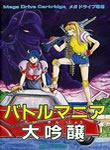
Battlemania Daiginjō (Mega Drive)

Horizontal
Checkpoints OFF
3 Difficulty levels
9 Stages
Ship speed by icons
- - - - - - -
Developed by Vic Tokai
Published by Vic Tokai in 1993


The fate of certain game franchises can be a cruel one, both for the games themselves and for fans. When Trouble Shooter came out in the US a Japanese version called  Battlemania soon followed, granting players with a lighthearted adventure that packed a nice sense of humor and a somewhat original concept for gameplay. However, when the more ambitious Battlemania 2 followed in Japan, no sign of a corresponding Western release ever materialized. Even worse, the Japanese cartridge had such a low print run that it soon became one of the rarest Mega Drive games, not to say one of the most desired prizes in any shmup collection around the world.

Primarily known as Battlemania Daiginjō, the sequel expands on all features of the first chapter to a great degree. Although it doesn't show much upon a first contact, the last half of the game is a tour de force on excellent game design, sheer boldness and creativity elevating graphics, music, presentation and gameplay to a whole new level. In general character interactions are also more frequent and fleshed out, too bad everything is in Japanese (a special translation for the ROM exists if you fancy emulation though). The only aspect that wasn't better handled and fails to deliver, just like in Trouble Shooter, is the scoring system. A blind completion is enough to counterstop the game, unfortunately.

Regardless of the way scoring works and how it deeply affects the game's lasting appeal, Battlemania Daiginjō is definitley a no-brainer as far as immediate fun is concerned, with non-stop action, scrolling in all possible directions, parallax galore, crazy bosses with multiple forms/parts and a pumping soundtrack to boot.
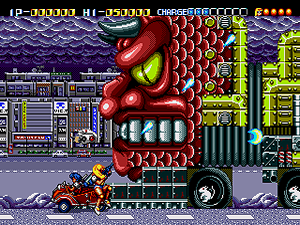
Now this is an ugly angry truck!

The pretty ladies introduced in Trouble Shooter are back to battle another crazy enemy gallery. Protagonist blonde Madison/Mania continues to take the lead while blue-haired Crystal/Maria has her friend's back throughout most of the journey. Following an intro that connects the end of the previous game to the new quest, the start screen is displayed. Going directly into the game is fine, however this time around you can tweak the behavior of your weapons and firepower in the options. Besides choosing from three different button settings (default is A for special attack or "heap", B for shot and C for firepower flip), you can also select between three ways of manipulating shot direction and three different behaviors for the pod/probe.

Regarding directions, 1way is the well-known setting where Mania shoots exclusively forward and only Maria turns her firepower left and right; in 2way both characters flip while in 8way you can point in all directions and lock fire when shooting. Don't get too excited though, even though 8way seems to be the most efficient choice it's also the one that requires the most practice to be properly used. As for the pods you select prior to each level, you can have them set between homing (default hovering pod), roll (circles the player) and negative (goes your opposite direction vertically).

The level progression of Battlemania Daiginjō is backed up by neat cut scene intermissions whose cheerful humor unfortunately gets lost in translation. Except for the vertical nature of the first stage, which sees Maria fighting alone while her partner is asleep, the game has them both together in a series of levels that are quite decent in terms of variety. The second level is an obvious throwback to the original Trouble Shooter, but everything after brings something new and exciting to the table. Giger-esque enemies and obstacles protruding from walls appear in the 4th stage, yet the real highlights are reserved for the couple of levels that follow. During the giant truck part the girls are stuck to their car at ground level, in the single part of the game where Mania is allowed to shoot upwards regardless of the chosen direction setting. Then comes an outer space station with revolving backgrounds, definitely one of the most impressive stages in the Mega Drive shmup library.

In each credit you're given an energy meter that's constantly refilled either at every 20.000 points or by collecting heart items released by enemies or hidden in unsuspected corners of the scenery. That makes for another remarkably easy ride that doesn't demand much in the way of challenge. The only real threat players must look out for is getting crushed by the scenery, an event that causes instant game over regardless of your life meter. Of course this only applies to main character Mania, since Maria is invulnerable and often falls behind due to obstacles that hold her back as the screen scrolls. In any case there's no harm from touching walls, another defining aspect in the game's overall low difficulty.

Lonesome hunters at heart!
(courtesy of YouTube user Wan1993)

Besides hearts for extra health/life, other items you'll come across are P (power-up), S (speed-up), ↓ (speed-down) and coin (extra points). The pod is powered up with the regular weaponry, and each of the four available types results in a different special attack to be used once the charge gauge is full. Note that unleashing the attack before the gauge recharges completely results in nothing and also resets the gauge. While pod types aren't really advantageous over each other some of them might be better for certain levels, as is the case of the blue pod in the giant truck section (it creates a destructive vertical energy bar for a few seconds).

After each stage you receive a few score bonuses for level completion, special attack usage (each one deducts 100 from 1.000 points) and "guts", which is related to the amount of energy you have after beating the boss (100 points for each health cell). You're also given a shooter rank that ranges across 11 classifications, from Ultimate A (best) to Failure, a designation that comes below D minus. An extra mode called "Score attack" can be selected from the start screen, but it's just a disappointing afterthought where you play only stage 2 for score without even getting to enter your performance in a high score table.

I got the counterstop in Battlemania Daiginjō in my first clear on a single credit playing at full defaults (Normal difficulty, 1way direction, homing probe). I did have a few goes afterwards with other weapon settings, just for the fun of it.

Saturday, December 11, 2021

Magmax (NES)

Horizontal
Checkpoints ON
1 Difficulty level
4 Stages (loopable)
Ship speed fixed
- - - - - - -
Developed by Nichibutsu
Published by FCI in 1988


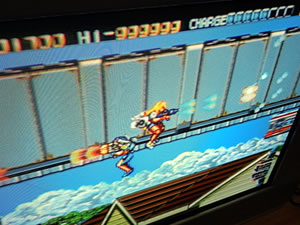
The NES was home to many games that didn't really have a proper ending, choosing instead to repeat themselves forever in neverending loops designed to either crush, tire or bore players to death. Magmax is one such example, but let it be known that this looping structure is actually derived from the original arcade version. The game is also a spiritual sequel to Seicross (or Sector Zone), even though it doesn't achieve the same gameplay excellence as far as NES adaptations go. In fact, chances are you'll be as bored as I was when playing it. There are far better shmup entries in Nintendo's 8-bit console, that's for sure.

Magmax invites shmuppers to embark on another sci-fi adventure by allowing them to build upon a bare bones spaceship in order to turn it into a badass robot. This robot is the last hope of the human race and bla-bla-bla, with the sad realization that he will never actually fulfill his mission due to the everlasting nature of the game, a seamless amalgam of four different areas that repeat over and over with a difficulty slope that only starts to get taxing by the third loop.

A quest to defeat the first mechanical monster Babylon
(courtesy of YouTube user nesguide)

Shooting is accomplished with any desired button (A or B) in the controller. Mashing the button won't produce outstanding results because the firing rate is severely capped, but a turbo controller certainly helps to alleviate the stress on the player's wrist nonetheless. The main objective is to collect the robot parts spread out along the way, which consist of the torso, the legs and a special cannon that can only be activated after you have at least collected the torso. Each added body part adds a bit of extra firepower but increases the hitbox a huge deal, thus making it harder to keep the robot in one piece. The good news is that getting hit just destroys a body part instead of killing you right away (you only lose a life if you're hit with the bare ship).

There are two playing fields in Magmax, a surface area and an underground area. Once the small ship is thrown into the action you appear over the surface, and to travel between these areas all you have to do is touch the icon for the oval transport tunnel. In the surface area the robot/ship glides over the terrain destroying ground targets, whereas the undeground parts play like a regular horizontal shooter with flying enemies and obstacles detaching from the ground and the ceiling. Even though there's no division between levels, there are four distinct areas to go through before you loop the game: plains, desert, water and machine city. The underground area does not change from plains to desert and takes place inside a cave.

A mechanical dragon with multiple heads called Babylon is the only boss that appears at the end of the desert and the machine city areas. During the levels the action is based on destroying all kinds of drones and creatures arriving in waves, but the scrolling on the surface is a little faster and harder than in the underground, mainly because you only get a single firing stream even when in complete robot form (on the surface the cannon turns into a laser that points down instead of shooting forward). Nevertheless the cannon does offer an advantage because it can destroy all indestructible obstacles both above and below ground.

Inside the machine city undergrounds

Despite the potential variety hinted by the dynamics of playing in two different fields, there's no escaping the fact that Magmax is extremely drab and repetitive. It is however relatively faithful to the arcade original considering the system's capabilities (the impressive ground parallax of the surface areas are of course absent on the NES). It's also quite an easy game in the first couple of loops, after that the robot parts don't come so often and the marginal increase in enemy aggression starts to impose a litle more pressure on players who are patient enough to get that far. If you're wondering about the music, different tunes play for surface and underground areas but sadly none of them are engaging enough.

On the scoring side Magmax is quite straightforward, yet you can exploit some aspects of the game to get a few more points, such as using the debris of the exploding bombs on the surface or the spikes from the underground sections to get extra 1.000 points from each enemy you destroy with them. The first extend is registered at 30.000 points, and each further one is granted with every 50.000 points. There's a faint sound cue that plays when the extend is achieved.

My demise in the high score below happened in stage 4-4. Weird note: as soon as I entered the fourth loop my score display was replaced by the word MEIGETSU, but soon got back to normal when I died.


Saturday, November 27, 2021

Cloud Master (NES)

Horizontal
Checkpoints ON
1 Difficulty level
6 stages (loopable)
Ship speed by icons
- - - - - - -
Developed by Disco / Taito
Published by Taito in 1989


Cloud Master, also known by its Japanese name Chuka Taisen, was somehow considered by Taito a strong title to be cascaded into ports soon after the arcade game was out in Japan. That's probably due to the perceived appeal of the game, which involves a boy flying on a cloud trying to defeat other enemies who also fly over clouds, the so-called "cloud masters". While not as famous as the Master System port (the only one to be published out of Japan), Cloud Master on the Famicom/NES is just as valid a version thanks to a faithful conversion full of color that preserves the original gameplay and even expands on it by adding an extra stage.

Villages, mountains, castles and ancient landscapes scroll by with no variation at all, which leaves to enemies and only a few ground obstacles the task of providing challenge and fun. In this sense the game feels like an early take on the Darius formula, complete with enemies arriving in waves, entering the screen in seemingly erratic patterns or firing from the ground as if they were turrets. No mechanical foes are to be seen, instead what we have is an enemy gallery comprised of animals and mythical creatures, as well as human figures and surreal things like flying bowls, flying swords and all kinds of flying heads.

It's time to become a cloud master myself!
(courtesy of YouTube user The VideoGames Museum)

Button B fires the main shot and button A fires the auxiliary shot. In line with the Japanese nature of the game, all icons are denoted by kanji characters but fret not, just a few credits are enough to get used to them and know what they mean. In order of importance there's power-up, speed-up, autofire, double power-up and extra life. Powering up increases shot power and changes its sprites to spread, double, spread and double again before maxing out at a wave shot that pierces through everything in sight. Once you get the wave shot power-ups stop coming, whereas the double power-up only appears in some of the later checkpoints after you die.

Having a turbo controller is of course the way to go unless you can wait to take the autofire icon. As for speed-ups, I always restricted myself to only two of them because I kept bumping into things with more than that. Just like in all other versions, there comes a point in Cloud Master where the most important strategy to survive is crowd control. That's why it's important to dodge the lightning bolts from the mini-bosses that appear throughout the level and enter the door they leave behind when defeated. There you have the chance to choose one of four available auxiliary weapons, which include rotating walls, directional shots, ball bombs, crawling bombs, exploding bombs and fire versions of a few of them. These increase in power if you continue to select the same type.

The steady difficulty slope of Famicom Cloud Master comes with a few detrimental aspects players need to cope with. By the time you reach the 4th stage checkpoints start to demand a lot more attention if you die, and soon after bouts of stuttery slowdown and a little flicker can make things even worse. A particularly tricky checkpoint to recover from is the second one in the 5th level, simply because the lion mid-boss has tons of health and the overlapping waves don't leave much room to maneuver. It's not uncommon to deplete the life stock there. Speaking of lives, besides the icon-based 1UPs there's also an extend routine that starts with 30.000 points and continues at every 150.000 points after that.

Just one quick note on a nasty bug: never start a game when you return to the main screen after a GAME OVER. If you do that you won't get any extra lives from scoring, so always reset the game on the console before starting a new credit.

A brand new area in the 8-bit gaming realm

Another detail that's important and worth checking out for survival is simply avoiding to maximize the main shot. Although the wave weapon is quite useful during levels due to its piercing ability, it's firing rate isn't as ideal as the firing rate of the double shot that's active before the last power-up. This is crucial to abbreviate battles against all cloud masters, mid-bosses and main bosses alike. I adopted the strategy myself in order to beat the game.

Besides the extra final stage that takes place in some sort of moon in outer space, this port of Cloud Master has another exclusive treat in the secret level you can access in stage 4. From that point on the level continues until you have to fight the regular stage boss. I did enter this secret area by accident once, but all you need to do is shoot and squeeze yourself between the ground obstacles that engulf the second ground dragon (all ground obstacles are harmless, by the way). As for the new last stage, it's a little shorter than the others and brings back three previous bosses for a final challenge before you can see the end of the game (the goblin/demon, the samurai and the dragon).

Is this port better than the Master System game? I think the Sega version is overall more polished, but the NES/Famicom interpretation is also worth it despite the shortcomings and tougher challenge. The PC Engine port is in a whole different league, so I'll leave it out of the comparison.

Once the end credits roll you win a bonus of one million points and the game is restarted with seemingly the same difficulty. However, soon enough you'll realize the enemies are more resilient, which makes checkpoint recoveries a tad trickier than before. My final score ended in stage 2-6 after I bumped into one of those flying heads that cruise the screen from right to left.


Friday, November 19, 2021

G Darius (Playstation)

Horizontal
Checkpoints OFF
8 Difficulty levels
5 stages
Ship speed fixed
- - - - - - -
Developed by Taito
Published by THQ in 1998


Three years after Darius Gaiden, the famous shmup series where you blast fish and sea monsters in outer space returned to the spotlight with G Darius (or G-Darius, as some prefer). A huge change in style and one of the biggest shmup efforts from Taito before the company slowed down its activities, G Darius is the fourth installment in the arcade series but also the sixth completely new entry in the franchise if you consider console outputs Darius Twin and Darius Force / Super Nova. The first port came out for the Playstation one year after the arcade release, with the new 3D polygon-based graphic design as the main selling point of the game.

Apart from the remarkable shift towards 3D, something that was expected during that time especially after Taito delivered Raystorm, G Darius keeps the trademark gameplay that combines enemy waves and environmental hazards with gigantic bosses preceded by the famous WARNING message. However, this time around the splitting path mechanic adopts letters from the Greek alphabet to determine the stages, with a total of only five stages instead of the customary seven. Each level has two sections though, with the second one being selected by standing above or below a green centerline that appears halfway the level. The designation for each played area comprises both the Greek letter and the corresponding Roman character of the splitting path, such as αA or αB, δG or δH, etc.

The game harks back to the roots of the series in its upgrade system based on colored orbs, with red for main shot, green for bombs and blue for shield. When the specific gauge for each ability is filled a major upgrade is granted, and every time you die the ship is respawned with this basic upgraded level instead of going back to its default state. There are also purple orbs which add to the stock of capture balls, expanding on an idea previously seen in Darius Gaiden to provide the foundation of the game's intricate scoring system. Finally, hitting certain fixed spots in the terrain uncovers extra yellow orbs (wipe out the screen), silver orbs (random point bonuses) or a single extra life in the 4th stage. 

Cruising through the Giant Plant area of the β zone

As soon as you start playing it you'll notice that the initial atmosphere of G Darius is quite different from the previous games in the series. The α stage takes place in open space against a greeny landscape with a futuristic city and harmless structures that collapse every now and then, ending in a fight against new boss Eclipse Eye. It sets the tone perfectly for what's to come but I must admit I didn't like the pacing or the new style up front, most probably because it took me some time to adapt to the 3D textures and also the fact that the game seems to run slower than usual due to the natural slowdown of this particular port. There are tons of variety and the action can get quite intense though, yet sometimes the color contrast just makes it a little tough to distinguish bullets from flying debris or even backgrounds.

Playing the game requires three inputs: shot (○ or R2), rapid fire (□) and capture ball (×). As usual, destroying full enemy waves and all boss parts is still the basic source of points in G Darius. However, what gives the game its special flair and helps determine its staying power is the mechanic around capture balls. With the obvious exception of stage bosses, the main rule is that any flying enemy can be captured by hitting them with a capture ball (don't worry if you miss, lost balls aren't deducted from the stock). Each enemy captured flies beside you and adds to your firepower in a specific way, a feature that gives the game a very strategic feel not only for survival but also for scoring. It goes without saying that experimentation is key to finding out the best enemies to capture in any given level.

Besides their default attacks, captured enemies can also be used in two different ways. The first one is by exploding them: just tap the capture ball button to trigger a powerful localized blast that also protects you from incoming bullets. The second one is firing an alpha beam: hold the shot button to absorb the captured enemy and charge, then release it for an ultra powerful blue laser that lasts 5 seconds. While lasering can be used at any time, it's often good to save a few balls and deploy the attack to counter beams fired by bosses. Then just keep the rapid fire button pressed to win the laser battle. These can turn in a real spectable if you're able to counter more than a single enemy beam, either two at a time or one after the other, with your own beam increasing in size for every counterattack achieved (the 5 second duration resets whenever two enemy lasers meet).

Everything you do with a captured enemy gives you more points in the form of multipliers, which is the bread and butter to score higher in G Darius. Multipliers vary in a wide range, from the basic act of destroying the last enemy in a wave with the attack of a captured enemy (×2) to the glorious dispatching of a boss with a quadruple counter beam (×12). Finding the best ways to inflict damage during the several boss patterns is essential in the long run, as well as figuring out where a beam might be useful for both survival and some more points during the levels themselves. Just remember not to use beams against enemies or obstacles covered with "solidnite", a golden substance that also deflects capture balls and emits a metallic sound when hit. You must always destroy solidnite shields before trying to capture a mid-boss, for example.

Besides using captured enemies to achieve score multiplers, getting to the end of the game can still provide a huge chunk of your final score. Each remaining life is worth one million points, with captured mid-bosses  (a.k.a. captains) and boss kills with counter beams giving you meaty bonuses as well (a quadruple counter boss kill is also worth one million points). A treat regarding captured captains is that they can also fire special attacks, which are triggered with combinations of directionals + shot as if you were in a fighting game. Try performing a hadouken with the first captain, for example.

One of the animated intros of G Darius on the Playstation
(courtesy of YouTube user RetroGameTV)

The way I see it, G Darius only achieves its full glory as a shmup once you've got acquainted with the enemy capturing aspect of the gameplay. It provides an extremely layered and deep scoring system that's great fun and is always making players come back for more, even though the game isn't visually on par with other polygon-based PS1 shmups like R-Type Delta and Einhänder. My biggest personal complaint as a fan is the tiny sprites of the Silver Hawk and the shield, an aspect that always struck me as one of the coolest in the franchise. Still G Darius has its share of special moments, such as the neat animations during boss transitions, which give a great cinematic feel but can still be skipped if you so wish (just press START). Special transitions might also appear during the levels themselves, sometimes making you briefly fly in diagonal directions.

The US Playstation release is really nice since one of the fully animated low-res intros serves to detail the story behind the game, actually a prequel that tells the origin of the Silver Hawk saga. Unlike the arcade original, the port separates both modes (Arcade and Beginner) right at the start screen while adding an extra Boss Rush mode. Configurable controls and a save feature complete the package, but I advise all players who like to enjoy a nice sound balance to reduce the volume of the sound effects in the options. Then you can properly listen to the sometimes weird, sometimes awesome soundtrack by Taito's in-house composers Zuntata.
 
I tested a handful of routes in Arcade mode to find a nice survival path with a little scoring potential on the side, settling with αA-γE-εI-θO-νY. At least for me the idea that the upper route is the easiest one isn't true at all, Fire Fossil is absolutely no joke at the end of zone η. I beat the game in the abovementioned route on Normal difficulty with the final score below and was ranked Gold Condor, a special classification based on several aspects of your performance during the run. I didn't try any credit in co-op, but I doubt it would thrill anyone given the potential slowdown that could be experienced.


Note: G Darius would later come out for the Playstation 2; it also got a recent HD makeover as G Darius HD for the Nintendo Switch and the Playstation 4.

Thursday, October 21, 2021

Aero Blasters (PC Engine)

Horizontal
Checkpoints OFF
1 Difficulty level
6 stages (loopable)
Ship speed fixed
- - - - - - -
Developed by Inter State / Kaneko
Published by Hudson Soft in 1990


Trouble Specialty Aero Blasters. This is written in minor characters inside the emblem in the cover of Aero Blasters for the PC Engine. It gives an interesting idea when put in context with the cover art and the game's story, which involves starships in a mission to destroy a mysterious and evil mechanical fortress that's orbiting Earth. And boy, this really means trouble! Just like in many other cases in the shmup genre, what we have here is the quintessential idea of fighting against the odds in a larger-than-life, almost suicidal undertaking. You are the pilot, you are the hero and the future of the planet depends on the success of your mission.

Originally released for the arcades, Aero Blasters (also known as Air Buster) was ported for the PC Engine almost at the same time the Mega Drive version came out. Both are frequently compared to each other, so I'll drop my impressions right away: the Mega Drive port is the closest to the arcade original, with better and more detailed graphics; the PC Engine version has slightly better music and modifies or simplifies a few sections of the game, but it's nothing substantial or disfiguring. Both ports are extremely challenging and rank quite high in the 16-bit difficulty scale, but the PC Engine is downright cruel during the last couple of levels.

One of the most glaring aspects of Aero Blasters is its exquisite use of color. The palette is vibrant and lively, applied to levels that are very distinct from each other. Every stage feels unique, with nice parallax effects and a specific pace dictated by the scrolling direction and/or speed, as well as a diverse enemy gallery. Props to Kaneko, which was never a development powerhouse but was clever enough to infuse the game with such flair. One can still spot influences from other shooters though, such Namco's Ordyne (cloudy and colorful skies) and Konami's Gradius (the spawning orbs in stages 3 and 4).

Out of gravity amidst outer space debris

Button II shoots and button I is used to unleash a "flash" attack that melts regular projectiles and weak enemies. This attack is performed by holding down the button until to fill up the charge gauge, upon which the ship will move a little slower until you let go of the button and trigger the attack. Don't make the mistake of taking the flash attack for granted, it's actually one of the most useful resources you can have in several parts of the game.

The story progression sees you departing to defend a city that gets oblitared by the time you reach the boss, then you must blaze through a series of maze-like corridors before scrambling towards the stratosphere amidst the clouds. Once in outer space the ship's movement is severely affected by the absence of gravity during two stages (every press of the d-pad sends you flying a little farther than expected). Gravity returns when you enter the alien fortress, but the final stage itself becomes the enemy when walls start moving as the screen relentlessly scrolls up and down.

Every once in a while a large yellow balloon will appear from the right. Shoot and watch as it explodes and releases several items, but stay alert to grab the one(s) you want because they fall away rather quickly. The most important one is P (power-up), which upgrades the ship's main shot. All others are interchangeable and take over the current auxiliary function when collected: S (satellite options), red M (missiles), green M (homing missiles), R (2-way rear shot), 6 (6-way shot) and H (rotating shot). There's also B, which stands for bumper and provides a minor degree of protection against side collisions. It only shows up close to walls in the second level.

If you're aiming for the 1CC achievement Aero Blasters can be considered one of the most demanding shmups of the 16-bit era with only three lives, no extends of any kind, deceiving enemy behavior and a slew of random dangers everywhere (not to say traps). The first couple of levels mislead you into thinking this might just be the next triumph of the weekend, but then the game throws all kinds of walls at you without an ounce of slowdown whatsoever. The major ambush in the station approach of the 4th level is a prime example of what's to come, as well as the bullet sprays from the mid-boss in stage 5. Handling and dodging these parts would be enough of a challenge in a regular shooter, but the extra difficulty brought about by the "lack of gravity" makes them a real test of strategy and reflex.

Seaside Front
(courtesy of YouTube user The Tenth Art)
 
By strategy I mean sticking to certain auxiliary weapons at specific points in the game. Despite its apparent weakness, for example, the 6-way shot is actually the best aid you can get from level 3 onwards, at least until you reach the stage 5 boss. Missiles are a nice choice for stage 2, and the rear shot really shines throughout the death circus in stage 6. The only weapon I couldn't find use for was the revolving shot (H). And then you have the flash attack, which is absolutely essential to increase your survival chances against the final boss and its antechamber.

Other details are more elusive, such as the opportunities bosses give you to milk a few more points from them (never mind the fact that the score display disappears during boss fights), or the fact that a medium-powered shot has better efficiency than a full-powered shot in the beginning of the game. Aero Blasters keeps players on their toes all the time, but is nice enough to include brief moments of peace for us to take a deep breath and move on to the next enemy wave. My favorite such moment is when you reach the highest possible altitude and the music changes in synch with the action as the outer space caterpillar mid-boss comes chasing you from below. The tune is upbeat and groovy, the enemy is mortal and the stakes are just about to get high. It's no coincidence you're halfway the journey towards victory.
 
Truth be told, just like its Mega Drive counterpart this port of Aero Blasters can be fun and infuriating at the same time. The PC Engine version however is a tad harder and certainly requires a little more patience to be conquered. There's no way around the fact that players need a deep knowledge of the game and of all factors that might disrupt a well-established plan towards the 1CC, as is the case with all shmups that demand a very strict approach.
 
Once beaten, the game loops and starts again with the same initial three lives, only with more bullets and enemies that suddenly become indestructible. The 1CC result below was achieved when I reached stage 2-3 on the player 1 side. Solo pilots can still choose the second craft if they want to, but there are no noticeable differences between them besides their color (player 1 is red, player 2 is yellow). Perhaps facing the game with a friend in co-op play makes it less daunting, I wonder? There's a secret code for the selection of two extra difficulties, but it's so flimsy and difficult to pull off I didn't even consider trying them out.


Sunday, October 10, 2021

Sonic Wings Special (Saturn)

Vertical
Checkpoints OFF
4 Difficulty levels
9 Stages
Ship speed fixed, selectable at start
- - - - - - -
Developed by Video System
Published by Mediaquest in 1996

For various reasons, many video game development houses quit their activities after years of successful operation during the 90s. Video System was no exception to this closure wave, but before finishing their business they delivered a final game for what certainly was the company's highlight series: Sonic Wings Special. Direct follow-up to Sonic Wings 3 / Aero Fighters 3, it was developed and released for the main 32-bit consoles with an arcade counterpart named Sonic Wings Limited. I couldn't find precise info on which version came out first, but suffice it to say that even though they're visually similar Special and Limited have fundamental differences that completely set them apart gameplaywise.

The strongest distinction about this game is that it's actually a remix of Sonic Wings, Sonic Wings 2 and Sonic Wings 3. Aspects of all previous chapters are represented in levels, enemies, available pilots and firing patterns, which means that shmuppers with previous knowledge of the series will definitely feel at home when playing Sonic Wings Special. The ensemble brings back well-known faces such as the Japanese duo of Hien and Mao Mao, as well as the all-American pilot Keaton, Swedish viking Kowful and Whity/Spanky, the most intelligent dolphin pilot of all times.

So brace yourself for the final entry of the saga, complete with a TATE mode that brings the game closer to the roots of the franchise. Mind you, even though you can still play it on a regularly oriented TV, the use of a vertical monitor definitely provides the best experience you can get in Sonic Wings Special. The game is just as fun as the previous entries, maybe even more due to the amount of characters available and the more balanced gameplay.

Opening movie and first stage with Mao Mao
(courtesy of YouTube user The VideoGames Museum)

The choice of planes and pilots is still associated with countries (or organizations in the case of PKF, which stands for UN PeaceKeeping Forces). Two characters are available for each nationality/agency, and each one has his/her own features regarding plane type, speed, firepower and bomb stock capabilities. Overall the game tries to offer some sort of equivalence across the character roster, in that slower planes will have more powerful weapons and vice-versa. The efficiency and the amount of bombs you can carry also vary between planes, often representing the deciding factor when you're trying to select the character that suits your sensibilities the most.

Inputs haven't changed from previous games. By default button A is shot, button B is bomb, button C is rapid fire and button R hides/shows the score display, all inputs fully configurable as you wish in the options. Items available consist of P (power-up), B (extra bomb) and F (full power-up, appears only once prior to the final boss). The number of necessary Ps to max out the firepower isn't the same for all planes, and once maxed out all of them will degrade to a lower power level after a while if you don't get another P. Note that some planes also have charge attacks when at least one power-up has already been taken, so don't forget to try this when testing out the characters.

Sonic Wings Special preserves the splitting path mechanic introduced in Sonic Wings 3 while still randomizing some of them. Once the first stage in Tokyo is beaten three out of four random levels must be played (Mato Grosso, Paris, New York and "Dark Forest"), then you go through stage 5 in the Syrian desert. In stages 6 and 8 you must choose between two paths that also define the following levels (7 and 9), then proceed to the tenth and final level. The three randomized stages are easier the earlier they appear in the game, with the third one being the hardest. After that the difficulty remains somewhat the same, but you still have to consider a very noticeable rank mechanic that makes the game harder the more powered up you are and the longer you survive.

Every enemy and destructible bullet or boss part gives you points, so performing a wee bit of milking whenever possible is of course good for scoring higher. The biggest chunk of points however comes from collecting capsules in excess (2.000 for power-ups and 10.000 points for bombs), as well as picking up the currency medals released by destroying ground targets. When taken at the very top of the screen they're worth 10.000 points each, quickly decreasing their value to 200 points if collected from the middle of the screen or lower. Going for 10K medals is quite risky though, that's why it's so convenient to get the Dark Forest or Mato Grosso as second or third levels. As for extra lives, there's only one single extend granted after you score 50.000 points.

The skies above Paris were never this dangerous

I really like the difficulty progression in Sonic Wings Special compared to the previous games. It's not ridiculously hard as Sonic Wings 2, not as indulgent as Sonic Wings 3 and certainly not as cruel and in-your-face tough as the similar output from stray company Psikyo (namely the Strikers 1945 series). Sure, the first stage might soon put you to sleep, but everything after presents a gradual difficulty slope that never feels overwhelming even at high rank. Choosing a crappy pilot makes everything a tad harder, but the game spices things up a little by adding secret planes that are only available after you complete it with the default ones (continuing is allowed, just note that in the final stages you need to restart the level when doing so). 

When a secret plane is unlocked a medal will appear over the character in the selection screen, prompting you to pick the desired plane once the pilot is chosen. If you manage to get all secret planes two new teams will be unlocked: the NATO team (also with unlockable secret planes) and two secret characters accessible by pressing UP from the USA team or DOWN from the NATO team (no extra planes for them). That means the game offers a whopping 26 different characters to play with, cumbersome unlocking criteria notwithstanding.

Another aspect about secret planes is that the game throws a completely different set of stages for them. Considering that Sonic Wings Special does not loop, it's as if the absent second loop levels were reserved especially for the unlockable planes, so be aware that you'll be facing a much harder game if you decide to play with one of them. Finally, a data save function can be used only once per credit when the pilot image appears between levels: press L + R and START to save, then return to this saving point from a fresh new entry in the start screen. The Sega Saturn edition also comes with an extra mini-disc with three songs dedicated to Mao Mao.

My pilot of choice for the 1CC on Normal difficulty was Kohful the viking and his default plane the AJ-37 Viggen. As for the splitting paths, I chose Panama in stage 5 and Mexico in stage 7. Other characters I enjoyed playing with were Volk and Keaton. Unfortunately good old ninja Hien was botched by too much spread in his daggers and an annoying effect that makes them stick to larger enemies before exploding, causing much visual confusion at least for me. Maybe I'll try to use a secret character when I get the chance to play the Playstation version, we shall see!


Wednesday, September 29, 2021

Quattro Arcade [F-16 Renegade] (NES)

Vertical / Rail shooter
Checkpoints OFF
1 Difficulty level
20 Stages
Ship speed fixed
- - - - - - -
Developed by Codemasters
Published by Camerica in 1992


I've never had much contact with the titles released by Camerica for the NES. The company has a special history with the platform because it only published unlicensed games developed by Codemasters, which is of course known for many other video game related endeavors such as the Game Genie. I now wonder if I should've started my journey through Codemasters shmups with a different game since F-16 Renegade is a lot like Mig-29 - Soviet Fighter, which was released at least a couple of years earlier and also seems to be the better choice from both.

Anyway, F-16 Renegade is one of the four games included in the Quattro Arcade compilation, the others being one racer and two platformers. It's a uniform mix of vertical and rail shooting stages where the main character is a young pilot fighting to defeat his crazy professor, who has hacked into the US Air Force's computers and programmed all of the jets to fly off and start World War III. Yes, the story is ambitious and told in fine details in the instruction manual, in what's clearly a very nice effort for an unlicensed title. Unfortunately the same compliment can't be made about the game itself.

Trying out F-16 Renegade for the first time
(courtesy of YouTube user DarkMurdoc666)

Once F-16 Renegade is selected from the initial menu and a credit is started you can't help but feel something's really off. First of all, that music you hear in the attract mode is gone, and all that's left to accompany the pilot in battle during the whole game are sound effects. Then you realize you have to cope with inertia, which makes moving and dodging a real pain until you get used to it. And once you start to try out the inputs (A for shot, B for bomb) it's impossible not to get annoyed by how unresponsive they are. Waiting until the enemy is ahead of you to shoot can be fatal, so just hold that button for whatever rate of fire you can get. And yes, bombing can be equally unresponsive.

Stage symmetry is guaranteed from beginning to end, meaning that odd-numbered levels are vertical and even-numbered levels unfold in rail shooting fashion, complete with a brief take-off animation that poorly emulates After Burner. The general approach to each type of level is of course quite different from each other, but the upgrade items appear in both. Besides P for power-up you'll also come across S for (smart) bomb and L for extra life. It takes five Ps to achieve maximum power, and both bomb and life stocks extend beyond the nine you're able to see if you manage to collect too many of them.

Due to the stage count and the rather repetitive nature of the game, F-16 Renegade certainly feels like a marathon. Graphics are quite simple throughout with drab colors and not so much variation in backgrounds, and the gallery of sound effects clearly tries to compensate for the lack of music. Everything comes together in an underwhelming and mostly forgettable experience, but at least the game presents a fairly steady progression for firepower upgrades and overall difficulty. This is sort of mirrored by stage names that categorize your performance from "rookie" in the first stage to "untouchable" in the final missions.

A natural evolution to River Raid, perhaps?

Each power-up improves the jet's offensive capability by a good amount either by providing more spread or more immediate power, and every time you die only one power level is lost. The game increases the challenge marginally in every stage by adding new enemy formations or by making boss patterns just a little more menacing. The only exception to this rule are rail shooter bosses, which behave practically the same from start to finish. On the other hand, those heat-seeking bullets in rail shooting areas do demand more careful maneuvering than the regular circular movement this type of game normally requires.

On vertical sections covering the whole screen can be a tad hard especially when ground turrets start firing lots of those guided missiles. They're often the reason why players get cornered and die. There's a catch to make the game easier though: the only enemies that will release upgrade items are those of the blue color. Destroying all enemies in a blue wave or a single ground blue target will always result in the appearance of an item (this information is also in the instruction manual, but who actually reads them?). As a result, you'll always acquire a decent amount of resources to complete the game if you get out of your way for blue enemies. A few further notes on upgrades: the blue enemy rule for power-ups is also valid for rail shooting areas; whenever your firepower is maxed out a P will give an extra bomb instead; bomb stock is independent of life stock, so you don't need to worry about losing all your bomb inventory when dying.

Only when I figured out that blue enemies should be my favorite target I was able to achieve the 1CC, as seen in the high score table shown below. The addition of a 2-player competitive mode in F-16 Renegade is an interesting albeit feeble twist, at least going by what's described in the instruction manual.